| |
Castor bean is a small to almost treelike shrub
growing to 10 or more feet tall, and having very large, palmately 5-11-lobed
leaves. The leaf margins are serrate and the blades can be as
wide as 16". Castor bean is monoecious with both male and
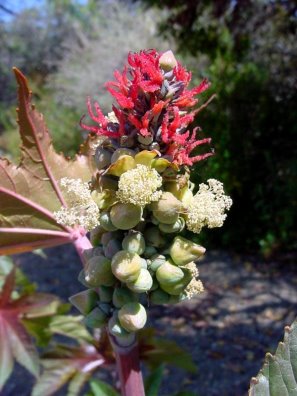
female flowers on the same plant, the staminate below the pistillate.
Both male and female flowers have 3-5 sepals and no petals, the
male flower has many clustered stamens, and the female flower has a
3-chambered bristly ovary and three reddish 2-lobed styles united at
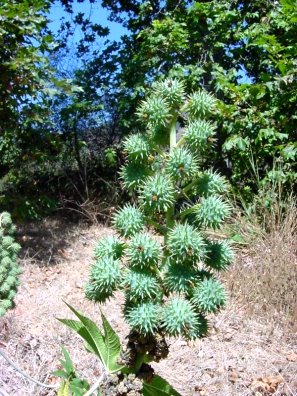
the base. The pistillate calyx is early deciduous. The fruit
is a large, round, 3-celled, spiny capsule with smooth and shiny, brown,
mottled seeds that resemble ticks, hence its name Ricinus which
is the name of a Mediterranean sheep tick. Castor bean flowers
all year round and is a pernicious difficult-to-control weedy shrub
of roadsides, fields and disturbed areas below 1000'. It is native
to Europe. Despite being the source of castor oil, the seeds are highly
toxic and can be fatal if ingested. These pictures were taken in lower
Zuma Canyon in the Santa Monica Mts.
Click here for Latin name derivations: 1) Ricinus
2) communis.
Pronunciation: RIS-i-nus KOM-yoo-nis.
Click here for Botanical
Term Meanings.
|
|