| |
Desert dodder is one of several dodders that
might be found in the desert but is likely the most common one. It
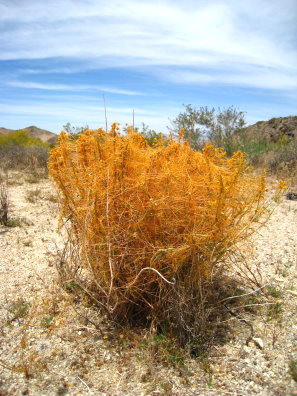
is a slender-stemmed parasitic annual that is usually seen twining around
and through herbs and shrubs in creosote bush scrub and joshua tree
woodland in the northern Colorado and Mojave Deserts. The stems
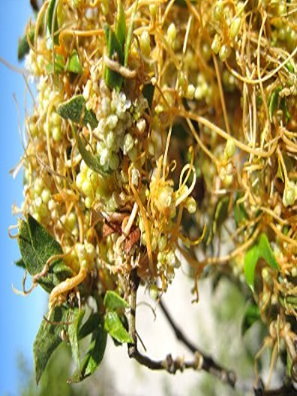
are pale yellow to orange, and like other dodders it exists by attaching
itself to its host's branches by means of little wartlike bumps called
'haustoria.' First it sprouts from a seed, then it twines counter-clockwise
around a plant's stem or branch, tightening its grip on its host and
pushing its haustorium into the stem. By now the dodder's connection
to the ground has been broken, and since it cannot make food of its
own it must depend on its host and draw its nourishment through the
haustorium. Although dodder usually doesn't kill its host plant,
a heavy infestation in times of limited water supply may cause significant
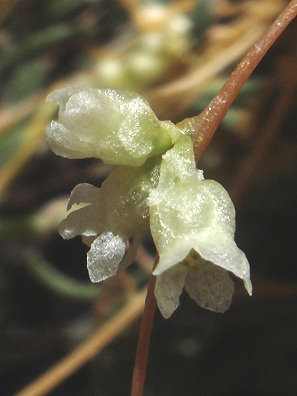
damage. C. denticulata produces small white flowers with shallowly
bell- to urn-shaped corollas. The five corolla lobes become reflexed
in age. Inside the corollas are appendages each of which has 0-few
knoblike divisions. Desert dodder grows to an elevation of about
4000' and blooms from May to October. Other names for dodder which I've
encountered are devil guts, witch's shoelaces, witch's hair, angel hair
and hairweed. These pictures were taken in Death Valley NP and
I believe the host plant in this case is Peucephyllum schottii.
Click here for Latin name derivations: 1) Cuscuta
2) denticulata.
Pronunciation: koos-KOO-ta den-tik-yoo-LAY-ta.
Click here for Botanical
Term Meanings.
|
|