| |
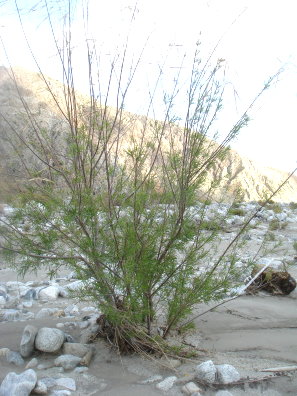
Desert willow is a large willow-like shrub or
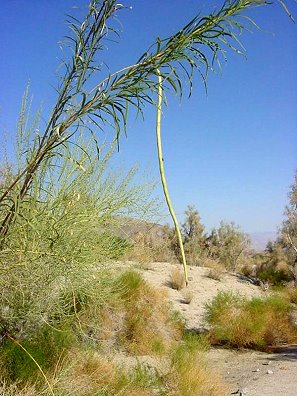
small tree from 4' to 21' tall with few to many slender, drooping branches
and long, narrow, terete fruit pods 6"-12" long. This
plant is common below 5000' in sandy washes and watercourses of both
deserts, and adjacent areas of the Transverse and Peninsular Ranges,
blooming from May to September. The leaves are simple, alternate
(though sometimes opposite or even whorled on same plant) and linear
to lance-linear. The leaves are deciduous and often fall off during
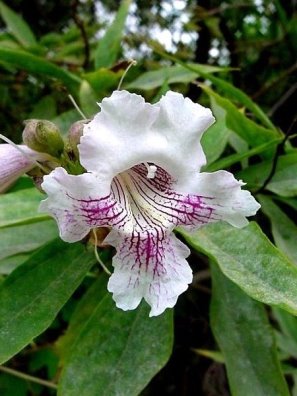
the dry season, leaving the shrub seem almost lifeless. The flowers
are large and showy, and range in color from lavender to pink to whitish,
with purplish lines and yellow ridges in the throat and on the lower
lobes. They have corollas to 2" long with five irregular
lobes, barely two lipped, and four included stamens. The calyces
are two-lipped, densely hairy, and sometimes slightly white-woolly.
This is the only species in its genus and the only genus in this
family in California. Another member of the Bignoniaceae that people
may be familiar with is the tree Catalpa. These pictures were
taken at the Environmental Nature Center in Upper Newport Bay and at
the Living Desert in Palm Springs.
Click here for Latin name derivations: 1) Chilopsis
2) linearis
3) arcuata.
Pronunciation: chil-OP-sis lin-ee-AIR-us ar-kew-AY-ta.
Click here for Botanical
Term Meanings.
|
|