-
dacitico'la: dwelling on dacitic soils, dacite being an extrusive
igneous rock made up mostly of plagioclase, quartz, pyroxene or hornblende. The taxon in the California flora is Arctostaphylos tomentosa ssp. daciticola.
-
dactylif'era: finger-like, furnished with fingers.
-
Dac'tylis: from the Latin dactylis and the Greek daktylos for a kind of grape or grass, the Greek name in turn derived from daktylos, "a finger," referring to the finger-like
appearance of the inflorescence. The genus Dactylis was published by Carl Linnaeus in 1753.
-
Dactylocten'ium: from the Greek daktylos, "finger,"
and ktenion, "a little comb," alluding to the arrangement
of the spikelets. The genus Dactyloctenium was published by Carl Ludwig von Willdenow in 1809.
-
dac'tylon: from the Greek daktylos,
"a finger or toe," possibly referring to the slender umbel-like
inflorescence which is somewhat like the fingers of a hand.
-
dahlsted'tii: named for Hugo Gustav Adolf Dahlstedt (1856-1934), a Swedish botanist born in Linköping. He was
 |
|
a pupil at Linköping Elementary School and then was a student in Uppsala. He took many study trips in Sweden and abroad partly with the support of the Academy of Sciences in 1893. He worked as a teaching assistant at the Bergian Garden or Hortus Bergianus and then in the botanical department of the Royal Museum of Natural History. He received an honorary doctorate at Uppsala University in 1907. His botanical interest centered mainly around the genus Hieracium. Based on his careful collections he established hundreds of new Hieracium species, which he published in |
his two excerpts Hieracia exsiccata (1889-1891) and Herbarium Hieraciorum Scandinaviae (1892- 1911), and later also described in his numerous publications concerning the Hieracium flora. His most comprehensive and most complete work was Contribution to South-East Sweden's Hieracium Flora published in three major parts 1890-94 He also received collections of Hieracium specimens from neighboring countries for processing and published species from Estonia, the Faroe Islands and Iceland, and his collections have largely been incorporated into the museum's herbaria. Perhaps his most important and most original scientific effort concerned the cultivated Taraxacums (dandelions). He cultivated them from many places in Sweden as well as from foreign countries in the Bergian garden and published a large number of works on Scandinavian and foreign forms. Because of his work the National Museum owns the largest and best processed Taraxacum collection which any museum can exhibit. (Photo credit: Swedish Biographical Dictionary)
-
Da'lea: named for Samuel Dale (1659-1739), an English physician, apothecary, botanist and botanical collector, and
 |
|
gardener who was the son of a silk weaver, author of several botanical works and a treatise on medicinal plants. He was an associate of several major botanical figures in England, notably John Ray, one of the founding figures of British botany and zoology, William Sherard, and Mark Catesby. Catesby sent him samples of specimens that he collected in Virginia, and it was through Dale that Catesby came to the attention of Sherard, who created the first chair in botany at Oxford, and he helped Ray with the cataloging of specimens. He also worked with William Sherard and |
Jacob Bobart the Younger to complete the third section of Robert Morison's Plantarum Historiae Universalis Oxoniensis after Morison's death. He was apprenticed to an apothecary and trained for eight years and then practiced as an apothecary. He developed an interest in botany and studied under John Ray and began collecting trips around the Braintree area, helping Ray with projects like the Synopsis methodica stirpium Britannicarum (1690) and later with his Historia (published in 1710, after Ray's death). JSTOR adds: “Dale also began to produce his own works: Pharmacologia (1693) contained the descriptions of many plants and their medicinal uses, and between 1892 and 1736 he published nine papers in Philosophical Transactions on non-botanical topics [including a very important account of the strata and fossils of Harwich Cliff]. Most importantly, though, was his section on natural history which appeared in Silas Taylor's The History and Antiquities of Harwich and Dovercourt and covered marine and terrestrial plants, fossils and major zoological groups.” The Pharmacologia went through three editions written in Latin, and was virtually a textbook of materia medica, pharmacology and therapeutics. The History and Antiquities of Harwich and Dovercourt was reissued in 1732. This book is now in print again. In addition to the genus Dalea in the Fabaceae published by Linnaeus in 1758, Dale had described the wild birds of Essex. He pursued and achieved a physician's degree late in life and practiced until his death in Braintree, Essex, in 1739 where he had also been a member of the town governing council. (Photo credit: Essex Field Club)
-
dales'iae/dalesia'na/dalesia'nus: named for Ella Dales Miles Cantelow (1875-1964),
co-author in 1957 of "Biographical Notes on Persons in Whose
Honor Alice Eastwood Named Native Plants" in Leaflets of Western
Botany. She was a researcher, an amateur collector. and a long time member of the California
Botanical Club. She was born in San Francisco, 12 Sept 1875. Long an enthusiastic collector of native plants, she
was made a life member of the California Academy of Sciences in 1942 in appreciation
of the plants she collected in Arizona, Nevada, Wyoming, Utah, Idaho, and Colorado,
and gave to the herbarium. She donated her private herbarium to the Academy
in 1947. She was also a member of the Cooper Ornithological Society.
-
dallimor'ei: named for British botanist William Dallimore (1871-1959), a well-liked and long serving member of staff at the Royal Botanic Garden Kew for more than 45 years. He was a student gardener there beginning in 1891 and worked in the palm house, the tropical propagating pits and the arboretum. He became curator of the arboretum in 1901. After this he became keeper of the museums and supervised the design and development of the National Pinetum at Bedgebury, Kent. It was established as the National Conifer Collection in 1925 and is now recognised as the most complete collection of conifers on one site anywhere in the world. He was regarded as one of the leading authorities on trees and shrubs in the UK, and was the author of Holly, Yew and Box published in 1908. He was also known for his conifer handbook with co-author A. Bruce Jackson.
-
dalma'tica: of or from Dalmatia on the Adriatic side of the Balkan
Peninsula.
-
da'lyi: named for Charles Patrick Daly (1816-1899), an American jurist, lecturer and writer. He was born in New York
 |
|
City. Two years before his birth, his parents had immigrated to the US from Omagh, County Tyrone, Ireland. He attended private school as a youth, but left school to earn a living after his father’s death, working first as a clerk in Savannah, Georgia, and then as a cabin boy on a trading ship. He was present at the capture of Algiers at the age of 14 and returned to New York at 16, where he was a mechanic’s apprentice for a quill manufacturer. After joining the New York Literary Society, he learned how to debate . He became a law student and was admitted to the bar in 1839. |
Four years later he was elected to the New York State Assembly and supported the establishment of Central Park. In 1844 he was appointed by the governor to the New York Court of Common Pleas (later to become the New York Supreme Court). When the position became elective, he won election and eventually became chief justice. He served the court for six terms and retired in 1885, whereupon he was elected to the American Geographic Society and in 1864 became its president, a position he held until his death. He was obviously vastly interested in geography because he was also an honorary member of the Royal Geographical Society of London, the Berlin Geographical Society, and Russia's Imperial Geographical Society. In London in 1895, he was a speaker at the 6th International Geographical Congress. He had a personal collection of some 12,000 volumes. In addition to geographical associations, he was a member of the New York Historical Society and the American Philosophical Society of Pennsylvania. He was granted an honorary LLD degree by Columbia University, and from 1860 to 1875 he lectured on the law at Columbia Law School. He died in North Haven, New York, five years after the passing of his wife Maria. The species Helianthus dalyi was published by Nathaniel Lord Britton in 1901 in the Journal of the New York Botanical Garden.
-
damascen'a: of or from Damascus, Syria.
-
Damason'ium: a classical Greek name. In connection with the taxon Cephalanthera damasonium, the website Uffizi Galleries says "It is assumed that the species name comes from the Greek word damaso, "I tame" (implying “I tame evil”), a name given, according to Pliny the Elder, to a plant considered an antidote to toad poison." And Wikipedia says "The species epithet damasonium comes from ancient Greek and means 'I take away/diminish,' possibly referring to a medical use for the plant." Although it can't be stated with certainty that the meaning of the generic name is the same as for the specific name, it does appear so because the lectotype of Miller's Damasonium listed in IPNI is Alisma damasonium, and Gledhill adds that Damasonium was a name in Pliny for Alisma. Finally Umberto Quattrocchi says that Damasonium was the Greek and Latin name for the water-plantain (Alisma). The genus Damasonium, called starfruit or thrumfruit, was published by Philip Miller in 1754.
-
damnationen'sis: yes, this is a real name recently assigned to Phacelia damnationensis and the epithet refers to Damnation Pass in Shasta County. The taxon was published in Madroño (2023) by Julie Kierstead, Len Linstrand III, and Martin J. Lenz.
-
danaen'sis/dana'us: after Mt. Dana, second-highest peak in Yosemite National
Park.
-
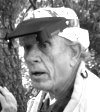
Dannorris'ia: named for American botanist Daniel Howard Norris (1933-2017). He was awarded a BS degree
 |
|
in botany from Michigan State University in 1954 and a PhD in botany from the University of Tennessee in 1964. In 1967 he became a professor of botany at Humboldt State University. Between 1984 and 1985 he was a Fulbright research scholar at the University of Helsinki, and in 1990 he was awarded with an honorary PhD from that institution. In 1991 he transferred his bryological collection to the University of California, Berkeley to continue his research. For two decades he held the position of curator of bryophytes at UC Berkeley. All together he collected |
about 116,000 bryophyte specimens mainly from California and Papua New Guinea but from every continent except Antarctica including four moss genera new to science. He died after a long period of being debilitated by Parkinson's disease. The genus Dannorrisia was published by Johannes Enroth in 2019.
-
Danthon'ia: named for Étienne Danthoine (1730-1794), a French botanist and agrostologist from Marseilles. David Hollombe provided the following: "Étienne Danthoine was born in Manosque in 1739 and died in Grasse in 1794. At the time of his death he was the pharmacist in the military hospital in Grasse. He was a member of the Academy of Sciences of Marseilles and had written articles on grasses, bedstraws and (published posthumously) gall wasps." He wrote numerous papers some unpublished on the plants of Provence. The genus Danthonia was published in 1805 by Augustin Pyramus de Candolle.
-
danthonio'ides: the species name means “resembling genus Danthonia,” which is a genus published by Augustin de Candolle in 1805.
-
Darlington'ia: named for William Darlington (1782-1863), an American
botanist. The following is quoted from the
 |
|
website called Virtual
American Biographies: "Darlington, William, scientist, born in
Birmingham, Pennsylvania, 28 April 1782; died in West Chester, Pennsylvania,
23 April 1863. His parents were Quakers, and his early education was
received in the country school. He began the study of medicine at
the age of eighteen, and was graduated at the University of Pennsylvania
in 1804. He studied languages and botany two years, and in 1806 went
to India as a ship's surgeon, for which (joining a military organization)
he was disowned by the Society of Friends. A sketch of his |
voyage, under the title of "Letters from Calcutta," was published
in the Analectic Magazine. He returned to the United
States in 1807, and for several years practiced medicine in West Chester.
Here he entered into politics, wrote in defense of the policy of President
Madison, and at the beginning of the war of 1812 aided in raising
an armed corps in his neighborhood, and, after the destruction of
Washington in 1814, was chosen Major of a volunteer regiment. He founded
an athenaeum, and a society of natural history, of which he became
the president. In 1813 he began a descriptive catalogue of plants
growing around West Chester, with the title Florula Cestrica (1826), afterward enlarged as the Flora Cestrica (1837; new
ed., 1853), containing a complete description and classification of
every plant known in the county. He was a member of congress from
4 December 1815, till 3 March 1817, and from 6 December 1819, till
3 March, 1823. In 1843 he edited the correspondence of his friend,
Dr. William Baldwin, with a memoir, entitling the work Reliquiae
Baldwiniana. In 1853 the name of Darlingtonia california was given in his honor to a new and remarkable variety of pitcher
plant found in California, in addition to which a number of rare plants
were named in his honor by naturalists in Switzerland and America.
The degree of LLD was conferred on him by Yale in 1848, and in 1855
that of doctor of physical science, by Dickinson College. He was a
member of forty learned societies in America and Europe. In addition
to the works noted above, he published Mutual Influence of Habits
and Disease (1804) and Agricultural Botany (Philadelphia,
1847)." The genus Darlingtonia was published by John Torrey in 1863.
-
Dar'mera: named for Karl Darmer (1843-1918), a German botanist and horticulturist in Berlin. He was born in Wolgast, and after elementary school, he trained to be a gardener and moved to Berlin in the 1860s. He became a member of the professional German Gardeners' Association founded in 1873, which accepted principals and gardeners' assistants alike. From 1878 to 1885, the German Gardeners’ Association flourished as a specialist educational association consisting of 5,000 members. In January 1887, after serious crises within the association, he was given extensive powers by the board as a committee member to consolidate the association, and the offices were relocated from Hamburg to Berlin. Darmer became the head gardener at the Jewish cemetary. At this time the association fell into decline and was dissolved. Although he lost considerable resources, he played a key role in rebuilding the gardening movement, and in 1890 the General German Gardeners’ Association was founded. While Darmer was confirmed as first chairman and managing director, conflict between various gardening groups roiled the gardening world and Darmer resigned in 1899. In 1904 he again found himself at the head of the German Gardeners Asssocation, but In 1906, when the German Gardeners' Association was transformed into a Christian union, Darmer stood aside. From then on he devoted himself only to his professional tasks and became an inspector at the Jewish cemetery. Karl Darmer died on January 20, 1918 in Berlin as a result of a stroke. The genus Darmera was published in 1899 by German botanist Andreas Voss.
-
Darwin'ia: named for Erasmus Darwin (1731-1802), a respected physician, well known poet, philosopher, botanist,
 |
|
naturalist, inventor, slave trade abolitionist, grandfather of Charles Darwin, and like his grandson a man with a remarkable array of interests and pursuits. He was born in Nottinghamshire, England, and was educated at Chesterfield Grammar School, then at St John's College, Cambridge. He obtained his medical education at the University of Edinburgh Medical School, but whether he got a formal degree is not known. He was a highly successful physician in the Midlands region for 50 years. King George III asked him to be royal physician, but he declined. He was married twice |
and had either fourteen or fifteen children. He formulated one of the first theories of evolution and talked about how competition and sexual selection could cause changes in species. He relied upon his observations of domesticated animals and the behaviour of wildlife, and just as his grandson did sixty years later, he integrated his vast knowledge of many different fields, such as paleontology, systematics, biogeography, embryology, and comparative anatomy. He invented amongst other things a carriage steering mechanism, a manuscript copier and a speaking machine. Erasmus Darwin was a founding member of the Lunar Society of Birmingham, a discussion group of pioneering industrialists and natural philosophers. He died just seven years before the birth of his famous grandson. It is not clear what caused his sudden death but it may have been angina pectoris, chest pain or discomfort due to coronary heart disease, from which he probably had been suffering for a number of years. The genus Darwinia was published by Edward Rudge in 1815.
-
darwin'ii: named for English naturalist, geologist and biologist Charles Robert Darwin (1809-1882). How do you
 |
|
summarize the life of such a giant? The following is more or less excerpted from Wikipedia. He was born at his family’s home in Shropshire. His father was a wealthy society doctor and financier. In 1817 he was entered into a day school run by the preacher of the Anglican church his mother attended, and he had an early interest in natural history. His mother died that July and the following year he joined his older brother Erasmus as a boarding student at the nearby Anglican Shrewsbury School. He assisted his father as an apprentice doctor in the summer of 1825 and then entered |
University of Edinburgh Medical School (at the time the best medical school in the UK) with his brother Erasmus. He neglected his studies which he found dull but learned taxidermy. In his second year he joined the Plinian Society, a student natural-history group featuring lively debates in which radical democratic students with materialistic views challenged orthodox religious concepts of science. He also learned the classification of plants, and assisted with work on the collections of the University Museum. He next went to Christ's College, Cambridge, to study for a bachelor of arts degree, but he preferred riding and beetle collecting. After graduating in 1831 he became a supernumerary naturalist on HMS Beagle with Captain Robert FitzRoy, on an expedition to chart the coastline of South America. The voyage that lasted almost five years occupied Darwin mainly in investigating geology and making natural history collections. During this time he also gained valuable social, political and anthropological insights into both native and colonial peoples, and was already considering ideas of the continuity and extinction of species. It was while in the Galapagos Islands that he began formulating rhe beginnings of his theory of evolution. In Cape Town, he met John Herschel who had written to Charles Lyell with some ideas about the stability of species, and this triggered questions in Darwin’s mind. He was already a celebrity by the time he returned to England in 1836. He brought back one of the greatest treasure troves of natural history specimens and information ever collected on a single trip. In 1838 he became secretary of the Geological Society and continued his work on the transmutation of species, an idea that sprang at least partly out of his observation of Galapagos finches and tortoises. Due to the stress of his work he began having health problems and for the rest of his life he was repeatedly incapacitated with episodes of stomach pains, vomiting, severe boils, palpitations, trembling and other symptoms, particularly during times of stress, the cause of which was never accurately determined. His reading of Thomas Malthus and an observation of animal breeding practices led to an increasing understanding of what he would come to call natural selection. In 1839 he was elected a fellow of the Royal Society. Darwin wrote so many influential books on so many scientific subjects and made so many contributions to the history of science and formed so many valuable relationships with other internationally-known scientists that they can scarcely by recorded in a brief description such as this, and Darwin’s work has been so significant that it is hardly an understatement to say that he is one of the most consequential scientists ever to have lived. He was the author of among others The Voyage of the Beagle, The Descent of Man, and On the Origin of Species. Few other individuals have had such a broad perspective on the fields of botany, paleontology, geology, zoology, ornithology, entomology, anthropology, mammalogy, and ichthyology, and the interrelationships between them. Almost 50 species of plants have or have at one time had their specific names honoring him. He and his wife had ten children and he died at Down House south of London, and was granted the exceptional priviledge of being buried in Westminster Abbey near another scientific genius, Isaac Newton.
-
Dasiphor'a: from Greek dasys, "hairy, shaggy" and phora, "to carry or bear," referring to its characteristic of bearing hairy achenes. The genus Dasiphora was published in 1840 by Constantine Samuel Rafinesque.
-
dasy-: from the Greek dasys, "shaggy, thick, hairy,
rough."
-
dasyan'themum/dasyan'thum: shaggy-flowered.
-
dasycar'pa/dasycar'pum: with wooly or hairy
seed heads or fruits.
-
Dasyno'tus: from the Greek dasys, "rough, hairy, thick, shaggy." and notus, "the back." The genus Dasynotus was published in 1948 by Ivan Murray Johnston.
-
Dasyochlo'a: from the Greek dasys, "shaggy, thick, hairy,
rough" and chloa, "a blade of grass." The genus Dasyochloa was published by Carl Ludwig von Willdenow in 1906.
-
dasyphyl'lum: with wooly or hairy leaves.
-
Datis'ca: both Gledhill and Stearn say derivation obscure. Umberto Quattrocchi says: "Perhaps
from the Greek dateomai, 'divide among themselves, cut in two,'
possibly referring to the ornamental foliage." FNA has this: "Cited by Dioscorides as a Roman name for a species of Catananche L. ( Asteraceae), applied here possibly alluding to the similarity." A short article in Phytoneuron (2010-6: 1–2) by Walter Holmes and Heather Blizzard entitled "The Derivation of the Name Datisca" gives the following: "The name Datisca is attributed to [Pedanius] Dioscorides in de Materia Medica [64 CE], where it was cited as a Roman common name for species of Catananche ( Asteraceae). Linnaeus apparently appropriated the name from Dioscorides but used it for species of a different genus and family. The statement by Dioscorides that datisca is a common name used by the Romans only gives the source of the name used by Linnaeus, not the origin of the word itself. The word Datisca itself, as used by Dioscorides, is best considered to be of unknown origin. Linnaeus (1753) apparently borrowed names liberally from de Materia Medica for inclusion as generic names in Species Plantarum. Despite the passing of 257 years since Linnaeus’s use of the name, the etymology of Datisca has remained unresolved." -
Datur'a: from the Hindu vernacular name Dhatūrā meaning 'thorn-apple.' The genus Datura was published in 1753 by Carl Linnaeus.
-
Daubenton'ia: named for Louis-Jean-Marie Daubenton (1716-1800), A French naturalist, comparative anatomist and
 |
|
contributor to the Encyclopédie ou Dictionnaire raisonné des sciences, des arts et des métiers. He was born at Montbard (Côte-d'Or). Like many others whose fathers intended them for a religious career, Daubenton was more interested in medicine. When his father died, he was free to pursue his chosen path, and in 1741 he graduated in medicine at Reims and returned to his hometown, planning to practice as a physician. When Georges-Louis Leclerc de Buffon, also a native of Montbard, was preparing his multi-volume work on natural history, the Histoire naturelle, |
générale et particulière, he invited Daubenton to assist him by providing anatomical descriptions. In 1744 he was elected a member of the French Academy of Sciences, and Buffon appointed him keeper and demonstrator of the king's cabinet in the Jardin du Roi. He conducted agricultural experiments and introduced Merino sheep to France. Wikipedia adds: “From 1775 onwards, Daubenton lectured on natural history in the College of Medicine, and in 1783 on rural economy at the Alfort school. He was also professor of mineralogy at the Jardin du Roi. As a lecturer he was in high repute, and to the last retained his popularity. When the Jardin des Plantes in Paris was converted to the Museum of Natural History in 1793, he became its first director. In December 1799 he was appointed a member of the Senate, but at the first meeting which he attended he fell from his seat in an apoplectic fit and, after a short illness, died at Paris.” His cousin Edmé-Louis Daubenton was also a naturalist. The genus Daubentonia was published in 1825 by Augustin Pyramus de Candolle.
-
daucifo'lia: with leaves that are carrot-like, from the genus Daucus.
-
Dau'cus: from Latin daucum, in turn from Ancient Greek daukos or daukon, “carrot.” The genus Daucus is called wild carrot and was published by Carl Linnaeus in 1753.
-
davallia'num: named for Swiss-English botanist Edmund Davall (1763-1798). He was born in England to parents of Swiss origin. When his father died in 1788, he returned to Switzerland with his mother, and created a botanical garden at Orbe, Canton de Vaud, where they settled. He was associated with Albrecht von Haller, Jakob Samuel Wyttenbach, Jean Senebier, Edward Forster, Horace Benedict de Saussure, and James Edward Smith, and became one of the original fellows of the Linnean Society. At some point he was inspector of forests. He was in the process of writing a work on Swiss flora, Illustrations of Swiss Plants, when he died at the age of 35. One of his sons, Edmond, also became a botanist. The fern genus Davallia was published by his friend J.E. Smith, to whom he bequeathed his herbarium and library.
-
david'ii: named for David Lee Anderson (1938- ), a grasslands and range management ecologist
who spent years in Argentina. (Euphorbia davidii)
-
david'ii: named for Pere Jean Pierre Armand David
(1826-1900), a missionary priest and zoologist. "Père Armand
 |
|
David was a Lazarist missionary
in the Franciscan order who was to travel to China and convert the
populace to Roman Catholicism, but soon found a greater calling in
the nature of this vast country. Born in Espelette near Bayonne in
the French Pyrenees, Jean Pierre was one of three boys in a successful
local family. His father Fructueux was a magistrate and doctor who
had a strong love of nature and an inquisitive mind, traits that Jean
Pierre inherited and embraced, which was a good thing, since his older
brother inherited everything else. Younger sons of established families |
would often seek a career in the clergy, and this is where young David
turned. In his day there would appear to be no conflict in a career
in the church and pursuit of the natural sciences, so his great affinity
for all living things was embraced by his new order, St. Vincent de
Paul. While many of his brother missionaries were sent to locations
as far afield as South America, Ethiopia, Africa, Persia and China,
Père David was sent to teach at a school in Italy. He taught
science at Savona College on the Italian Riviera for ten years, and
during that time became one of the most popular teachers there. He
made his classes interesting by actually involving his students, by
imbuing them with his own enthusiasm and love of nature, and he was
deeply missed when he was finally given the assignment he had wanted
for so many years - China." (from PlantExplorers.com)
"Ordained in 1862, he was shortly afterwards sent to Peking,
and began there a collection of material for a museum of natural history,
mainly zoological, but in which botany and geology and palæontology
were also well represented. At the request of the French Government
important specimens from his collection were sent to Paris and aroused
the greatest interest. The Jardin des Plantes commissioned him to
undertake scientific journeys through China to make further collections.
He succeeded in obtaining many specimens of hitherto unknown animals
and plants, and the value of his comprehensive collections for the
advance of systematic zoology and especially for the advancement of
animal geography received universal recognition from the scientific
world. He had found in China altogether 200 species of wild animals,
of which 63 were hitherto unknown to zoologists, and 807 species of birds,
65 of which had not been described before. Besides, a large collection
of reptiles, batrachians [tailless ampibians], and fishes was made and handed over to specialists
for further study, also a large number of moths and insects, many
of them hitherto unknown, were brought to the museum of the Jardin
des Plantes. What Father David's scientific journeys meant for botany
may be inferred from the fact that among the rhododendrons which he
collected no less than fifty-two new species were found and among
the Primulæ about forty, while the western mountains of China
furnished an even greater number of hitherto unknown species of gentian.
The most remarkable of hitherto unknown animals found by David was
a species of bear ( Ursus melanoleucus, the black-white bear) which
is a connecting link between the cats and bears. Another remarkable
animal found by him received the scientific name of Elaphurus davidianus (Père David's deer).
Of this animal the Chinese say that it has the horns of the stag,
the neck of the camel, the foot of the cow, and the tail of the ass.
It had disappeared with the exception of a few preserved in the gardens
of the Emperor of China, but David succeeded in securing a specimen
and sent it to Europe. In the midst of his work as a naturalist Father
David did not neglect his missionary labors, and was noted for his
careful devotion to his religious duties and for his obedience to
every detail of his rules." (from the Catholic
Encyclopedia). His name will forever be linked with the giant panda (Ailuropoda melanoleuca), the handkerchief tree (Davidia involucrata) and the deer named in his honor as well as the Buddleja (Buddleja davidii). ( Buddleja davidii)
-
davidson'iae: named for Laura Morris Davidson (Mrs. William Henry Davidson) (1825-1911). She was born and died in England, and both she and her husband were Quaker missionaries in China.
-
davidsonia'na/davidsonia'nus/davidson'ii: named for Anstruther Davidson (1860-1932),
a Scottish botanist who like so
 |
|
many others came to the fields of
botany and natural science from a medical background. The following
assessment of Davidson is by Joseph Ewan and is quoted
from Madroño Volume 2: "He is a man of interest - not
'shelved,' nor cynical, nor disappointed with life, but a trifle melancholy
and above all full of sifted wisdom.' This is my recorded appraisal
upon returning home from my last visit with Dr. Davidson just two
months before his death on April 3rd, 1932. 'He sat in his easy rocker,
the old cherry-wood sort, with stationary base, and between draughts
on his made-as- |
needed cigarettes, foiled rather carelessly and twisted
in the manner of taffy wrappers, he told of other days and California
botany. His terse phrases concerning Hasse, Greata, Parish and others
were flavored with personal understanding and accented with measured
strokes of his goatee. His face is slender and sharp-featured, but
set with eyes full of brightness.' Anstruther Davidson was born at
Watten, Scotland, on February 19, 1860, being the son of George and
Ann (Macadam) Davidson. He graduated in medicine from the University
of Glasgow with the degrees of M(edicinae) B(accalaureus) and C(hirurgiae)
M(agister) at the age of twenty-one. Six years later he obtained his
MD (1887). He emigrated to America two years later and in the same
year began the practice of medicine in Los Angeles which was carried
on practically continuously until his death. A dermatologist in the
medical field, he was at one time assistant professor of that subject
at the University of Southern California. He was a fellow of the American
Medical Association. His skill in his chosen field was the basis of
the regular visits made to the Good Samaritan hospital of Los Angeles,
when no longer in active practice, a consulting dermatologist, a schedule
continued up to his last brief illness. During the preceding January
Dr. Davidson was struck by an automobile and thrown forward to the
pavement, suffering internal injuries, doubtless of a more serious
nature than early recognized, which were the almost certain cause
of his death some three months later at the age of seventy-two. In
the fields of systematic botany and entomology Anstruther Davidson
will certainly be permanently remembered for the early studies he
carried out in these subjects in Southern California. Davidson's
botanical activities were carried out principally through the Southern
California Academy of Sciences and through the medium of its Bulletin.
He served as the second president of the society, from 1892 to 1894,
being re-elected for a second term. He was among the founders of the
society and served as treasurer, as a member of the board of directors
and of the publication board. In short he was an active associate
for forty-one years." He was the author in 1923 along with
George Moxley of Flora of Southern California. ( Arabis davidsonii, Atriplex serenana var. davidsonii, Astragalus crotalariae var. davidsonii, Calochortus davidsonianus, Capsella procumbens var. davidsonii, Collinsia bartsiifolia var. davidsonii, Eriogonum
davidsonii, Lotus
nevadensis var. davidsonii, Malacothamnus davidsonii, Mentzelia davidsoniana, Phaca davidsonii)
-
davidson'ii: named for Dr. George Davidson
(1825-1911), an English-born American geographer and astronomer
 |
|
who
collected plants in Yosemite and elsewhere in California. Quoted from
The Columbia Encyclopedia: "From 1845 to 1895 he was on the staff
of the US Coast and Geodetic Survey. He charted (1850-1860) the
US Pacific coast for navigation purposes and recorded the results
in the Pacific Coast Pilot. From 1860 to 1866, Davidson surveyed
the Delaware River and mapped the district around Philadelphia for
fortifications. His survey (1867) of the Alaskan coast resulted in
the government publication Coast Pilot of Alaska (1869 and
later editions). From 1867 to 1887, |
Davidson was charged with work
along the coast of the western United States. In San Francisco he built (1879)
the first observatory on the Pacific coast. He also headed US expeditions
to observe solar eclipses and the transits of Venus and Mercury. His
writings include The Tracks and Landfalls of Bering and Chirikof (1901), The Discovery of San Francisco Bay (1907), and Francis
Drake on the Northwest Coast (1908)." Dr. Davidson was honorary
professor of astronomy and geodesy at the University of California
and a regent of the University from 1877 to 1885, professor of geography
from 1898 to 1905, and president of the California Academy of Sciences
for 16 years and of the Pacific Geographical Society from 1881 on.
He was born in Nottingham, England and emigrated to the US with
his parents in 1832, where they settled in Philadelphia. Davidson
was a student under Alexander Dallas Bache before Bache's appointment
as the second superintendent of the Coast Survey. Thus was much of
his life's work determined at an early age. His early work on the
west coast involved the establishment of accurate latitude and longitude
for the prominent points along the coast, dangerous work due to the
small boat landings in rough seas often including swamped or overturned
boats, not to mention the hostility of local natives. He chose sites
for many of today's lighthouses and wrote Directory for the Pacific
Coast which evolved into the Coast Pilot series for all of the
US. "His 1889 edition of the Coast Pilot of California,
Oregon and Washington became the authoritative list of sailing
directions for the west coast mariner, traced the origin of many of
the names of features on our west coast, delineated the tracks of
early explorers and navigators, and contained over 400 sketches of
pristine coastal views prior to the encroachment of civilization.
This document is considered one of the great historic works detailing
the geography and early exploration of our Pacific margin. Many consider
Davidson's crowning achievement to have been the measurement of the
Yolo Baseline in the Sacramento Valley and the Los Angeles Baseline
in southern California to the then unprecedented accuracy of better
than one part in a million. The baselines approached 11 miles in length
and were the longest baselines for geodetic survey work completed
to that time. These lines served as the starting point for the great
geometric figures ever after known as the "Davidson Quadrilaterals"
upon which the primary triangulation of the Pacific Coast states was
based. In 1867 he headed the party making a geographical reconnaissance
of Alaska and his report helped sway the United States Government
to purchase 'Russian America.' In 1872 he was appointed
one of three Commissioners of Irrigation of California and became
recognized as a world authority on irrigation problems. He was instrumental
in helping establish the Lick Observatory. He survived the San Francisco
earthquake in 1906, and became the first president of the Pacific
Seismological Society founded in 1906." (From an announcement
by the National Oceanic and Atmospheric Adminstration honoring George
Davidson with the naming of a ship). Davidson apparently collected
the first specimen of Phacelia davidsonii in Kern County and was honored
by Asa Gray in having it named for him. He was one of 182 charter members of the Sierra Club in 1892 and served as a member of its board of directors from 1894 to 1910. He died in San Francisco. ( Penstemon davidsonii, Phacelia
davidsonii)
-
davidsson'ii: named for Ólafur Davidsson (1862-1903), an Icelandic natural scientist, ethnographer and folklore collector, author of The Folklore of Icelandic Fishes. He was born on 26 January 1862 at Fell in Sléttuhlíð. He was a student at The Learned School in Reykjavik from 1874 to 1882 and kept a diary of his last year of study there. Davidsson studied natural sciences at the University of Copenhagen but then immediately turned to ethnology, working at the Arnamagnæan Institute. In 1897, Davidsson returned to Iceland and was a part-time teacher at Möðruvellir in Hörgárdal, where he also engaged in folklore collecting and other scholarly work. He was also the author of Magic and Sorcery in Iceland. Ólafur drowned in Hörgá, single and childless, on 6 September 1903.
-
davis'iae: named for Nancy Jane Davis (1833-1921). The following was
provided by David Hollombe and was written
 |
|
by Willis Jepson in his
series "California Botanical Explorers" in Madroño (Vol. 1,
No. 13) and is here reproduced with only a few minor changes: "In the
northern Sierra Nevada one of the more unusual and peculiar shrubs
is Leucothoe davisiae. This name was published by Asa Gray
in the Proceedings of the American Academy of Arts and Sciences,
volume 7, page 400, in 1867. It was based on a manuscript name by
John Torrey and the specific description rested on material collected
near Eureka in Nevada County by Miss N. J. Davis, the discoverer.
During this entire |
period since 1867, it does not appear to have been
known in California whether Miss Davis was a local collector or a
chance traveller. At any rate this was a collector concerning whom
the writer never had the faintest clue. One evening in August, 1926,
a small group of botanists, engaged in cheerful talk, were seated
on a garden lawn above Lake Cayuga, in the state of New York. One
of them, Professor J. H. Faull, then of the Toronto University, very
incidentally and very casually to other matters, spoke the name Nancy
Davis. The writer of this article had never before heard the name,
but some impulse caused him to make one query after another and it
soon developed that Nancy Davis of Birmingham, Pennsylvania, and miss
N. J. Davis, the discoverer of the rare shrub, Leucothoe davisiae of California, were one and the same. Through the interest of Dr.
and Mrs. J. H. Faull were obtained the printed memorials of Miss Davis
from which are derived the following facts as to her life: Nancy Jane
Davis was born in the Kishacoquillas Valley near Lewiston, Pennsylvania,
on December 20, 1833. She died at Birmingham, Pennsylvania, on June
18, 1921. At that place she had been in 1853 one of the founders of
the Birmingham School (now called the Grier School) and for over sixty
years its principal. On the sixtieth anniversary of the school, Mount
Holyoke College, of which she was an early graduate, honored
her with the degree of Doctor of Humane Letters. In 1863 she came
to California by way of Panama and made in the district of Nevada
County, says Dr. Gray, 'a fine and beautifully prepared collection
of plants.' She visited California again in 1893 and yet again in
1915. The name Miss Davis is enshrined in many a memorial at or hard
by Birmingham School. It is pleasant to make more definitely known
the name of another plant lover, noble in mind and generous in purpose,
who belongs to the roster of California field botanists. Her plants,
it is to be said, went mainly to Asa Gray, and towards Cambridge she
bent her steps for several summers in order to carry on botanical
work. Amongst other things she also collected a sub-alpine Polygonum in northern California which was named for her as Polygonum davisiae by W. H. Brewer in 1872." She is honored today by the naming of the Nancy Jane Davis Library at the Grier School.
-
davisia'num/davis'ii: named for American botanist and plant collector Ray Joseph Davis (1895-1984), author of Flora of Idaho and a professor of botany at Idaho State University. He was born a Mormon in Provo, Utah, was married and had at least four sons. He lived in Rexburg, Madison, Idaho, in 1930 and Bannock, Idaho, in 1940. He has collection items at the Botanic Garden and Botanical Museum of Berlin. He was apparently a Mormon. He died in Preston, Franklin, Idaho.
-
da'vyi: named for Joseph Burtt Davy (1870-1940),
a British botanist, agriculturist and ecologist, eminent student of
 |
|
the flora of California and South Africa, and founder of the Praetoria National Herbarium in 1903. Born and educated first in England, in 1891 he became a technical assistant at Kew Gardens, but left shortly thereafter for the United States where he spent the decade 1892 to 1902 first as a research student at Berkeley, then an instructor of botany at UCLA, and finally assistant curator in the US Department of Agriculture in Washington, D.C. At the Jepson Herbarium, along with Willis Lynn Jepson and Harvey Monroe Hall, Davy was responsible for the vascular plant collection. He |
studied range grasses and forage plants, publishing in 1902 Stock Ranges of N.W. California: Notes on the Grasses and Forage Plants and Range Conditions. He interviewed original white settlers who described how native perennial bunch grasses were being replaced by introduced exotics. He had a hard time finding examples of native prairies even in 1901. In 1903 he was appointed the first government botanist and agrostologist with the newly founded Transvaal Department of Agriculture in South Africa and made the first thorough study of cycads there. By the time of his retirement in 1913, his collections numbered some 14,000. Burtt Davy's appointment led directly to the founding of the Division of Botany. This later became the Botanical Research Institute (BRI) and then the National Botanical Institute (NBI) in 1989 when it amalgamated with the National Botanic Gardens. Still not content, bureaucracy stepped in once more in 2004 and it was renamed the South African National Biodiversity Institute (SANBI). One of Burtt Davy's great interests was the subject of plant introduction, a matter to which he devoted much attention, importing plants and seeds from all over the world. He was responsible for introducing the forage crop, teff, as well as the lawn grass kikuyu. He helped establish a maize-breeding centre at Vereeniging and resigned shortly before the publication of his comprehensive work on maize in 1914. Upon his retirement he took up farming in the Transvaal, and continued studying the flora there, then moved back to England in the early 1920s, and published in 1926 Part 1 of A Manual of the Flowering Plants and Ferns of the Transvaal with Swaziland, the second part appearing in 1932. He became the first curator of the Forest Herbarium at the University of Oxford. Under Davy there began a systematic approach to forest botany which included the identification and naming of timber trees, particularly tropical ones which were not well known. At its peak, accessions to the Forest Herbarium reached a total of 13,425 in 1929-1930, most of which was either African or from Trinidad, Sri Lanka, Belize and Malaysia. After he retired in 1939, he returned to work without pay because of a wartime staff shortage and because he still had much writing and research he wished to do. He died only a few months after his official retirement.
-
de-: a prefix meaning "down, down from, away, off"; also indicating an undoing of an action.
-
dealba'ta: whitened. The root alba means "white," and dealbatus means "whitened or whitewashed, covered with a white powder."
-
dean'ei: named for George Clement Deane (1854-1930), an American naturalist. Born and educated in Cambridge, Massachusetts,
he moved to California in the late 1870s where he took up grape raising in San Diego County. In 1881 he switched to cattle ranching in Kansas but after four years returned to Massachusetts where he lived the remainder of his life. He was elected a member of the Nuttall Ornithological Club in 1899 and that same year joined the American Ornithologists' Union. He was the younger brother of Walter Deane (1848-1930), the eminent Cambridge botanist, ornithologist, schoolteacher and friend of Asa Gray's, who was also a member of the Nuttall Ornithological Club. Ethel Bailey Higgins in "Type localities of vascular plants in San Diego County, California" (1959) says: "Mr. Deane, a native of Cambridge, Massachusetts, came to California with a partner in the late 1870s and started a vineyard at Bonita, in the Sweetwater Valley. Most of his later life was spent in Cambridge, but he returned twice to California. Though primarily interested in birds, he collected many botanical specimens for his brother Walter Deane." These collections included Stephanomeria exigua ssp. deanei and Phaca deanei (= Astragalus deanei).
-
debeaux'ii: named for Jean Odon Debeaux (1826-1910), a French military pharmacist, botanist and malacologist. He was born in Agen and trained in Bordeaux and at the School of Pharmacy in Paris, qualifying in 1854. He joined the French Army and was stationed in Algeria from 1854 to 1859. Then he was part of a military expedition to China (1860-1862), on which he collected botanical and malacological specimens on stops in the Canary Islands and South Africa and probably Madagascar. Next he was stationed in Corsica and Perpignan and then returned to Algeria where he was chief pharmacist at the hospital in Oran from 1880 to 1886. The years from 1886 until he retired and settled in Toulouse in 1898 are somewhat of a blank, but after his retirement he published on Chinese medicinal plants, and was the author of Synopsis de la flore de Gibraltar, Notes sur quelques plantes rares ou peu connues de la flore oranaise, and Flore de la Kabylie du Djurdjura, all published during that period.
-
deb'ilis: weak, frail, from Latin debilitatus, past participle of debilitare, "to weaken," from debilis, "weak, helpless," from de, "from, away," and -bilis, "strength," from PIE root bel-, "strong."
-
dechamplain'ii: named for André-Albert Dechamplain (1900-1986), a French priest and natural history professor.
 |
|
He was born in Sainte-Luce, Quebec, and did his course of letters at the Seminary of Rimouski from 1913 to 1919, his philosophy course in Montreal from 1919 to 1921, then returned to the Seminary of Rimouski from 1921 to 1925 for his theological studies. In 1925 he was ordained a priest. He was immediately appointed a professor at the seminary and taught natural sciences (chemistry, botany, geology, biology, zoology, astronomy, etc.) at the seminary. From 1931 to 1933, the institution sent the professor to Laval University to study chemistry, following which he |
returned to the seminary to teach until he retired in 1965. He was the curator of the seminary museum and an inveterate collector of botany specimens, molluscs and shells, insects, fossils, and samples of stones and ores. He was a philatelist and numismatist, an authoritative geneologist, and an excellent photographer who developed his own photos. He was endowed with superior intelligence and multiple talents, he was patient, precise, meticulous and careful. Described as an admirable man by those who knew him, he was a generous and helpful priest and a skillful and sensitive educator. In 1970 he donated his herbarium to the University of Quebec. In addition to his love of the natural sciences, he was an advocate of scouting, and set up in 1933 the first Scout troop of the diocese of Rimouski and collaborated with the magazines Naturaliste Canadien and Scouts Catholiques. From 1933 to 1941, he wrote his scout journal, a very interesting document for the history of scouting in Bas-Saint-Laurent. He died in Rimouski, Bas-Saint-Laurent, at the age of 86.
-
decip'iens: deceptive, in some sense not what it appears to be. CasaBio says from the Latin decipiens, "deceptive or false," "to catch or trap;" usually referring to its similarity to another taxon. Decipiens can also have the meaning of deceiving or cheating.
-
decornu'tus: having no horns or spurs, hornless, as with the fruit. Cornutus means with horns or spurs. The only taxon in California with this epithet is Ceanothus decornutus. Awebsite of the Marin Chapter California Native Plant Society says "In describing it for publication, V. Thomas Parker of San Francisco State University zeroed in on the distinctive fruit shape, which is “hornless,” so naming it Ceanothus decornutus in Latin." This taxon is called Nicasio ceanothus because it was discovered on the hills southwest of Nicasio Reservoir.
-
decor'ticans: with peeling bark, from Latin corium, "skin, hide, leather." The word decorticate means to remove the bark, rind, or husk from.
-
decor'um/decor'us: attractive, comely, becoming, from Latin decorus, "seemly."
-
decum'bens: prostrate, from the Latin decumbere, "to lie down, recline."
-
decur'rens: with the leaf margins running
gradually into the stem, that is, having a wing-like or ridge-like
extension beyond the actual or apparent point of attachment, like
a leaf base that seems to continue down the stem , from the Latin decurrens, "extending downward beyond the point of attachment."
-
decurta'ta: from the Latin decurto, "to cut short," decurtatus, "mutilated."
-
decussa'ta: with the leaves in pairs, and one pair at right angles
to the next, i.e. cross-shaped, from the Latin decussatus, from decussare, “to divide crosswise, arrange crosswise or mark with a cross.”
-
Dedeck'era/dedeck'erae: named for Mary Caroline Foster DeDecker (1909-2000), a lifelong California botanist,
 |
|
conservationist and plant collector, and a specialist on the flora of the northern Mojave Desert. She was born in Oklahoma and moved to California when she was eight. Her father was a farmer, and he probably first triggered an interest in botany and taught her about observing plants. She studied at Van Nuys High School in the San Fernando Valley where she was introduced to biology, and after that completed one year at the University of California, Los Angeles (UCLA). The depression years, and her marriage in 1929, along with financial pressures caused her to give up her dream of |
completing her college education. She married Paul DeDecker who got a job with the Los Angeles DWP. Two daughters were born and the couple moved to Independence in the Owens Valley for Paul's job in 1935. At some point she met and began working with Mark Kerr, a botanist who focused on Paiute uses of native plants and helped her to begin learning what the different plants of the Owens Valley were, and encouraged her, despite the fact that it didn't cover the area very well, to use Willis Jepson's 1925 Manual of the Flowering Plants of California. She learned botanical terms and was inspired to become a self-trained botanist. Numerous extended family camping trips which began in the 1940s in the Sierras allowed her to become familiar with the natural history of that area and learn Sierran plants. She began studying and collecting plants and in the early 1950s sending specimens, also at Mark Kerr's advice, to Phillip Munz at Rancho Santa Ana Botanic Garden and to John Thomas Howell at the California Academy of Sciences in San Francisco, both of whom were impressed by what she was able to achieve. The family trips soon included the White-Inyo Mts and the desert ranges, and by this time DeDecker knew this was her calling. Around 1954 she began compiling a herbarium and eventually amassed some 6,400 specimens which was eventually donated to Rancho Santa Ana Botanic Garden (now California Botanic Garden). Aside from Dr. Munz and J.T. Howell, she also sent specimens to Reed Rollins at Harvard and Peter Raven at the Missouri Botanical Garden. It was because of her work trying to conserve the Eureka Dunes area that she discovered the shrub that eventually bore her name, Dedeckera eurekensis, which was published in 1976 by Jim Reveal and J.T. Howell. The canyon where Mary found this shrub subsequently was named Dedeckera Canyon. She was selected by the BLM to conduct a plant survey of the northern Mojave Desert, a large area consisting of Inyo County east of Owens Valley and the southeastern tip of Mono County. Out of this study grew her book Flora of the Northern Mojave Desert which was published by the CNPS in 1984. She detailed the importance of desert landscapes and histories for the rest of her life through writing, political activism, and passionate testimonies. She was named a CNPS fellow in 1977, and she received the 1988 CNPS Rare Plant Conservation Award and the Andrea Lawrence Lifetime Achievement Award by the local Sierra Club chapter in January, 1999. She was also the author of Mines of the Eastern Sierra published in 1966 and worked assiduously to protect and conserve the Owens Valley. She was the founder in 1982 of the Bristlecone Pine chapter of the California Native Plant Society. DeDecker was active in such organizations as the Garden Club, Civic Club, League of Women Voters, various botanical organizations, Inyo Associates, and the Death Valley '49ers, a supportive organization for Death Valley National Park. She served a number of years as park liaison chairman and as second vice-president of the Death Valley '49ers, Her extensive knowledge and passion were crucial to the effort to pass the California Desert Protection Act in 1994, which established Death Valley National Park and stands as a monumental environmental conservation effort. Her Find-a-Grave memorial says "Botanist, mother, author, environmental leader, avid outdoorswoman, homemaker, visionary, grandmother, educator, respected friend. These are just a few of the words that could be used to describe Mary DeDecker." Few botanists, especially self-trained ones, have ever contributed so much to our knowledge of the California flora, and when she died in 2000 at the age of 91 there was left a gaping hole. (Much of this information was extracted from a 1985 interview with Mary DeDecker conducted by Carol Holleuffer and printed as part of Women in Botany under the auspices of UCLA Regional Oral History Office of the Bancroft Library) (Photo credit: Who's in a Name by Larry Blakely/Bristlecone Chapter CNPS)
-
deduc'tum: from the Latin deductus, "led apart, split,
separated," past participle of deducere, "lead down, bring away." Currently there is only one taxon in California with this epithet and that is Eriogonum nudum var. deductum, for which the Jepson eflora has the common name reduced wild buckwheat, although other common names include things like naked wild buckwheat and barestem buckwheat.
-
defic'iens: lacking in some necessary quality or element, defective, from Latin deficiens, present participle of deficere, “to lack, fail, be wanting.”
-
deflex'a/deflex'um/deflex'us: bent, or turned
abruptly downward at a sharp angle as buds, sepals and petioles sometimes are, from the Latin deflexus, "bent or turned backwards."
-
defolia'tum: presumably means something like leafless, from the past-participle stem of late Latin defoliare, "to shed leaves," from de- and folium, "leaf." The de- prefix often has the sense of "without" or "undoing" in some fashion. So to defoliate (a term made popular during the Vietnam War) meant to get rid of the leaves of vegetation. The leaves of Symphyotrichum defoliatum are often withering by flowering time. That species is the only one in the California flora with this epithet.
-
degen'eri: named for Otto Degener (1899-1987), a botanist and conservationist who specialized in identifying plants of the Hawaiian Islands. He was born in East Orange, New Jersey, and graduated from Massachusetts Agricultural College (now University of Massachusetts Amherst). He took a trip to Hawaii and decided to settle there, receiving an MA from the University of Hawaii in 1922. He was awarded a PhD from Columbia University, and taught botany at the University of Hawaii from 1925 to 1927, and was the first naturalist for what are now Hawaii Volcanoes National Park and Haleakala National Park. In 1932 he began working on a book on Hawaiian plants called Flora Hawaiiensis which was published in several volumes over his lifetime. He collected over 36,000 different species and preserved some 900 threatened and endangered plants. His herbarium was the largest and finest collection of Hawaiian Island specimens in existence. His specimens were left to the New York Botanical Garden, He was appointed collaborator in Hawaiian botany by the NYBG in 1935 and was associated with the NYBG until his death in 1988. In 1952 on a trip to Berlin he met and married Dr. Isa Irmgard, a taxonomic botanist who studied at the University of Berlin and worked as an assistant to Drs. Hermann Otto Sleumer and Erich Werdermann, and she was to become her husband's lifelong collaborator and was appointed honorary collaborator of Hawaiian botany in 1975. In 1962 he was a recipient of the Linnaeus Medal from the Royal Swedish Academy of Sciences and in 1979 he was awarded the Willdenow Medal from the Berlin Botanic Garden. He is one of the relatively few people to have a plant family, the Degeneriaceae, named for him. He died in Honolulu.
-
Deinan'dra: from the Greek deinos,
"wondrous, fearful, terrible," and aner, andros,
"man, male, stamen." (info from Umberto Quattrocchi). The Jepson Herbarium says " Greek: fierce man, probably for name it replaced, Hartmannia DC., meaning "stag man," stags being fiercely territorial. Another website says possibly referring to the robust or formidable nature of the plants in this genus (?). No etymology stated in protologue. The genus Deinandra was published by Edward Lee Greene in 1897.
-
Delair'ea: named for Eugene Delaire (1810-1856),
head gardener at the botanical gardens in Orléans from 1837 to 1856. The genus Delairea was published in 1844 by Antoine Charles Lemaire.
-
delessertia'na: named for Jules Paul Benjamin Delessert (1773-1847), a French banker, philanthropist and amateur
 |
|
naturalist, born at Lyon the son of Étienne Delessert, the founder of the first fire insurance company and the first discount bank in France, and a Swiss mother. His interest in the natural sciences was initiated when his mother received a copy of Elementary Letters on Botany (1789) from Jean Jacques Rousseau. In 1784 he went to Scotland to study at Edinburgh University. While in Britain he met the economist Adam Smith and the inventor James Watt. When the French Revolution began, he went back to France to join the Paris National Guard, becoming an officer of artillery |
in 1793. He served in campaigns in Belgium and the Netherlands, but after his brother died at the hands of revolutionaries, their father wanted him to manage the family bank and bought him out of the army. He remained as a director for half a century. He founded a cotton factory and a sugar factory, and sat in the chamber of deputies for a number of years. In 1818 he founded the first savings bank in France. As an example of his philanthropy, he set up with his good friend, the botanist Augustin-Pyramus de Candolle, a soup kitchen for the poor of Paris, and went on to found charitable institutions such as child-care houses. He was also a devoted botanist with a botanical library of some 30,000 volumes. JSTOR adds the following: “Delessert acquired several important herbaria in the early years of the 1800s. In 1803 he added the collection of Luis-Guillaume Lemonnier to his herbarium, and in 1810 that of Nikolaas Burman, which included plants collected by Thunberg and specimens from Lapland donated by Linnaeus. In 1817 he appointed a paid curator for the collection, Achille Richard, and in 1830 a librarian, Antoine Lasègue. Antoine Guillemin was also a member of staff from 1820 until his death. The three completed many works while in Delessert's employ, financed by him and mostly based on his collections. These included Florae senegambiae tentamen (1831-1833, the work of Guillemin and Richard in collaboration with the collector Perrottet) and Icones selectae plantarum (1820-1845), mostly by A-P. de Candolle. Few of these botanical publications bore Delessert's name, reflecting his humble personality. Indeed, de Candolle described him in his memoirs as shy and modest. The most momentous publication produced on the collections was Lasègue's Musée botanique de M. Benjamin Delessert. An annotated list of the collections and a guide to the world's public herbaria, it was a forerunner to today's Index Herbariorum. Thanks to Lasègue, the book is not merely an enumeration of Delessert's collections but a mirror of mid-19th century taxonomic botany.” The herbarium which he amassed included at the time of his death a total of 300,000 specimens, and was eventually moved to Geneva, probably at the behest of his friend de Candolle.
-
delica'ta: delicate, tender, from Latin delicatus, "alluring, delightful, dainty."
-
delicio'sum: delicious, derived from Latin deliciosus, meaning "tasty."
-
delnorten'sis/delnor'ticus: of or from Del Norte County, California.
-
Delosper'ma: from the Greek delos, "evident, visible"
and sperma, "seed," referring to the seeds which
are exposed in the unenclosed chamber of the capsule. The genus Delosperma was published by Nicholas Edward Brown in 1925.
-
Delphin'ium: from the Greek name delphinion for the larkspur derived from delphinos or delphis for
"dolphin" because of the flower shape in some species. The genus Delphinium was published in 1753 by Carl Linnaeus.
-
deltoid'ea/delto'ides:
triangular, like the fourth letter of the Greek alphabet, delta.
-
demar'eei: named for Delzie Demaree (1889-1987), a school teacher and plant collector. He was born in Benham,
 |
|
Indiana, and attended Danville High School, then joined the Marine Corps in WWI. He fought in France and suffered a serious wound to one of his feet, something that did not prevent him from taking long hikes throughout his life. When he returned from the war, he began studying botany at Indiana University, receiving a BSc in 1920. A year later he was awarded a master’s degree from Chicago University. Later in his life he got a doctorate in botany from Stanford University. He held teaching positions in Indiana, Arkansas, Texas and Mississippi, and used these positions to further |
his plant collecting. From 1926 until 1956 he taught at Arkansas colleges such as the University of Arkansas at Fayetteville (1926-1930), Monticello Agricultural and Mechanical College (1936-1946) and Arkansas State University at Jonesboro (1946-1953). He was a bit of an odd character, and refused to buy a car. Instead, he would board a bus and ask the driver to let him off in the middle of nowhere, then hiking into the woods, would collect for the day, and hike back to the road to await the next bus. This led to him being exposed to some criticisms that his unsual method of transportation caused him to miss species. Also instead of putting in a mileage location from a car, he had to put in the nearest post office. Trailways sent him a tribute in which they said they had carried him 200,000 miles. Nevertheless he travelled tirelessly and published both an "Annotated list of the ferns and fern allies of Arkansas" (1979) and "A catalogue of the vascular plants of Arkansas" (1943). An article in Sida gives a remembrance by professor of botany Robert Bennie Channell to wit: "Dr. Demaree is notorious. He led classes fearlessly through forest, field, marsh, and stream. He was known to stomp a rattlesnake or moccasin in the safety of his laced up, knee high leather boots. He was even known to catch poisonous snakes occasionally with his bare hands while holding them underfoot. He enjoyed an old fashioned coon hunt and could stay out all night, after a hard day of collecting plants, listening to the bark of the hounds in pursuit, their howl when the fleeing animal was treed. On field trips he collected plants by the scores, duplicates of some up to twenty — any kind of plant: big, medium or small; tree, wildflower or weed. He had no use for a vasculum, often ridiculing another’s use of that ungainly contrivance. He collected plants in a cardboard box, held by a belt-like strap, if he did not press the plants on the spot in his rugged, beat-up field press." He amassed a herbarium of over 50,000 plants which eventually was donated to Southern Methodist University in Dallas and subsequently transferred to the Botanical Research Institute of Texas in 1987. He died of pneumonia following surgery on a broken hip in Texas, where he had resided since 1981.
-
demer'sum: living under water, submerged, from Latin demersus, "submerged, immersed."
-
Demido'via: named for Prokofi Akinfievich Demidov (1710-1786), a Russian industrialist, philanthropist, and ama-
 |
|
teur naturalist. On the death of his father, he inherited an enormous family fortune. He founded an orphanage, a scientific institute in Moscow, and a school of commerce in St. Petersburg, in addition to financing the opera in Saint Petersburg and hundreds of people's schools and philanthropic institutions across Russia. On his death he owned 55 foundries and metallurgical factories. He was very interested in botany, and without any apparent education in the field, collected a harbarium, wrote a treatise on bees, and housed a number of bird cages in his house. The founder of the |
influential Demidov family was Nikita Demidovich (1656-1725), a blacksmith from Tula who had come to the attention of Peter the Great who helped him found an iron works. Peter also ennobled him under the name 'Demidov.' Nikita’s son, Akinfy Nikitich Demidov (1678–1745) vastly expanded the business and acquired gold, silver and copper mines in the Ural and the Altai Mountains. He amassed a colossal fortune and was made a councillor of state. He also purchased salt works, and in the village of Krasnoye near Solikamsk, one of the first botanical gardens in Russia was established soon after 1730. It is unclear whether this garden was founded by Akinfy, or by his sons. Nikita’s grandson Prokofi spent some years in Tula studying botany and apiculture which seems to have been his main interests at the time as he had sold all his factories in the Ural Mts. He established scientific links and exchanged material with Johann Amman in St. Petersburg and with the Moscow Apothecary Garden. Prokofi moved to Moscow in 1750. and created there “a large private botanical garden (the site of Demidov’s garden is now a public garden, Neskuchny Sad; the palace of Demidov (Fig. 30) belongs now to the Russian Academy of Sciences). Prokofi had about 5,000 plant species cultivated in his garden and was interested not only in medicinal, economic, and ornamental plants but also in various exotic “useless” species, including numerous annuals. There were eight large greenhouses in the garden. Through his contacts with various botanists, he exchanged material and received seeds from Peter Simon von Pallas, Ivan Lepechin, Traugott Gerber, Nicolaud Joseph von Jacquin, Andre Thouin and other botanists. He may also have received some seeds either directly or indirectly from Carl Linnaeus. Von Pallas visited Demidov’s garden several times and published a catalog of its plants in which he honored Demidov with the genus name Demidovia in 1781. He had a collection of around 4,000 specimens. He was also an outstanding patron of Moscow University. After his death, his widow and sons donated his collection to Moscow University, but unfortunately they were mostly lost in the Moscow fire of 1812. Prokofi’s brother, Grigory Akinfievich, was also a well-known amateur botanist who had a substantial career of his own, and established close relations with Georg Gmelin, Gerber, and the zoologist Georg Wilhelm Steller. (Much of this entry was extracted from an article by Dimitry Sokoloff et. al. in the journal Huntia entitled “The History of Botany in Moscow and Russia in the 18th and early 19th Centuries in the Context of the Linnaean Collection at Moscow University."
-
deminu'ta: from the Latin deminutus, "small, diminutive."
-
demis'sa/demis'sum/demis'sus:
"hanging down, weak" from Stearn's Dictionary of Plant Names, from Latin demissus, "let down, fallen, past participle of demitto, "to let down," from Jaeger's A Source-book of Biological Names and Terms; "hanging down, low, weak, dwarf," from Gledhill's The Names of Plants; "hanging, drooping," from Plant Names Explained; "drooping, lowly, humble" from Hyam and Pankhurst's Plants and Their Names; "low, weak," from L.H. Bailey's How Plants Get Their Names.
-
dendroi'dea/dendroi'deus: tree-like, from the ancient Greek dendron meaning "a tree" and eîdos meaning "form" or "likeness," referring to the tree like growth form of this species. In California we have Oxytheca dendroidea and Acmispon dendroideus.
-
Dendrome'con: from the Greek dendron,
"tree," and mekon, "poppy," thus literally
meaning "tree poppy." The genus Dendromecon was published in 1835 by George Bentham.
-
-dendron: tree.
-
Dennstaedtia'ceae: named for August William Dennstedt (1776-1826), a German
physician and botanist, burgomeister of Magdala, a town near Weimar, director of the Grand Ducal
garden in Belvedere, and author of Weimar's Flora in 1800, Nomenclator botanicus in 1810, and a work entitled Hortus Belvedereanus in 1820,
a compilation of some 1,500 plants. His name is sometimes given as Dennstaedt accounting for the spelling of the genus name Dennstaedtia. The family name Dennstaedtiaceae was published in 1970 by Rodolfo Emilio Giuseppe Pichi Sermolli.
-
den'sa/den'sum/den'sus: compact, dense, from densa or denso, "dense, thick, heavy."
-
densiflor'a/densiflor'um/densiflor'us:
densely flowered.
-
densifo'lium: densely leaved.
-
densispin'a: densely spiny.
-
denta'ta: toothed like a saw, from Latin dentata, "having teeth."
-
denticula'ta/denticula'tus:
finely-toothed, from denticulus, “small tooth," and - atum or - atus, a suffix added to noun stems to form adjectives meaning "provided with."
-
denuda'ta/denuda'tus:
naked, denuded. from Latin denudo, "to denude, uncover, plunder."
-
depaupera'ta/depaupera'tum: starved, dwarved,
depauperate, from medieval Latin depauperatus, “impoverished,” past participle of depauperare, “to impoverish,” from pauper, “poor.”
-
dep'pii: named for Paul Ferdinand Deppe (1795-1861), a German naturalist, explorer and painter. He was born and died in Berlin. He was a natural history collector for the Berlin Museum, and his interests were eclectic, plants, mammals, reptiles, birds and insects. He travelled to Mexico in 1824 and collected with the German explorer Count Sebastian Albert von Sack and the English traveller and naturalist William Bullock. He also collected in California and Hawaii on his way home in 1830. Some of the flies he collected were described by Christian Rudolph Wilhelm Wiedemann in Aussereuropäische Zweiflügelige Insekten (Non-European Two-winged Insects). His name is associated with Abronia deppii (Deppe's arboreal alligator lizard), Aspidoscelis deppei (blackbelly racerunner), Pituophis deppei (Mexican pine snake), and Tantilla deppei (Deppe's centipede snake), and also with Deppe's squirrel (Sciurus deppei) and Oxalis deppei, the so-called "lucky four-leaf clover. His brother Wilhelm was an accountant with the zoological museum of Berlin. The species in California with this epithet is Thysanocarpus deppei.
-
depres'sa/depres'sum/depres'sus: appearing
to be pressed down flat, from the Latin depressus meaning "flattened from above, somewhat sunken at the centre." There are over a dozen taxa in California which use this epithet.
-
Deschamp'sia: named for French botanist Louis
Auguste Deschamps de Pas (1766-1842). A website of the National Herbarium
of the Netherlands offers this information: "Surgeon-naturalist
of the expedition of the Recherche in search of [the explorer
Jean-François de Galaup, Comte de la Perouse, 1791-1793. When
the expedition stranded in Java he was interned for a short interval,
but Governor van Overstraten offered him to stay in Java to make natural
history investigations for which he would get facilities to extend
his research into the interior of the island. Deschamps accepted,
as he says, in the interest of science, and took leave of his travel
companions. In the subsequent years this Frenchman made numerous trips,
and he certainly has been the first to make botanical collections
on several of the mountains and in many remote localities of Java.
It is a pity that evidently none of his botanical specimens are preserved,
as his diary, drawings and MS papers are such, that we might have
expected extremely valuable material. During his travels he was partly
accompanied by some young assistants who were to help him with the
description and drawing of plants and animals (he collected fishes
too!). Afterwards he settled at Batavia as a physician until 1802,
in which year he sailed for Mauritius. Later he settled at St. Omer
in France." La Perouse and the two ships under his command were last seen in March, 1788, after which they were never seen again. Several expeditions found only clues, and it was not until the 1820s that definitive evidence was found as to their fate, which was to have been shipwrecked on an island north of Australia. The genus Deschampsia was published in 1812 by Ambroise Marie Françoise Joseph Palisot de Beauvois.
-
Descurain'ia: named for François Descourain
(1658-1740), a French physician, pharmacist and botanist in Étampes, near Paris. He became known for his correspondence with various well-known botanists and even wrote a book about the flora he found in the vicinity of his hometown, Etampes, which was not published in his lifetime, but was published by his grandson Jean Etienne Guettard in 1747 in two volumes under the title Observations sur les plantes. He was friends with Antoine and Bernard Jussieu. The genus Descurainia was published by Philip Barker Webb and Sabin Berthelot in 1836.
-
deser'ti: of or from the desert.
-
deser'tica/deser'ticum: of or from the desert.
-
desertico'la: dwelling in the desert.
-
desertor'um: of the deserts.
-
desicca'tum: dry, desiccated, from the Latin desiccatus, past participle of desiccare, "to make very dry," from de-, "thoroughly," and siccare "to dry."
-
Desmazer'ia: named for Jean Baptiste Henri Joseph Desmazières
(1786-1862), an independently wealthy French
 |
|
mycologist, horticulturist, microscopist and merchant from Lille and
expert on cryptogams, author of Plantes cryptogames du Nord de
la France (Cryptogamic plants of Northern France, 1825-1851) and Plantes cryptogames de France (Cryptogamic plants of France,
1853-1861), editor of the journals Annales des sciences naturelles and the Bulletin de la société des sciences de Lille. He was a member of the Botanical Society of France and the Linnean Society of Paris and in 1827 he published a treatise on the genus Mycoderma, entitled "Recherches microscopiques et |
physiologiques sur le genre Mycoderma." The genus Desmazeria was published in 1822 by Barthélemy Charles Joseph Dumortier.
-
desvaux'ii: named for Augustine Nicaise Desvaux (1784-1856), a botanist, mineralogist and author. He started out as the director of the Botanical Garden of Poitier and regularly went to Angers to listen to François Richard de Tussac’s
lectures on botany. He became professor
of botany at Angers in 1816, and then director of the botanical garden at Angers from 1826 until
1838, succeeding Tussac. Desvaux wrote and published on botany, zoology, mineralogy, and related subjects. His scholarly output was extensive, but he seems not to have been admired for his precision. He was particularly interested in minerology and many of his
published works related to that subject. He was also the author of Flore de l'Anjou (1827), Observations sur les plantes des environs d'Angers (1818) and Nomologie botanique (1817), and was the editor of the broadly conceived but short-lived Journal de Botanique. There is also a genus Desvauxia named for him and published in 1827 by Robert Brown.
-
detling'ii: named for Leroy Ellsworth Detling (1898-1976), a botanist, taxonomist, plant collector, teacher and curator of the herbarium at the University of Oregon. He was born in South Dakota and grew up there and in Washington and California. After being educated in romance languages and teaching high school and university level French and Latin, and being mentored in techniques of collecting, identifying, and caring for herbarium specimens by Louis F. Henderson, then curator of the plant collection, he gained an MA in botany and a PhD in biology at Stanford. He went to work at the herbarium of the Museum of Natural History at the University of Oregon, serving as curator from 1939 until his death in 1967. Quoted from a web essay called “Contribution to a book in preparation, Plant Hunters of the Pacific Northwest” by his daughter Eileen Flory: “Detling worked on the collection and taxonomy of far western plants and plant fossils (with monographs on Cardamine (Dentaria), Descurainia, and Lupinus), and on the ecology and origin of Oregon plant communities, with particular attention later in his career to plant migration. This subject took him on several trips to Mexico, where he collected many specimens for the herbarium.” During this time he also taught courses in botany, zoology, biology and plant taxonomy. He was focused on biogeography, specifically plant migrations and the origins of current western flora. He made five collecting trips to Mexico and one to Costa Rica. He was an extraordinary and very consequential human being and lived a joyful and significant life.
-
deton'sa/deton'sus: bare, shorn, from the Latin detonsus, "shaved."
-
deus'tus: burned, from the Latin deustus, "burnt down, consumed, destroyed."
-
Dew'eya/deweyan'a: named for Chester Dewey (1784-1867), a professor of chemistry
and natural history at the
 |
|
University of Rochester. The following
is from a website of the University
of Rochester Libraries: "Chester Dewey was a Congregational
minister, educator, and scientist. He was internationally recognized
as a botanist and served as the university's first professor of natural
science from 1850 until his death in 1867. For Dewey, education was
moral as well as academic, and teaching was an invigorating mission:
'I have lived my life with the young, and for them I have labored.
By their influence I have felt obliged to keep up with the times in
valuable knowledge and benevolent |
effort, and my life has seemed to
be renewed among them.' Dewey Hall was dedicated in 1930 as one of
the original River Campus buildings." And this is from his alma mater,
Williams
College: "Professor Chester Dewey was directly responsible
for the commencement of meteorological observation. A Berkshire County
native (Sheffield, Mass.), Dewey graduated from Williams in 1806 and
then spent two years studying for the Congregational ministry. After
earning his license to preach in 1807, Dewey returned to Williams
in 1808 in the role of tutor. In 1810, he was promoted to professor
of mathematics and natural philosophy. In December, 1812, Dewey went
to Yale to learn about chemistry from Benjamin Silliman, much as Silliman,
in a similar position, had gone to Philadelphia 10 years earlier to
learn chemistry from Robert Hare. At Yale, Dewey obtained chemical
apparatus for the college, its first, and on his return in 1813, established
a chemical laboratory." His botanical studies were mainly concentrated
on grasses, but he was widely published in a number of natural history
disciplines. (Photo credit: University of Rochester River Campus Libraries)
-
dewinkeler'i: named for John Bartholomew Dewinkler (1886-1963). He was born in Montreal of Belgian parents. He was a gardener and ‘stationary engineer’ on a private estate in Miami, also a plant collector and an associate of John Kunkel Small. He died in Miami-Dade County.
-
Deyeux'ia: named for Nicolas Deyeux (1745-1837), a French chemist and pharmacist born in Paris. He learned
 |
|
the pharmacy tradc alongside his uncle, and studied at Mazarin College. In 1772, he graduated with a master’s degree in pharmacy, and took over from his uncle and worked for fifteen years in his place. Being more interested in research than business, he sold the pharmacy in 1787. He had also been, since 1777, a demonstrator at the new College of Pharmacy. He later taught medical chemistry and published alone or in collaboration many articles in the Journal of Physics, the Annals of Chemistry and the Journal of Pharmacy. He contributed in particular to the writing of |
the report of his friend Antoine-Augustine Parmentier on the analysis of blood. In 1790 he published a comparative report on the physical and chemical properties of women's, cow's, goat's, sheep's, donkey's and mare's milk, which earned him the first prize of the Royal Society of Medicine. He was always interested in the improvement of dairy products (butter and cheese). His brother, Claude-Didier, a notary in Paris, was arrested during the Revolution and guillotined two days later. He would likely have been arrested as well, but a clever servant hid him in a trunk, and he escaped. He resumed his scientific work and continued to teach at the School of Pharmacy and was appointed member of the Health and Hygiene Council of the Department of the Seine. The emperor’s physician, Jean Nicolas Corvisart, asked him to become the royal pharmacist, and he accepted on the condition that he never have to leave Paris or serve in any military campaigns. He became head of the court pharmacy and held that position for ten years. Deyeux received from the emperor the Knight's Cross of the Legion of Honor, and continued his professorship under the Restoration, being appointed in 1816 a member of the Academy of Medicine, but was dismissed from his chair as a result of a student demonstration. Louis-Philippe reinstated him to the faculty but, considering his old age, he did not teach any more. He lived another seven years and died at Passy at the age of ninety-two. The genus Deyeuxia was published by Jacques Clarion in 1812.
-
diabolen'se: named for the Diablo Range, one of the Coast Ranges which
forms the west wall of the Central Valley from Mt. Diablo to Kern
County. This name was originally listed in the Jepson Manual as "diabloense"
but corrected to "diabolense" because this is the way it
was originally published in Plant Life. The only taxon in the California flora is Allium diabolense.
-
dia'boli/dia'bolis: I'm not sure of the etymology of these name, but it would appears to derive from the same root as the word diabolic, meaning fiendish or devilish. There are several taxa in California with this epithet, Monardella diaboli (called Avenal coyote mint), Eriogonim diabolis (Devil's buckwheat) and Poa diaboli (Diablo Canyon bluegrass). See also diabolica.
-
diabol'ica: like diabolense, this epithet has something to do with the devil and Isocoma menziesii var. diabolica is called Satan's goldenbush. See also diabolense/diabolensis.
-
dian'dra/dian'drus: furnished with two or twin
stamens.
-
dianthiflor'us: the flowers resembling
carnations, which are in the genus Dianthus.
-
Dian'thus: from the Greek dios, "divine," and anthos,
"flower," this was the divine flower or the flower of Zeus.
The genus Dianthus was published by Carl Linnaeus in 1753.
-
Dicen'tra: from the Greek di- or dis-, "twice, double"
and centron, "spur," meaning "twice-spurred,"
in reference to the flower shape. The genus Dicentra was published by Johann Jakob Bernhardi in 1833.
-
di'cha-/di'cho-: Greek prefix meaning "in two."
-
Dichanthe'lium: from the Greek dicha, "in two or bifid,"
and anthele, "a type of inflorescence, a little flower,"
from anthelion, a diminutive of anthos, "flower." The genus Dichanthelium was published in 1974 by Frank Walton Gould.
-
Dichelostem'ma: derived from two Greek
words dicha, "bifid," and stemma, "a
garland or crown," and thus meaning "a garland which is
twice-parted to the middle," referring to the forked appendages
on the stamens. The genus Dichelostemma was published by Karl Sigismund Kunth in 1843.
-
dichlamyd'eum: from the Greek di, "two," and chlamydos,
"cloak, mantle."
-
Dichon'dra: from the Greek di, "two,"
and chondra, "a lump of grain," hence "double
grain" from the deeply lobed fruit. The genus Dichondra was published in 1776 by Johann Reinhold Forster and Johann Georg Adam Forster.
-
dichot'oma/dichot'omum/dichot'omus: forked in pairs, repeatedly dividing
into pairs of branches.
-
dichotomiflor'um: with branching flowers.
-
dichroceph'alum: with heads of two colors. Gandoger's description
of Eriogonum dichrocephalum includes the following: "...flores
5 m. longi ochroleuco-flavescenes cum macula rubra extus ad dorsum..."
(flowers 5 m. long ochre-white-yellow with a red spot from the outside to the back..."). It's called two-color sulphur flower.
-
dick'eyi: named for Paul Beeman Dickey (1903-1985). His name is listed as a degree holder in botany from the University of California. He was born in Bakersfield, California, and after graduating from college was a public school teacher in Ketchikan, Alaska, in 1930, and a USDA agronomist in California in 1940. He died in Josephine County, Oregon.
-
dickie'ana: named for Scottish botanist and algologist George Dickie (1812-1882). He was born at Aberdeen, the son of a royal navy purser, in the house in which he was to spend most of his life. Wikipedia says: “He studied arts, then medicine at the Universities of Aberdeen and Edinburgh. He became a lecturer on botany in King's College, Aberdeen, then university librarian. In 1849 he was appointed the first professor of natural history at Queen's College, Belfast. In 1860 he returned to Aberdeen University as regius professor of botany [and chair of the department, a position he held until his retirement in 1877. He] worked, most importantly on the range and depth of marine algae and on material from the Challenger expedition [of 1872-76 which was a scientific exercise that made many discoveries that laid the foundation of oceanography. Dickie] was a fellow of the Linnean Society (1863), and a fellow of the Royal Society (1881) and a member of the Belfast Natural History Society.” He received an AM at Marischal College in Aberdeen in 1830 and studied medicine at the Universities of Aberdeen and Edinburgh, receiving his medical degree at Edinburgh in 1842. He was at King’s College, Aberdeen, for ten years, and taught botany, geology, physical geography, and zoology at Belfast. He was made a member of the Royal Colleges of Surgeons in 1834, was a member of the Botanical Society of London, and was an honorary member of the Edinburgh Botanical Society. He was the foremost authority on marine algae. Among his works are Flora abredonensis: comprehending a list of the flowering plants and ferns found in the neighbourhood of Aberdeen and A Flora of Ulster. He died at Aberdeen after becoming an invalid from bronchial troubles and deafness.
-
diclin'um: from the Greek for "two beds," the word diclinous
means having the stamens and pistils in separate flowers. The only taxon in California with this epithet is Eriogonum diclinum.
-
Dicor'ia: from the Greek dis,
"twice," and koris, "a bug," thus literally
"two bugs" in reference to the two-fruit heads of achenes
of the original species. The genus Dicoria was published by John Torrey and Asa Gray in 1859.
-
Dicranoste'gia: from the Greek dikranon, "pitchfork," or dikranos, "two-headed," and stegos, "a covering," for the two-forked calyx. The genus Dicranostegia was published in 1947 by Francis Whittier Pennell.
-
dictyo'ta/dictyo'tum: net-like, made in net fashion, latticed, from Greek diktyote, feminine of diktyotos, "latticed, made like a net," from diktyon, "net."
-
didymobot'rya: from didymus, "twin," meaning with
pairs of grape-like structures, with paired bunches, and botrys, "bunch or cluster," referring to the paired inflorescence. The taxon in California with this epithet is Senna didymobotrya.
-
didymocar'pus: with fruit in pairs.
-
did'ymum/did'ymus: in pairs, double or twin, from the Greek didumos, "twin."
-
dieck'ii: named for German dendrologist, entomologist, botanist and plant collector Georg Dieck (1847-1925).
 |
|
He was born in Zöschen bei Merseburg. He was a pupil at the Naumburg Grammar School and later studied natural sciences at the University of Jena where he was a student and assistant of professor of botany Ernst Haeckel. In 1870 he established a large arboretum in Zöschen which included 6,000 types of woodland plants. Dieck took several expeditions, traveling to North America in 1888, where he explored the Rocky Mountains. In 1891 he undertook an expedition to the Caucasus, and in 1892 another to Spain where he collected plants, beetles and mosses. Later |
he also visited France, Italy, Sicily, Morocco, the Balkans and Turkey. He was particularly interested in roses, and as director and chief gardener of the botanical garden of the Duke of Schwerin, Germany, collected specimens from more than 300 species and varieties from around the world. These collections were exhibited at the World Exhibition in Paris in 1908. He was a longtime member of the French Entomological Society. His collections of insects are now at the University of Halle-Wittenberg, the Natural History Museum in Paris and the Natural History Museum in London.
-
diegen'sis/diegoen'se/diegoen'sis: of or
from San Diego.
-
diehl'ii: named for Isaac Emery Diehl (1861-1940). He was born in Ashtabula County, Ohio, and died at Tooele, Utah. He was a newspaper publisher/editor in Robinson, UT, and later in Salt Lake City. He was also an amateur botanist and a close friend of Marcus Jones. He printed Jones’ ‘Contributions to western botany’ #s 10 & 11.
-
Dielsi'ris: named for German systematic botanist Friedrich Ludwig Emil Diels (1874-1945). He was born in Hamburg,
 |
|
grew up in Berlin, and studied botany and taxonomy under Adolf Engler and geography under Ferdinand von Richthofen at Berlin. His father was a classical scholar at the university and served as secretary of the Academy of Science. Despite the fact that he had never been there, his doctoral thesis was titled “Vegetation Biology of New Zealand.” He became an assistant to Engler, with whom he published several monographs. Between 1900 and 1902 he and Ernst Pritzel collected widely in South Africa, Java, eastern and western Australia and New Zealand. They were in |
western Australia from October 1900 to December 1901, and collected over 5,700 specimens, returning to Berlin in 1902. Their joint publication Fragmenta Phytographiae Australiae Occidentalis is one of the milestones in the description of western Australian plants. Around this time he also began his research into the Chinese flora, on which he published lengthy articles such as Plantae Forrestianae (1911-1913). Shortly before the first world war he travelled to New Guinea and in the 1930s to Ecuador, and to North America for a lecture tour. His collections of plants from Australia and Ecuador, which contained numerous holotypes, enriched the knowledge of those floras. His monography on the Droseraceae from 1906 is still a standard. The majority of his collections were stored at the botanical garden in Berlin-Dahlem, where he had been vice-director since 1913. He became its director in 1921 and remained in that position until 1945. His collections were destroyed there during an air raid in 1943. In 1937 he published Beiträge zur Kenntnis der Vegetation und Flora von Ecuador about his explorations in the Andes. JSTOR provides the following: “Diels accepted a position at the University of Marburg in 1906, taking with him his new wife, Gertrud Biesenthal, who bore him three children. Their happy family life was complemented by his work on plant geography and systematics over the next eight years, alongside duties as assistant professor (from 1908). They returned to Berlin in 1914 when Diels was recruited as assistant director at the Botanical Garden and Museum in Dahlem (1914), taking over from Ignatz Urban. (He was not required to serve in the First World War thanks to an injury to his skull suffered in the Alps.) When Engler retired as director in 1921, Diels succeeded him and was appointed to a professorship at the University of Berlin. He was later named director-in-chief of the museum and gardens (in 1928) and elected to the Academy of Science. Further honors were bestowed upon him in the form of corresponding memberships to many learned societies in Europe, Australia, New Zealand and the United States, while in 1930 he was awarded an honorary DSc at the International Botanical Congress in Cambridge. Events took a downturn after Diels' return to Germany. The success of the Nazi party and the ideology to which Diels was obliged to acquiesce, as the leader of a national institution, displeased him. Around this time he also suffered a tragedy when his son was killed in an air disaster. One of the brighter occurrences of the late 1930s was the revival of his connection with Australia, as the Australian botanist Charles Gardner visited Berlin and took with him samples from Diels' specimens. A far darker time lay ahead, though. Most of Diels' plant collections were deposited at the herbarium at Berlin-Dahlem, which was destroyed in an air strike in March 1943. The loss of his specimens, many of which were holotypes, along with many other irreplaceable collections and the museum library, was a terrible blow for the ageing botanist. When he died in Berlin two years later, the botanic gardens were in a lamentable state, having lost their greenhouse stock for lack of coal for the heating system and the landscape having been turned literally into a battlefield. Diels was buried in the gardens alongside his predecessor, Adolf Engler, and is remembered as one of Berlin's great systematists.” The genus Dielsiris was published in 2015 by Manuel Benito Crespo, Mario Martinez-Azorín and Evgenij Vladimirovich Mavrodiev. Also named for him were the genera Dielsantha, Dielsia, Dielsiocharis, and Dielsiothamnus. (Photo credit: Australian National Herbarium)
-
Dieter'ia: not named as I had originally supposed for someone named Dieter, but according to David Hollombe, Thomas Nuttall, who was the publisher of the genus, indicated that he
intended the meaning of this name to relate to the biennial habit of the type species.
It is derived from the Greek di-,
"two or twice," and etesios, "yearly, annual." The genus Dieteria was published by Thomas Nuttall in 1840.
-
diffor'mis: of unusual or abnormal form or shape, irregular,.misshapen or ill-formed, from the Latin dēfōrmis, from de-, “down, down from, away from,” and forma, “form, figure, shape.”
-
diffu'sa/diffus'um/diffus'us:
spreading loosely.
-
diffusis'simus: very spreading, from Latin diffusus, "diffused, spread widely or loosely."
-
Digita'lis: from the Latin digitus for "finger," because
of the corolla shape. The Online Etymology Dictionary says: "a Modern Latin translation of German fingerhut, the German name of the plant, a transferred use of the German word for "thimble," literally "finger-hat," the plant so called for the bell-shape of the flowers." Leonhart Fuchs first invented the name for this plant in his 1542 book De historia stirpium commentarii insignes (Notable comments on the history of plants). The genus Digitalis was published by Carl Linnaeus in 1753.
-
Digitar'ia: from the Latin digitus, "a finger,"
from the arrangement of the inflorescence branches. The genus Digitaria was published in 1768 by Albrecht von Haller.
-
digita'ta: lobed like fingers, shaped like an open hand, digitate.
-
dig'yna/dig'ynum: with an ovary having two carpels.
-
dilata'ta/dilata'tum: spread out, shaped like an open hand, digitate.
-
dill'ei: named for Alfred Burton Dille, Sr. (1842-1913) and/or Alfred Burton Dille, Jr. (1879-1965). All I have about them is that A.B. Dille, Sr. was born in Cuyahoga, Ohio, was a farmer, married Mary Leming in 1865 and they lived in Edgerton, Kansas, where they had six children including A.B. Dille, Jr. who married Ethyl Rose Coult. A.B. Sr. died in Kansas City and is buried in Edgerton. Alfred Sr.'s name is listed in The Annual Catalog of the Officers and Students of the Kansas State Agricultural College published in 1889. David Hollombe says: "This taxon may have been named for Sr., as he was living in Alamagordo with his widowed daughter, schoolteacher Mary A. Hulett in the 1910 census, while Jr. was counted in Kansas that year. The cactus named for him was collected 15 miles south of Alamogordo in 1908." A subsequent communication clarified that "A. B. Dille & Son' were in Alamogordo in 1907, so it could have been either one." Opuntia dillei is a synonym of Opuntia engelmannii, and the name was published by David Griffiths in 1909.
-
dilu'ta/dilu'tus: diluted, weak, from the Latin dīlutus, from dīluere, “to wash away, dissolve, cause to melt, dilute,” from dī-, dis-, “away, apart,” and luere, “to wash.”
-
Dimeres'ia: from the Greek dimeres, "bipartite,"
alluding to the two-flowered heads. The genus Dimeresia was published by Asa Gray in 1896.
-
dimidia'tum: from the Latin dimidiatus, "halved, divided."
Stearn's Dictionary of Plant Names defines this as "divided
into two dissimilar or unequal parts."
-
dimor'pha: from the Greek di or dis, "twice
or two," and morphe, "shape," and thus meaning
possessing two different forms of leaf, flower or fruit on the same
plant. The specific epithet is on three taxa in the California flora, Amsinckia, Antennaria and Viola.
-
Dimorphothe'ca: from the Greek dimorph, "two forms,"
and theke, "case or container," alluding to two forms of cypselae (fruit) within each head." The genus Dimorphotheca was published by Conrad Moench in 1794.
-
Dio'dia: from the Greek for thoroughfare, from this plant's habitats. The genus Diodia was published by Johan Frederik Gronovius in 1753 and is called buttonweed.
-
dio'ica/dio'icus: dioecious,
having male and female flowers on separate plants, from Greek di or dis, "two, double," and oikos, "house, home."
-
Diospy'ros: from Dios, an appelation or descriptive name for
Zeus or Jupiter, dios being Greek for "divine," and pyros, "grain or wheat." Theophrastus used the name diospyron for the fruit of the nettle-tree, Celtis australis,
and Pliny and Dioscorides used diospyros as a name for some
other plant. The genus Diospyros was published in 1753 by Carl Linnaeus.
-
dipet'ala: having two petals.
-
Dip'lacus: from the Greek di, "two, double," and plax or plakos, "a flat round plate, tablet or broad surface." Thomas Nuttall's 1838 publication On Two New Genera of California Plants in which he named this genus says "The generic name alludes to the splitting of the capsule, attached to each valve of which is seen a large placenta, and under its edges are found the slender subulate seeds."
-
diploscy'pha: uncertain but seemingly from the Greek roots diploos, "double,"
and skyphos,"a cup." of unknown application.
-
Diplotax'is: from the Greek diplous, "double," and taxis, "row," because of the double row of seeds
in the seed pod. The genus Diplotaxis was published by Augustin Pyramus de Candolle in 1821.
-
Dipo'gon: from the Greek di, "two," and pogon,
"beard." The genus Dipogon was published by Frederik Michael Liebmann in 1854.
-
Dip'sacus: from the Greek dipsa, "thirst," from
the connate (joined or attached) leaf bases that in some ssp. hold
water. The genus Dipsacus was published in 1753 by Carl Linnaeus.
-
Dipteros'temon: from di, "two," ptero, "wings," and stemon, "stamen." The genus Dipterostemon was published by Per Axel Rydberg in 1912.
-
Dir'ca: from the Greek dirke, "a fountain," specifically
a fountain northwest of Thebes in Boeotia, referring to its moist
habitat. Mythology tells us that this was the ancient fountain of Dirke, where according to a myth, king Kadmos killed a dragon, at Thiva, or Thebes, Greece.
The genus Dirca was published in 1753 by Carl Linnaeus who was enamored of mythological names.
-
discoid'ea: without rays, discoid.
-
dis'color: from the Greek prefix dis-
which like the Latin bis- means two or twice, and thus of two
or different colors. Note: My friend Bob Allen alerted me to the fact
that the prefix dis- can have a different meaning, conveying
a sense of negation, thus discolor would mean "without
color," which at least in the case of Holodiscus discolor would make more sense since the bloom is all white, but of course
the name can refer either to flowers or leaves. Also a prefix that can mean "very." So this could mean of two colors, without color, or very colorful.
-
discombobula'tus: an epithet never before used and having been perhaps somewhat humorously applied to a species of Malacothamnus by Keir Morse who published it in 2023, it comes from the word discombobulate which means "to confuse or disconcert; upset; frustrate." About the taxon, Keir says "This species is currently only known in the wild from Monterey and San Luis Obispo counties in California. Malacothamnus discombobulus makes up what was previously the northern populations of the rare species M. davidsonii. These species look very similar, which causes the discombobulation it's named for, but phylogenetic analyses indicate they are not closely related." Dictionary.com says "the term was originally a jocular American coinage from the north midland US (from Ohio west through Indiana, Illinois, and Iowa, to Nebraska). Discombobulate is a pseudo-Latinism like 'absquatulate' and 'confusticate,' and based on learned Latin words like 'disaffiliat'e or 'disaggregate,' or humorous alterations of 'discompose' or 'discomfort.' "
-
disep'ala: having two sepals.
-
disjunc'tum: Helen Sharsmith's definitive study of Hesperolinon (1961) states that "Hesperolinon disjunctum, apparently an obligate serpentine dweller, is frequently restricted to remote populations in which marked morphological disjunction accompanies the geographical disjunction." Thanks to David Hollombe for shedding light on this name. Wiktionary says as a noun, disjunct means the state of being disjointed, disjointedness, a disconnect, and as an adjective separate, discontinuous, not connected, with the specific botanical meaning as occurring in widely separated geographic areas. A disjunct population usually indicates one that is widely separated from or outside of its main area.
-
dis'par: from Latin dispar meaning unequal, dissimilar. different, disparate, unequal to the usual characteristics of the
taxon, from Latin disparatus,"unlike in kind, essentially different, having no common ground," past participle of disparare, "to divide, separate," from dis-, "apart" and parare, "get ready, prepare."
-
disper'ma/disper'mus: having two seeds.
-
disper'sa: scattered, from Latin dispersus, past participle of dispergo, “to scatter abroad, disperse,” from dis-, “apart” and spargo, “to scatter.”
-
Dispor'um: from the Greek dis, "two or twice," and spora, "seed," referring to the two-seeded fruits.
The genus Disporum was published by Richard Anthony Salisbury in 1812.
-
Dissanthel'ium: from the Greek dissos, "of two kinds,
double," and anthelion, a diminutive of anthos,
"flower, blossom," from the two small florets. The genus Dissanthelium was published by Carl Bernhard von Trinius in 1836.
-
dissec'ta/dissec'tum:
cut into many deep segments, dissected, from Latin dissectus, past participle of dissecare, "cut in pieces," from dis, "asunder, apart, in two," and seco or secare, "to cut, cut off."
-
dissectifo'lia: with dissected leaves.
-
dis'sita: lying apart, well-spaced, in reference to the pairs of opposite leaves along the stem, from Latin dissitus, "scattered."
-
dista'chya/dista'chyus: with two
spikes.
-
dista'chyon/dista'chym: from the Greek dis, "twice," and stachys, "an ear of corn or a spike." Inflorescence two-branched or two-spiked.
-
dis'tans: separated, apart, widely-spaced,
from Latin distantia, “distance, remoteness, difference,” in reference to the long, exserted stamens, which are apart from each
other.
-
distantiflor'us: with widely-separated flowers.
-
dis'ticha/dis'tichum: in two ranks, from the Greek distichos meaning "two ranked."
-
Distich'lis: from the Greek distichos,
"two-ranked," in reference to the arrangement of the leaves.
The genus Distichlis was published by Constantine Samuel Rafinesque in 1819.
-
distichophyl'la: with leaves in two ranks.
-
Ditax'is: from the Greek dis, "two,"
and taxis, "rank," referring to the stamens which
are in two whorls. The genus Ditaxis was published by Martin Vahl in 1824.
-
Dithyr'ea: from the Greek dis, "two
or twice," and thureos, "shield," thus meaning
"two shields" and referring to the double, spectacle-like
seed pods. The genus Dithyrea was published by William Henry Harvey in 1845.
-
Dittrich'ia: named for the German botanist Manfred Dittrich (1934-2016), a plant collector and specialist in Asteraceae at the herbarium of the Geneva,
Switzerland, Conservatory and Botanical Garden and later director
of the Herbarium of the Botanic Garden and Botanical Museum Berlin-Dahlem. He died in Dresden. Almost nothing is available on the internet about this individual. The genus Dittrichia was published by Werner Rodolfo Greuter in 1973.
-
divaricar'pa: from the Latin divarico, "to spread apart,"
and carpa, "fruit." Boechera divaricarpa is called spreading-pod rock-cress.
-
divarica'ta/divarica'tum: spreading out, growing in a straggly manner, from Latin divaricatus, "spread out."
-
diver'gens: spreading out widely from the
center or differing from each other or from a standard, from divergare, "to go in different directions."
-
diversifo'lia/diversifo'lius: with differently
shaped leaves.
-
diversilo'bum: diversely-lobed.
-
di'ves: rich, a rich man. Etymonline says related to divus, "divine," and originally meaning "favored by the gods, blessed."
-
docia'na: named for Docia Isabel Patchett (1891-1991), a public school teacher. Her parents moved to Sonoma County from Iowa in the mid-1850s. Docia was born in Annapolis, Sonoma, California, and died at the age of 100 in Santa Rosa, California. She had nine siblings, and none of them survived her. She attended the University of California and graduated with highest honors in botany. Ancestry.com has records of her going to and returning from Honolulu in 1927, and to and from Brazil and Panama in 1955. The 1926 Santa Rosa High Yearbook has her listed among the faculty and staff. Calflora has a record of her collecting a Phacelia egena in Mendocino County in 1919. I can't find any record that she was ever married. She was buried in Annapolis, Sonoma County, California.
-
docmil'leri: named for Durand Roburds "Doc" Miller III (1947- ). The taxon in California with this epithet is Gilia
 |
|
tenuiflora ssp. docmilleri, the author of which, David Keil, wrote "named in honor of friend, colleague, and field companion 'Doc' Miller. For over 35 years Doc, a keen-eyed amateur botanist, has explored the backcountry of northwestern San Luis Obispo County and documented his observations with many specimens deposited in the Robert F. Hoover Herbarium (OBI) at California Polytechnic State University. Doc has assembled and periodically updated a checklist of the flora of the Pine Mountain region of the Santa Lucia Range. His voucher specimens have been |
an important resource for the preparation of the San Luis Obispo County flora." A 2016 article in the San Luis Obispo weekly The Cambrian by John Fitzrandolph reports that his Pine Mountain cabin where he has lived since 1980, an hour's drive up San Simeon Creek Road, was burned and totally destroyed in a forest fire. "Miller lost 90 percent of his personal possessions in the fire. That included years of painstaking weather records that had regional historical value. He was heartbroken. Moreover, he was deeply disillusioned because he had built his cabin and two other smaller buildings to resist fire." He had catalogued 762 species on the nine square miles surrounding his property. It also said he plans to rebuild nearby. He is a graduate with a degree in botany from UC Santa Barbara. (Photo credit: The Cambrian)
-
Dodecahe'ma: from the Greek words dodeka, "twelve,"
and hema, "dart, javelin," referring to the number
of awns on the involucre. The genus Dodecahema was published by James Lauritz Reveal and Clare Butterworth Hardham in 1989.
-
dodecan'dra: having twelve stamens.
-
Dodecath'eon: from the Greek dodeka,
"twelve," and theos or theoi, "god(s)." Pacific Bulb Society says that one
source implies that it was considered to be powerful medicine and
under the care of the twelve leading gods, and another suggests that
since the flowers sometimes appear in clusters of twelve, the Roman
naturalist Pliny bestowed this name because he thought the flowers
represented the twelve Olympian gods. The latter seems unlikely to me. FNA says a fanciful name given by Pliny to a primrose purportedly protected by the gods. The genus Dodecatheon was published by Carl Linnaeus in 1753.
-
Dodo'naea: named for Rembert Dodoens (1517-1585), a Flemish physician and botanist, also known under his Latin-
 |
|
ized name Rembertus Dodonaeus. He was born in Mechelen, a town between Antwerp and Brussels and capital of the Spanish Netherlands, and his birth name was Rembert van Joenckema. His father was one of the private physicians to Margaret of Austria, governor of the Netherlands. The following is mostly quoted from Wikipedia: “He was educated at the municipal college in Mechelen before beginning his studies in medicine, cosmography and geography at the age of 13 at the University of Leuven under Arnold Noot, Leonard Willemaer, Jean Heems, and Paul |
Roelswhere. He graduated with a licentiate in medicine in 1535, and as was the custom of the time, began extensive travels in Europe until 1546, including Italy, Germany, and France. In 1539 he married Kathelijne De Bruyn who came from a medical family in Mechelen. With her he had four children. In 1557, Dodoens turned down a chair at the University of Leuven. He also turned down an offer to become court physician of King Philip II of Spain. After his wife's death at the age of 55 in 1572, he married Maria Saerinen by whom he had a daughter. He became the court physician of the Holy Roman emperor Maximilian II, and his successor, Austrian emperor Rudolph II in Vienna (1575–1578). In 1582, he finally became professor in medicine at the University of Leiden. Dodoens' initial work was in the fields of cosmography and physiology. His De frugum historia (1552), a treatise on cereals, vegetables, and fodders marked the beginning of a distinguished career in botany, and his herbal Cruydeboeck (herb book) with 715 images (1554, 1563) was influenced by earlier German botanists, particularly that of Leonhart Fuchs. Rather than the traditional method of arranging the plants in alphabetical order, he divided the plant kingdom into six groups, based on their properties and affinities. It treated in detail especially the medicinal herbs, which made this work, in the eyes of many, a pharmacopoeia. This work and its various editions and translations became one of the most important botanical works of the late 16th century, part of its popularity being his use of the vernacular rather than the commonly used Latin. The Cruydeboeck was translated into French, English and Latin, and at the time was the most translated book after the Bible. It became a work of worldwide renown, used as a reference book for two centuries, influencing and assisting the work of John Gerard and Thomas Johnson. Dodoens died in Leiden. The genus Dodonaea was published in 1754 by Philip Miller.
-
Doellingeri'a: named for Ignaz Döllinger (1770-1841), a German doctor, anatomist and physiologist, and one of the
 |
|
first professors to understand and treat medicine as a natural science. The following is quoted from Wikipedia: "Ignaz Döllinger was born in 1770 in Bamburg, where his father was a professor at the university and physician to the Prince-Bishop. He commenced his studies in his native town (where he took a doctorate in 1794), continuing them in Würzburg, Pavia and Vienna before returning to Bamberg. Soon after gaining his doctorate in 1794, he became professor for physiology and general pathology in Bamberg, but was called to a professorship of anatomy and physiology in Würzburg |
in 1803. In 1823 he moved to Munich (to the Academy, as the university was still in Landshut at this time). When the university finally moved to the capital, he transferred there. His best known students were Louis Agassiz, Karl Ernst von Baer, Lucas Schönlein, Christian Heinrich von Pander, Lorenz Oken and Philip Franz Balthasar von Siebold. Döllinger's importance comes from his contributions to the understanding of human development and comparative anatomy, based on his knowledge in all areas of morphology and physiology. His work on the circulation of blood, secretory processes and the first stages of embryological development are exemplary here. At the same time, he was aware that simply collecting scientific facts was just as ineffective as pure speculation, and it was because of this attitude that he is considered a natural philosopher, although he never argued in favor of any extreme point of view. He died in Munich." The genus Doellingeria was published by Christian Gottfried Daniel Nees von Exenbeck in 1832.
-
dolichan'tha: from the Greek dolichos,
"long," and anthos, "flower."
-
Dol'ichos: a Latin and Greek name used by Theophrastus and Pliny
for the kidney bean, from dolichos, "long." The genus Dolichos was published by Carl Linnaeus in 1753.
-
dolo'sa/dolo'sum/dolo'sus: deceitful, appearing
like some other plant, from Latin dolosus, "cunning, false,"
in turn from the Greek dolos, "fraud or deceit."
-
domes'tica/domes'ticum: just what it sounds like, cultivated, domesticated.
-
domingen'sis: most of the plants that have this eithet are associated
with or occur in the Dominican Republic, the capital of which is Santo Domingo,
and since Typha domingensis is a species of primarily warm,
tropical latitudes, I assume some connection with that country.
-
do'nax: a Greek name for a kind of reed, from Latin donax, "a sort of reed," alternatively a pen, pipe, or arrow made out of reed."
-
donellia'na: named for Carlos Alberto O'Donell
(1912-1954), an Argentinian botanist who studied the genus Di-
 |
|
chondra. He was born in Buenos Aires, Argentina, and graduated from Manuel Belgrano National High School (Colegio) and from the National University of Buenos Aires, from which he received an honor diploma in pharmacy in 1937. He trained in pharmacy and botany and wrote over sixty articles, but his major focus was on plant taxonomy, and he contributed to major revisions of the Convolvulaceae, the Euphorbiaceae, and the Zygophyllaceae. From 1937 until his death he worked at the Miguel Lillo Foundation at Tucumán, which published a periodical in botany and one in |
zoology, and was engaged in producing a flora and fauna of Argentina. O’Donell was director of its Botanical Institute and acting director of the Foundation. He divided his time between teaching several courses at the National University of Tucumán, and at the same time served as chairman of the faculty of biological sciences at the university. He died at San Miguel de Tucumán. The genus Odonellia was published in his honor in 1982 by Kenneth Robertson. (Photo credit: Brittonia Vol. 8, No. 2, 1955)
-
Don'ia/donnia'na: named for Scottish botanist, horticulturist and plant collector George Don, Sr. (1764-1814). He was
 |
|
born at Ireland Farm in the parish of Menmuir in Angus, and moved when he was about 8 or 9 to Forfar with his family. He was first a shoemaker’s apprentice in Forfar, and then a clockmaker‘s apprentice in Dunblane. He spent time working in London as a clockmaker but by the age of 15 he went to work alongside his uncle in the gardens of Dupplin Castle, Perthshire. He then spent 8 years working in England as a gardener before resuming his trade as a watchmaker, this time in Glasgow. By 1797 he was married to Caroline Stewart. They secured a ninety-nine year tenancy on |
a piece of land called Doohillock to build a home and supply Forfar with fresh fruit and vegetables. His market garden however became more of a botanical garden as his plant collection grew. He had a catalog of plants for sale and sent material all over Britain. The garden was well known for its collection of hardy plants, some of which were quite rare. He corresponded with some of the most eminent botanists of the time, such as James Edward Smith. In 1801 Don became superintendent or principal gardener at Royal Botanic Garden Edinburgh. George spent a lot of time out in the surrounding area, discovering many new species of wildflowers, lichens, mosses and fungi. He became an associate of the Linnean Society and a member of the Natural History Society of Edinburgh. He also attended medical classes at the university. He started to contribute to publications, and his first herbarium (a book containing dried specimens) was issued. He only remained in the post at RBGE until 1806, resigning due to conflicts with regius keeper Professor Daniel Rutherford, the restrictions of the city life and the challenge of sustaining his large family of 15 children on a £40 yearly stipend. He returned to country wandering and plant collecting and spent a great deal of time travelling and making discoveries in the hills and glens, at Forfar Loch, Restenneth Moss and the coast. He did not manage to make the garden a financial success however, perhaps because he spent so much time away from it. He published Herbarium Britannicum which today is incredibly rare with only a few complete sets in existence. By 1812 the family was almost destitute, relying on neighbors and fellow botanists for food and charity. In the autumn of 1813, George returned from a trip with a severe cold. Instead of resting and recovering, he had to keep on working, and his symptoms worsened. He died on 14 January 1814 at Doohillock, at which time only six of his children were left alive. Two of his sons went on to become respected botanists in their own right, George, Jr. as a professional collector for the [Royal] Horticultural Society and author, and David as librarian to the Linnean Society, then first professor of botany at King’s College London and also author of Prodromus Florae Nepalensis, the first flora of Nepal, in 1825. The three younger boys, Patrick Neill, James Edward Smith and Charles Lyell had careers in horticulture in England. The genus Donia was published by Robert Brown in 1813, and the moss taxa Seligeria donniana and Grimmia donniana (despite the doubling of the 'n' in the names) were also named for him. (Photo credit: Royal Botanic Garden Edinburgh)
-
Don'dia: named for Giacomo de Dondi (1268-1360), one of the most remarkable of the early clockmakers, a learned professor of astronomy and medicine, he built a clock with a planetarium for the palace in his native town of Padua. He was the head of a family of horologists (people or companies that make or repair clocks and watches) known later on as Dondi dall'orologio. His son Giovanni (1318-1380) was also an astronomer and physician; he built a clock that was even more complicated than his father's. Giacomo was the founder of a family of watchmakers and astronomers, and there are a number of Dondis around which can be confusing. The genus Dondia was published by Curt Polycarp Joachim Sprengel in 1813.
-
donellia'na: named for Carlos Alberto O'Donell (1912-1954), an Argentinian botanist and pharmacist born in Buenos Aires. . The following is quoted from JSTOR: "Carlos Alberto O'Donell was a key character in the formation of the Miguel Lillo Foundation in Tucumán and was its director between 1937 and 1954. His high school studies took place at the Manuel Belgrano National College and O'Donell went on to study pharmacy and plant anatomy at the School of Pharmacy and Biochemistry (University of Buenos Aires); here he was an assistant in pharmaceutical botany in 1935 and 1936 and graduated in 1937. This same year his publication on the anatomy of unusual plants in Argentine medical material awarded him the Nitre Association prize for chemistry and pharmacy. From this time until his death at the age of just 42 he worked at the Miguel Lillo Foundation. Initially as an assistant in botany and later as a professor he soon became responsible for the running of much of the Foundation. Alongside Profrddor Horacio Raúl Descole (Rector of the University of Tucumán), O'Donell transformed the Foundation from Lillo's initial collection into a world renowned institution. As head of phanerogamic taxonomy (1942-1948) and of plant anatomy (1942-1945) O'Donell also conducted taxonomic research into the Zygophyllaceae, Euphorbiaceae and the Convolvulaceae, publishing extensive revisions of these families in over thirty articles. As director of the Botanical Institute and acting director of the foundation, O'Donell ensured its smooth running, overseeing the publication of two journals, a Flora and Fauna of Argentina, directing numerous staff and personally supervising the Institutes exchanges. At the same time he taught between two and four classes in plant anatomy and undertook many other administrative roles, including chairman of the faculty of biological sciences, assistant dean of the school of pharmacy and was actively involved in the reorganization of the university when Descole was absent. O'Donell was an energetic and devoted manager who maintained good personal relationships with the foundation's staff and in 1948 he had a son, Carlos Jr."
-
donnel'lii: named for John Donnell Smith (1829-1928), an American biologist and taxonomist. He was born in
 |
|
Baltimore and was a graduate of Yale in 1847. He began his career as a businessman and lawyer, then served as a Captain in the Confederate artillery during the latter part of the Civil War. He was wounded at Gettysburg and was present at the signing of the surrender at Appomattox in 1865. After the war he devoted himself to botany, although I have no idea where or when this interest began. He carried out much collecting in the southern states in the 1870s and in the 1880s developed a special interest in the flora of Central America. He made several trips to this region, |
collecting in Guatemala and Costa Rica in particular. In 1905 he was elected an honorary associate of the US National Herbarium, and the next year he presented his herbarium consisting of more than 100,000 mounted specimens and his botanical library of over 1,600 bound volumes pertaining mostly to the systematic botany of Mexico and Central America to the Smithsonian Institution. He was a great friend of Harvard botanist Sereno Watson and corresponded with many European botanists. He was a fellow of the Linnean Society of London and at the time of his death at the age of 99 in 1928 was the oldest living graduate of Yale University. (Photo credit: Geni)
-
Dopa'trium: Umberto Quattrocchi says: "Possibly from the Hindi dopatta, a name for a silk scarf with golden threads,"
referred to in John Lindley's Edwards' Botanical Register (1835), but FNA says from "Hindi do, "two," and patra, "leaves," alluding to the opposite leaf arrangement. The genus Dopatrium was published by Francis Buchanan-Hamilton in 1835.
-
dor'ei: named for William George Dore (1912-1996), a Canadian botanist
and prolific author on a variety of subjects.
 |
|
The following is exerpted
from the Canadian Field-Naturalist, the official publication
of the Ottawa Field-Naturalists' Club: "An Ottawa Field-Naturalists'
Club field trip with Bill Dore as leader is an experience not soon
to be forgotten. His tremendous knowledge of plants, of early settlement
in the Ottawa Valley and of the history of Indian travel and village
sites, are imparted with typical Dorean enthusiasm. Since he joined
the Club in 1944 he has enlivened many evenings with his unique lectures
on various natural history topics. Bill Dore's career as a professional |
botanist of world-wide reputation may not be as well-known to local
members. He served as associate editor of the Canadian Field-Naturalist for many years. His studies of Canadian grasses have taken him from
Nova Scotia to British Columbia and he has written numerous scientific
and popular papers. Local naturalists know him best for his "Grasses
of the Ottawa District" and his bulletin on wild rice." The following is quoted from JSTOR: "Born in Ottawa, he entered Queen's University in Kingston in 1930 and soon afterwards began his studies into the flora of Canada. After his graduation with a BSc in 1933 he embarked upon his postgraduate studies in bacteriology at the same university but this he never completed. At the same time he started conducting pasture studies at the Dominion Experimental Farm as well as at MacDonald College (McGill University) from which he soon earned a master's degree (1935). Moving to Halifax, Nova Scotia, in 1937 Dore began to work at Dalhousie University where he taught botany, bacteriology, ecology and physiology and was later named an assistant professor. Following a year teaching at the University of Guelph (1946) he returned to the Dominion Experimental Farm. Remaining there until his retirement in 1976 he completed a PhD during this period (1948) with a thesis entitled Pasture Associations of Eastern Canada. He was primarily interested in systematics and identification but throughout his career studied aspects of physiology, phytogeography, ethnobotany and ecology. Particularly concerned with the difficulty of identifying pasture plants which had been grazed, he published an important book on the identification of grasses by vegetative characteristics alone (with F.S. Nowosad and D.E. Newton Swales, 1936). Following years of cultivation, field observations and lab work he produced many papers and a book entitled Grasses of Ontario (1980). Although Dore collected primarily grasses in Ontario, Quebec and Nova Scotia, he also travelled throughout the Maritime Provinces collecting all variety of plants, including mosses and lichens, as well as some parts of the Canadian prairies and the USA. His herbarium numbering tens of thousands, Dore was a prominent member of the Ottawa Field Naturalists Club and a founding member of the Canadian Botanical Association."
-
dor'is-niles'iae: named for Dr. Doris Kildale Gillespie Niles (1903-1995), author of Wildflowers of Humboldt County,
 |
|
who "attended Eureka Junior College from 1920 to 1922 when she passed her teacher's
examination. In 1926 she earned a degree in biological science from
Stanford University. This was followed by a master's degree in 1927,
and finally a PhD in botany in 1930. Doris taught first at Dobyn
Creek School, then at Humboldt Normal School where she taught biology
from 1927 to 1929. From 1930 to 1950 she taught biological science
at Humboldt State part-time. In the years from 1960 to 1990 Doris
became an extension teacher for the University of California at Davis. In |
the northern California area she taught the natural sciences, consisting
of ecology, seashore, wildlife, rocks and fossils, and wild flowers.
She was responsible for the Humboldt County Office of Education's
Wild Flower Show in May from 1980 to 1989. With a grant from the Humboldt
Area Foundation, The Doris K. Niles Humboldt County Science Series,
consisting of twenty illustrated booklets, was produced in the years
from 1982 to 1990." Quoted from a website called "Women
Making a Difference in Humboldt County" by the American Association
of University Women. A Facebook post from the Clarke Historical Museum in Eureka added this: "She described the habits of fishers, martens, salamanders, orchids, ferns, mosses, lilies and northern spotted owls. Niles was entranced by the relationship between the fog and the forest. 'You wouldn't have redwoods if you didn't have fog.' Without the redwoods, 'there would be some fog but not nearly the way we have it. They need each other.' The naturalist helped others to see the beauty of Humboldt County."
-
dor'rii: named for Clarendon Herbert Dorr (1816-1887),
aka Herbert C. Dorr, a poet, inventor, and son of the captain of the first American ship
to anchor in a California port, who was Ebenezer Dorr of the "Otter."
David Hollombe provided the following information: "He collected plants near Virginia City, Nevada for the California Academy of Sciences, including the types, all now lost, of Spraguea paniculata, Audibertia dorrii, Silene dorrii, Viola aurea, Lupinus calcaratus and Haplopappus nevadensis."
-
douglas'ii/douglasia'na/douglasia'nus:
named for David Douglas (1798-1834), a Scottish collector who was sent
to
 |
|
North America first in 1823 and then two more times by the Horticultural
Society of London to collect plants that could grow in English gardens. He began his professional life at the age of eleven as an apprentice
gardener, then attended college near his home in Perth. Later he became
associated with the Botanical Gardens in Glasgow where the new professor of
botany who happened to be William Jackson Hooker was impressed by
him and took him on collecting field trips. His first trip was to
the East Coast, New York, Philadelphia and Canada, meeting such notables
as John Torrey |
and Thomas Nuttall. His second was to the Columbia
River area of the Northwest, and his third to California, where he
collected 500 specimens of California plants and discovered the Douglas
fir. He also was the first westerner to discover the Sitka spruce, the sugar pine and
numerous other conifers, and had the reputation of being a crack shot
able to shoot down the cones from the tops of sugar pines. The official story is that he
died at the age of 35 on the slopes of Mauna Kea in Hawaii after falling
into a pit dug to entrap wild bulls and being gored and crushed by a wild bull
that had previously fallen in. However, there was considerable speculation and some evidence
that he had actually been murdered by a man with whom he had breakfasted
on the morning of his death, a man named Ned Gurney who had escaped
from Australia's Botany Bay and come to Hawaii where he gained his
living as a bullock hunter. It will probably never be conclusively known exactly how this tragic death occurred, but the botanical world lost a major figure in a man who had
introduced to Europe over 200 new species.
-
Douin'ia: named for French bryologist Charles Narcisse Isidore Douin (1858-1944), native of Bouville, Eure-et-Loir, a professor at the Lycée de Chartres, and author of a highly regarded work on mosses and liverworts titled Nouvelle flore des mousses et des hépatiques pour la détermination facile des espèces (1892). He also published a book involving bryology of Eure-et-Loir, Muscinées d'Eure-et-Loir (1906). On the advice of his teacher, he entered the normal school and graduated in 1877. He became a tutor at the college of Dreux, then at the college at Chartres, while preparing his baccalaureate in science, he received a degree in natural sciences. He was then appointed professor at the Chartres college (which would be called Marceau high school) from 1889 to 1920, and devoted himself to the study of moss. He also carried out studies on liverworts , and particularly on those of the Cephaloziellaceae family, a family which he named. He was a member of the Botanical Society of France. His son was the bryologist Robert Douin, professor at the University of Lyon and director of the Parc de la Tête d’Or in Lyon. He died in Chartres, at his home on the rue de Varize. (Information from French Wikipedia) The genus Douinia was published by Hans Robert Viktor Buch in 1928.
-
Downin'gia: named for Andrew Jackson Downing (1815-1852), the first great American landscape designer and
 |
|
horticulturist. Downing is considered to be a founder of American landscape architecture. He was born in Newburgh, New York, and his father was a nurseryman and wheelwright. Andrew worked at his father’s nursery and became interested in and started writing about landscape gardening and design. In 1841 he wrote and published the first book of its kind in the United States entitled A Treatise on the Theory and Practice of Landscape Gardening, Adapted to North America. He was also co-author of Cottage Residences and Fruits and Fruit Trees of America (1845), and in 1850 |
he published The Architecture of Country Houses. He became the editor of The Horticulturist and the Journal of Rural Art and Rural Taste the articles of which on such subjects as horticulture, pomology, botany, entomology, rural architecture, and landscape gardening were highly influential. He first suggested the creation of a centrally located park in New York City and for the establishment of state agricultural schools. Later with new partners, Frederick Clarke Withers and the Englishman Calvert Vaux, he designed grounds for the White House and the Smithsonian Institution in Washington, D.C. He also proposed a design for the National Mall which was only fitfully and in part over the years adopted. In 1845 he was elected to membership in the National Academy of Design as an honorary academician, but regrettably seven years later he and eighty others were killed as a boiler explosion and fire aboard the steamer Henry Clay destroyed the vessel on the Hudson River just south of Yonkers. He had great influence on the landscape architect Frederick Law Olmsted and it was their joint design that was adopted for Central Park in New York City. He was one of the most influential and consequential horticulturists and landscape architects in US history. The genus Downingia was named in his honor by John Torrey in 1857.
-
Dra'ba: from the Greek drabe for "sharp"
or "acrid" and referring to the burning taste of the leaves
which supposedly had a medicinal value as a poultice. The genus Draba was published by Carl Linnaeus in 1753.
-
dracun'culus: derived from the Greek draconis,
"dragon," and -unculus, "little," meaning
"a small dragon or serpent," and thus dragon- or serpent-like,
from Pliny who said that the name was given for the resemblance of
the rhizome to a small snake.
-
Draper'ia: named for John William Draper
(1811-1882), an American historian and scientist. "Dr. William Draper, an
 |
|
Englishman by birth, was
a professor of chemistry at New York University. In 1837, two years
in fact before the announcement of the daguerreotype, he had discovered
photography. His early achievements include a photograph of the moon,
and of objects through a microscope. He began to experiment with the
process, making a camera out of a cigar box. One of his first successful
portraits was that of his sister Catherine. Constrained by the considerable
exposure times necessary, he first tried to overcome this by coating
Catherine's face with flour, but this was not satisfactory. |
He then
discovered that by increasing the aperture of the lens and reducing
its focal length he could drastically reduce exposure time. In December,
1840, he was using a lens with an f1.4 aperture. Draper set up a partnership
with Samuel Morse, a colleague at New York University." (From
the Columbia Encyclopedia at Bartleby.com)
He received his MD at the University of Pennsylvania in 1836, was
professor of chemistry and natural philosophy at Hampstead-Sidney
College, Virginia, 1836–1838, and became professor of chemistry
at the University of the City of New York in 1839. He helped to organize
the medical school of the university, became its professor of chemistry
and physiology, and in 1850 succeeded as its president. "Draper’s
chief contribution to abstract science was research in radiant energy.
His work on the spectra of incandescent substances foreshadowed the
development of spectrum analysis, in which his son Henry Draper became
a pioneer.Most of his papers on radiant energy were republished in
his Scientific Memoirs (1878). His Human Physiology (1856)
was the leading textbook of the period in its field, and it contained
his own admirable micro-photographs, the first ever published. In
1863 his History of the Intellectual Development of Europe was published, and in 1874 his History of the Conflict between
Religion and Science, a rationalistic classic that aroused great
controversy. His other works include History of the American Civil
War in 3 volumes (1867–70) and Thoughts on the Future
Civil Policy of America (1865)." (from a website called Infoplease).
The genus Draperia was published in 1868 by John Torrey.
-
drepano'ides: from the Greek drepane or depranon, "a
sickle," which combined with the -oides ending indicating
resemblance would mean "sickle-like," the common name of
this species in the Jepson Manual being "sickle-fruit jewelflower."
-
drew'iae: named for Kathleen Mary Drew-Baker (1901-1957), a British botanist and phycologist. She was born in
 |
|
Leigh, Lancashire, and attended Bishop Wordsworth’s School, Salisbury, and won a scholarship to study botany at the University of Manchester, from which she graduated in 1922 with a first class honors degree, then receiving an MSc in 1923. She spent most of her academic life at the cryptogamic botany department of the University of Manchester, serving as a lecturer in botany and researcher from 1922 to 1957. In 1925-1926 she worked at the University of California, Berkeley, travelling also to Hawaii to collect botanical samples. After returning to Manchester, she married |
Professor Henry Wright-Baker of the Manchester College of Science and Technology in 1928. Between 1924 and 1947 Drew-Baker published 47 academic papers mainly concerned with red algae. She was the author of A Revision of the Genera Chantransia, Rhodochorton, and Acrohaetium (1928). She was best known, especially in Japan where she never travelled, for her research on the edible seaweed Porphyra laciniata (nori), which led to a breakthrough for commercial cultivation. In honor of her contributions to the Japanese aquaculture and role in rescuing the commercial production of nori, she was named 'Mother of the Sea' in Japan, and since 1953 an annual "Drew festival" is celebrated in the city of Uto, Kumamoto, in Japan, where a shrine to her was also erected. She was one of the founders of the British Phycological Society and served as its first president. During her 33 years of research she collected more than 2,700 species which were donated to the British Museum. She died at the early age of 55.
-
Drosanth'emum: from the Greek drosos, meaning "dew,"
and anthos, "flower," in reference to the glistening
papillae on the flowers or leaves. The genus Drosanthemum was published by Martin Heinrich Gustav Schwantes in 1927.
-
Droser'a: from the Greek droseros, "dewy," referring
to the gland-tipped hairs on the leaves that make them look moist.
The genus Drosera was published by Carl Linnaeus in 1753.
-
Drudeophy'tum: named for Karl Georg Oskar Drude (1852-1933), a German botanist and university professor,
 |
|
considered as one of the founders of plant ecology as a discipline. He was born in Braunschweig, Germany, and studied natural sciences and chemistry at the Collegium Carolinum in Braunschweig (1870-1871), then attended the University of Göttingen, receiving a PhD in 1873. He was made an assistant to Friedrich Bartling at the Göttingen herbarium, and then a lecturer in botany 1876-1879, when he was made professor and chair of botany at Dresden Technical University and director of the Dresden Botanical Gardens. In 1920 he was made professor emeritus of botany at Dresden |
Polytechnic. He also served as rector twice. He was the author of Atlas der Pflanzenverbreitung, Handbuch der Pflanzengeographieand Die Ökologie der Pflanzen. He is known best for his research in the field of plant geography that included the mapping of the world's different floristic zones. With Adolf Engler he was co-editor of Die Vegetation der Erde (1896-1928). The genus Drudeophytum in the Apiaceae was published in 1900 by John Merle Coulter and Joseph Nelson Rose. (Photo credit: Western Kentucky University)
-
drummondia'na/drummond'ii: named for Thomas Drummond (1790-1835), a Scottish naturalist who like his fellow
 |
|
countryman David Douglas made an ill-fated collecting trip to North America. His older brother was the botanist James Drummond who collected plants for Sir William Jackson Hooker among others and was the director of the Cork, Ireland, botanical garden before emigrating to Australia. Thomas Drummond was an assistant-naturalist to Dr. John Richardson with Sir John Franklin's second land expedition beginning in 1825, and spent two years collecting bird and plant specimens in western Canada, finally leaving the expedition at some point to explore the Rocky Mountains. |
The thousands of specimens of plants sent home by Drummond, in addition to those collected by Douglas, Richardson, and Archibald Menzies, were described by and formed the basis of Hooker’s Flora Boreali-Americana. In 1828 Drummond returned from North America to become the curator of the Belfast Botanical Garden. In 1830 he again went to North America to explore this time the western and southern United States, and journeyed from the Alleghany Mountains to St. Louis and eventually to New Orleans. He had become aware of the work being done in Mexico and Texas by Jean Louis Berlandier, and on behalf of Hooker continued on a collecting mission to Texas, where he spent 21 months collecting birds and plants. Many of his travelling companions died in a cholera outbreak and although Drummond also contracted the disease, he recovered. Floods and wet weather destroyed a third of the plants he had collected, and after a second bout of cholera he sailed to Cuba to collect plants there. His plan was to visit Florida and then return to England, but he died of fever in Havana in 1835 after having sent back more than 700 plants and seeds. Since he did not collect in California, it is not surprising that California botany is not replete with his name, yet there have been more than a dozen taxa with his name. In addition to his distributed collections of dried Scottish mosses entitled “Musci Scotici” produced in 1824-1825 and which attracted the attention of and began his relationship with Hooker which was to be so consequential, he later assembled 50 two-volume copies of exsiccata of American mosses, entitled “Musci Americani,” and it was said by Hooker that Drummond had discovered more mosses on a single trip than were known to exist in the whole of North America. In 1830 Augustin de Candolle published the genus Drummondia in his honor, and William Henry Harvey published Drummondita in 1855 for Thomas and his brother.
-
drupa'cea: bearing fleshy fruits or drupes. CasaBio says "With the fruit resembling a drupe, a stone-fruit in which the outer part of the pericarp becomes fleshy or softens like a berry, while the inner hardens like a nut, forming a stone with a kernel, as the plum, cherry, apricot, and peach." The taxon in California with this epithet is Arctostaphylos pringlei ssp. drupacea.
-
drymario'ides: like genus Drymaria.
-
Drymocal'lis: from the Greek drymos, "a forest, oakwood, coppice," and kallos, "beauty," hence a woodland beauty, from which comes the new Jepson common name of woodbeauty. The genus Drymocallis was published by Jules Pierre Fourreau in 1898.
-
Dryop'teris: from two Greek words drys,
"oak, tree" and pteris, "fern," commonly called wood ferns, possibly meaning something like "fern of the oak woods," referring
to the plant's habitat. The genus Dryopteris was published by Michel Adanson in 1763.
-
du'bia/du'bium/du'bius: doubtful,
as in the sense of not conforming to a pattern. There are a half dozen taxa in California with this specific epithet. It comes from the Latin dubia, meaning "doubtful," and may refer to some doubtful taxonomic status.
-
Duchesn'ea: named for Antoine Nicolas Duchesne
(1747-1827), pronounced du-SHANE, a French botanist and
 |
|
horticulturist. He was "the
first to conduct an in-depth taxonomic study of the genus Cucurbita.
This study was based on the results of cross-pollination and was conducted
from 1768 until 1774. The results were presented as a reading from
a manuscript accompanied by drawings, most of them lifelike watercolors,
before the French Royal Academy of Sciences in 1779. The original
manuscript has been lost but several brief summaries are scattered
in various libraries. The drawings, housed at a museum in Paris, France,
are mostly of mature fruits. Most are of C. pepo |
and include
the earliest known drawings of cocozelle and straightneck squash whilst
several are of C. moschata and C. maxima." (Quoted
from a website of the International
Society for Horticultural Science) Between 1769 and 1774, Duchesne
made 364 drawings, mostly watercolors, of Cucurbita, and these
drawings are currently in the Central Library of the Muséum
National d'Histoire Naturelle in Paris. The genus Duchesnea was published in 1811 by James Edward Smith, and by Wilhelm Olbers Focke in 1888.
-
duda'im: David Hollombe says that "While the biblical dudaim
is usually identified as the mandrake, that translation was not always
accepted." A paper published in 1737 called "A Critical
Dissertation on the Mandrake of the Ancients with Some Observations
on the Egyptian, Grecian and Roman Literature, Botany and Medicine"
argued that unlike the mandrake, the dudaim was delicious and pleasant-smelling,
and those probably referred to the dudaim melon. And the website Botanical.com
(A Modern Herbal) gives Cucumis dudaim (now Cucumis melo
var. dudaim) the common names of the dudaim melon and Queen Anne's
pocket melon, and states further that dudaim is the Hebrew name of
the fruit. Another website
stated: "In days long ago, the melons were carried in the pockets
of those who may not have had the facilities needed for proper hygiene.
The melons would help to mask body odors when one was not able to
bathe, thus the term 'pocket pomander' [or pocket melon] was born.
Stories of old tell that Queen Anne herself carried one, which would
explain why common names such as Her Majesty's Melon have been used."
This taxon is native to Persia. It is considered a noxious weed and
is one that is subject to California's weed eradication program. It
began to be a problem in the melon fields of the Imperial Valley beginning
in the mid-1960s and was declared to be eradicated from the entire
state of California in 1998, according to a report of the Cucurbit
Working Group of the USDA. Supposedly it is not especially flavorful
and is more to be desired because of its sweet smell.
-
Dud'leya/dudleya'na/dudleya'num/dud'leyi:
named for William Russel Dudley (1849-1911), a professor of botany and
 |
|
head of the botany department at Stanford University. He was born in Connecticut and grew up on a farm where he was first exposed to plants. He graduated from Cornell University in 1874 after paying his way by milking cows. Following his graduation he pursued botanical study in Strassburg and Berlin. He studied natural history under Louis Agassiz and became an instructor of botany at Cornell in 1873 and assistant professor of cryptogamic botany in 1884. He was also appointed botanical collector for the University, taught at Indiana University in 1880, and then in 1892 took |
over the Stanford department of systematic botany. He was a leading member and for some years the director of the Sierra Club of California. Wikipedia says that Professor Dudley “was an early forest preservationist, often consulting for US forester Gifford Pinchot, regarding developing national forests in California. He became an activist in the Sempervirens Club, devoted to protecting the coast redwood ( Sequoia sempervirens), and was key to establishment of what is now Big Basin Redwoods State Park in the Santa Cruz Mountains. In 1901 the California legislature passed an enabling act whereby 3,800 acres (1,500 ha) of land were purchased by the state in the next year to preserve the coastal redwood forest throughout the Santa Cruz foothills area. Dudley was one of four men appointed to the first state board of commissioners. Big Basin Redwoods State Park was established in 1902, the first of many in that state created since then. His contributions to the knowledge of the flora of California were extremely significant and his important published works include The Cayuga Flora (1886), A Catalogue of the Flowering Plants and Vascular Cryptograms found in and near Lackawanna and Wyoming (1892), The Genus Phyllospadix, and Vitality of the Sequoia gigantea. He died of tuberculosis in 1911. The genus Dudleya was published in his honor in 1903 by Nathaniel Lord Britton and Joseph Nelson Rose. (genus Dudleya, also species in Clarkia, Eriogonum, Amsinckia, Bromus, Carex, Juncus, Mimulus, Pedicularis, Polystichum, Rosa, Triteleia)
-
dud'leyi: named for Chester David Dudley (1868-1947), born and died in California, married Charlotte White, residence at Ferndale, California (1880), Merced (1900), Monterey (1920), and Los Angeles (1930). Cantelow & Cantelow adds: "Cattleman, amateur botanical collector...An enthusiastic collector of our native flora who donated many appreciated specimens to the California Academy of Sciences. His botanical library was given to the Academy by Mrs. Dudley after his death.” ( Malvastrum dudleyi, Streptanthus dudleyi)
-
Dugald'ia: named for Dugald Stewart (1753-1828) who "was [born in
and] educated in Edinburgh at the high school
 |
|
and the university,
where he read mathematics and moral philosophy under Adam Ferguson.
In 1771, in the hope of gaining a Snell exhibition and proceeding
to Oxford to study for the English Church, he went to Glasgow, where
he attended the classes of Thomas Reid. While he owed to Reid all
his theory of morality, he repaid the debt by giving to Reid's views
the advantage of his admirable style and academic eloquence. In Glasgow
Stewart boarded in the same house with Archibald Alison, author of
the Essay on Taste, and a lasting friendship sprang up between them. |
After a single session in Glasgow, Dugald Stewart, at the age of nineteen,
was summoned by his father, whose health was beginning to fail, to
conduct the mathematical classes at the university of Edinburgh. After
acting three years as his father's substitute he was elected professor
of mathematics in conjunction with him in 1775. Three years later
Adam Ferguson was appointed secretary to the commissioners sent out
to the American colonies, and at his urgent request Stewart lectured
as his substitute. Thus during the session 1778-1779, in addition
to his mathematical work, he delivered an original course of lectures
on morals. In 1783 he married Helen Bannatyne, who died in 1787 leaving
an only son, Colonel Matthew Stewart. In 1785 he succeeded Ferguson
in the chair of moral philosophy, which he filled for twenty-five
years, making it a centre of intellectual and moral influence. Young
men were attracted by his reputation from England, and even from the
Continent and America. Among his pupils were Sir Walter Scott, Francis
Jeffrey, Henry Thomas Cockburn, Francis Homer, Sydney Smith, Lord
Brougham, Dr Thomas Brown, James Mill, Sir James Mackintosh and Sir
Archibald Alison. The course on moral philosophy embraced, besides
ethics proper, lectures on political philosophy or the theory of government,
and from 1800 onwards a separate course of lectures was delivered
on political economy, then almost unknown as a science to the general
public. Stewart's enlightened political teaching was sufficient, in
the times of reaction succeeding the French Revolution, to draw upon
him the undeserved suspicion of disaffection to the constitution.
The summers of 1788 and 1789 he spent in France, where he met Suard,
Degbrando, Raynal, and learned to sympathize with the revolutionary
movement. In 1790 Stewart married a Miss Cranstoun. His second wife
was well-born and accomplished, and he was in the habit of submitting
to her criticism whatever he wrote. They had a son and a daughter,
but the son's death in 1809 was a severe blow to his father, and brought
about his retirement from the active duties of his chair. Before that,
however, Stewart had not been idle as an author. As a student in Glasgow
he wrote an essay on dreaming. In 1792 he published the first volume
of the Elements of the Philosophy of the Human Mind; the second
volume appeared in 1814, the third not till 1827. In 1793 he printed
a textbook, Outlines of Moral Philosophy, which went through
many editions, and in the same year he read before the Royal Society
of Edinburgh his account of the life and writings of Adam Smith. Similar
memoirs of Robertson the historian and of Reid were afterwards read
before the same body and appear in his published works. In 1805 Stewart
published pamphlets defending Mr. (afterwards Sir) John Leslie against
the charges of unorthodoxy made by the presbytery of Edinburgh. In
1806 he received in lieu of a pension the nominal office of the writership
of the Edinburgh Gazette, with a salary of £300. When the shock
of his son's death incapacitated him from lecturing during the session
of 1809-1810, his place was taken, at his own request, by Dr. Thomas
Brown, who in 1810 was appointed conjoint professor. On the death
of Brown in 1820 Stewart retired altogether from the professorship,
which was conferred upon John Wilson, better known as "Christopher
North." From 1809 onwards Stewart lived mainly at Kinneil House,
Linhithgowshire, which was placed at his disposal by the Duke of Hamilton.
In 1810 appeared the Philosophical Essays, in 1814 the second volume
of the Elements, in 1811 the first part and in 1821 the second
part of the "Dissertation" written for the Encyclopaedia
Britannica Supplement, entitled "A General View of the Progress
of Metaphysical, Ethical, and Political Philosophy since the Revival
of Letters." In 1822 he was struck with paralysis, but recovered
a fair degree of health, sufficient to enable him to resume his studies.
In 1827 he published the third volume of the Elements, and
in 1828, a few weeks before his death, The Philosophy of the Active
and Moral Powers. He died in Edinburgh, where a monument to his
memory was erected on Calton Hill. Stewart's philosophical views are
mainly the reproduction of his master Reid. He upheld Reid's psychological
method and expounded the 'common-sense' doctrine, which
was attacked by the two Mills. Unconsciously, however, he fell away
from the pure Scottish tradition and made concessions both to moderate
empiricism and to the French ideologists (Laromiguière, Cabanis
and Destutt de Tracy). It is important to notice the energy of his
declaration against the argument of ontology, and also against Condillac's
sensationalism. Kant, he confessed, he could not understand. Perhaps
his most valuable and original work is his theory of taste--the Philosophical
Essays. But his reputation rests rather on his inspiring eloquence
and the beauty of his style than on original work. Stewart's works
were edited in 11 vols. (1854-1858) by Sir William Hamilton and
completed with a memoir by John Veitch. Matthew Stewart (his eldest
son) wrote a life in Annual Biography and Obituary (1829), republished
privately in 1838." (Quoted in full from Wikipedia). The genus Dugaldia was published by Alexandre Henri Gabriel de Cassini in 1828.
-
dulcama'ra: from the Latin dulcis, "sweet," and amarus, "bitter," thus "bittersweet." The taxon in the California flora is Solanum dulcamara, called the bittersweet nightshade.
-
dul'cis: sweet.
-
Dulich'ium: Latin name for a kind of sedge, and according to Umberto
Quattrocchi, from the Greek Doulikion, an island in the Ionian Sea southeast of Ithaca, mentioned in both the Iliad and the Odyssey.
Numerous ancient writers remate that Dulichium was either a city on, or an island off, the Ionian Sea coast. There are other ideas. For example, it has been suggested that the word dulichium might have been derived from the Greek dulichos, meaning a race-course, possibly referring to the plant's linear leaf arrangement. Or dolichos, meaning "long." The genus Dulichium was published by Christiaan Hendrik Persoon in 1805.
-
dumetor'um: of shrubby or bushy places, from Latin dumetum, "thicket, bush, hedge."
-
dumo'sa/dumo'sum: bushy,
shrubby, from the Latin dumosus, "bushy, abounding in bushes."
-
dunk'lei: named for California botanist Meryl Byron Dunkle (1888-1969). He was born in Meadville, Pennsylvania,
 |
|
and died in Fallbrook, California. He married Ada Tiffany. He was the principle of the Catalina Island High School at Avalon. Later he and his wife Ada moved to Long Beach and then to a ranch after passing the house in Long Beach to his son Theodore and his wife, Iola. He began collecting on Santa Catalina Island in 1928. He went on to collect extensively on all eight of the Channel Islands and thus became a member of the exclusive All Eight Club. He was the field botanist for the Los Angeles County Museum Channel Islands Biological Survey from 1939 to 1941. He |
organized an annual flower show in Avalon, served as president of the American Begonia Society, and named a San Clemente Island variety of Lotus after George Allan Hancock (of La Brea Tar Pits fame) “because of his interest in scientific research, and because he has made possible the author’s botanical and ecological research on the Channel Islands.” (Photo credit: Islapedia)
-
dun'nii: named for George Washington Dunn (1814-1905), entomologist, conchologist and collector of plants in the Santa Ynez Mountains. Born in Seneca County, New York, he worked as a schoolteacher for twenty years then from 1850 to 1860 during the gold rush he worked unsuccessfully in the placer mines out west. For the rest of his life he took up residence in San Diego and devoted his time to collecting plants and beetles, mostly in California but also made twelve trips to Baja, joining Edward L. Greene on an expedition to Guadeloupe and Cedros Islands in 1885 and Edward L. Palmer on an exploration of Cantillas Canyon. He had long been associated with the California Academy of Sciences and was elected a resident member in 1874.
-
dupret'ii: named for Canadian priest, bryologist and plant collector Abbe François Hippolyte Dupret (1853-1932).
 |
|
He produced a highly annotated list of mosses of the Montreal area which demonstrated his great mastery of the subject. He was born in France and came to Quebec in 1878 where he taught successively at the Seminary College of Montreal and at the Seminary of philosophy. He mastered English, Latin, Greek, and Hebrew and had a good knowledge of German. He came under the influence of the Abbot Jean Moyen, priest and professor of science and natural history at the College of Montreal. In 1871 he published a work on the flora and botany of Canada, which was a |
popular manual for amateur botanists, students and doctors. He worked with Ferdinand Renault, an important French bryologist who died in 1910. He then established links with other American, French, British and German bryologists, and frequently came into contact with the Canadian botanist Brother Marie-Victorin, identifying his mosses and liverworts. During the last thirty years of his life, he devoted all his spare time to the study of mosses, exchanging observations and specimens with the foremost bryologists of the time. He analyzed and established a herbarium containing about 8,000 specimens of bryophytes from Quebec and 8,000 from several other regions of the world. These specimens are now part of the collection of the herbarium of the University of Montreal. He also made sketches with other observations which were attached to the herbarium samples. His main publication was however Studies on mosses of the Montreal area, the manuscript for which remained unpublished at the time of his death. It was published in 1934 by the laboratory of botany of the University of Montreal, and is still today the most comprehensive study of the moss flora of the region of Quebec. Another interest and area of expertise of his was in the the field of beekeeping.
-
dur'a: from Latin durus, "hard."
-
duran'ii: named for Victor Gershon Duran (1897-1989), a student of botany
under Willis Linn Jepson, and explorer
 |
|
and botanical collector from
1926 to 1933. He earned a BA in physics with honors from UC Berkeley in 1926, and an MA in physics in 1928, but he also included botany and entomology in his studies and eventually switched his primary area of interest to botany. He did extensive field studies in the White Mountains of California, and became a plant collector for the UC herbarium. He left behind an important legacy of photographs from the mountains and deserts of southern California, the White Mountains, and the Sierra Nevada, taken in the 1920s and 1930s.
A UC |
Berkeley website says: "He seldom went to a mechanic but repaired his own cars, and he even resoled his own tennis shoes. Once on a camping trip in the 1950s on the east side of the Sierra Nevada, the transmission in their 1938 Plymouth broke down. Instead of calling a tow truck, Victor, who was slight of build, pulled the transmission out of the car himself, put it in his pack, and hiked from South Lake down to Bishop (about 18 miles away and four thousand feet lower) to find a repair shop. Fortunately the mechanic, after fixing the transmission, drove him and the heavy piece of machinery back up to their camp." A Flora of the White Mountains, California and Nevada was dedicated to him. He also was an avid long-distance runner, and was married with a single daughter.
-
durand'ii: named for Elias (born Élie) Magloire Durand (1794-1873), an American botanist and pharmacist born in
 |
|
Mayenne, France, the youngest of 14 children. He was apprenticed from 1808 to 1812 to a M. Chevallier, a local chemist and pharmacist, who gave him excellent instruction which he paid forward by giving the same to his own apprentices later in life. Then he studied pharmacy in Paris and after graduation in 1813 joined the medical corps of the army of Napoleon in which he served for a little more than a year. Resigning his commission he became an apothecary in Nantes where he spent two years studying botany. After the fall of Napoleon, he sailed for New York City in |
1816 where he anglicized his name to Elias. He worked for several pharmacists in Boston and Baltimore before moving to Philadelphia in 1824, where he established his own pharmacy. He was elected to the Academy of Natural Sciences in Philadelphia in 1825, and in 1832 a corresponding member of the Societé de Pharmacie in Paris. He was the first to begin bottling mineral waters in the US in 1835, and in 1854 was elected to the American Philosophical Society. He became very knowledgeable about the flora of North America and amassed a herbarium of some 10,000 species which he donated to the museum of the Jardin des Plantes in Paris in 1868. He died in Philadelphia.
-
Duran'ta: named for Castore Durante (1529-1590), an Italian physician, botanist and poet. He was born at Gualdo
 |
|
Tadino and graduated in medicine at Perugia in 1567. He then practiced as a doctor in Gualdo Tadino. He later taught at the Archiginnasio della Sapienza (now called the Sapienza University of Rome) and, on the recommendation of Cardinal Girolamo Rusticucci, was appointed chief physician at the court of Pope Sixtus V. His major work was the Herbario Nuovo, which was a description of medicinal plants from Europe and the Indies (East and West) illustrated by Leonardo Parasole da Norcia. Each species description included discussions of its habitat and medicinal |
uses. It was reprinted for well over a century. He was also the author of Il Tesoro della Sanità (1586), a collection of folk-medicine remedies for the family, with practical rules for hygiene and dietary suggestions. He died at Viterbo in 1590 and was buried in the church of the Franciscan monastery. The genus Duranta was published in 1753 by Carl Linnaeus.
-
durantifo'lia: presumably with foliage like genus Duranta (see previous entry). (Photo credit: Jepson Herbarium Archives, University of California Berkeley)
-
dura'ta: hardened, made callous or hardy, from
the Latin durus, "hard."
-
durbrow'ii: named for Pierson Durbrow (1867-1949) and Elizabeth Durbrow (née Dodge) (1866-1948). Pierson was born in San Francisco and he is listed in the class of 1883 at Boys High School there. The couple was married in either 1890 or 1891. He was evidently a botanist of some ilk and was one of Alice Eastwood's companions in 1899 when she and several others explored the South Fork of the Kings River and Bubbs Creek, proceeding as far as Harrison and Kearsarge passes. I have no further information about either of them. Aster durbrowii was named for Pierson and must be an old name because it's no longer listed in the Jepson eflora. The taxon Vicia durbrowii (now Vicia americana) was named for both of the Durbrows.
-
duri'aei: named for Michel Charles Durieu de Maissoneuve (1796-1878), a French military officer, botanist and plant
 |
|
collector. He was born in Saint-Eutrope-de-Born. He began his studies at the École Militaire de Brienne. The following is quoted from JSTOR: “In 1814 he entered the specialist military school of Saint-Cyr to train as a Lieutenant with the aim of working in national defence. In 1823, however, he was sent to Spain to participate in the Battle of Trocadero, besieging the fort and entering Cadiz with the French troops. At this time Durieu did not seem to have an interest in botany or the natural sciences. Later, in 1825, he began to observe fresh water algae and his passion for the study of |
plants developed. Two years later while garrisoned in Paris he met the botanist Jean-Baptiste Bory de Saint-Vincent whom he befriended and who, in 1830, was assigned as a botanist on the scientific section of the Morea Expedition. This mission was primarily a military affair to intervene in the revolutions in the Peloponnese, and in this capacity Durieu was involved as well. In 1835 he returned to Spain, this time to study its flora and explored Asturias, collecting many plants, although he did not study them himself and instead sent his specimens to others for identification. His cryptogams went to Camille Montagne and the phanerogams to Jacques Gray. By 1840 Durieu was based in Algeria as an army Captain and also as a member of the commission for the scientific exploration of the country, this commission was headed by his friend, Bory Saint-Vincent. Between 1839 and 1841 Durieu alternated between scientific and military missions and after the war ended he continued to botanize in the region, not leaving Algeria until 1845. Between 1840 and 1842 he published a series of accounts of this expedition entitled Exploration scientifique de l'Algérie in two volumes. On his return Durieu settled in Paris in order to organize and write up the results of his botanical exploration, again sending specimens to many experts for identification while continuing to collect plants in the greater Paris region. In 1853 he retired from all his duties as Captain and moved to Bordeaux, where he was named professor of botany at the municipal botanic garden. In this role he moved the garden from the suburbs into the centre of the city and began to cultivate many North African species which he knew from his travels. In 1858 he was named director of the garden and, almost ten years later at the age of 70, he opened a public botany course. Durieu was one of the most active members of the Linnaean Society of Bordeaux and during his years at the garden undertook excursions around his home country. Corresponding with other French botanists about his findings he slowly became a knowledgeable systematic botanist himself and published several works. Particularly interested in Isoetes or the quillworts, he described several new species and also published a monograph of Les Glumacées (the Poaceae) with Ernest Cusson. During his life Durieu contributed four new species to the flora of France and ten to the flora of Algeria.” He was also the author of Plantae Selectae Hispano-Lusitanicae, Section I (1856). (Photo credit: Phaedra Digital Collections)
-
durius'cula: somewhat hard.
-
Duschek'ia: named for Franz von Paula Dusek/Duschek (1769-1827), a Bohemian forest inspector who also worked in Hungary and Croatia. The genus Duschekia in the Betulaceae was published by the Czech-German forester and botanist Philipp Maximilian Opiz in 1839.
-
dusen'ii: named for Per Karl Hjalmar Dusén (1855-1926), a Swedish civil engineer, botanist and explorer. He was
 |
|
born in Wimmerby, Småland and became an engineer in 1878 although he only worked at this profession for a couple of years. His father encouraged him to begin studying the natural sciences, which he did between 1881 and 1898, working as an assistant at the Swedish Museum of Natural History. His interests included pteridology, bryology and paleobotany. Dusén made a number of botanical expeditions to foreign countries including Cameroon, Equatorial Guinea, and Liberia in 1890-1892, Greenland, Mexico, Haiti, and temperate South America in 1895-1896 and 1904- |
1905), and Argentina, Chile, and Paraguay. During his expeditions to Greenland, he visited Disko Island to catalogue the variety of flowering plants, horsetails and ferns. The expeditions to Brazil started in 1902, during which Dusén dedicated himself extensively to the study of the Paraná state flora, first in 1903 and 1904, later from 1908 to 1912, and again from 1913 to 1916. Between 1890 and 1892, Dusén collected nearly 560 leaf fossils preserved in basalt in the vicinity of Mount Cameroon on the west coast of Cameroon. He made botanical expeditions to Africa, Greenland and South America. Many of his botanical specimens are at the New York Botanical Garden, being obtained when they acquired the herbarium of Princeton University in 1945. In 2003, many of the original specimens housed were damaged in an alleged arson at the New York Botanical Gardens. The suspect is still at large, but witnesses report seeing a well dressed, balding man fleeing the scene. His collections amounted to some 70,000 specimens of vascular plants and 1,000 specimens of mosses. Most of his collections however are in the Swedish Museum of Natural History in Stockholm. In 1904, Dusén was awarded an honorary doctorate in botany at Princeton University. More than 200 species were named in his honor.
-
dutton'ii: named for Harry Arnold Dutton (1873-1957). The following
is quoted from The History of Botanical Collecting in the Santa
Cruz Mountains of Central California by John Hunter Thomas, published
in Contributions from the Dudley Herbarium, volume 5: "[He]
was born in Glenwood, Kansas, attended Stanford University and received
his bachelor's degree in botany in 1900. Dutton was in the building
supply business, but maintained his interest in botany throughout
his life. During his student years he collected extensively in the
Woodside serpentine and in September, 1949, relocated the stand of Cupressus
abramsiana on Butano Ridge in southern San Mateo County,
a stand which had been "lost" for nearly fifty years. His
name is commemorated in an endemic member of the mint family, a plant
which is now probably extinct, Acanthomintha obovata var. duttonii. Dutton was a good friend of Willis L.
Jepson. In a biographical sketch of Jepson, Marion R. Parsons (1947, p. 105)
wrote "...Mr. Harry Dutton, himself a botanist by avocation,
accompanied Dr. Jepson from 1909 to 1930 on botanizing trips that
covered 'every township in California.'"
-
duval'ii: named for French naturalist Charles Francois Jeunet Duval (1751-1828). He was first in the military but killed an opponent in a duel so he had to flee from France. He went to Germany where he worked as a fencing and language instructor, then later as a professor of mathematics and natural history. He and a compatriot, François Gabriel de Bray, were involved with the creation of the Regensburg Botanical Society in 1790. He worked intensively on botany and zoology. In 1801 he accompanied de Bray and Count Montgelas on a journey to the Salzburg and Tyrolean Alps. In 1813 he followed de Bray to Irlbach, where he dedicated himself to a study of the local flora. He published a work which is the oldest printed local flora in Lower Bavaria. He died in Irlbach.
-
Dysphan'ia: from the Greek dys, "bad or with difficulty,"
and phanos, "a torch," from phaneros, "evident,
conspicuous, visible," thus meaning "only visible with difficulty"
in reference to the tiny flowers. The genus Dysphania was published by Robert Brown in 1810.
-
Dysso'dia: from the Greek dysodes for "a disagreeable
odor." The genus Dyssodia was published in 1801 by Antonio José Cavanilles.
|


