-
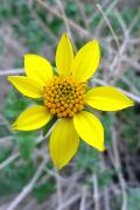
labro'sus: probably from the
Latin word labrum, referring either to a "lip," and the word ending -osus which means "full
of," so alluding to the prominent lip formed by the lower
three lobes of the corolla. The word "labrose" means "having
thick lips." Labrosus is a fairly common epithet used in fishes, and also for a frog, a snail and a plant. The fish species Chelon labrosus is commonly called thick-lipped gray mullet.
-
Labur'num: an old Latin name mentioned by Pliny for the broad-leaved
bean trefoil, a species of Cytisus in the Fabaceae. The genus Laburnum was published by Philipp Conrad Fabricius in 1759.
-
lacca'tus: possibly from the Italian lacca, "varnish."
Snogerup, Zika & Kirschner's Taxonomic and nomenclatural notes
on Juncus (2002) says: "The glossy cataphylls of J. laccatus look varnished, the source of the specific epithet." Cataphylls
are "brown and colorless scale-like structures believed to be
modified leaves." (from Plant Identification Terminology by Harris and Harris).
-
la'cera/la'cerum: torn or cut into fringe-like segments, originally derived from the Proto-Indo-European lek-, "to tear, rend."
-
lacera'tus: same as previous entry.
-
lacinia'ta/lacinia'tum/lacinia'tus:
torn or deeply cut, slashed into narrow divisions, irregularly divided, referring to the fringed petals, from the Latin lacinia, “flap or edge of a garment,” and -ate.
-
lackshewitz'ii: for Paul Moritz Alexander Lakshewitz (1865-1936), a Latvian botanist, entomologist and physician. A Latvian website called Nacionala ensiklopedija (National Encyclopedia) provides the following information: He was born the eldest of eight children in the southeast of Estonia in Repin, and his father was a doctor. He obtained a doctorate in medicine in 1892. In 1893, in Tsarskoye Selo, he married the daughter of Alexander Theodor von Middendorff, professor of zoology at the Petersburg Academy of Sciences, and they had three children. In 1915, he married a second time and continued to live in Liepāja, Latvia until the end of his life. As a child, Paul collected beetles and butterflies, but during school he became interested in the plants of the Baltic area. He studied at a private gymnasium in Türbat (1877-1883), where he was interested in natural sciences and met prominent zoologists of Türbat. He studied medicine at the University of Türbat (now the University of Tartu). In April, 1893, he received the degree of doctor of medicine. During his studies from 1884 to 1886 he was an assistant at the zoological museum in Türbat. In 1884 he went on an expedition to the Solovki Islands in the White Sea, where he collected materials for the museum. He started his career as a doctor in St. Petersburg, at the Alexander Hospital (1891-1892). From 1893 he was a freely practicing doctor in Liepāja, and from 1895 to 1903 he was also an attending physician at Liepāja City Hospital. However, he was more interested in Baltic nature than working in a hospital and private practice, so he conducted research in his free time and at his own expense. Together with the botanist Karl Reinhold Kupffer, he regularly traveled to Samsala and the coast of Estonia, where he collected plants for the herbarium and studied insects. He was especially interested in willows, and in order to study willows, in the summer of 1911, he went on a polar expedition to the Novaya Zemlya archipelago in the Arctic Ocean together with two world-famous Swedish willow researchers, the priest Sven Johan Enander and the doctor Björn Gustaf Oscar Floderus, and surveyed the southeastern side of the island. He returned from the expedition with new materials and findings, and the Petersburg Academy of Sciences invited him to process the collection of willows stored there. World War I interrupted research and polar expeditions. After the war, he collected and published the results of his impressive entomological collections, focusing especially on the systematics of Diptera (the order of flies). In this regard, he maintained correspondence with many researchers and museums. He was a member of the Riga Society of Naturalists (Naturforscher-Verein zu Riga). In 1928 he collected samples of a rare plant, Pedicularis sylvatica. He studied the willows of northern Europe, the Caucasus and Siberia, participated in the compilation of the herbarium list of Russian flora and the herbarium of Turbat University, creating chapters on willows. He published his observations on willows together with K. Kupfer in the circular of the Riga Naturalists Society as "Small notes." Difficulties were caused by the large number of these plants (in Latvia, 18 species, in the world, several hundred), not to mention that individual species easily hybridize. Lackshewitz’s contribution to botany is on a global level, and his contribution to the herbarium of the botany and mycology collections of the Liepāja Museum can be measured in its 11,000 collected specimens.
-
lac'ryma-jo'bi: from the Latin lachrima, "tears,"
and jobi for the Biblical Job, this taxa is called Job's tears.
Stearn quotes Job 16:16, "My face is foul with weeping , and
on my eyelids is the shadow of death." Another website entitled White River Valley Historical Quarterly (Volume 2, Number 2 - Winter 1965) says "The name comes from the hard, shining tear-like seeds that have a bluish-gray porcelain appearance. Legend says that in his grief for the many agonies he endured, Job wept ‘tears unto God’. And they weren’t wasted for, as his tears fell to the ground, a miracle happened. The tears were as seed which sprouted and grew into a tall, luxuriant growth of rare beauty. That tall grass, in turn, produced seed resembling those same tears Job wept so copiously in his hour of grief."
-
lac'ta: Latin for "milk," referring to the milky sap in
the stem, and a root word for lactic acid.
-
lac'tea/lac'teus: milky or milk-white.
-
lactiflor'um: with milky white flowers.
-
Lactu'ca: see lacta above. The genus Lactuca was published by Carl Linnaeus in 1753.
-
lactuci'na: from the Latin lacta for "milk" and
the suffix -ina denoting likeness or possession.
-
lacu'na-verna'lis: from lacuna for a lake, pond or cavity, and vernalis meaning 'of spring.' An article in Madroño by Robert Preston says "The epithet 'lacuna-vernalis' refers to the undulating vernal pool-swale terrain in which the species often occurs."
-
lacunos'um: with holes or pits, from Latin lacunosus, "full of holes, cavities, gaps."
-
la'cus-ur'si: from the Latin lacus, "a basin, lake, pond,"
and ursus, "bear," this is a taxon that is restricted
to the area of Big Bear Lake in San Bernardino County.
-
lacus'tre/lacus'tris: of or pertaining to lakes.
-
ladan'ifer: bearing ladanum, a gum resin
used in perfumery.
-
Ladea'nia: named for LaDean H. Egan (1949- ), mother of Ashley N. Egan, in recognition of her steadfast support during numerous field-collecting trips throughout the course of her daughter’s study of North American Psoraleeae. Ashley Egan is one of the authors of the new species Ladeania lanceolata, formerly Psoralidium lanceolatum. The genus Ladeania was published in 2009 by Ashley Noel Egan and James Reveal.
-
Laenne'cia: named for French physician René Théophile Hyacinthe Laennec (1781-1826), a professor of clinical
 |
|
medicine and inventor in 1816 of auscultation, which is the procedure of listening to the sounds of the body through an instrument he devised which we know as the stethoscope. He was born in Brittany and his mother died of tuberculosis when he was five. He was a somewhat sickly child and lived first with his great-uncle the Abbé Laennec. When he was twelve he went to Nantes where he began to study medicine under the direction of his uncle, Guillaime-François Laennec, who was on the faculty of medicine at the University. He had a thorough training in anatomy, physiology, |
chemistry, botany, pharmacy, legal medicine and medical history. He learned English and German, however his father discouraged him from this vocation, and it was not until 1799 that he returned to the field of medicine and studied at the University of Paris. He was a pupil of Jean-Nicolas Corvisart-Desmarets, Napoleon's great physician, and it was from him that he first got the idea for listening to the sounds of the chest. He wrote the classic treatise De l'Auscultation Médiate, published in August 1819. Considered by many as the father of the study of pulmonary diseases, he was also well known for his work on cirrhosis and peritonitis. He coined the term melanoma and wrote A Treatise on the Disease of the Chest with 55 editions published between 1821 and 1986. But while studying tuberculosis at a time when its contagious nature was only beginning to be suspected, he contracted the disease himself and died at the early age of forty-five. The genus Laennecia was published in 1822 by Alexandre Henri Gabriel de Cassini.
-
lae'ta/lae'tum/lae'tus: bright, vivid, gay, of unknown etymology.
-
laetifo'lius: brightly and abundantly leaved.
-
laetiflor'us: abundantly flowered with flowers of a gay or joyful
appearance.
-
laevicau'lis: from Latin laevis, "smooth," and Greek kaulos or Latin caulis, "a stem," thus smooth-stemmed.
-
laevicul'mis: from Latin culmus, "a stem of grain or straw," thus meaning with a smooth culm, which is a hollow or pithy stalk
or stem, as in the grasses, sedges and rushes.
-
laeviga'ta/laeviga'tum/laeviga'tus:
smooth or slippery, lustrous or shining. polished, not rough, from Latin laevis, "smooth."
-
lae'vipes: smooth-stalked.
-
lae'vis: smooth, free from hairs or roughness, from Latin laevis, "smooth."
-
Lagophyl'la: from the Greek lagos,
"a hare," and phyllon, "leaf," alluding
to the copius silky pubescence of the upper leaves of the originally
observed species. The genus Lagophylla was published by Thomas Nuttall in 1841.
-
lagopi'nus: like a hare's foot, referring to the softly pubescent
foliage and pods.
-
Lagunar'ia: named because of its resembance to the earlier genus Laguna, which was named for Andrés Laguna de
 |
|
Segovia (1494-1560), a Spanish humanist physician, pharmacologist, and botanist. His year of birth is not certain with 1494 and 1499 being the most commonly given. The 16th century Segovian historian Diego de Colmenares indicates it was 1499 and others 1494 and some even 1511. His father was an important converted Jewish physician in Segovia. Andrés began studying the Latin language and moved to Salamanca where he finished studies in human sciences, philology and fine arts. In 1530 he moved again to Paris where he graduated from the arts and went on to study |
medicine, returning to Spain in 1536. He traveled to England and lived for some years in the Netherlands collecting herbal remedies. He worked as a doctor in Metz between 1540 and 1545 and for the next ten years remained in Italy where he received a doctorate from the University of Bologna. He became a physician for Pope Julius III, following which he was in the Netherlands again until 1557. In that year he returned to Spain where he served as doctor to Charles V and Philip II. Like many medieval physicians, he was intensely interested in botany and created the botanical garden of Aranjuez. He was the author of Methodus cognoscenci in vesicae collo carunculas, considered a landmark in the study of urology. Like his date of birth, the year of his death is somewhat uncertain with 1559 and 1560 being the most likely. The genus Lagunaria was published by Heinrich Ludwig Gottlieb Reichenbach in 1828.
-
lagunen'sis: of or from the Laguna Mts.
-
laguro'ides: resembling genus Lagurus.
-
Lagur'us: from the Greek lagos, "a hare," and oura,
"a tail," from the densely hairy inflorescence. The genus Lagurus was published by Linnaeus in 1753.
-
laing'ii: named for Hamilton Mack Laing (1883-1982), a Canadian naturalist, educator, photographer, artist, bird
 |
|
collector, nut farmer and author. He was born in Hensall, Ontario, and attended art school in New York and traveled the American west before teaching school from 1901 to 1911 and then becoming principal of the high school in Oak Lake. He moved to Brooklyn, New York, in the summer of 1911 and enrolled in the Pratt Institute’s Program of Fine and Applied Arts. Three years later, he graduated with an art diploma. He was an accomplished artist and produced beautifully accurate and detailed images. In 1914 he rode a motorcycle from New York to Winnipeg. In 1913, Laing’s |
first book, Out With The Birds, was published. In 1918-9, he worked in the observation tower at RAF Beamsville, Ontario, where he met three prominent ornithologists, Hoyes Lloyd, James Henry Fleming, and Percy Tavener. He made his home in 1922 in the Comox Valley of Vancouver Island and built a home from a kit. He married Ethel Hart of Portland in 1927 and they established a successful and commercial orchard which included walnut, pecan, filbert, hazelnut, apple and plum trees. They also grew mushrooms and vegetables. He collected specimens for the National Museum of Canada, wrote for almost every North American outdoor nature magazine, and was a friend and contemporary of many noted naturalists. Laing was engaged to accompany ten important expeditions for the National Museum of Canada and three expeditions funded by Canada and the US, as a collector-naturalist, between 1933 and 1935. He was considered a top field man. In 1944 his wife died of cancer. In addition to many articles, he wrote hundreds of letters, expressing his views to friends, colleagues and the press. In 1979 his biography of a friend and colleague, Allan Brooks – artist naturalist, was published by the British Columbia Provincial Museum. At the age of 99, after falling and requiring a hip operation, he died of a massive coronary. He left his home to the town of Comox. (Photo credit: Mack Laing Heritage Society of Comox Valley)
-
lalon'dei: named for Louis Marie Lalonde (1896-1978), a Trappist priest of Oka Monastery, Quebec, and professor
 |
|
of genetics and botany. He obtained a master's degree in natural sciences at Laval University in 1925 and a PhD in biology from Harvard University in 1928. He also received an honorary doctorate from Laval University in Quebec in 1962. He was the author in 1931 of Flore-Manuel of the Province of Quebec. The Père-Louis-Marie Ecological Reserve and the Louis-Marie Herbarium whose collection grew to more than 100,000 specimens under his direction were named in his honor. He taught at the Agricultural Institute of Oka from 1923 to 1962. (photo credit: Université |
de Montréal)
-
Lamarc'kia/lamarc'kii: named for Jean Baptiste Antoine Pierre
Monet de Lamarck (1774-1829), a French botanist.
 |
|
The following is
quoted from Wikipedia: "Lamarck was born in Bazentin-le-Petit,
Picardy on August 1, 1744. Born into poor nobility (hence chevalier
- knight), Lamarck served in the army before becoming interested in
natural history and writing a multi-volume flora of France [Flore
Francaise]. This caught the attention of Georges-Louis Leclerc,
Comte de Buffon who arranged for him to be appointed to the Muséum
National d'Histoire Naturelle in Paris [and botanist at the Royal
Botanical Garden, the Jardin des Plantes]. After years working on
plants, Lamarck was appointed |
curator of invertebrates — another
term he coined. He began a series of public lectures. Before 1800,
he was an essentialist who believed species were unchanging. After
working on the molluscs of the Paris Basin, he grew convinced that
transmutation or change in the nature of a species occurred over time.
He set out to develop an explanation, which he outlined in his 1809
work, Philosophie Zoologique. Lamarck developed two laws: 1. In every
animal which has not passed the limit of its development, a more frequent
and continuous use of any organ gradually strengthens, develops and
enlarges that organ, and gives it a power proportional to the length
of time it has been so used; while the permanent disuse of any organ
imperceptibly weakens and deteriorates it, and progressively diminishes
its functional capacity, until it finally disappears. 2. All the acquisitions
or losses wrought by nature on individuals, through the influence
of the environment in which their race has long been placed, and hence
through the influence of the predominant use or permanent disuse of
any organ; all these are preserved by reproduction to the new individuals
which arise, provided that the acquired modifications are common to
both sexes, or at least to the individuals which produce the young. Lamarck saw spontaneous generation as being
ongoing, with the simple organisms thus created being transmuted over
time (by his mechanism) becoming more complex and closer to some notional
idea of perfection. He thus believed in a teleological (goal-oriented)
process where organisms became more perfect as they evolved. During
his lifetime he became controversial; his criticism of the palaeontologist
Georges Cuvier’s anti-evolutionary stance won him no friends.
Lamarck married three, possibly four, times. His first marriage was
to his mistress from 1777, Marie Delaporte, the mother of his first
six children, whom he married on her deathbed in 1792. He remarried
in 1795 to Charlotte Reverdy, but she died in 1797. His third wife was Julie
Mallet in 1798. She died in 1819. Rumours exist of a fourth wife and
widow but no documentary evidence exists of her. Lamarck died penniless
in Paris on 28 December 1829." The genus Lamarckia was published by Conrad Moench in 1794.
-
lambertia'na: named for Aylmer Bourke
Lambert (1761-1842), the English botanist and conifer expert. Wikipedia
 |
|
says: [He] was born at Bath, England on 2 February 1761, the son of Edmund Lambert of Boyton House and Bridget Bourke who was the daughter of the 8th Viscount Mayo. Lambert's mother died in 1773, the same year that he started school and through her family he inherited estates in Jamaica and Ireland. Lambert went to Newcome's School for the sons of gentlemen at Hackney, and then attended Oxford University for three years. Lambertstudied at Oxford and because of family wealth was able to procure
and assemble both a library of botanical source materials and an |
important
herbarium of plant specimens from around the world. In 1797 he published
"A Description of the Genus Cinchona" (Cinchona, or quinine,
the plant which was used to fight malaria), which was presented to
the Linnaean Society . He became the patron of Frederick Traugott
Pursh who while in America was unable to produce the flora of North
America he wanted to, but who finally published the Flora Amaerica septentrionalis in England in 1814. The following is quoted from
James Reveal's website entitled "A Nomenclatural Morass":
"There is a tale, probably apocryphal, that to get the flora
finished, Lambert locked Pursh in his attic room, providing him only
with books, specimens, paper, ink, food and beer." Pursh named
the purple locoweed he found in Kansas, Oxytropis lambertii,
in honor of his friend. In 1803, Lambert assigned the name of Pinus
taxifolia to specimens of the douglas fir ( Pseudotsuga menziesii)
first collected by Archibald Menzies in 1792 as part of the Vancouver
expedition, a name which had to be dropped because it had already
been used on another conifer. Menzies also acquired samples of the
coast redwood (whether he actually collected them himself is uncertain)
and these samples formed the basis of Lambert's description of this
species, a species to which in 1824 he assigned the name Taxodium
sempervirens. This name lasted for 23 years until it also was
dropped in favor of Sequoia sempervirens (from "The Ecology
of Sequoia sempervirens" by James A. Snyder). Lambert
published "A Description of the Genus Pinus" in 1828-1829.
He died in 1842, and his library and herbarium was sold to raise money.
Most of his materials were acquired by the British Museum and are
now at the Natural History Museum in London. The Lewis and Clark specimens
taken to England in 1811 by Frederick Pursh were however returned
to the United States and presented to the Academy of Natural Science
in Philadelphia . The pine which bears his name was first collected
in 1826 by the Scottish botanist David Douglas who managed while in
Oregon to shoot down three cones, collect some twigs and take measurements,
later naming it Pinus lambertiana in honor of the author of
the classic work on pines. (Photo credit: ScienceSourceimages)
-
Lamias'trum: from the genus Lamium and the Latin suffix -astrum,
suggesting some superficial resemblance to that genus. The genus Lamiastrum was published by Lorenz Heister in 1759.
-
Lam'ium: the ancient Latin name for the mints. The genus
Lamium was published by Carl Linnaeus in 1753.
-
lammersia'na: named for Clemens Lammers (1806-1893), a German plant collector who collected the type specimen of the liverwort Cephalozia bicuspidata ssp. lammersiana.
-
lamott'ei: named for the French biologist and botanist Simon Gabriel Lamotte (1820-1883), a member of the Botanical Society of France. Name sometimes given as Simon Gilbert Lamotte Martial. He engaged in pharmacy studies in Paris and became a professor at the Clermont-Ferrand School of Medicine and Pharmacy in 1860. He was a collaborator of the great naturalist Henri Lecoq and curator of his collections. He was particularly interested in mushrooms and created a work that included 858 watercolor plates but was never published.
-
lamprosper'ma: from the Greek lampros, "shining,"
and sperma, "seed."
-
lana'ta/lana'tum/lana'tus:
covered with long, wooly hair, from Latin lana, "wool."
-
lan'cea: spear-shaped.
The Latin noun lancea referred to a Roman auxiliaries' short javelin; a light spear or lance.
- lanceifo'lia: lance-leaved.
-
lanceola'ta/lanceola'tum/lanceola'tus:
lance-like, referring to the shape of the leaves.
-
lancifo'lia/lancifo'lium: lance-leaved.
-
Lancis'ia: named for Giovanni Maria Lancisi (1654-1720), a cardiologist, anatomist, forensic physician and epidemi-
 |
|
ologist, considered the foremost Italian physician of his time. He was born in Rome of middle-class parents. He first pursued theology but then turned to the natural sciences. In 1676 he was appointed doctor at the Hospital of Santo Spirito and in 1678 he was nominated to membership in the College del Salvatore, where he spent five years in quiet study. He was appointed a professor of anatomy at the Collegio Romano, Sapienza, at the age of 30, in 1684 and professor of the theory and practice of medicine at the age of 43, a position held until his death. Wikipedia says: “Giovanni Maria Lancisi |
(Latin name: Johannes Maria Lancisius) was educated at the Collegio Romano and the University of Rome, where he qualified in medicine aged 18. He was physician to Popes Innocent XI, Clement XI and Innocent XII. He was given the lost anatomical plates of Bartolomeo Eustachius by Pope Clement XI; these were made in 1562 and had been forgotten in the Vatican Library. Lancisi edited and published them in 1714 as the Tabulae anatomicae. He studied epidemiology, describing malaria and influenza epidemics. He published De Noxiis Paludum Effluviis (On the Noxious Effluvia of Marshes) in 1717, in which he recognized that mosquito-infested swamps are the breeding ground for malaria and recommended drainage of these areas to prevent it. He also published extensively on cardiology, describing vegetations on heart valves, cardiac syphilis, aneurysms and the classification of heart disease. His landmark De Motu Cordis et Aneurysmatibus was published posthumously in 1728. Early in the 18th century, Lancisi had protested the medieval approaches to containing rinderpest in cattle by stating that 'it is better to kill all sick and suspect animals, instead of allowing the disease to spread in order to have enough time and the honor to discover a specific treatment that is often searched for without any success.' It was Lancisi who made the first breakthrough in the control of rinderpest, a procedure that was later adopted by Thomas Bates.” He was considered the first modern hygienist. He died in Rome. The genus Lancisia was published by Philipp Conrad Fabricius in 1759.
-
Landolt'ia: named for Elias Landolt (1926-2013) of the Swiss Geobotanical Institute at Zurich and author of A Mono-
 |
|
graph of the Lemnaceae and the two-volume Biosystematic investigations in the family of duck- weeds (Lemnaceae). "Dr. Landolt is the world’s recognized expert in all aspects of the biology of the Lemnaceae, and is professor emeritus in the Geobotanical Department of Eidgenössische Technische Hochschule, Zürich. He has authored dozens of journal articles and four definitive monographs on Lemnaceae biology that represent a compilation of knowledge of this plant family. During his 35 year tenure at ETH in Zurich, Dr. Landolt traveled the world amassing an extensive |
living collection of more than 900 strains of Lemnaceae, including representatives of all genera and species." (from a website of Biolex Therapeutics) He was born and grew up in Zurich. His father was a lawyer and politician and later the mayor of Zurich. From 1945 to 1949 he studied the natural sciences at the Swiss Federal Institute of Technology and received a doctoral degree in 1953. For the next two years he was in California doing research at the Carnegie Institution for Science, Department of Plant Biology, Stanford, and then at the California Institute of Technology in Pasadena. When he returned to Zurich he became an assistant and then an associate professor and finally a full professor at the Geobotanical Institute where he taught and researched until his retirement. From 1966 to 1993 he served as director of the Institute. He also made many exploratory trips to tropical and subtropical countries to collect both living duckweeds and herbarium specimens which constitutes the most significant collection of Lemnaceae anywhere in the world. The genus Landoltia was named in his honor in 1999 by Donald Les and Daniel Crawford.
-
Langloi'sia/langlois'ii: named for the Reverend Father Auguste Barthélémy Langlois (1832-1900), a Louisiana
 |
|
priest and botanist. Born in Chavanay in the Department of the Rhône, France, his early education was at the Montbrison Seminary in the Loire Region. It was while studying in Montbrison that Langlois' botanical pursuits began as he assembled a 1,200-1,300 specimen collection of plants from the region. In 1855 he went to Cincinnati, Ohio, where he completed studies at the College of Mount St. Mary of the West, and was ordained a Roman Catholic priest in 1857. He was first posted to low-lying Point à la Hache (elevation 3 feet), in Plaquemines Parish of the south-eastern |
Mississippi delta about 70km from New Orleans, and in this region he gathered a large part of his plant collection. His predecessor there had been murdered after being called out during the night, perhaps by his parishioners. His initial interest was somewhat stymied by having no authoritative sources to draw on for identification of specimens and his pursuits lapsed. After 35 years in this parish he was moved in 1887 to St. Martinville at the considerably higher elevation of 23 feet, and began again to botanize in the surrounding parishes. Another region in which Langlois collected plants was St. Tammy Parish, where he yearly attended a church retreat. In correspondence with a number of important lichenologists and mycologists, he sent many of his Louisiana fungi to Job Bicknell Ellis who was subsequently able to describe a number of species. Langlois himself described some new species, including Volutella ellisii which he named for Ellis. He botanized extensively in surrounding areas as well as in Mississippi and Alabama. Langlois sent his lichen samples to various specialists such as Auguste Marie Hue in Paris, Johannes Muller Argoviensis in Aargau, and John Wiegand Eckfeldt in Philadelphia. Flowering plants were sent to John Donnell Smith of Baltimore, grasses to George S. Vasey from Washington, liverworts to Franz Stephani from Leipzig and mosses to Jules Cardot and Ferdinand Renauld. He systematically collected and classified more than 20,000 specimens of Louisiana plants between 1877 and 1900, carried on a correspondence with Edward L. Greene, published a catalog of plants of lower Louisiana in 1887, and lectured on botany at Catholic Winter School in New Orleans and at DePaul University in Chicago. He died at Point-à-la-Hache at the age of 69. His herbarium of some 20,000 specimens was deposited in the Catholic University of America in Washington, DC, and was named the Langlois Herbarium. The collection was sold off in 1985-1986 and today Langlois specimens may be found in at least four dozen herbaria in the United States. The genus Langloisia was published in 1896 by Edward Greene.
(Photo credit: North Carolina Botanical Garden)
-
langsdorf'ii: named for artist Georg Heinrich von Langsdorff (1774-1852),
known for West Coast sketches. He was
 |
|
born at Wöllstein, in the Electoral Palatinate, Holy Roman Empire. The following is quoted from Wikipedia:
"Georg Heinrich von Langsdorff, Baron de Langsdorff was a Prussian
aristocrat, politician and naturalist. He lived in Russia and was
better known by his Russian name, Grigori (Gregory) Ivanovitch. He
was a member and correspondent of the Russian Imperial Academy of
Sciences and a respected physician, graduated in medicine and natural
history at the University of Göttingen, Germany. Langsdorff first
participated as naturalist and physician in the great Russian |
scientific
circumnavigation expedition commanded by Ivan Fedorovich Kruzenshtern, from 1803 to 1805. He left the expedition in Kamchatka to explore
the Aleutians, Kodiak and Sitka; and returned from San Francisco by
ship to Siberia and thence to Saint Petersburg by land, arriving in
1808. In 1813 Langsdorff was nominated consul general of Russia in
Rio de Janeiro, Brazil. He acquired a farm (named "Mandioca",
or manioc) in the north of Rio and collected plants, animals and minerals.
He hosted and entertained foreign naturalists and scientists, such
as Johann Baptist von Spix and Carl Friedrich Philipp
von Martius, and explored the flora, fauna and geography
of the province of Minas Gerais with French naturalist Augustin Saint-Hilaire
from 1813 to 1820. In 1821 he proposed to the Tsar Alexander
I and to the Academy of Sciences to lead an ambitious exploratory
and scientific expedition from São Paulo to Pará, in
the Amazon, via a fluvial route. In March 1822, he returned to Rio
in the company of scientists Édouard Ménétries, Ludwig Riedel, Christian Hasse and Nester
Gaverilovitch Rubtsov, who would take care of zoological,
botanical, astronomical and cartographical observations during the
expedition. With the aim of illustrating and documenting his findings,
the Baron hired painters Hércules Florence, Johann Moritz Rugendas
and Adrien Taunay. After extensive preparations, the Langsdorff Expedition
departed with 40 people and 7 boats from Porto Feliz, by the Tietê
river on June 22, 1826 and reached Cuiabá, in Mato Grosso on
January 30, 1827. The expedition was then divided into two groups:
the first one, with Langsdorff and Florence, was able to reach Santarém
on the Amazon River on July 1st, 1828, with enormous difficulties
and suffering. Most of the members of the expedition became ill with
tropical fevers (most probably yellow fever), including the Baron
de Langsdorff. As a consequence of the febrile attacks, he became
insane at the Juruena River on May 1828. Adrien Taunay died by drowning
in the Guaporé river and Rugendas abandoned the expedition
before its fluvial phase. Therefore only Florence remained during
the whole expedition. The expedition was joined again in Belém
and returned by ship to Rio de Janeiro, arriving on March 13, 1829,
almost three years and 6,000 km after its departure. The rich scientific records of the expedition,
comprising many descriptions and discoveries in zoology, botany, mineralogy,
medicine, linguistics and ethnography were lost for a century in institutions in Moscow and Leningrad. They were found again in 1930. Due
to the travel's hardships, Langsdorff team was unable to collect many
biological specimens or study them in detail, so most of their account
is geographic and ethnographic, being particularly interesting on
the many indigenous people of Brazil they met, many of which became
extinct. Today, a large part of the material has been recovered and
is in the Ethographic Museum, the Zoological Museum and in the repositories
of the Academy of Sciences of St. Petersburg. Langsdorff returned
to Europe shortly thereafter, in 1830, and died in Freiburg, Germany,
of typhus, in 1852." His work, Voyages and Travels in Various
Parts of the World, during the Years 1803, 1804, 1805, 1806, and 1807,
was published in Dublin in 1813.
-
lan'iger: wooly, wool-bearing, from lana, "wool, " and -gera, "bearing."
-
-
lanosis'simus: very wooly.
-
lansdalea'na: named for Ethel Shipley Smith (Mrs. Philip van Horne Lansdale) (1871-1962), a nature lover, philanthropist, and conservationist. She was a lover of beautiful gardens, whether natural or man-made, and was active in conservation movements. She is one of the many who recognized the worth and ability of Alice Eastwood and became her devoted friend. The type specimen of Iris lansdaleana was collected by her and Alice Eastwood in Mendocino County. Her husband was a United States Naval officer who on April 1, 1899, was ordered to quell a native uprising at Apia, Samoa led by Chief Mataafa. After quelling the uprising and returning to the cruiser USS Philadelphia, his party was ambushed and he was seriously wounded in the fight. Unable to walk, he ordered his landing party to leave him. Three sailors refused to leave him and attempted to carry him to the cruiser. When this failed, they stood their ground and were overwhelmed and killed. The USS Lansdale (DD-101), a Benson class destroyer, was named in his honor.
-
Lanta'na: a Latin name for Viburnum for the
similar inflorescence. The genus Lantana was published by Carl Linnaeus in 1753.
-
lanugino'sa/lanugino'sum/lanugino'sus: wooly or downy.
-
lanulo'sa: lanulose, from the Latin root lanula, "a tiny
lock of wool," and a diminutive form of lanata or lanosa,
thus meaning "minutely wooly."
-
lanszwert'ii: named for Louis Lanszweert (1825-1888), a Belgian-born San
Francisco pharmacist in the early days of the California Academy of
Sciences.
He was elected to the American Pharmaceutical Association in 1859. The taxon in the California flora with this epithet is Lathyrus lanszwertii.
-
lapathifo'lia/lapathifo'lium: this name apparently
derives from the root lapath or lapathium for "sorrel
or dock," hence would mean "with leaves like sorrel or dock."
-
Lapham'ia: named for Increase Allen Lapham (1811-1875), a scientist, naturalist, author, and educator. He is consid-
 |
|
ered the ‘Father’ of the U. S. Weather Bureau.. He was born in Palmyra, New York, and his family moved to Pennsylvania, back to New York, to Ohio, to Louisville, Kentucky, and then back to Ohio. In 1836 Lapham moved to Wisconsin and before the end of the year he had published a Catalogue of Plants and Shells, Found in the vicinity of Milwaukee, on the West Side of Lake Michigan, perhaps the first scientific work published west of the Great Lakes. He was educated as a civil engineer and served on several canal projects, including the canal around the Falls of the Ohio |
at Louisville. Wikipedia says: “He founded the Wisconsin Natural History Association, which eventually became the Wisconsin Academy of Sciences, Arts, and Letters, of which he also was a charter member. Many of his works and early maps were used for various civil projects such as canal and railroad development. In 1844 Lapham published the first substantial book on the geography of the Wisconsin Territory. His first map of Wisconsin was made in 1846. He published many more papers and books through his life, particularly on geology, archaelogy and history, and flora and fauna of Wisconsin, including publication by the Smithsonian Institution.” In 1850, he discovered the Panther Intaglio Effigy Mound, which is now listed on the National Register of Historic Places. Lapham was elected a member of the American Antiquarian Society in 1853.” The 'Mound' is a depression in the ground near Fort Atkinson, Wisconsin, and is in effect a reverse mound: a depression in the shape of a panther or water spirit which was created by Native Americans before the arrival of settlers. Lapham lobbied Congress and the Smithsonian Institution to create an agency to forecast storms on the Great Lakes and both coasts. He was instrumental in establishing the Milwaukee public high school program, was one of the founders of Milwaukee Female Seminary (1848), and was president of The State Historical Society (1862-1871). He was chief geologist for Wisconsin (1873-1875), and was a founder and member of many early educational, civic, and scientific organizations, corresponding regularly with leading scientists throughout the world. His natural history collection, including fossils, minerals, shells, meteorites, Indian relics, and a large herbarium, was acquired by the legislature in 1876 for the University of Wisconsin. He died of a heart attack in Oconomewoc, Wisconsin. The genus Laphamia was published by Asa Gray.
-
lapidico'la: dwelling in stony places. A 1992 article in the journal Nuytsia by
A.E. Orchard about the Australian species Myriophyllum lapidicola says "dwelling on granite rocks, a reference to its specialized habitat." The California flora has two taxa using this epithet, Lupinus lapidicola and Eriogonum microtheca var. lapidicola, neither of whose common names make any allusion to granite rocks.
-
Lapor’tea: there is uncertainty as to the individual this genus was named for when it was published by Charles Gaudichaud-Beaupre in 1830. Flora of North America says it was François Louis Nompar de Caumont Laporte, Count of Castelnau (1810-1880), a French naturalist and diplomat. He was born in London the illegitimate son of the Comtesse de Mesnard-la-Barotiere, and this fact and the many versions of his name that have come down to us may partly explain why so little is known about his early childhood. The Australian Dictionary of Biography says: “Travel books by Captain Cook and Le Vaillant were his childhood reading. He studied natural science in Paris under Baron Cuvier, Geoffroy Saint-Hilaire and other noted zoologists. In 1837-41 he traveled in the United States, Texas and Canada; in 1843-47 he went from Rio de Janeiro to Lima in South America, collecting specimens from the River Amazon. After the 1848 revolution he became French consul at Bahia, Brazil. In 1856-58 he traveled in South Africa and then in Asia. In Siam he was French consul and the first European to study the country's fishes. He arrived at Melbourne in 1862 and became consul-general for France in 1864. He visited Sydney and Brisbane in 1876, was an active member of the Zoological and Acclimatisation Society of Victoria and of the Entomological Society of New South Wales. His earlier works were lavishly produced but his later papers are marred by some inaccuracies, perhaps because written in English. As Laporte or Delaporte and later Castelnau he wrote about ninety books and papers, some jointly with colleagues, on a variety of scientific subjects: geography, palaeontology and anthropology, mammals, birds, reptiles and his favourite fishes and insects. His monographs on insects, written in his youth, were collected into a sumptuous Histoire Naturelle, published between 1835 and 1841. He described his 1843-47 journey as Expédition dans les parties centrales de l'Amérique du Sud (Paris, 1850-59). African and Asian studies followed and in the 1860s his 'Notes on Australian Coleoptera' were published in the Proceedings of the Royal Society of Victoria. Then he turned to ichthyology and in the 1870s published several papers on Australian fishes in Melbourne, Paris and Sydney. The genus Laportea (tropical stinging tree) was named after him as were many insects and fishes. He died at his home, Apsley Place, East Melbourne, on 4 February 1880.” Despite his significant career and the fact that sources identify him as the honoree of Laportea, it seems unlikely to me. He would have been only 20 when Gaudichaud-Beaupre published the name, and there seems to be nothing that connects him with Gaudichaud-Beaupre. The other possibility is Pierre Louis Delaporte (1773-1853), a surgeon and doctor in the French navy. One French online source says "He entered the Brest Naval School in 1790, was received first class surgeon in 1796 and became professor in 1802, second chief surgeon in 1808, first chief surgeon in 1814. He submitted a doctoral thesis to the Faculty of Medicine of Paris on August 21, 1819. Apparently he had to leave the service in 1829 because of unspecified infirmities. He is considered the first to have performed ligation of the external iliac artery in France in 1810, inspired by reports of English attempts. The Medical Society of Emulation awarded him a gold medal as a reward, which today decorates the beautiful arsenal of surgical instruments with which he had endowed the School of Brest in 1823. He was also elected corresponding deputy of the Academy of Medicine for the surgery section on July 5, 1825. He was named Knight of the Legion of Honor before 1819. Gaudichaud-Beaupre’s greatest claim to fame was serving as botanist on a circumglobal expedition from 1817 to 1820, accompanying Freycinet on the ships Uranie and Physicienne. The wreck of the Uranie in the Falkland Islands, at the close of 1819, deprived him of more than half the botanical collections he had made in various parts of the world. He often named plants that were found after crewmembers or other people he had been associated with, and he may well have known Delaporte.” The derivation for this epithet must unfortunately for the time being remain uncertain.
-
lap'pa: a Latin name for a bur.
-
Lap'pula: a diminutive of the Latin lappa, "bur," referring to the fruits. The genus Lappula was published by Conrad Moench in 1794.
-
Lapsa'na: a name used by Dioscorides for some edible plant. Wikipedia says "The scientific name comes from lapsane, an edible herb described by Marcus Terentius Varro of ancient Rome," and FNA says from "Greek lapsanae, a vegetable mentioned by Dioscorides, perhaps actually Raphanus, with lyrate leaves resembling those of Lapsana." Apparently lapsane was a Greek name for a kind of cress. The genus Lapsana was published by Carl Linnaeus in 1753.
-
laricifo'lia: with leaves like the larch.
-
lariversia'nus: named for Ira La Rivers (1915-1977), entomologist, malacologist, conchologist and professor of biology at the University of Nevada, Reno. He was born in San Francisco but grew up among the mining camps and farms of western Nevada. He received a bachelor of science degree from the University of Nevada in Reno in 1937 and began working as a field researcher in the Department of Entomology of the Department of Agriculture of the United States. He then began a teaching assistantship at North Carolina State College in Raleigh and from 1947 to 1948 taught at the University of California, Berkeley. From 1948 to 1954 he worked as an entomologist at the University of Nevada. During World War II he was in the US Naval Reserve and in 1948 received a PhD from the University of California, Berkeley. He visited the Marshall Islands in the summer of 1950 and was married the following year to fellow teacher Marian Byrd Ballinger. He was director of the Museum of Natural History of the University of Nevada from 1953 to 1961 and from 1961 to 1977 professor at the University of Nevada. He was the author of Fishes and Fisheries of Nevada (1962). His main interest was in the aquatic insects and algae of Nevada and he carried out research in the Amargosa Desert, Death Valley and the Great Basin. He was a member of the Biological Society of Nevada and the Western Society of Malacologists.
-
larran'agai: named for Dámaso Antonio Larrañaga Pires (1771-1848), Uruguayan architect, and naturalist-botanist.
 |
|
He was born in Montevideo and studied in Cordoba. He completed his preparatory studies at the Royal College of San Carlos and returned to Montevideo in 1799. In 1804 he held a religious administrative position for the Metropolitan Cathedral located in front of the Plaza Constitución or Plaza Matriz of Montevideo, a structure began in 1790 but not consecrated until 1804. Two years later came the first of two failed English attempts to invade and annex parts of Uruguay, and Larrañaga marched with the troops to counter these moves, after which he continued his religious |
activity, took up scientific work and worked on his library, activities that continued until his death. Because of some controversial opinions, he was expelled from Montevideo in 1811 along with other patriotic priests, but was comissioned to attend as a delegate to the Constituent Assembly of 1813 in Buenos Aires, however his participation was frusrated. Perhaps to mollify him, he was offered the position of public librarian which he accepted and held until 1815 when he returned to Oriental Province. At some point he became pastor at the Metropolitcan Cathedral and later was appointed director of the National Library. About this time Brazil was in the process of incorporating Oriental Province into Brazil under Portuguese dominaton, and Larrañaga was selected to be a deputy to the Cisplatino Congress summoned by the Portuguese colonial administrator Carlos Federico Lecor, in which it was agreed for the definitive incorporation of the Eastern Province to the Portuguese monarchy. In 1824 he was confirmed as Apostolic Vicar which was equivalent to that of a Diocesan Bishop. In 1825 there was a revolution intended to free Uruguay in which he did not participate because of his religious duties, but the Republic was reconstituted in 1830 and he was elected senator for the department of Montevideo until 1835. Two of the bills he sponsored were for the restriction of the death penalty and for the emancipation of slaves. The remainder of his life was spent in ecclesiastical matters. As the highest church authority in Uruguay, he had been appointed by Manuel Oribe, president of Uruguay and founder of the National Party, to hold the first rectory of the University of the Republic, but because it was not actually inaugurated until one year after his death in 1849, the position was granted to Lorenzo Antonio Fernández, who succeeded him as apostolic vicar. He died of a stroke in Montevideo.
-
Lar'rea: named for Bishop Juan Antonio Hernández Perez de Larrea (1731-1803), a Spanish clergyman at Valladolid
 |
|
and patron of the sciences. He was born in Villar del Salz in the Diocese of Zaragosa. He was an eminent botanist and friend of the poet, jurist and politician Juan Meléndez Valdés, president of the Royal Aragonese Economic Society of Friends of the Country, preacher in the Holy Cathedral Church of Zaragoza, and Knight of the Order of Carlos III. His interest in the flora of Aragon was demonstrated by his offer of 10 pesos for anyone who could find an uncatalogued plant. One of the things he supported was the admission of women to professional societies. Shortly before his death |
he was appointed as Bishop of Valladolid. The genus Larrea was named for him in 1797 by Casimiro Gómez de Ortega. (Photo credit: Gran Enciclopedia Aragonesa)
-
larsen'ii: named for a plant collector named John Larsen (1849?-?). John Lemmon
hired him as an assistant in 1875 and they collected the type specimen
of Gilia larseni on Mt. Lassen. Lemmon made this comment on his record of the isotype of this taxon: "Named for my companion John
Larsen, since deceased, in the ascent of Lassens Peak."
David Hollombe sent
me the following: "John Larsen was registered in Sierra County
on March 22, 1875 as a resident of Sierraville, occupation clerk,
age 31, born in Norway, naturalized in San Francisco District Court
26 May 1874. The old registers were closed and new register begun
in 1879 and Larsen re-registered as Lars John Larsen, resident of
Forest (City), age 31, same naturalization data. He is not listed
in 1880 or later registers."
-
Lasal'lea: named for René-Robert Cavelier Sieur de La Salle ( 1643-1687), a French explorer and fur trader in North
 |
|
America. He was born in Rouen and is often referred to as Robert La Salle, but Sieur de La Salle, which translates approximately as Lord of the Manor, was an honorary title which was purchased by him, not earned or awarded. He enjoyed science and nature as a youth. The Encyclopedia of Arkansas History and Culture relates: “Educated at the Jesuit College in Rouen, La Salle gave up his inheritance to enter the Society of Jesus and studied to become a priest. Feeling unsuited for the priesthood, La Salle left the order and sailed for Canada in 1667 to join his brother, Jean. He traded |
furs in the Ohio River valley and explored the Mississippi River Valley with the objective of establishing fur trading posts from the Great Lakes to the Gulf of Mexico. By the 1670s, La Salle secured a patent of nobility and a seigniorial grant from the French king for land in North America. Aided by [the French military officer, explorer and voyageur Henri] de Tonti, La Salle cultivated important military, social, and political alliances with Indian tribes in the Mississippi River Valley. Reaching Arkansas in 1682, La Salle and his men stopped at the Quapaw village of Kappa, a settlement located on the Mississippi River approximately twenty miles south of the mouth of the White River, where, after initial suspicion, the tribe received them cordially. Before leaving the Quapaw, La Salle erected a column bearing the coat of arms of Louis XIV and a painted cross at Kappa. From this moment until Spanish domination of Louisiana in the 1760s, the Quapaw allied themselves with the French to obtain firearms and manpower to face their enemies; they also traded, formed political alliances, and even intermarried with them. It was an advantageous relationship for both the Quapaw and the French. Following this ceremony, La Salle made a land grant to his trusted friend, de Tonti, who established a small trading post that would become Arkansas’s first permanent European settlement in 1686. La Salle returned to France in order to promote settlement in French-occupied territory. Returning to North America with 200 colonists, La Salle’s expedition missed the mouth of the Mississippi River and ended up landing on the coast of Matagorda Bay, Texas, in 1685. He ordered a fort to be built and set off in search of the Mississippi River with several colonists. His error in judgment and indecision regarding their situation caused dissention, which led members of the exploration party to kill him on March 19, 1687, near the Hasinai (Tejani Indians) village. La Salle ultimately failed in his undertaking of establishing fur trading posts along the Mississippi River, but his expeditions were his fame. However, he did open the great waterway for development and established friendships with Arkansas indians, who would assist and support the French colonial settlers in the area for over 100 years.” The genus Lasallea was published by Edward Greene in 1903.
-
lasian'dra: "with wooly stamens"
from lasi, meaning "wooly" and andros, "a
man, male" referring to the stamens.
-
lasian'tha/lasian'thum:
with wooly flowers.
-
lasi-/lasio-: wooly.
-
lasiocar'pum/lasiocar'pus: having wooly
seed heads or fruits.
-
lasiococ'cus: from lasios, "wooly," and kokkos,
"a kernel, grain," thus wooly-fruited.
-
Lasiosper'mum: from the Greek lasios, "shaggy, wooly,
velvety," and sperma, "a seed," in reference
to the achenes. The genus Lasiospermum was published by Friedrich Ernst Ludwig von Fischer in 1812.
-
lasiol'epis: wooly-scaled.
-
lasiophyl'la/lasiophyl'lus: wooly-leaved.
-
lasiorhyn'cha/lasiorhyn'chus: from lasio,
"wooly," and rhynchus, "a snout or beak."
-
lasiosta'chys: with spikes of wooly flowers.
-
lassenen'sis: same as next entry.
-
lassenia'nus: of or from Lassen County.
-
Lastar'riaea: named for the Chilean José Victorino Lastarria Santander (1817-1888), a teacher, lawyer and founder of
 |
|
the Liberal Party in Chile, also one of the founders of the Chilean University. He was born in Rancagua in central Chile, the son of a merchant. After early studies in his hometown, he went to Santiago where he was granted a scholarship by the government to the Liceo de Chile. While there, the director of the school was expelled from the country by the conservatives who had won the Chilean Civil War of 1829-1830, and Lastarria became a revolutionary against what he saw as a dictatorship. The following is quoted from Wikipedia: “After graduating from the National Institute, |
he studied for various careers, earning the titles of geographer and attorney from the University of San Felipe and the Institute of Law and Sacred Canons in 1839. With a group of students from the National Institute, he formed the Literary Society of 1842, an entity for the dissemination of liberal ideas then prohibited by the government of Manuel Bulnes. In 1843, Lastarria joined the ranks of the founding professors of the University of Chile.” The history of Chile at this time is one of political upheaval, and Lastarria in 1848 joined a group called the Society of Equality which sought to overthrow the constitution of 1833. He was arrested in 1850 and sent to Lima, but returned the following year to participate in the Revolution of 1851 which was ultimately unsuccessful. After being declared one of the ten most wanted men in Chile, he escaped back to Peru. In 1853 he returned to Chile and settled in Valparaiso, joining the Freemasons. By 1859 the tide had turned and Lastarria was part of the new liberal movement that eventually took over the government. In addition to being the dean of philosophy at the University of Chile, he was appointed Mnister of Finance. He became an ambassador and returned to Lima, participating in the negotiations with Argentina over Patagonia. He was elected to the Chilean Senate and served 1867 to 1879. In 1876 he was appointed Interior Minister, and was sent to Brazil to prevent that country from supporting Chile’s enemies, Bolivia and Peru, in the War of the Pacific. He also served as minister of the Court of Appeals and the Supreme Court, and was a corresponding member of the Royal Spanish Academy. He was the author of Elementos de Derecho Público Constitucional y Teoría del Derecho Penal (1847), Historia Constitucional del Medio Siglo (1853), Constitución Comentada (1856), and Juicio Histórico a Portales (1860). The genus Lastarriaea was named in 1851 or 1852 by the French naturalist Ezechiel Jules Rémy.
-
Lasthen'ia: named for the Athenian girl Lasthenia
who dressed as a boy in order to attend Plato's classes in the 4th century
BC. Lasthenia was published by Alexandre Henri Gabriel de Cassini in 1834.
-
Las'trea: named for the French botanist, lawyer and politician Charles Jean Louis Delastre (1792-1859), author of Flore analytique et descriptive du départemente de la Vienne (1842). He was the mayor of Saint-Benoît, a commune in west-central France located in the southern suburbs of Poitiers, in the Vienne department (New Aquitaine region). He was born and died in Paris. The genus Lastrea was published in 1824 by Jean Baptiste Georges Geneviève Marcellin Bory.
-
la'tens: from the Latin latens, present participle of lateo,
"to lurk, lie hidden, be concealed," probably the same root
as for the word latent.
-
lat'eri-: in compound words signifying "at the side."
-
lateriflor'a: with flowers on the side.
-
Lathroca'sis: an article in Western North American Naturalist, Vol. 60. No. 4, 2000, by Leigh Johnson entitled "Geographic Distribution, Morphological and Molecular Characterization, and Relationships of Lathrocasis tenerrima" says "Lathrocasis is derived from the combination of the Greek lathro- (hidden, secret) and kasis (sister), in recognition
of the obscurity in relationship accorded this taxon, beginning with
its initial description. True to its name, it is not clear presently
whether Lathrocasis is sister to Gilia, a group composed
of Allophyllum, Collomia, and Navarretia, or
both of these groups combined." The genus Lathrocasis was published in Aliso in 2000 by Leigh Alma Johnson.
-
lath'yris: an old Greek name for a kind of
spurge.
-
lathyro'ides: like the genus Lathyrus.
-
Lath'yrus: from the Greek lathyros,
an old name for "pea." The genus Lathyrus was published by Carl Linnaeus in 1753.
-
lati-: in compound words signifying "wide, broad."
-
latibractea'ta: with broad bracts.
-
lat'idens: with broad teeth, from Latin latus, “wide,” and dens, “tooth, tusk.”
-
latiflor'a: broad-flowered.
-
latifo'lia/latifo'lium/latifo'lius:
having wide leaves, from Latin latus, "wide, broad."
-
latiglu'me: from the Latin latus, "broad," and gluma,
"a hull or husk."
-
latilo'bum: with broad lobes.
-
latim'eri: named for Howard Leroy Latimer (1929-2024), a professor emeritus
in biology at California State University, Fresno.
An obituary said "He was a respected teacher, mentor, and scientist (with a species named for him - Saltugilia latimeri) who taught at CSU Fresno for 35 years. He was an artisan of bonsai, a native plant advocate, and designer of a beautiful landscape around his home and of a section of the Clovis Botanical Garden. He was a skilled fisherman, gardener, and a product of the cool, green Pacific Northwest who adapted to the hot, dry Central Valley. He enjoyed smooth jazz and a nice glass of wine. He had a legendary dry sense of humor. He is survived by his wife, Mary Ann, with whom he shared 66 years of building a family and a home. These few words cannot hope to capture the complexity, generosity of spirit, and gentleness of a man loved and respected by those lucky enough to have known him." He died Feb. 9. 2024.
-
lat'ior: broader, from the Latin latus, "broad, wide,
extensive."
-
lat'ipes: with a broad stalk.
-
latisec'tus: broadly cut.
-
latisqua'mum: broad-scaled, referring to
the phyllaries.
-
latis'sima: very broad.
-
Lauren'tia: named for Marco Antonio Laurenti (1678-1772), an Italian physician, botanist, and professor of medicine and philosophy at the University of Bologna. The genus Laurentia in the Lobeliaceae or Campanulaceae was published in 1763 by French botanist Michel Adanson based on an earlier publication by Italian botanist Pier Antonio Micheli. Jose Mari-Mutt has provided the additional information that "the author took the name from Micheli, who provides the etymology (Novarum plantarum genera, 1729, p. 18." Tropicos lists Laurentia as an illegitimately published taxon, and it is now considered a synonym of Lobelia. The first chair of parauniversity chemistry in Italy was founded in 1714 in Bologna at the Institute of Sciences and this chair was held by Laurenti, who apparently never actually lectured.
-
laurifo'lium: laurel-leaved.
-
-
laurocera'sus: a generic name that is derived from the
Latin laurus, "laurel," and cerasus, a cherry." A website of North Carolina Extension says "The epithet, laurocerasus, means laurel cherry because of its laurel-like or evergreen leaves and cherry-like fruits."
-
Lau'rus: a Latin name for the laurel or bay. The genus Laurus was published by Carl Linnaeus in 1753.
-
lau'tum: from the Latin lautus, "washed, clean, neat,
splendid," from lavo, "to wash." The only taxon with this epithet currently in the California flora is Eriogonum umbellatum var. lautum.
-
Lavater'a: named for the Lavater brothers, Johann
Heinrich (1611-1691) and Johann Jacob (1594-1636), Swiss physicians
and naturalists, who were the sons of Heinrich Lavater, also a physician. Almost nothing is known about Johann Jacob but Johann Heinrich was a professor of medicine and natural history at the Collegium Carolinum in Zurich. He obtained his PhD in Basel n 1647 and became town physician in Bern in 1653. He later worked in Zurich, where he drew up the Zurich Ordinance, relating to the plague, in 1668. The genus Lavatera was published by Carl Linnaeus in 1753.
-
Lavaux'ia: named for Francois Urbain Delavaux (1775-1855), a French professor of physical sciences and a student of Lamarck. He was born in Port-Louis and served as a pharmacist with the army in 1793. He taught at various institutions in Paris before joining the faculty of the Lycée de Nimes. In 1809 he became professor of natural history at the Ecole Centrale de Saintes and taught mathematics elsewhere. There is some evidence that botany was his specialty, and in 1838 John Torrey was interested in obtaining his herbarium. He was also a teacher of Joseph Henry, a scientist who served as the first secretary of the Smithsonian Institution. He died at Loir-et-Cher. Further research found that he apparently founded the botanical garden of Nimes. Much of this information is from The book page is from The Papers of Joseph Henry - Volume 3 - Page 555.
Joseph Henry, Nathan Reingold, Marc Rothenberg · 1972. The genus Lavauxia was published by Édouard Spach in 1835 and is a synonym for Oenothera.
-
lavin'ii: named for Nevada botanist Matthew Thomas Lavin
(1956- ) of the Department
of Plant Sciences and Plant
 |
|
Pathology at Montana State University.
In 1978 he received a BS degree in biology from University of Nevada-Reno, followed by an MS in botany in 1981 from the same institution and a PhD from the University of Texas-Austin in 1986. A website of Montana State University lists his research interests as "Plant biodiversity and biogeography of vascular plants but particularly the graminoid families and the legume family and of highly seasonal environments, which includes the sagebrush steppe of western North America and tropical seasonally dry forests and woodlands, patterns of |
alpha and beta diversity associated with climate variables, types of disturbance, and other abiotic and biotic variables. Research potentially relevant to reclamation and restoration efforts in highly seasonal environments." He is also director of the Montana State University Herbarium. (Photo credit: Montana State University)
-
lawsonia'na: named for Charles Lawson (1794-1873), since 1821 the
head of Peter Lawson and Son Nursery in Edinburgh, Scotland, a nursery
founded in 1770 by his father Peter Lawson. The Lawson cypress was
first discovered near Port Orford in Oregon and introduced into cultivation
in 1854 by collectors working for the Lawson and Son nursery who sent
seeds back to Scotland.
-
law'tonae: named for Elva Lawton (1896-1993), an American botanist and bryologist known for her research on ferns and her comprehensive study of the mosses of the Western United States. She was born in West Middletown, Pennsylvania, graduated from high school in 1915, and was an elementary school teacher in Pennsylvania from 1915 to 1919. She received a BS degree from the University of Pittsburgh in 1923. Initially intending to major in chemistry and Latin, her interests shifted to biology. From 1923 to 1925 she taught biology and Latin at Crafton High School while completing requirements for a master’s degree. She was a laboratory assistant at the University of Michigan while seeking a PhD from 1925 to 1928, then taught at Hunter College in New York. She finally completed her doctoral degree in 1932. She remained at Hunter until 1959 when she moved to the University of Washington as a research associate, curating the herbarium’s bryophyte collection. During this lengthy period she had worked at Cold Spring Harbor Laboratory, the Michigan Biological Station, and at Lakeside Laboratory in Iowa, so she was well acquainted with laboratory work. She also collected mosses from across the western United States, receiving several grants from the National Science Foundation and the University of Washington’s Anderson Research Fund. She worked almost daily in the herbarium until she was 90 years old and lived alone in her own house to 95. She was a member of the Torrey Botanical Club, serving as both treasurer and president. In 1971 she published Moss Flora of the Pacific Northwest, which was perhaps her most significant contribution to bryology. As she aged, she pursued opera and classical music, gardening, leathercraft and needlepoint, and theater. The genus Bryolawtonia was named in her honor in 1990 by Daniel Howard Norris and Johannes Enroth.
-
la'xa/la'xum: growing loosely, slack, free, from Latin laxus, "loose, open."
- laxiflor'um/laxiflor'us: with flowers in loose clusters, loose-flowered.
-
laxmann'ii: named for Erik Laxmann (1737-1796), a Finnish clergyman, natural historian and biologist. He was born
 |
|
in Nyslott (Savonlinna), and studied at the Åbo Academy (now Turku) from 1757 and moved to St. Petersburg in 1762 where he was ordained as a priest. He briefly taught at a German private school and then went to Siberia to work as preacher to a German Lutheran community in Barnaul which was on the upper reaches of the Ob River. He began exploring and collecting plant and animal specimens and corresponded with the Russian Academy of Sciences and with Carl Linnaeus in Sweden. In 1766-1767 he traveled to Irkutsk, Baikal and Kiachta, returning to St. Petersburg the |
following year where he was appointed professor of chemistry and economics at the Academy of Science. He remained in that position for ten years, making at least two more trips to Siberia. JSTOR adds that “From 1784 until his death Laxmann was based in Irkutsk where he developed a museum and collected for the Imperial Cabinet. In 1792 Laxmann was also involved in the preparation of an expedition to return some shipwrecked Japanese subjects to their home country and make economically important ties. His son, Adam Laxmann, was tasked with leading the voyage which he carried out successfully. Erik was due to take part in a second Japanese expedition but died at the outset.” His name was given to Laxmann’s shrew ( Sorex caecutiens). Some of the other subjects that fascinated him were cartography, chemistry, ecology, entomology, geography, geology, meteorology, mineralogy, mining engineering, and zoology. In particular he made significant contributions to glass-making technology. He died in Tobolsk.
-
Lay'ia: named for British naturalist and missionary from Stradbroke, Suffolk, George Tradescant Lay (1799?-1845), a botanist on the vessel HMS Blossom which visited California in 1827. The Blossom, under the captainship of Frederick Beechey, left England in 1825, explored the South Pacific and the Kamchatka/Alaska coast in search of the Northwest Passage. and returned in 1828. Lay botanized in Hawaii, California and Alaska. The primary purpose of the expedition was to act as a relief and support vessel to John Franklin's second arctic expedition in search of the north-west passage, but Franklin's expedition had to turn back and the Beechey expedition's main contributions were made elsewhere in the region. Plant collections from Beechey's expedition were made by Lay and A. Collie, the specimens being subsequently worked on by W.J. Hooker and G.A.W. Arnott (1799-1868) over a period of many years. Beechey surveyed the Bonin islands (1827) where he formally took possession of them, leaving a copper plaque declaring his claim in respect of Great Britain nailed to a tree. The following is quoted from Larry Blakely's online article on Layia glandulosa: "Little is known of the life of Lay (born ?, died 1841). His middle name is the surname of the John Tradescants, father and son (1570-1638, 1608-1662), famous plantsmen of their age - royal gardeners, horticulturists and plant explorers. Based on Lay's middle name, it's plausible to suppose that his family was involved in some way with botany, but nothing appears to be known now of his life before he joined the crew of the Blossom. A few years after the return of the Blossom, Lay was back in China, not as a naturalist but as a missionary, sent out by the British and Foreign Bible Society. Shortly before his death he published a book entitled The Chinese as They Are: Their Moral, Social and Literary Character." He was also one of the founders of the Medical Missionary Society in China, formed in Canton in 1838, and he served as vice-president under T.R. Colledge. Lay continued to work in the region, acting in both a religious and political capacity, visiting Brunei in 1837. He became first British Consul at Fuzhou (1844) when it was opened to foreign trade under the Treaty of Nanjing which concluded the recent Opium War (1839-1842) between Birtain and China. During the war he acted as a translator. Lay continued to send specimens from China back to Hooker who acknowledged his contribution to science with the genus Layia. He was married to Mary Lay and had six children. The date of birth given above is based on the index to the 1841 English census which listed George Lay's age as 41, but other dates for his birth have been given as 1797 and 1792, so there is some uncertainty about that. JSTOR records it as 1799. The genus Layia was published by Augustin Pyramus deCandolle in 1838 based on a previous publication by Sir William Hooker and George Arnott Walker Arnott..
-
layne'ae: named for Mary Katherine (Curran) Brandegee (nee Mary Katherine Layne) (1844-1920), the noted Amer-
 |
|
ican botanist known for her studies of California flora. She was born in western Tennessee the daughter of a farmer. She moved with her family to California at the age of five during the Gold Rush. When she was nine, they settled in Folsom. In 1866 she married Hugh Curran and stayed married to him until he died of alcoholism in 1874. A year later she moved to San Francisco to attend medical school at the University of California, and while there became interested in medic- inal plants and botany. She got an MD in 1878 but chose to pursue botany rather than practice |
medicine. She joined the California Academy of Sciences, collected plants and worked in the herbarium alongside Albert Kellogg. When he retired in 1883 she became botanical curator, a position she held until 1893. In 1889 she married civil engineer and plant collector Townsend Stith Brandegee. For their honeymoon, the couple walked from San Diego to San Francisco collecting plants. She took up writing and editing to establish the Bulletin of the California Academy of Sciences, which gave West Coast botanists the opportunity to publish their new species quickly rather than having them be transported to Asa Gray at Harvard. She also founded and contributed to the botanical journal Zoe. In 1891 she brought Alice Eastwood to the Academy as co-curator of the herbarium, and when she resigned two years later, Eastwood continued as sole curator. She moved with her husband to San Diego the following year, built a herbarium, and established San Diego’s first botanical garden, continuing to collect plants across California, Arizona and Mexico. In 1906 following the great earthquake, they moved back and donated over 76,000 specimens to UC Berkeley. Mary K. Brandegee died in 1920 at the age of 75. Photo credit: Hunt Institute for Botanical Documentation)
-
Leach'ia: named for William Elford Leach (1790-1836), an English zoologist and marine biologist. He was born at Plymouth, and at the age of twelve began a medical apprenticeship at the Devonshire and Exeter Hospital, studying anatomy and chemistry. By this time he was already collecting marine animals from Plymouth Sound and along the Devon coast. At seventeen he began studying medicine at St. Bartholomew's Hospital in London, finishing his training at the University of Edinburgh before graduating MD from the University of St Andrews in 1812. He abandoned medicine almost immediately to devote himself to natural history and in 1813 was appointed assistant librarian, and had risen by 1821 to be assistant keeper of the natural history department in the British Museum. In 1815 he published the first part of his excellent history of British crustacea, which was never completed. Though he made many new discoveries among the various classes of vertebrates, especially birds, it was in entomology and malacology that his labors bore the most fruit, his knowledge of crustacea being superior to that of any other naturalist of his time. Unfortunately Leach's studies injured his health, and his brain becoming affected he was compelled in 1821 to retire from his post at the museum. For the last few years of his life he resided with his sister in Italy, resumed to some extent his favorite occupations, and wrote letters of interest on scientific subjects to his friends in France and in England. He died suddenly of cholera on 25 Aug. 1836, at the Palazzo St. Sebastiano, near Tortona. “Few men,” says Dr. Boot, in the Anniversary Notice of Members of the Linnean Society, 1837, “have ever devoted themselves to zoology with greater zeal than Dr. Leach, or attained at an early period of life a higher reputation at home and abroad as a profound naturalist.” He was elected a fellow of the Royal Society in 1817, and was also a member of the Linnean Society and of numerous other learned societies in England, France, and America. He was the author of articles on crustacea in the Encyclopædia Britannica and Edinburgh Encyclopædia, in addition to numerous papers in the “Philosophical Transactions,” the “Zoological Journal,” and “Dictionnaire des Sciences Naturelles.” (Information mostly from the Dictionary of National Biography and Wikipedia)
-
leachia'na: named for Lilla Irvin Leach (1886-1980), an independent field botanist who specialized in the flora of
 |
|
Oregon for thirty years, and her husband, John Ray Leach. She was born in Barlow, Oregon, and developed a love of wildflowers while wandering the family acreage as a child. She attended Tualatin Academy in Forest Grove and then the University of Oregon, from which she graduated with a BA in 1908. She established the botany department of Eugene High School and taught there. She was married to John Ray Leach in 1913 and moved to Portland where her husband established a pharmacy. For years she concentrated on field trips and the botanical garden she created which is |
now called the Leach Botanical Garden. Between 1928 and 1938 she and her husband spent nine summers in the Siskiyou Mountains of Curry County in southwestern Oregon where she discovered the beautiful Kalmiopsis leachiana. Kalmiopsis is endemic to southwesterm Oregon and the Kalmiopsis Wilderness is named for the plant. In 1963 she donated her large collection of more than 3,000 pressed specimens to the University of Oregon. John Ray Leach (1882-1972) was born in Weston, Oregon, and he received a degree in pharmacy from Oregon Agricultural College (Oregon State University) in 1906. After years of wooing, he pursuaded Lilla to marry him based on his assurance that he knew how to handle pack animals and "could take her where the cake-eating botanists could never get." He was founder and first president of Southeast Portland Chamber of Commerce and active in the Y.M.C.A., Boy Scouts, and many other community projects. John died in 1972 and Lilla followed him eight years later, their ashes being scattered in the Kalmiopsis Wilderness that had been such a love of their life. (Photo credit: Oregon Encyclopedia)
-
lea'na: named for Lambert Wilmer Lee (1845-1881). David Hollombe contributed
the following: "According to Barnhart's 'Biographical note upon
botanists', L.W. Lee was born and died at Saluda, Jefferson County,
Indiana. 'Tea [?] Ind; Fulton, NY; Portland, Ore. 1875-1878 at least;
US Geological Survey; Hanover College, AB 1870.' '[Lewisia
leana] is named for Mr. L. W. Lee, who collected it, August 2,
1876, on the Siskiyou Mountains, near the southern boundary of Oregon."
(T.C. Porter, Botanical Bulletin (Hanover), Vol. 1, p. 49, 1876). He was only 36 when he died.
-
leavenworth'ii: named for amateur botanist, explorer and surgeon Dr.
Melines Conklin Leavenworth (1796-1862), a
 |
|
graduate of Yale Medical School in 1817 and plant
collector for whom John Torrey named the genus Leavenworthia.
He was born in Waterbury, Connecticut, and was educated at Cheshire Academy and Ellsworth Academy, beginning his medical studies when he was eighteen. After graduating he became interested in botany and was placed in charge of a botanical garden that was maintained for the benefit of the medical college. In 1819 he became an assistant lecturer and made a trip through most of the southern states. He made himself familiar with the flora of every state and territory he |
visited, which added to the knowledge he already had of the plants of New England and some of the middle states. He started practicing medicine in Alabama and then was in the drug business for four years in Georgia before becoming an assistant surgeon in the Army, a position he held for eleven years. During this period he availed himself of every opportunity during leave time to investigate the flora of Texas and the plains states, and his contribution to botanical science was acknowledged by Torrey and Asa Gray. He was a frequent correspondent of John Torrey over the period 1836-1845 regarding the plants he encountered during his postings in Louisiana and Florida with long lists of plants he had observed. He also collected in Mexico. He resigned from the Army in 1842 and returned to Waterbury to practice medicine but was never fully happy with that decision and applied for the position of surgeon with one of the Connecticut regiments at the outbreak of the Civil War. He arrived in New Orleans with the 12th Regiment Connecticut Volunteers and arrived in New Orleans at the time of its capture in the winter of 1861/1862. In the fall of 1862 he contracted pneumonia and died. His name is on Leavenworth's tickseed, Leavenworth's goldenrod, and Leavenworth sedge. This is not the individual who founded Fort Leavenworth, the city of Leavenworth, Kansas, or Leavenworth Prison, who was
Col. Henry Leavenworth (1783-1834). (Photo credit: Geni)
-
Lecanor'a: from the Greek lekanon, "a small bowl," and ora, "form, beauty," in reference to the appearance of the apothecia, small cup-shaped structures on top of lichen that release sexually produced spores.
-
Lecid'ea: the Consortium of Lichen Herbaria says "The name Lecidea derives from the Greek lekis 'small shield,' and eidos, 'shape,' in reference to the appearance of the apothecia."
-
lecont'ei: named for John Lawrence LeConte (1825-1883),
an internationally recognized entomologist. He was a
 |
|
graduate of Harvard
and later became an authority on the Coleoptera (beetles).
He had two bird species named for him, the LeConte sparrow (Ammospiza
lecontei), and the LeConte thrasher (Toxostoma lecontei), named for
him by none other than John James Audubon. He was the author of Classification
of the Coleoptera of North America. "Born in Philadelphia
to a family of scientists, LeConte studied at St. Mary's College in
Maryland and took a medical degree at the College of Physicians and
Surgeons in New York. Early a passionate field investigator, he visited the Lake |
Superior region and the upper Mississippi and the Rocky Mountains;
spent two years exploring the Colorado River, then several months
in Honduras during the building of the Honduras Interoceanic Railway,
and in Colorado and New Mexico during the survey for the Kansas Pacific
Railroad. He afterward traveled in Central America and the Near East.
LeConte was an original member of the National Academy of Sciences,
president of the AAAS, founder of the American Entomological Society,
and the foremost American entomologist of his time. A volunteer on
this survey, and never employed by government in the field, LeConte
described the Coleoptera collected by the US and Mexican Boundary
Survey (1848), Sitgreaves's expedition down the Zuni and Colorado
Rivers (1851), the Pacific Railroad Surveys (1853), and the Northwest
Boundary Survey (1857). He was as inveterate a correspondent as he
was a traveler." (from a webpage of the American
Philosophical Society).
-
lec'tulus: Latin for a couch or bed, and I
have no idea how it applies to this species. Diminiutive of lectus, "chosen, picked, having been selected, choice, excellent." Another Latin source gives a funeral bier as one of the meanings of lectulus. The taxon in the California flora with this epithet is Astragalus purshii var. lectulus.
-
ledebour'ii: named for German botanist Carl Friedrich von Ledebour (1785-1851),
a professor of science and director
 |
|
of the botanical garden of the University
of Tartu in Estonia 1811 to 1836, then in Heidelberg and Munich. He
was the first one to describe many species that were collected in
Siberia and other unexplored regions of the Russian empire, and he
himself traveled to the Altai Mountains area. He was the author of Flora Altaica (1833), Reise durch das Altai-Gebirge (Berlin, 1829) and Flora rossica, sive hucusque Enumeratio plantarum
in totius imperii rossici provinciis europaeis, asiaticis and americanis
observatarum (Stuttgart, four volumes, 1841-1853) .
One of the species that he |
described for the first time was Malus
sieversii, the wild ancestor of the apple.
There is currently only a single taxon in the California flora with this epithet, Lonicera involucrata var. ledebourii.
-
ledifo'lius: with leaves like Ledum or Labrador tea.
-
ledophyl'la/ledophyl'lus: same meaning as previous entry? There is another possibility
and that is the Greek name ledon for the Oriental shrub called
mastic.
Stearn says it means "with sticky leaves." One possible clue is that the species Doellingeria ledophylla var. covillei is described as glandular.
-
Le'dum: from the Greek ledon, "cistus," for the
plant now known as Cistus, unclear how this relates to Ledum. The genus Ledum was published by Carl Linnaeus in 1753.
-
Leer'sia/leers'ii: named for German botanist, mycologist, lichenologist and pharmacist Johann Daniel Leers (1727-1774), author of Flora Herbornensis (1775), published posthumously by his son. He was born in Wunsiedel in northern Bavaria and died in Herborn in the Hesse region of Germany. By 1740 he was an apprentice pharmacist in Nuremberg and elsewhere and after 1755 managed a pharmacy in Herborn. He described the local flora exactly and with locations given. His list of 1,140 plants was arranged according to the Linnaean system and included watercolors, drawings and engravings by Leers. One of his contacts was the Swiss polymath and botanist Albrecht von Haller. Leers was particularly interested in the grasses. The genus Leersia was named for him in 1788 by Swedish botanist and taxonomist Olof Swartz.
-
Legen'ere: anagram of Edward Lee Greene (1843-1915), American botanist, see greenei. The genus Legenere was published by Rogers McVaugh in 1943.
-
Legous'ia: named for Bénigne Legouz de Gerland (1695-1774), a French author, patron of Burgundy, and academician
 |
|
who wrote essays on local history, was an honorary member of the Académie of Dijon (1760), and founded the botanical garden of Dijon. He was born in Dijon, the son of Charles Le Gouz-Morin, master of the wardrobe of Madame la Dauphine. He studied at the College de Clermont in Paris and developed an interest in science, literature and the arts that he cultivated throughout his life. He was appointed an honorary academician in 1761. In 1833 the plants from Dijon's first botanical garden, established in 1771 by writer Bénigne Legouz de Gerland (1695–1774), were transferred to form |
today's botanical garden, which was named a Conservatoire Botanique Régional in 2002. The genus Legousia was published in 1782 by Jean François Durande.
-
lehmannia'na/lehmann;ii: named for German botanist Johann Georg Christian Lehmann (1792-1860). Lehmann was a
 |
|
professorbof physics and natural history at the Gymnasium Academicum in Hamburg from 1818 to 1860, and head librarian from 1818 to 1851. He was born in Haselau and died in Hamburg. In 1836 he wrote to John Torrey to inform him that both he and Asa Gray had been elected members of the Botanical Society of Regensberg. He helped to establish the Alter Botanischer Garten in Hamburg, which he directed for a time, as one of the best in Germany. He was a prolific author on botanical subjects, including a massive description of the 200,000 plant specimen collection of Johann |
August Ludwig Preiss entitled Plantae Preissianae (1844-1847). He studied medicine in Copenhagen and Göttingen, receiving a doctorate in 1813. He also was awarded a doctorate in philosophy from the University of Jena in 1814. He was a member of some twenty-six learned societies and academic associations, and also authored Generis Nicotiniarum Historia (1818), Semina in Horto Botanico Hamburgensi (1822-1840), Monographia Generis Potentillarum (1820), and a number of other works.
-
lei'bergii: named for John Bernhard Leiberg (1853-1913), a Swedish bryologist, forester and botanical explorer. He
 |
|
came to the US in 1868 and settled near Lake Coeur d'Alene, Idaho, exploring and collecting plants for various projects in Idaho, Washington, Oregon, and Nevada. He had little formal education but worked with the United States Geological Survey. He moved with his wife who was a doctor and surgeon to the Lake Pend Oreille area in 1884. He supplied specimens to the New York Botanical Garden. Later he worked as a field botanist under Frederic Coville, curator of the US National Herbarium, collecting botanical specimens in eastern Oregon, including the vicinity of Crater Lake. |
In 1897 he was transferred to the US Geological Survey where he was assigned to examine the Bitterroot Forest Reserve, an area of 6,480 square miles, a project which occupied him for two years. He described the topography, trees and mapping locations in an area previously relatively undocumented. He was a forestry inspector in the Philippines from 1904 to 1905, and investigated the timber supply of the Forest Reserves of Montana, Idaho, Oregon, California, and Arizona from 1905 to 1906. A particular concern of his was the devastating effects of fire arising from poor forest management practices and of over-grazing. He donated his personal herbarium to the University of Oregon before he died. He contributed to and authored many publications including Contributions to the Flora of Idaho and Minnesota and many forestry related works. He died in 1913.
-
leichtlin'ii: named for the German horticulturist Maximilian Leichtlin (1831-1910), who introduced American plants
 |
|
to the gardeners of Europe during the latter half of the 1800s. He was born in Karlsruhe. His father had founded a paper company that was one of the most important of its type in Europe at the time, but young Max did not want to follow that profession as his brothers did. Interested in plants from an early age, from 1845 to 1848 he attended the Polytechnic School, became an apprentice gardener for the Grand Ducal Court Gardens at the age of 15, and held positions at Frankfurt, Bolweille and Ghent. He also was at the Royal Gardener School in Potsdam for a period. He spent a good deal |
of time in traveling and returned from a very educational botanical trip to South America in 1856, and spent several years at the highly-regarded Van Houtte's Nursery in Ghent. There then occurred the death of his eldest brother in 1857 which precipitated a sixteen-year gap in his botanical endeavors while he worked with two other brothers in the family paper-manufacturing business. He spent much of his free time with his garden in Karlsruhe, importing seeds and plants from around the world. He introduced, cultivated and propagated a great number of hardy plants, and was particularly enamored of irises, tulips, nerines and alliums. He had some 250 species of lilies in his garden. He carried on a spirited correspondence with noted botanists of the day like Sir Joseph Hooker, who named Lilium leichtlinii in his honor. After retiring toward the beginning of the 1870s he gave up his Karlsruhe garden and moved his plants to a private botanical garden in Baden-Baden, where he continued to work and established one of the richest collections of lilies then in existence. He was appointed a member of the Royal Horticultural Society and honored with various awards. His fame spread widely as a result of his botanical contributions and his skill dealing with rare plants. He died in Baden-Baden. (Photo credit: Karlsruhe)
-
leiocar'pa/leiocar'pum: from the Greek leios, "smooth,"
and karpos, "fruit," thus "smooth-fruited."
-
leiosper'ma/leiosper'mus: smooth-seeded, from leios, "smooth"
and -spermus, in Greek compound words meaning "-seeded."
-
lelandsmith'ii: named accidentally and through some confusion in 1941 by Alice Eastwood for the botanist Leland Seymour Smith (1878-1975) when the 1913 collection of the plant was actually by Loyal Edgar Smith (1850-1920). The following is quoted from an obituary in the Sacramento Union October 1920: “Loyal Edgar Smith was born in New York, and came west with his parents while young, the best years of his life being spent in Sacramento, where he had a hand in many good works. He was one of the organizers of the Sacramento Lecture Association and of the Chautauqua Circles, and from May 4, 1886, to October 3, 1892, was a trustee of the Sacramento Free Public Library. He was also an active member of first one and then the other of the Methodist churches, which have now united to form the Grace Methodist Episcopal church. He was a valued teacher in the Sunday school and a member of the choir, for some years serving as director of the latter. Mr. Smith was a lover of books and nature, and his greatest delight was to share his enthusiasm with those about him. The libraries of Northern California and Nevada have been enriched by many volumes which he bought and read, and then passed on to the libraries for larger service. The California Academy of Sciences in San Francisco had a collection of wild flowers which he gathered while traveling back and forth between Sacramento and Oregon for a Sacramento company, which he represented on this route for a number of years. From 1905 on, for about ten years, Mr. Smith’s business called him to Tonopah and Reno Nevada, and then, with his wife and two sons he settled on a ranch at Sisson to finish his days in sight of Mount Shasta, among the beauties of nature he loved so well. Here, as in the other places where he lived, he spent himself for the good of the church and community.” Leland Seymour Smith (1878-1975), whose name is on the plant but shouldn't have been, was born in Boone County. Iowa, and he graduated from the first class of forestry at the University of California. He served in Tahoe National Forest for 39 years, and was one of the first forest rangers there. He was a veteran of the Spanish American War having served in the Signal Corps of the US Army covering American combat operations. He was a POW in the Philippines and suffered from malaria, dengue fever, dysentery and malnutrition before being liberated. Later he served in the Chinese Boxer Rebellion as an official photographer, covering US troop actions. He finally mustered out in 1907. Mr. Smith was an honorary life member of the Sierra Club and past commander of Nevada Commandery of Knights Templar. He belonged to the Alturas Lodge Free and Accepted Masons, the Royal Arch Masons of Nevada City, the Ben Ali Temple of Sacramento, and the Evangeline Chapter Order of the Eastern Star, Nevada City. He lived in Nevada City for 60 years and died in Reno.
-
Lember'tia/lember'tii: named for John Baptist Lembert (1840-1896), "a strange
sort of hermit who took up a quarter-section of land in Tuolumne Meadows
in 1885 as a homestead. His claim included the Soda Springs and the
meadow land across the river. Lembert had lived for a time in and
around Yosemite and conceived the idea of raising fine breeds of goats
in the high Sierra. He built a log cabin on his claim and lived there
with his goats for several years, both winter and summer, until the
heavy storms in the winter of 1889-1890 forced him to flee to Yosemite
and abandon his goats. With the loss of his stock, he took to collecting
butterflies and botanical specimens, which he sold to museums. His
career ended in a tragedy in the winter of 1896-97 when his body was
found in a cabin near Cascade Creek below Yosemite Valley, bearing
the unmistakable signs of murder. The Lembert claim, which had been
patented in 1895, was purchased in 1912 by members of the Sierra Club."
(From Early
Settlers of the High Sierras) The Sierra Club in turn sold
the land to the National Park Service in 1973. Lembert Dome is named
for him. The genus Lembertia was published by Edward Greene in 1897.
-
Lemmon'ia/lemmon'ii: named for John Gill Lemmon (1832-1908), who with his wife Sara Allen Plummer Lemmon
 |
|
(1836-1923), collected plants throughout the American West. He was born in Lima, Michigan, to a father who was a descendent of Henry Hudson. He was a schoolteacher for eight years and then attended the University of Michigan. In 1862 he enlisted in the Union Army and fought in numerous battles before being captured by the Confederates in August, 1864 and imprisoned at the infamous Andersonville prison. Exhausted after surviving his imprisonment, he traveled to Sierraville in the Sierra Nevada foothills of California to visit his brother Frank. While there |
recuperating, he began collecting plants and like seemingly every other collector sending specimens to Professor Asa Gray, who was delighted and requested more. He began corresponding with Henry Bolander at the California Academy of Sciences as he was collecting previously undescribed plants. He also made extensive plant collections in western Arizona in 1884. Ten years after arriving in California, he met Sara Plummer while visiting Santa Barbara on a collecting and lecture trip. Plummer was a fellow member of a botanical club, a transplanted East Coast artist and intellectual who had also developed an interest in botany. After corresponding for several years, the couple married in 1880 and took a botanical collecting trip to Arizona for a honeymoon. Later they established the Lemmon Herbarium, now part of UC Berkeley’s University and Jepson Herbaria. John served as state botanist for the California State Board of Forestry, ending his career by working to preserve the state's diverse forests. He died in 1908, 15 years before Sara Plummer passed. The genus Lemmonia was published by Asa Gray in 1876.
- Lem'na: from the Greek limnos, "lake
or swamp," referring to its aquatic habitat. The genus Lemna was published by Carl Linnaeus in 1753.
-
lengyelia'num: named for Géza Lengyel (1884-1964). He was born in Salgótarján, Hungary, and was a professor, agronomist and botanist. He received primary and secondary education in Budapest and pursued an interest in botany, zoology and geography, and in 1904 worked as an apprentice in the Botanical Institute of the University of Budapest. In 1907 he was promoted to assistant and was awarded a PhD in 1907. In 1908 he began working at the Seed Test Station in Budapest and became an assistant professor. From 1937 he became director of agriculture and retired in 1940. He also had taught at Eötvös Loránd University and the Budapest University of Technology and Economics. He was a member of the Hungarian Academy of Sciences.
-
lenman'iae: named for Susan Lenman Gottlieb (Mrs. Dan Gottlieb) (1941- ). The following is quoted from the website
 |
|
of the Gottlieb Native Garden: "When Susan Lenman Gottlieb was born, her family was living in a log cabin built by her Swedish immigrant father in a remote area of Quebec, Canada. After graduating from nursing school in Ontario, Susan worked for many years in California as a registered nurse. Although the Gottliebs have had a lifelong interest in nature and the environment, Susan became actively involved in the 1990s when she began the restoration of her garden by removing most of the exotic and invasive plants and replacing them with California natives. The |
Gottlieb Native Garden is now designated by the National Wildlife Federation as an official Backyard Wildlife Habitat and a Xerces Society Designated Pollinator Habitat. It is often included as a stop on LA's prestigious garden tours. In addition to her passion for native gardening and conservation photography, Susan currently serves on the President's Council of National Wildlife Federation, the boards of directors of the Friends of Ballona Wetlands and Audubon California, and is a supporter of many environmental organizations including Earthjustice, UCLA IoES (Institute of the Environment and Sustainability), the California Native Plant Society and the Theodore Payne Foundation, among others. She is also co-founder of Bird LA Day, an annual initiative that celebrates LA's immense biodiversity through more than 50 bird- and nature-themed events throughout the greater Los Angeles area." The garden is home to more than 200 hand-selected native plant species and over 1,500 documented wildlife species, and is in the heart of Beverly Hills. Her husband died Jan. 29, 2024.
-
Lennoa'ceae: named for Joaquin Leño Barberena (1793-1823), a military figure subordinate to General Santa Ana. The family Lennoaceae was published in 1870 by Hermann Maximilian Carl Ludwig Friedrich zu Solms-Laubach.
-
lenophyl'lus: possibly from the Greek lenos, "wool,"
and phyllus, "leaves," thus "wooly-leaved." The species Astragalus whitneyi var. lenophyllus has the common name wooly-leaved milkvetch.
-
Lens: the classical name for the ancient lentil, and a name given
to the optical device because it was shaped like a lentil seed. The genus Lens was published by Philip Miller in 1754.
-
lenticular'is: shaped like a lens.
-
lentifor'mis: shaped like a lens, referring
to the fruits.
-
lentigino'sus: freckled, spotted, from lentigo, "a freckle."
-
len'tus: tough but pliant Stearn).
This may well be a botanical definition, but according to Wiktionary, the word has a variety of meanings including sticky, tenacious, slow, sluggish, flexible, pliant, indifferent and phlegmatic. My Dictionary of Word Roots and Combining Forms gives the meaning of the root lent as "thick, sticky, slow." And Gledhill for lentus gives "sticky, tough, pliant, lasting."
-
lenz'ii: named for Lee Wayne Lenz (1915-2019), a director emeritus of Rancho Santa Ana Botanic Garden (RSABG)
 |
|
(now the California Botanic Garden). A memorium in the Plant Science Bulletin Archive of the Botanical Society of America provides this description of his career: "After studying at Montana State College, Lenz left his childhood home on the family ranch near Bozeman for the University of Minnesota and then went on to do graduate work at Washington University (St. Louis) in association with Missouri Botanical Garden. He completed his PhD in 1948, after an interruption by WWII and service in the navy (1942–1946). Lenz’s first professional appointment, as assistant |
botanist on the staff of RSABG, came as he was writing his dissertation. He relocated with the garden from its original Santa Ana Canyon location near Yorba Linda in Orange County, California, to the current Claremont site to affiliate with the Claremont Colleges, specifically with Pomona College. In Claremont he was promoted to staff scientist and later took over as executive director from Philip Munz (1960), a position he held until his retirement in 1983. At RSABG (now the California Botanic Garden), Lenz collaborated with other garden staff (including Percy Everett and John Dourley) to popularize native California plants for gardens. His 1956 book, Native Plants for California Gardens, was an early entry into the niche of native plant gardening. Like his graduate mentor, Edgar Anderson, he was fascinated by hybridization and conducted experiments in hybridizing plants throughout his professional life. Lenz also made substantial contributions in plant systematics. His earlier years focused on Iris, resulting in about 15 papers, including a taxonomic revision of the Pacific coast irises where he described two new California subspecies. Late in his life he turned again to the Asparagaceae, focusing on Yucca. He proposed recognition of Y. jaegeriana, thought by many to be “just” the western form of Joshua tree, Y. brevifolia, but now recognized as a valid species in its own right. Lenz also had a lifelong interest in the plants of Mexico. In the late 1940s, funded by the Rockefeller Foundation, he traveled with a team of botanists throughout Mexico to sample races of corn. Later, he published two floristic inventories in western Mexico. Lenz published on a number of other subjects over his long career, including paleobotany, chromosome number reports, and a biography of Marcus E. Jones (1986)." He died peacefully at home at the age of 104 after a brief hospitalization.
-
leobrew'eri: named for American physical chemist Leo Brewer (1919-2005). He was born in St. Louis, Missouri,
 |
|
and spent the first ten years of his life with his family in Youngstown, Ohio, where his father was a shoe repairman. They moved to Los Angeles in 1929. He entered California Institute of Technology and received a BS degree in chemistry there in 1940. While there Linus Pauling advised him to go to the University of California, Berkeley for his PhD and he got his degree there after research on chemical kinetics in aqueous solutions. He then joined the Manhattan Project District at Berkeley and he worked there on the new secret element plutonium. Following the war he became first an |
assistant professor of chemistry, then an associate professor in 1950 and a full professor in 1955. He was a member of the faculty for over sixty years. He was elected to the National Academy of Sciences in 1959. associated with the Lawrence Berkeley National Laboratory (formerly the Lawrence Radiation Laboratory) from 1943–1994, and served as director of the Inorganic Materials Research Division of LBNL from its inception in 1961 until 1975. He maintained close ties with organizations that represented the international scientific community and sat on the editorial advisory boards of many respected scholarly journals. He had vast chemical knowledge and is considered to be the founder of modern high-temperature chemistry. He had a longtime interest in California native plants, cultivating them around his home, and visiting native plant sites around California. In 1965 he was one of the founding members of the California Native Plant Society. A species of manzanita and at least three other California flowering plants are named for him. He died in Lafayette, California, at least partially as a result of beryllium poisoning from his work in World War II. (Photo credit: University of California)
-
leonard'ii: named for Fred Eugene Leonard (1866-1922), author of a number of books about physical education and training including Pioneers of Modern Physical Education (1915) and A Guide to the History of Physical Education (1927). He was born in Darlington, Wisconsin, and was raised with a strong appreciation for natural history and biology. Later he changed his main focus to physical education. He was educated at Oberlin College and at the College of Physicians and Surgeons, and became involved with the growing movement for physical education at American colleges and universities. He had early teaching positions in Park City, Utah, and Oxford, Idaho. He helped to create the Ohio Physical Education Association in 1895.
He has five taxa of North American plants named for him, but only one, Senecio leonardii, in California. He was involved in botany in Utah especially as a member of a Salt Lake City chapter of the Agassiz Association, and took plant specimens in northern Utah, especially in Salt Lake County. His collections were sent east, where they were named later by Rydberg.
-
leo'nis: named for Charles Leo Hitchcock (1902-1986), see hitchcockianus. (Phacelia leonis)
-
leo'nis: named for Leo David Whitney (1908-1937), American botanist, plant collector, and writer on Hawaiian grasses and taro. An article in the Santa Rosa Press Democrat Nov. 9, 1937, says: "News of the death of Leo David Whitney in Honolulu Sunday following an influenza illness stunned scores of friends and acquaintances in the Santa Rosa area who recalled the brilliant social event which solemnized his marriage here last December 19 to the former Jacqueline Mtchell of this city. Whitney, who returned with his bride to Honolulu where he was assistant agronomist at the University of Hawaii, died after an illness of but three days. Educated in the local schools and Junior College, Whitney made a brilliant record at the University of California where he continued his studies. He graduated with an AB degree in 1933 and did research work as a graduate student at Berkeley until 1935. He was a member of several honorary societies." (Lotus leonis)
-
Leono'tis: a member of the mint family cultivated as an ornamental
in California and deriving its name from the Greek leo for
"lion" and otis for "ear" because its corolla supposedly
resembles a lion's ear. The genus Leonotis was published by Robert Brown in 1810.
-
Leon'todon: from the Greek leon, "lion," and odous,
"tooth," because of the toothed leaves. The genus Leontodon was published by Carl Linnaeus in 1753.
-
leonur'us: from the Greek leon for "lion" and oura,
"a tail," hence resembling a lion's tail.
-
leopold'ii: named for Leopoldo di Borbone-Due Sicilie, Conte di Siracusa (1813-1860). He was born in Palermo and
 |
|
remained there until 1820. He was a prince of the Two Sicilies and known as the Count of Syracuse, a title he was given at the age of three. When his father died, he was named by his elder brother Ferdinand II as Lieutenant General in Sicily, a position which he held until 1835 with much public approval. Later he was governor in Palermo but was recalled from that position in 1835 and sent to travel abroad. Leopold was an artist, a skillful sculptor and patron of the arts. He lacked great ambition, preferring to lead a life of pleasure. In 1837 he began an unhappy marriage with the |
Princess Maria of Savoy, he being an agnostic liberal and she a conservative religious fanatic. They had a single short-lived child and soon lived apart. Between 1846 and 1850 he lived abroad, and suffered a stroke in 1854 from which he recovered. He died in Pisa in 1860.
-
lepagea'na: named for Canadian botanist, lichenologist, pteridologist and bryologist Abbé Ernest Lepage (1905-
 |
|
1981). He was born in Rimouski, Quebec, Canada, and did classical studies at the Petit Séminaire de Rimouski from 1918 to 1926 where he first became enamored of botany, receiving there a BA degree, followed by theological studies at the Grand Seminary of Rimouski 1926-1929 to prepare for an ecclesiastical career. From 1929 to 1933 he was vicar at Saint-Moïse (Matapédia) and from 1933 to 1936 studied at the École supérieure d'agriculture in Sainte-Anne-de-la-Pocatière and obtained a baccalaureate in agricultural sciences. At the latter institution he was introduced to |
cryptogams. Until 1961 he taught at the Rimouski Middle School of Agriculture. During this time he also engaged in a master’s degree program at Laval University in Quebec City. His thesis was an annotated list of the bryological and lichenological flora of the province of Quebec. In 1943 he began a long and fruitful collaboration with a former student of the Agricultural Institute of Oka, Father Arthème Dutilly (1896-1973). Together they explored the areas around James Bay, Hudson Bay and Ungava Bay, and traveled an incredible 7,500 kilometers by canoe. He ended his explorations in 1971, received the Marie-Victorin Foundation Medal in 1974, retired in 1975, and was awarded an honorary doctorate from the University of Quebec at Rimouski in 1977. His vascular herbarium, containing from 20,000 to 25,000 plants, is now in possession of Laval University, as is his herbarium of 5,000 specimens of mosses and liverworts. (Photo credit: Hunt Institute for Botanical Documentation)
-
Lepechin'ia: named for Ivan Ivanovich Lepekhin (1737-1802), a Russian botanist, physician, naturalist and traveller.
 |
|
He was born in St. Petersburg, the son of a non-commissioned officer of the Preobrazhensky regiment. He was accepted into the gymnasium of the St. Petersburg Academy in 1751 and in 1760 was admitted to the University of the Academy, where he immersed himself in the fields of botany and natural history. In 1762 he was sent to Strasbourg to study medicine and take courses in the natural sciences, and graduated in 1767 with a doctorate. Returning to St. Petersburg, he was admitted as an adjunct member of the Russian Academy of Sciences. He set out on an expedition |
to the Volga and Caspian Sea the following year and continued on to the Ural Mountains, western Siberia and northern Russia where he traveled for five years, making important scientific collections and observations. Between 1773 and 1774 he traveled to Belarus and the Baltic region. Back in St. Petersburg, he edited his travel diaries and drafted and translated various scientific works. In 1774 he became director of the Imperial Botanical Garden of St. Petersburg, a position he held until his death, and between 1777 and 1794 he was an inspector of the gymnasium established at the Academy of Sciences. He was also among the editors of the Dictionary of the Russian Academy. He was an authority in the usage of medicinal plants, supported the study of indigenous plants, and described some 29 new species of flowering plants. The genus Lepechinia was named in his honor in 1804 by German botanist Carl Ludwig Willdenow. (Photo credit: MySlide.ru)
-
lep'ida/lep'idus: Stearn says this epithet has the meaning of elegant or
graceful, but other sources refer to the Greek root lepis, "a flake or scale." Wiktionary says it derives from lep(os), “pleasantness, sweetness,” and -idus, “tending to,” an adjectival suffix. Lepida can apparently also have the meaning of amusing or witty.
-
Lepid'ium: from the Greek lepidion,
meaning "a little scale," in reference to the shape of the
fruit pods. An alternative derivation is also given by a variety of sources, such as that found on Wikipedia which says "The genus name Lepidium is a Greek word meaning 'small scale', which is thought to be derived from a folk medicine usage of the plant to treat leprosy, which cause small scales on the skin." The genus Lepidium was published by Carl Linnaeus in 1753.
-
Lepidospar'tum: from two Greek words lepis, meaning "scale," and sparton, the broom
shrub, hence meaning "broom-scale" or "scalebroom."
The genus Lepidospartum was published by Asa Gray in 1883.
-
lepido'ta/lepido'tus: from lepis, "scale,"
and the suffix ota/otus indicating possession, thus having
or possessing small scurfy scales.
-
-lep'is: in compound words referring to a scale.
-
leporinel'la: from the root word lepus or leporis for "a
hare," and the common name of this taxon, Sierra hare sedge, is
obviously related but I'm not sure how. Perhaps it means "a
small hare."
-
lepori'num: from the same derivation as in
the previous entry.
-
lepro'sa: scurfy, spotted like a leper, from the Latin word lepra, which means "scaly," or leprous.
-
lepta'lea/lepta'leum/lepta'leus: fine, slender.
-
leptan'dra: with thin stamens.
-
leptan'tha: slender-flowered.
-
lep'to-: narrow, slender, from the Greek leptos, "slender, thin, small, weak."
-
leptocar'pa: thin-fruited.
-
leptocer'as: slender-horned.
-
Leptochlo'a: from the Greek leptos, "slender," and chloe or chloa, "grass." The genus Leptochloa was published by Ambroise Marie François Joseph Palisot de Beauvois in 1812.
-
leptocla'da/leptocla'dus: from Greek leptos, "slender" and klados, "branch or sprout," thus having thin branches or twigs.
-
leptoco'ma: thin-haired.
-
Leptodac'tylon: from the Greek leptus or leptos, "narrow," and dactylon, "finger," referring
to the leaf lobing. The genus Leptodactylon was published by William Jackson Hooker and George Arnott Walker Arnott in 1841.
-
leptomer'ia: with or having slender parts.
-
leptopet'ala: with narrow petals.
-
leptophyl'la/leptophyl'lum: narrow-leaved.
-
leptopo'da: slender-footed.
-
leptosep'ala: narrow-sepaled.
-
Leptosi'phon: from the Greek leptos,
"slender," and siphon, "a tube." Leptosiphon was published by George Bentham in 1833.
-
leptosta'chya: with a narrow or slender spike, from the Greek leptos, "thin/slender" and stachys, "spike/ear of corn," referring to a thin flower inflorescence.
-
Leptosy'ne: from Greek leptos, "slender, thin, small, weak," and syne, "together, joined," likely in reference to the narrow leaf lobes. The genus Leptosyne was published by Augustin Pyramus de Candolle in 1836.
-
lepto'tes: from the Greek leptotes, "delicateness, thinness."
-
leptothe'ca: from the Greek leptos, "slender," and theke for a "case, box or cup."
-
leschkea'na: named for Hans August Gottlieb Leschke (1883-1973), a German operatic conductor who came to San Francisco in 1924 as the director of the San Francisco Municipal Chorus. He retired from the directorship in 1964. In addition to his lifelong interest in music, he was also drawn to natural history and botany. An article in Madroño by Elizabeth McClintock of the California Academy of Sciences says: "From the University of Berlin he received a doctorate in paleontology. But apparently he had a greater interest in plants than fossil animals for during all of his years in San Francisco his spare time away from music was devoted to hiking and studying plants along the way. In the late 1930s he met John Thomas Howell through Sierra Club activities and this led to his association with the Academy. During a number of summers Dr. Leschke and his wife spent vacations and camping trips in Lassen Volcanic National Park. Intensive field work during these summers resulted in his later collaboration with George W. Gillett and John Thomas Howell in A Flora of Lassen Volcanic National Park, California published in 1961. In addition to his field studies in Lassen Park, Dr. Leschke also collected extensively in Olympic and Mt. Rainier national parks in Washington. His local interest centered in Marin County and Mt. Tamalpais in particular, where his field work was of great help to Mr. Howell when he was preparing his Marin Flora. Dr. Leschke had a broad knowledge of western plants but he developed a particular and critical interest in the large difficult genus Carex. The Academy Herbarium has an exceptionally fine collection of this genus and Dr. Leschke spent much time during his later years critically working on this material. On his field trips Dr. Leschke always collected specimens, which he brought to the Academy Herbarium for identification. He deposited a set of his collections there but in addition he kept a small personal herbarium, which on his death was presented to San Francisco State University." John Thomas Howell, the author of the taxon Castilleja leschkeana, known only from Point Reyes Peninsula in Marin County, wrote: "It is a pleasure to name this plant for my friend, Dr. Hans Leschke, a critical and enthusiastic amateur and my agreeable companion on many botanical trips in Marin County."
-
Lescurae'a: see Lesquerella.
- lescur'i: see Lesquerella.
- lescuria'na: see Lesquerella.
- leseur'ii: variant spelling of lescurii.
-
lesh'erae: named for Robin Diane Lesher (1955- ). She was an ecologist for the Mt. Baker-Snoqualmie National Forest who had primary responsibility for moss and lichen taxonomy and ecology. She received a BS degree in 1979 and an MS in biology in 1983 from Western Washington University. She worked several years doing botanical and ecological surveys in the North Cascades. She is co-author of Field Guide to the Forested Plant Associations of the Mt. Baker-Snoqualmie National Forest.
-
Les'kea: named for Nathanael Gottfried Leske (1751-1786), a geologist and botanist of Leipzig. He was born in Muskau, and received early education from his mother and father, a minister of the Protestant church in Muskau. From 1765 to 1769, Leske attended the Gymnasium in Bautzen. Some sources say that he studied at the Bergakademie of Freiberg in Saxony and then at the Franckeschen Stiftungen in Halle, but others believe that he attended university in Leipzig beginning in 1769, studying medicine, philosophy, economy and especially natural history under the guidance of Christian Gottlieb Ludwig, and graduating in 1774. Leske became an Extraordinary Professor of natural history at the University of Leipzig in 1775. From 1777-1786 he taught economics and then, after being denied the chair of physics, was offered a position as the chair of financial science and economics at the University of Marburg. Unfortunately, on his way to Marburg he had a fatal accident and died at an early age. He had long maintained a correspondence with the famous geologist and mineralogist Abraham Gottlob Werner at Weimar, and co-edited the Leipziger Magazin zur Naturkunde, Mathematik und Oekonomie. He had also put together a collection of his and several other collector’s mineral and natural history objects and specimens that was sold to the Dublin Society after his death, and is now in the National Museum of Ireland. He was a member of almost all the European scientific societies of the time. The genus Leskea was published by Johann Hedwig in 1801.
-
Lescur'aea: see following entry.
-
Lesquerel'la/lescur'i/lescuria'na/lescur'ii: named for Charles Leo Lesquereaux (1805-1889), an American botanist
 |
|
and the foremost authority of American fossil botany in the latter part of the 19th century. The following is quoted from the Virtual American Biographies online series: [He was] "...born in Fleurier, Switzerland, 18 November, 1806. He was destined for the church by his mother, but, on entering the academy of Neuchatel, met Arnold Guyot, and together they became devoted to natural science. After completing his course at the academy in 1827, he went to Eisenach for the purpose of perfecting himself in the German language preparatory to entering the University of Berlin, and |
supported himself by teaching French to upper-class children and some of royalty in Eisenach. From 1829 until 1833 he was principal of the college at Chaux-de-Fonds.In 1833 he suffered a total loss of hearing as a result of some medical malpractice on the part of a French otologist, and resigned his position. He then worked at engraving, and also made watch springs until 1848. Meanwhile he had begun the study of mosses and of fossil botany, and despite not having had much formal training in botany took many trips to collect them in the Jura Mountains, and this led him to the investigation of peat bogs, and peat in general, its production, and possible reproduction. His knowledge of this subject led to his engagement by the government of Neuchatel to examine the peat bogs of that canton, and later, under the patronage of the king of Prussia, he explored the peat bogs of northern Europe. His researches gained for him in 1844 a gold medal, which was awarded by the government of Neuchatel for the best popular treatise on the formation of peat. In 1848 he came to the United States, and at first made his home in Cambridge, where he assisted the great naturalist Louis Agassiz for a time, but soon removed to Columbus, Ohio, where he has since lived. There he became first associated with William S. Sullivant in the study of American bryology. Together they published Musci Americani Exsiccati (1856; 2d ed. 1865), and subsequently he assisted Mr. Sullivant in the examination of the mosses that had been collected by Captain Charles Wilkes on the South Pacific exploring expedition and by Lieutenant Amiel W. Whipple on the Pacific railroad exploration, and finally in his Icones Muscorum (Cambridge, 1864). His own most valuable researches, beginning in 1850, were studies of the coal formations of Ohio, Pennsylvania, Illinois, Kentucky, and Arkansas, on which he contributed memoirs to the reports of the state surveys. His investigations on the coal flora of Pennsylvania are of special value. He prepared a 'Catalogue of the Fossil Plants which have been named or described from the Coal Measures of North America' for the reports of Henry D. Rogers in 1858, and in 1884 furnished The Coal Flora (3 vols. of text, with an atlas) for the second geological survey of Pennsylvania, which is regarded as the most important work on carboniferous plants that has thus far appeared in the United States. Since 1868 parts of the material in fossil botany have been referred to him by the various national surveys in the field, and he has contributed to their reports the results of his investigations. He is a member of more than twenty scientific societies in the United States and Europe, and in 1864 was the first member that was elected to the National Academy of Sciences. The titles of his publications are more than fifty in number, and include twelve important volumes on the natural history of the United States, besides which he has published Letters written on Germany (Neuchatel, 1846) and Letters written on America (1847-1855). He has also published, with Thomas P. James, Manual of the Mosses of North America (Boston, 1884)." According to the Jepson eflora, leseurii and lesueurii are both variant spellings of lescurii for the species Juncus lescurii. I am curious as to how the name Lesquereux became lesueurii etc., and if anyone knows for sure please let me know. David Hollombe sent me the following information: Bolander didn't explain 'leseurii' [which he published in 1862]. Later botanists have guessed that he might have intended to name the species for Lesquereux, who had introduced him to botany, but it's possible he meant to name it for someone else, such as [the French naturalist and artist] Charles Alexandre Lesueur (the spelling name was later changed to lesueurii), but why he would name it for him I don't see. Most likely someone else involved in the printing of the Calif. Academy's 'Proceedings' is responsible for the mistake? Bolander would only have been about fifteen when Lesueur died, and that was about his age when he came to the United States from Germany, so he couldn't have known him personally, and although Lesueur did spend twenty-some years in Philadelphia and Indiana, he apparently never traveled to or collected in the west. A website of the Harvard University Herbaria, however, does say that "he [Bolander] was introduced to the study of plants by his neighbor, Leo Lesquereux, a paleobotanist and bryologist," so this is the likely derivation despite the spelling discrepancy. The genus Lesquerella was published in 1888 by Sereno Watson.
-
Lessin'gia:
named for three German members of the Lessing family, Christian Friedrich Lessing (1809-1862), his brother Carl Friedrich Lessing (1808-1880), and their grand uncle Gotthold Ephraim Lessing (1729-1781). Christian Friedrich Lessing was a German physician and botanist who was a native of Groß Wartenberg, Niederschlesien, in southwestern Poland. He was a botanical authority on the plant family Asteraceae which he specialized in. After completing his studies in Berlin, he was awarded a doctorate in 1832. A year earlier he had published the work Reise durch Norwegen nach den Loffoden durch Lappland und Schweden (Journey through Norway to the Lofodden, through Lapland and Sweden), as the fruit of a seven-month journey that he carried out with the support of the Prussian minister Altenstein, mainly for botanical purposes. He conducted extensive botanical research in Lapland and Siberia and in 1832 published an influential treatise on the Asteraceae entitled Synopsis generum Compositarum. He got the material for it partly through his travels, and partly through careful use of the rich plant treasures available in the botanical garden in Berlin, especially through insight into the most important herbaria, such as those of Vahl, Kunth, Ecklon, Thunberg, Bergius and others provided. He went to Petersburg in 1832 and later that same year began a long journey to Asiatic Russia. In addition to Prussian support, he also received Russian state support, which he lost after a few years because he was no longer fulfilling the condition attached of sending one specimen each of the collected plants to the academies in Berlin and Petersburg. He first turned to Orenburg, and from there he researched the flora of the southern Urals and the adjacent steppes. He presented the results of his research in an essay “Contribution to the Flora of the Southern Urals and the Steppe” that appeared in the ninth volume of Linnaea (1834). In 1833 he traveled, always collecting, to the plainer part of the Orenburg Governorate, the land of the Ural Cossacks, a part of the Kyrgyz Land and the Astrakhan Governorate. In October he came to Astrakhan, stayed here until February, 1834, and went via Orenburg to Omsk in Siberia. In May he arrived in Tomsk, traveled through the Altai and part of the upper Yenisei river basin and finally reached Krasnoyarsk, where he remained until his death. The botanical yield of this trip ended up in different hands. Some went to Petersburg, another, the larger part, to Berlin. At some point in Siberia he learned about panning for gold and took up that occupation. When his fortunes declined, he returned to medicine. Life in Siberia was hard and it’s possible that he took up beer brewing. In 1862 he died and was buried in Trinity Cemetery, in Krasnoyarsk, where he was the town doctor. Carl Friedrich Lessing was a German historical and landscape painter, who exercised great influence on the Düsseldorf school of painting. He spent most of his childhood in Wartenberg, where he developed an early love of nature. After spending two years at a Catholic school in Breslau, his talent for drawing was noted by the artist Johann Heinrich Christoph König who in 1822 arranged for him to study at the Bauakademie in Berlin. The following year, against his father's wishes, he decided to become a painter. He spent three years studying at the Prussian Academy of Arts. A successful showing in 1825 reconciled his father to his chosen career. In the first phase of his career, he painted dark and imaginative landscapes, with romantic motivs like castle ruins, churchyards, or ragged rocks, with figures of monks, knights, robbers, or gypsies. Other subjects he drew from poetry or tales and legends. He tried some monumental representations but decided that wall painting did not appeal to him. His most renowned and influential work was The Hussite Sermon which had not been a historical subject until he painted it. Three of his wife’s sisters were painters, as were two of his children and a grandchild. In 1846, he was offered the position of director at the Städelschen Kunstinstituts in Frankfurt am Main, but declined. Later, in 1858, he accepted an appointment as director at the Großherzoglich Badischen Gemäldegalerie in Karlsruhe. There he resumed painting landscapes. In 1867 he received another offer as director of the Kunstakademie Düsseldorf, but chose to remain in Karlsruhe. In 1848, he was named a professor by King Friedrich Wilhelm IV, and was one of the first artists to receive the Pour le Mérite medal. He was also a member of the Prussian Academy and served as chairman of the progressive artists' association "Malkasten." Gotthold Ephraim Lessing was a writer, philosopher, dramatist, publicist and art critic, whose plays and theoretical writings substantially influenced the development of German literature. He is considered Germany's first dramatist and comedy playwright, and was a champion for religious tolerance, a translator and Shakespearean scholar. He was born in Kamenz, a small town in Saxony, and his father was a Lutheran minister. He studied at the Latin School in Kamenz from 1737 to 1741 and next attended the Fürstenschule St. Afra in Meissen. After completing his education at St. Afra's, he enrolled at Leipzig University where he pursued a degree in theology, medicine, philosophy, and philology. After writing his first play, from 1748 to 1760, Lessing lived in Leipzig and Berlin, and began to work as a reviewer and editor for the Vossische Zeitung and other periodicals. In 1765, he returned to Berlin, leaving in 1767 to work for three years at the Hamburg National Theatre. In 1770 he became librarian at the ducal library, now the Herzog August Library. In 1776 he married Eva König, who was then a widow, in Jork (near Hamburg). She died in 1778 after giving birth to a short-lived son. His most influential play was Nathan the Wise in which the question was raised as to which of the three major religions was the genuine one, a question which he answered by saying that no religion was the correct one. He was also an important literary critic. On 15 February, 1781, Lessing, aged 52, died during a visit to the wine dealer Angott in Brunswick. The genus Lessingia was published by Ludolf Karl Adelbert von Chamisso in 1829.
-
lessin'gii: named for Christian Friedrich Lessing (1809-1862), see previous entry. (Barkhausia lessingii, Franseria lessingii)
-
les'terae: named for Gertrude Ellen Lester Rowntree (Mrs. Bernard Rowntree) (1879-1979), a renowned field botanist
 |
|
and horticulturalist, and a pioneer in the study, propagation, and conservation of California native plants. She was born in Penrith, England, and moved with her family to a frontier homestead in Kansas where two children died because of contaminated well water. After two hard years in Kansas, her father moved the family to a Quaker community near Los Angeles, and this was where she developed a passion for the California flora which was to occupy her life. She attended high school near Philadelphia and after marriage to fellow Quaker Bernard Rowntree settled in New |
Jersey. In 1920 they relocated to southern California and then to the Carmel Highlands in 1925. Within five years she had begun a wildflower seed business, but her domestic life went downhill and she was divorced in 1931. She established a small wooden house and nursery nearby where she lived until her death in 1979. She was the author of two well-received books on native plants and shrubs, Hardy Californians and Flowering Shrubs of California, four children’s books, and over 700 magazine, newspaper, and journal articles. She botanized widely throughout the West including several winter seasons in northern Mexico. She gave many public talks and lectures about native plants, horticulture and her travels. In 1949 a series of wildfires destroyed her seed collections, the nursery house with hundreds of potted plants, and the writing studio that contained her field notes, photographs and several book manuscripts. From the late 1950s until she lost her driving permit in 1968, she spent many winters exploring Joshua Tree National Monument. When the California Native Plant Society was formed in 1965, she was named its honorary president, a position she held until her death. She was honored by the American Horticultural Society in 1971 and the California Horticultural Society in 1974. She died five days after her 100th birthday.
-
lesueur'ii: variant spelling of lescurii.
-
letterman'ii: named for George Washington Letterman (1841-1913). The
following is quoted from Transactions of the Academy of Science
of St. Louis, June 2, 1913, vol. 22, p. xlii: "With the death
of Mr. George W. Letterman in Allenton, Mo., on May 28, 1913, there
passed one of the few persons who have worked upon the botany of St.
Louis and vicinity during their whole lifetime. His herbarium represents
the flora of St. Louis county probably better than any other in existence.
While Mr. Letterman had worked especially in Missouri, he was an authority
on the plants of the region included in eastern and northern Texas,
Louisiana, Arkansas and Oklahoma. George W. Letterman was born in
Pennsylvania seventy-two years ago. While at State College in Center
County, the Civil War broke out and young Letterman enlisted as a
private, serving until the end of the war, when he was mustered out
of the service with the rank of Captain of volunteers. He crossed
the plains to New Mexico in 1866, returned to Pennsylvania, and again
going west to Kansas with the idea of farming in that state, he settled
finally in 1869 in Allenton, Mo., a hamlet about thirty miles west
of St. Louis. Here Mr. Letterman taught school for [20] years also
serving as superintendent of schools in St. Louis county. Shortly
after settling in Allenton, Mr. Letterman met August Fendler, the
botanist, who had a farm in that neighborhood. This meeting stimulated
his interest in plants, especially in trees. For Dr. Engelmann Letterman
made large collections of plants in the neighborhood of Allenton,
with many notes on the oaks and hickories. In 1880 he was appointed
special agent of the Census Department of the United States to collect
information about the trees and forests of Missouri, Arkansas, western
Louisiana and eastern Texas. Later he collected specimens from the
same region for the Jesup Collection of North American woods in the
American Museum of Natural History in New York. The name Lettermani commemorates his numerous discoveries in these little known regions."
A 1913 issue of Torreya (Vol. 13, p. 170) stated that: "George
W. Letterman, aged 72, a recluse and botanist, died in poverty and
attended only by a negro neighbor in his little cabin at Allenton,
thirty miles west of St. Louis, last night. Throughout his long stay
in Allenton the botanist lived alone in his one-room cabin, spending
most of his time in the woods in search of rare plants and trees.
Many distinguished American and European scientists made pilgrimages
to his cabin and went on excursions with him through his beloved woods
along the Meramec. Many rare plants which he discovered were named
after him. Harvard professorships twice were offered to Mr. Letterman,
but he waved them aside as temptations, preferring the woods to halls
of learning." Some of the genera containing species named for
him are Vernonia, Poa, Stipa, and Crataegus.
It does not appear that he ever published anything.
-
leucan'tha: white-flowered.
-
leucanthemifo'lia: with leaves like
genus Leucanthemum.
-
Leucan'themum: from the Greek leukos,
"white," and anthemon, "flower." C.
leucanthemum is the Old World ox-eye daisy now renamed Leucanthemum
vulgare. The genus Leucanthemum was published by Philip Miller in 1754.
-
leucar'pum: from Greek leukos, "white" and karpos, "fruit."
-
Leucel'ene: possibly from leukos, "white," and chlaena or laina, "cloak or blanket." This is a genus that has been replaced by Chaetopappa and if you google Leucelene all you get are entries about Chaetopappa. The genus Leucelene was published by Edward Greene in 1896.
- leucobryo'ides: resembling genus Leucobryum.
-
leucocau'los: white-stemmed.
-
leucoceph'ala/leucoceph'alum: white or dusky-headed.
-
Leucocri'num: from the Greek leukos, "white," and krinon, "a lily," in reference to the fragrant white
flowers. The genus Leucocrinum was published by Thomas Nuttall in 1837.
-
leucoder'mis: white-skinned.
-
Leuco'jum: from the Greek leukos, "white," and ion,
"violet," referring to the white flowers similar to violets.
The genus Leucojum was publshed by Carl Linnaeus in 1753.
-
leucolo'bus: white-lobed.
-
leucopap'pa: with a white pappus.
-
leucophyl'la: white-leaved.
- leucophys'alis: from leukos, "white,"and genus Physalis, alluding to large, white corolla and resemblance.
-
leucop'sis: white.
-
leucosta'chys: having a white-flowering
stalked inflorescence.
-
Leucosy'ris: the likely derivation of this is from the Greek leukos, "white," and syra, "a skin." The genus Leucosyris was published by Edward Greene in 1897.
-
leucothe'ca: from the Greek words leukos, "white," and theke, "a cup, box or case."
-
Leuco'thoe: named for a princess of Babylon, Leucothoe, daughter
of King Orchamus of Persia and one of the many loves of the sun god Helios. The grisly Wikipedia mythological entry regarding her says: "The daughter of Orchamus, a king of Persia, Leucothoe was either a lover of the sun god Helios or a victim of rape. A nymph or Leucothoe's own sister named Clytie, who loved Helios and was jealous of Leucothoe, informed Leucothoe's father that Leucothoe, despite being unmarried, was no longer a virgin, whereupon Orchamus buried his daughter alive in punishment. Helios then transformed Leucothoe's dead body into a frankincense tree." The genus Leucothoe was published by David Don in 1834 and is called fetterbush, dog-hobble, and leucothoe.
-
leucotri'cha: white-haired.
-
Leu'zea: named for Jean (or Joseph) Philippe François Deleuze (1753-1835), a French naturalist, author, librarian and
 |
|
botanist. Little is known about his early life except that he was born in the village of Valernes, just north of Sisteron in what is now the Département de Alpes de Haute-Provence. He was apparently bent at first on a military career and saw some military service in the mid-1770s. From then until 1795 the historical record seems to be largely blank. However recently published letters of the Abbé Dominique Chaix reveal that by the 1780s Deleuze was laboring to master botany by undertaking fieldwork in his native region with the support of what appears to have been a single work by |
Linnaeus, presumably Species plantarum. Chaix had compiled a short flora for the area around Gap, which was the largest town of the Hautes-Alpes department, and there are included there attributions to collections by Deleuze. He carried on a correspondence with the Abbé and also sought his advice on plant determinations. This correspondence ended in 1786 and it was not until two years later that Chaix learned that Deleuze was in Paris. He was likely studying botany there and in 1795 became assistant naturalist at the National Museum of Natural History, where he would remain in several other capacities until his retirement in 1834. It can only be speculated why his qualifications were such to justify such a position. At the Museum he collaborated with Antoine Laurent de Jussieu and his son Adrien, Charles Louis L’Héritier de Brutelle, René Desfontaines, and Augustin Pyramus de Candolle. He edited the Annales du Museum d’Histoire Naturelle from 1802 to 1813 when it ceased publication. As an assistant naturalist and librarian of the Natural History Museum, he is best known for being a proponent of the theory of animal magnetism or mesmerism, and proposed that the French Academy of Sciences study it. He was a resident member of the Société des observateurs de l'homme. He was also a prolific author and among his works were The Annotated Memoirs of the Life and Botanical Travels of Andre Michaux, Histoire Critique du Magnetisme Animal, Histoire and Description of the Royal Museum and Practical Instruction in Animal Magnetism. He well understood and appreciated the difference between the new type of botanic gardens and the traditional medieval herbal gardens associated with convents and monasteries that were basically collections of living plants that existed for the purpose of scientific teaching and research, and were more concerned with the pharmaceutical properties of the plants. He understood that the new botanic gardens were sanctioned by secular authorities and were placed in the care of laymen, and he documented the establishment of the principal botanic gardens in the sixteenth and seventeenth centuries. These gardens were frequently attached to universities with medical schools, and though still concerned with herbal plants, were coming more and more to be in the charge of professors of botany, and thus were reflecting a separation of botany and medicine. Also in the sixteenth and seventeenth centuries there was a major upsurge in sea voyages to Asia and the Americas, and thus these gardens came to be repositories of exotic plants with nutritional, medicinal or merely ornamental benefits which necessitated in many case special kinds of greenhouses or shelters. His relative obscurity is perhaps accounted for by the fact that he did not have a medical doctorate which was the usual source of botanical training, and he did not hold one of the chairs in the Muséum de l’Histoire Naturelle, therefore was not engaged in teaching and research. He died the year following his retirement from the Museum. The genus Leuzea was published by Augustin Pyramus de Candolle in 1805.
-
levynsia'na: named for Dr. Margaret Rutherford Bryan Michell Levyns (Mrs. John Edward Philpott Levyns) (1890-1975), a prominent phytogeographer, botanist and taxonomist. She was born at Sea Point, Cape Town and was educated by her mother and then at Ellerslie Girls School. In 1908 she entered South Afcrican College to study for a BA degree. Subsequently she enrolled at Newnham College, Cambridge, in 1912 for botanical research. After three years, she worked at the John Innes Horticultural Institution at Merton Park, London, returning to South Africa in 1917 to take up an appointment in the botany department of the South African College. For 54 years she was on the staff of the College, later the University of Cape Town,. or closely associated with it. In 1923 she married John Edward Philpott Levyns (1897-1984), later assistant provincial secretary of the Cape Province who was on the council of the Botanical Society of South Africa. She actually became the first woman staff member to retain her post after marriage. Together they hunted for plants, on foot and by wagon and cart, over veld and mountain, as well as making a memorable trip across Australia by motorcar in 1959. Then in 1932 she became the first woman to receive the degree of DSc from the University of Cape Town, awarded for her thesis "A taxonomic study of Lobostemon and Echiostachys." She was also the first woman to become president of the Royal Society of South Africa. She lectured in the botany department at the University of Cape Town and published A Guide to the Flora of the Cape Peninsula in 1929 and major sections of Flora of the Cape Peninsula by Adamson & Salter in 1950. She died in Cape Town at the age of 85.
-
Lewin'skya: named for Jette Lewinsky-Haapasaari (Mrs. Øjvind Moestrup, Mrs. Matti Kalervo Haapasaari) (1948-
 |
|
1998), a Danish bryologist. She was born in Copenhagen and received elementary education at Lyngby Statsskole secondary school and enrolled at the University of Copenhagen in 1967. Her courses included biology, mathematics, physics and chemistry and she matriculated as Candidate of Science in 1973 with a master’s degree. She did fieldwork in East Greenland in 1970 and 1971, West Greenland in 1973, and the Faroe Islands in 1973 and again in 1985 and 1987. She attained a Licentiate in Science degree for bryology in 1976, and spent a good deal of time in Australia and |
New Zealand in 1974, 1979, 1980 and 1987-1988. Shorter excursions were made to East Africa, the American West, Scotland, Alaska, Iceland and Hawaii. In furtherance of her bryological researches, she also visited several foreign herbaria and museums. She was active in the Nordic Bryological Society holding the positions of both vice-president and president, and received a PhD from the department of botany at Helsinki University. She was a course assistant at the University of Copenhagen 1969-1970, a junior lecturer at the botanical Museum in 1976-1977 and a senior lecturer from 1977 to 1992. From 1983 to 1986 she was keeper at the botanical museum in Copenhagen working primarily in the bryophyte herbarium. She moved to Finland in 1992 and continued working as an associated scientist at Kuopio Natural History Museum and in 1995 became docent lecturer of botany at Helsinki University. She was one of the foremost bryologists of her time, held many national as well as international positions, contributed to scientific journals and collaborated on many international flora projects such as Flora Neotropica, Illustrated Mossflora of Arctic North America and Greenland, Flora of Australia, Moss Flora of the Huon Peninsula, Papua New Guinea, and Nordic Moss Flora. Few other bryologists have had such a wide and global knowledge. She was married twice, had two children, was very artistic and interested in classical music and arts and crafts, and was fond of growing lilies. (Info from an obituary by Timo Koponen in the Journal of Bryology (1999). Photo credit from same.) The genus Lewinskya was published in her honor by Francisco Lara, Ricardo Garilleti and Bernard Goffinet in 2016.
-
Lewis'ia: named for Captain Meriwether Lewis (1774-1809)
of the Lewis and Clark expedition of 1804-1806. Though
 |
|
not a scientist
by profession, he was given a crash course in natural history before
leaving St. Louis. Over the course of the next two and a half years,
he and his companions traveled almost eight thousand miles by boat,
horse and foot. Upon their return, the tremendous collection they
had amassed was dispersed to various places, and for some reason many
of their specimens were sent to England for identification and description.
Only a few of their discoveries bear their names, and although they
were received as heroes upon their return to St. Louis, they got little
credit at the |
time for their botanical accomplishments, but today
the state flower of Montana is Lewisia rediviva, one of the
species they found. They collected hundreds of plant specimens, recording
information on their habitats, growth forms and uses by the indians.
Since they collected from areas where no trained botanists had ever
been, about 80 of the species they collected were new to science,
and in addition to Montana, the future state flowers for Oregon and
Idaho were also among their finds. Because Lewis died only three years
after returning from the West, the publication of their finds was
delayed, but eventually Frederick Pursh included them in his flora
of North America called the Flora Americae septentrionalis which was published in 1813. It was he who named Lewisia rediviva and Clarkia pulchella after the two intrepid explorers.
The cause of his death is still unproved, and although various sources at the time claimed that he was murdered, the greater likelihood is that he committed suicide at an inn on the Natchez Trace about 70 miles southwest of Nashville while traveling to Washington, DC to resolve issues regarding the denied payment of drafts he had drawn against the War Department while serving as governor of the Upper Louisiana Territory. Both William Clark and Lewis's friend Thomas Jefferson accepted suicide as the cause of his death, and modern historians (although not all) have discounted the murder theory. He was only 35. Wildflower hikers in California are very familiar with both Lewisia and Clarkia.
-
lewis'ii: named for Frank Harlan Lewis (1919-2008), a merit awardee in 1972 by the Botanical Society of America
 |
|
from which the following is quoted: "Eminent evolutionary biologist, teacher, and administrator; his studies of chromosome behavior in such genera as Clarkia, Mentzelia, Delphinium, and their relatives have provided the cytotaxonomic basis for his brilliant generalizations as to population dynamics, the processes of speciation, and the nature of biological taxa." He grew up on a ranch in Redlands, CA, where his father grew apricots and oranges. When he was ten his fifth grade teacher taught his class how to press flowers, and his interest in botany was born. His teacher in 10th grade |
had been a student of Philip Munz. He became a member of the Samuel B. Parish Botanical Society for amateur botanists and later was president of that organization. He got an AA degree from San Bernardino Community College in 1939 and his undergraduate and graduate degrees from UCLA, did postgraduate work at Cal Tech, and was a professor of botany, professor emeritus, chairman of the department of life sciences and then dean emeritus at UCLA. He was a fellow of the American Association for the Advancement of Science, president of the Pacific Division of the Botanical Society of America, president of the Society for the Study of Evolution, president of the American Society of Plant Taxonomists, president of the International Organization of Plant Biosystematics, and president of the American Society of Naturalists (1971), as well as a fellow of the California Academy of Sciences. His interests were far-ranging, including taxonomy, cytogenetics, systematics, genetics, evolution, plant distributions, and even physiological ecology. ( Camissoniopsis lewisii, Clarkia lewisii)
-
lewis'ii: named for Meriwether Lewis, see Lewisia
above. ( Hesperoscordum lewisii, Linum
lewisii, Mimulus lewisii, Philadelphus lewisii)
-
lewisros'ei: named for Lewis Samuel Rose (1893-1973). David Hollombe provides the
following from Cantelow & Cantelow in Leaflets of Western Botany,
1957: "Rose, Lewis Samuel. Botanist; born in San Francisco, Calif.,
25 Nov. 1893, where he still resides. Graduate of Univ. Calif., Berkeley,
1917; collected and studied algae in Japan, 1917-18 (specimens in
Univ. Calif. under the name of L.S. Rosenbaum); life member and fellow
of Calif. Acad. Sci.; friend and benefactor to the university herbarium
to which he has given without remuneration over 25 years of his time
and energies, enlarging it and making it more serviceable; since 1930
he has been collecting western American plants ond exchanging them
on all continents, the specimens received by exchange presented as
a gift to the academy; it is estimated he has given the herbarium
over 70,000 specimens, far more than any other donor." He died
in 1973. The article doesn't mention that he also created a card file
of all species, subspecies, etc. described from the western US, sorted
by state and county.
-
Leycesteri'a: named for William Leycester (1775-1831), a British judge and horticulturist in Bengal, India. He was born in Surrey, was chief judge in the Bengal Civil Service, a patron of botany and horticulture, and a friend of Danish surgeon and botanist Nathaniel Wallich. He was president of the Agricultural and Horticultural Society of India. He was married in 1813 in Bengal, India and died there. The genus Leycesteria was published by Wallich in 1824.
-
Ley'mus: an anagram of Elymus, which
all Leymus spp. were formerly classified as, and which was
an ancient Greek name for millet. The genus Leymus was published by Christian Ferdinand Friedrich Hochstetter in 1848.
-
leys'seri: named for Friedrich Wilhelm von Leysser (1731-1815), a German botanist born in Magdeburg, Saxony-Anhalt, who served as a counsellor to the King of Prussia. He was the first German botanist to adopt the sexual system of Carl Linnaues. He was the author of Flora Halensis (Flora of Halle) (1761), and was the first president of Naturforschende Gesellschaft zu Halle. The plant genus Leysera from the family Asteraceae was named for him by Linnaeus in 1753.
|