-
macar'thuri: named for William MacArthur (1800-1882), a respected Australian amateur botanist, noted plant breeder
 |
|
and cultivator of vineyards, and one of the most active and influential horticulturists in Australia in the mid-to-late 19th century. He was born in Parramatta to parents who were pioneers of the Australian wool industry. He was educated in England at Rugby School, returned to Australia with his father in 1817, and assisted in the management of his estates. His brief career in colonial politics was eclipsed by his love of botany. He was president of New South Wales Vineyard Association, had a vineyard and extensive cellars at the family estate at Camden Park, and published in 1844 a |
small volume, Letters on the Culture of the Vine, Fermentation, and the Management of the Cellar, which was well received. He sent plants to the British botanist and missionary James Backhouse which are now in the herbarium at the Royal Botanic Gardens, Kew and the British Museum. As a successful sheep breeder he was the first to perfect the washing of sheep for ensuring good presentation of the clip in London. He also was involved in horse-breeding, introduced camellias, grew many fruit trees, vegetables and flowers, and from 1843 published an annual catalog of their plants. Later he built a hothouse and imported valuable orchids. Wikipedia says this about his political career: “In 1849 he was elected a member of the New South Wales Legislative Council for the electoral district of Port Phillip. [He] represented New South Wales at the Paris International Exhibition of 1855, where his fluency in French was invaluable in resolving initial confusion over the areas allotted to the Australian colonies. A selection of Australian timber specimens from the Exposition are displayed at Camden Park. Shortly afterwards he was knighted. After his return to Australia in 1857, he was appointed a member of the Legislative Council, but he never took a prominent part in politics and was more at home with his pastoral pursuits, having been given stewardship of his family's landmark pastoral property Camden Park. He was also active in club life and served as the president of the Australian Club.” The Australian Dictionary of Biography relates: “In June 1836 Macarthur had joined the committee of the Australian Museum and from 1853 was a trustee; in November 1860 he became the first vice-president of the Acclimatisation Society of New South Wales and in 1870 a trustee of the Free Public Library. Vice-president of the Australian Club for many years, he was president in 1879, and president then senior vice-president of the Agricultural Society of New South Wales. In 1860-80 he was a member of the Senate of the University of Sydney. He was knighted in 1856, awarded the Légion d'honneur and in February 1861 was made an honorary member of the Société Impériale Zoologique d'Acclimatation.” He never married and died at Camden Park.
-
macbrid'ei: named for James Francis MacBride (1892-1976), an American botanist who devoted most of his profess-
 |
|
ional life to the study of the flora of Peru. He was born in Rock Valley, Iowa, graduated with an AB degree from the University of Wyoming in 1914, and worked briefly at the Gray Herbarium, Harvard University. In 1921 he joined the staff of the department of botany at the Field Museum of Natural History, Chicago, to head the newly created Flora of Peru program. The Museum’s first curator of botany, Charles Frederick Millspaugh, had chosen Peru as a center of floristic research, and in 1922 MacBride and his assistant William Featherstone set off on the first of two expeditions |
to that country, with MacBride returning for a second time the following year and gathering over 6,000 pressed specimens and duplicates. For the following decade, MacBride spent a great deal of time in Europe, visiting Copenhagen, Hamburg, Geneva, Hannover, Madrid, Munich, Paris and Vienna, and accumulating over 40,000 photographs of specimens of tropical American flora preserved in herbaria, a resource of immense importance as many of the German herbaria were destroyed in Allied bombing campaigns. Due to further expeditions to Peru while MacBride was in Europe, the Field Museum’s herbarium gathered more than 33,000 specimens of Peruvian flora, the largest such collection in the world. The Flora of Peru series was begun in 1936 and eventually produced treatments for nearly 180 families, of which MacBride was responsible for 150. In the late 1940s, Macbride relocated to California and used the facilities of the University of California and Stanford University to continue his work on the Flora of Peru project. He died in Riverside, California. (Photo credit: Andean Botanical Information System)
-
maccabea'na: named for Thomas Tonkin McCabe (1890-1948). He was born in Bloomington, Indiana, where his father was a professor of romance languages. He attended the Middlesex School in Concord, Massachusetts from 1900 to 1908, and received BA and MA degrees from Harvard University. An obituary in the ornithological journal The Auk, Vol. 67, No. 3, July 1950, says: "In 1915 his bride of only a month was drowned in an accident in which he too was badly injured, and his heart severely strained. While recuperating. he lived in the White Mountains of New Hampshire. Here he became interested in natural history, and particularlu in botany, through the friendship of Mrs. Frank Bolles, whose daughter later became his wife. In the first World War. McCabe served in the British Royal Field Artillery, attaining the rank of captain. Following the war, he was instructor in English, first at Yale and then at the Naval Academy in Annapolis, but had to resign in 1921 owing to ill health. In 1923 he married Elinor Bolles of Cambridge, Massachusetts, and moved to British Columbia where he had prevously bought a tract of land. Here, he and his wife spent several years living in the woods and studying the flora and fauna, gradually widening their sphere of interestto include much of the southern half of the province. In 1929 they moved to Berkeley, California, where Mr. McCabe could have access to museums and libraries during the winters, while continuing their field trips every summer. When the war curtailed extensive field work, he undertook a special study of mice in the Berkeley region. Mr. McCabe became affiliated with the University of California as Research Associate in Botany and turned over his collections of mammals and plants to the University during his lifetime. His third collection, however, he sent to his alma mater, Harvard, for the Museum of Comparative Zoology, where he held the title of Associate in Ornithology at the time of his death. In addition to a number of short papers on birds published in the ornithological magazines in America, Mr. McCabe wrote, or co-authored several works on rodents, two of which appeared in Canadian publications."
-
macdonaldia'na/macdonald'ii: named for James Monroe McDonald (1825-1907).
David Hollombe contributed the
 |
|
following from Cantelow and Cantelow
and other sources: "McDonald, Capt. James Monroe, capitalist,
philanthropist; born in Washington County, Kentucky, 10 July 1825,
died in San Francisco, California, 7 June 1907." At an early
age he crossed the plains with the first of the gold seekers to California
(S.F. Chronicle). It was in appreciation of his generosity in making
possible the publication of Prof. Edward Lee Greene's book, West
American Oaks, that Alice Eastwood named a new species in his
honor. He was one of the three who gave the Ricksecker collection
of |
Coleoptera to the University of California in 1881." He married Mary Julia Ledlie in 1893 in Los Angeles. An article about him in a newspaper posted on Family Search says: "Captain McDonald was a prominent figure in pioneer life in San Francisco and northern California. He was a man of philanthropic spirit and devoted considerable money to the endowment of a hospital in San Francisco ... He was also largely identified with many enterprises. He was a large property owner in San Francisco and in Sonoma County. It will be remembered that the deceased, at the time of the erection of the Carnegie Library, donated the basalt rock used in its construction." He enlisted in the Civil War and was co-founder of Pacific Bank, San Francisco, with his brother Richard Hayes McDonald. The website Wikitia says "James Monroe McDonald, better known as 'Captain' and brother Marcus Lindsey McDonald are identified with many western projects among them the building of the first toll road across the Sierra Nevada mountains and the construction of the first telegraph lines both in California and the Pacific Northwest. The Captain was the first to discover the use of the glass insulator in the construction of telephone and telegraph lines." The UC Davis Department of Plant Sciences has established an endowment fund for research students in the name of James Monroe McDonald. There is currently a taxon in California named Quercus X macdonaldii.
-
macdougal'ii: named for Daniel Trembly Macdougal (1865-1958). A webpage of the Archives and Manuscripts
 |
|
Department of the LuEsther T. Mertz Library of the New York Botanical Garden provides the following: “Daniel Trembly MacDougal (1865-1958) began working at the NYBG in 1899 as director of the laboratories and was promoted in 1904 to an assistant directorship. He was recognized as the leading American authority on desert ecology and one of the earliest botanists to research chlorophyll. He is also known as the inventor of the MacDougal dendrograph, an instrument used for recording changes in the volume of tree trunks. Born in Liberty, Indiana in |
1865, he attended DePauw University where he received his master's degree in 1894. He went on to receive a PhD from Purdue University and pursue post-doctoral studies in Leipzig and Tubingen. He was employed by the USDA to collect specimens in Idaho and Arizona during the summers of 1891 and 1892. He taught plant physiology at the University of Minnesota from 1893 until he left in 1899 to come to the NYBG. After seven years at the NYBG, he left to become director of botanical research at the Carnegie Institution in Washington, DC. He remained at the Carnegie Institution until his retirement in 1933. While at the NYBG, Dr. MacDougal served on a committee to establish a tropical research laboratory. This led to the establishment in 1905 of the Plant Desert Laboratory in Tucson, Arizona. He was appointed its first director and it would later become part of the Carnegie Institution. In 1907, he organized the Pinacate expedition to study the lava fields of Mexico with Godfrey Sykes and William T. Hornaday, who published a book on the expedition. In 1909, he established a coastal botanical lab in Carmel, California and became known as an expert on the Monterey pines. He teamed up with Godfrey Sykes once again in 1912 to cross the Libyan desert. Dr. MacDougal received many honors in his lifetime and was a member of several scholarly organizations. Among these were the Hollandsche Maatschappe der Welenschappen, Societe d'Acclimation de France, American Philosophical Society, Explorers Club, American Society of Plant Physiology, and the American Academy of Arts and Sciences. He was an honorary member of the California Academy of Sciences and the Botanical Society of Edinburgh. He was a life member of the Torrey Botanical Club and the Botanical Society of America, from which he received a merit award in 1956. He was the recipient of two honorary degrees, one in 1912 from DePauw and one in 1915 from the University of Arizona. In 1950 he was elected honorary president of the International Botanical Congress in Stockholm and was awarded the first Certificate of Distinguished Service from the NYBG in 1956.” He was the author or co-author of about 140 scientific papers and several books and monographs including an account of one of his expeditions to Mexico, The Camp-Fires on Desert and Lava: Exploring the Unknown Pinacate Region of Northwestern Mexico (1908). He was also the author of Botanical features of North American deserts, Studies in tree-growth by the dendrographic method, The Salton Sea: a study of the geography, the geology, the floristics, and the ecology of a desert basin, The conditions of parasitism in plants, The pneumatic system of plants, especially trees, and others. He died at Pacific Grove, California, at the age of 92.
-
macgregor'ii/mcgregor'ii: named for Ernest Alexander McGregor (1880-1975), an ichthyologist, acarologist and entomologist with the USDA and author on plants, mites, insects and fish. He got an AB degree in zoology from Stanford in 1908 and an MA in 1909. He was on a collecting trip in 1908 with Dr. LeRoy Abrams. He died in Long Beach, California.
-
Machaeran'thera: Greek for sword-like
anthers. The genus Machaeranthera was published by Christian Gottfried Daniel Nees von Esenbeck in 1832.
-
macilen'tum: thin, lean, from the Latin macies, “leanness; poverty,” and -ilentus, “full of, abounding in.”
-
mackenziea'na: named for the MacKenzie River, the longest river in
Canada, which flows through thinly populated boreal forest from Great Slave Lake in the Northwest Territories
to the Arctic Ocean. It has the second largest drainage basin in North America after the Mississippi. It takes its name from native words meaning big or great river.
-
mackenziea'na/mackenzie'i: named for Alexander MacKenzie (1764-1820), a Scottish explorer born at Stornoway on
 |
|
the Isle of Lewis in Scotland. At ten years of age he sailed with his father and his two aunts to New York City to join his uncle. During the Revolutionary War his father and uncle served on the British side and young Alexander was put in the care of his two aunts. After his father died suddenly in 1780 and for his safety as the son of a loyalist, he was sent to Montreal where he received a brief schooling and by 1779 was apprenticed to a prominent fur-trading company in that city. In 1785, now employed by a newly organized Northwest Company, MacKenzie was assigned to a post in |
Saskatchewan where he worked under Peter Pond. Pond speculated that a river which local Indians said flowed out of the west end of Great Slave Lake was the same as the river that Captain Cook found entering the Pacific. Eager to test this hypothesis and locate a navigable route to the Pacific, and Pond having been sent home, in 1789 MacKenzie set out by canoe with a number of others to explore it. Unfortunately for him, when he reached the river's mouth at the Arctic Ocean, he realized that the river, later to be named for him, did not empty into the Pacific, and he considered the expedition to be a failure. However in 1792, not being one to suffer defeats lightly, he set out again with a small party of nine that included a dog, and by following various rivers arrived at the Pacific Coast in British Columbia the following year, a feat that has been described as “the first east to west crossing of North America north of Mexico, which preceded the more famous Lewis and Clark Expedition by 12 years. The site is now Sir Alexander Mackenzie Provincial Park and is designated a First Crossing of North America National Historic Site.” His return from the West Coast was accomplished with astonishing speed, and he reached Fort Chipewyan, the fort he had established on the southern shore of Lake Athabasca, in only a month. The roundtrip journey had taken him approximately 2,300 miles. His journals were published in 1801 as Voyages from Montreal, he was knighted in 1802, and served in the legislature of Lower Canada for Huntingdon County from 1804 to 1808. Having spent a good deal of his time since 1805 back in England, he returned to Scotland and in 1812 was married to 14-year old Geddes Mackenzie, who became Lady MacKenzie. They had a daughter and two sons. He died in 1820 of Bright’s disease, a type of kidney disease. The MacKenzie River is the longest river system in Canada and the second longest in North America.
-
maclos'keyi: named for George Macloskie (1834-1920),
a naturalist, educator, and author who was born in Castledawson, County
Londonderry, Ireland. He was educated at Queen's
College, Belfast, where he received a gold medal in natural science
in 1857, and in physical science in 1858. Subsequently he studied
theology, and became a Presbyterian clergyman, having charge of the
parish of Ballygoney during 1861-1873, and then was secretary of the
Bible and Colportage Society during 1873-1875. He was called to the
chair of biology at Princeton University by President McCosh in 1874
(Macloskie had studied under him at Belfast), and held a professorship
there until 1906. Macloskie and McCosh were strong defenders of evolution, as were their
followers, chiefly Charles A. Young, the astronomer, and the physicist
Cyrus Fogg Brackett. The trustees enthusiastically approved this choice
after turning down the president's first selection of Theodore Gill,
a Darwinist from the Smithsonian. Professor Macloskie received the
honorary degree of DSc from Queen's University, and that of LLD from London University, where in 1871 he received a gold medal
for special excellence in a law examination. He was a member of various
scientific societies, and a fellow of the American Association for
the Advancement of Science. His writings include papers on insects
and on botany in the "American Naturalist" and "Psyche,"
and he was the author of Elementary Botany, published in 1883.
(Information from the website Virtual
American Biographies and from the Encyclopedia of American
Biography)
-
Maclur'a: named for William Maclure (1763-1840), an American geologist.
The following is quoted from the website
 |
|
of Clark Kimberling, professor of mathematics at the University of Evansville:
"Born to wealth in Ayr, Scotland, on October 27, 1763, William
Maclure came to the United States in 1778. Before 1800, he had owned
businesses in the new country, traveled extensively in Europe, and
joined the American Philosophical Society. In 1803 Maclure served
in Paris on a United States Commission representing American citizens
with losses resulting from the French Revolution. In Switzerland in
1805, he visited the educational leader Johann Heinrich Pestalozzi,
and in 1806 he contacted the |
Pestalozzian educator Joseph Neef. Having
conducted geological studies in France and Spain, Maclure began intensive
studies in the United States in 1808. In 1812, while in France, Maclure
became a member of the newly founded Academy of Natural Sciences of
Philadelphia (ANSP). In 1815, Maclure contacted Charles-Alexandre
Lesueur, artist and natural scientist, and the two traveled extensively
together, arriving in Philadelphia in 1816. Joined by Thomas Say and
Gerhard Troost, the four made a geological trip in eastern states
in 1817. That same year, Maclure became president of the ANSP, a post
he held for the next twenty-two years. The next few years, Maclure
traveled and resided in France, Italy, Paris, Switzerland, and Spain.
In 1824, he visited Robert Owen's cotton mill at New Lanark, Scotland.
In July, 1825, he arrived in Philadelphia with Madame Fretageot's
nephews. The following November, he met Robert Owen in Philadelphia
and decided to join Owen's venture to Harmonie in Indiana, recently purchased
by Owen from the Harmonist leader, George Rapp. In January, 1826,
the keelboat, Philanthropist, afterwards known as 'The Boatload of
Knowledge,' journeyed down the Ohio River to Mount Vernon, Indiana.
From there the travelers made their way to New Harmony. Among them
were Lesueur, Say, Maclure, and Pestalozzian educators Marie Duclos
Fretageot and William S. Phiquepal. Soon to join them in New Harmony
were Neef and Troost. After 1826, Maclure spent most of his time in
Mexico. However, he continued financial support through Madame Fratageot's
management in New Harmony, enabling the scientific work of Thomas
Say and Charles-Alexandre Lesueur and later, David Dale Owen and other
geologists. Much has been written about the coming together of Maclure
and Owen, as well as their separation of ways. According to Walter Harry Green Armytage, in William Maclure, 1763-1840: A British Interpretation,
(Indiana Magazine of History 47, 1951, 1-20), 'Owen was anxious
to inaugurate his new moral world as far away from the corrosions
of the old one as possible; Maclure wished to try the Pestalozzian
methods of instruction on human beings who had known no other. It
was but natural that they should get together, especially as Maclure's
considerable wealth enabled him to play the part of joint patron.
The agreement was that each should provide the sum of one hundred
fifty thousand dollars, an agreement which was to be the ostensible
cause of their parting.' Twenty geological publications by William
Maclure are listed in John M. Nickles, Geologic Literature on North
America 1785-1918, Part I. Bibliography, USGS, Government
Printing Office, Washington, 1923. Among these publications are 'Observations
on the geology of the West India Islands, from Barbados to Santa Cruz,
inclusive' and 'Essay on the formation of rocks, or an inquiry into
the probable origin of their present form and structure,' appearing
initially in Journal of the Academy of Natural Sciences of
Philadelphia in 1817 and 1818 and then as reprintings from the press
in New Harmony in 1832. Most of Maclure's other publications appeared
in American Journal of Science and Arts, founded by his colleague
Benjamin Silliman, professor of chemistry at Yale, in 1818. The next
year, Silliman organized the American Geological Society, and Maclure
was elected president. The European Journals of William Maclure,
edited, with Notes and Introduction by John S. Doskey, was published
in 1988 by the American Philosophical Society." And from a History
of Geology website by James Aber, professor of geology at Emporia
State University: "Maclure, who is known as the 'father of American
geology,' published the first widely available geologic map of the
United States in 1809. He traveled throughout the region east of
the Mississippi River, crossing and recrossing the Appalachians many
times, making geological observations. His crudely drawn map utilizes
the Wernerian system of classifying rocks and shows the distribution
of rocks by color. The map accompanied Observations on the geology
of the United States (1809), published in the Transactions
of the American Philosophical Society. Observations was
revised and expanded in 1817, but without adding much new geological
information and retaining the Wernerian classification. Maclure adhered
to the Wernerian system, which placed severe limits on his understanding
of geology. He paid little attention to fossils, which he did not
use for stratigraphy. Thus, he did not recognize the relationship
between Paleozoic strata of the Appalachian Mountains and Appalachian
Plateau regions. He cannot be regarded as a great stratigrapher, such
as William Smith of England. Maclure was, in fact, at least a decade
or more behind in terms of geological concepts in Europe. Nonetheless,
his map and report were the first widely circulated account of geology
in the United States. On that basis rests his claim as the 'father
of American geology.' He also had quite progressive plans for agricultural
education. In spite of much effort, however, he did not succeed in
putting his ideas into practice. Nonetheless, he influenced many contemporaries
and he played a significant role in development of American geology
through his activities." The genus Maclura was published by Thomas Nuttall in 1818.
-
macnabia'na: named for James McNab (1810-1878), a horticulturist and botanist, and father of William Ramsay
 |
|
McNab. James was born at Richmond, Surrey, the eldest son and second of nine children of William McNab, who had been appointed to the staff of the Royal Botanic Gardens, Kew, in 1801 and was made foreman in 1803. Shortly after James’ birth, his father was transferred to Edinburgh on the recommendation of Joseph Banks to take charge of the garden there which had suffered under some mismanagement, and the family moved to Edinburgh, Scotland. James was Superintendent of the Caledonian Horticultural Society's Garden in Edinburgh from 1836 to 1849, worked with his father |
at the Royal Botanic Garden, and after William’s death in 1848 until the time of his death in 1878 was curator or superintendent, the post which his father had previously held since 1810. One of the people who came to be employed at the garden and attracted James’ attention was John Jeffrey, for whom the Jeffrey pine is named. James is now remembered chiefly for his 7-month trip in 1834 to the northeastern United States and southeastern Canada with nurseryman Robert Brown, collecting plants for cultivation, from which he successfully introduced into England the poinsettia. James was a prominent member of the Botanical Society of Edinburgh, serving as curator from the Society's foundation, and as president in 1872. He was also an artist of considerable talent and had work published in William Curtis's Botanical Magazine. He contributed greatly to the family herbarium which was intended to be a complete collection of British plants. His brother, Gilbert McNab, a medical doctor, also carried out botanical collecting in Scotland, Jamaica, and other West Indian islands, and his sister, Catherine McNab, published Botany of the Bible (1850-1851). His son was the well-known William Ramsay McNab, physician, botanist, chair of botany in the Royal College of Science, Dublin, scientific superintendent of the Royal Botanic Gardens, Glasnevin, Dublin, and Swiney lecturer on geology at the British Museum. (Photo credit: Royal Botanic Garden, Edinburgh)
-
macoun'ii: named for James Melville Macoun (1862-1920), a Canadian botanist and ornithologist from Belleville, Ontario, and the son of the noted Irish botanist John Macoun. He was trained at Albert University, Belleville. In 1883 he joined the Geological Survey of Canada, first as an assistant to his father and later as assistant naturalist, botanist and finally chief of the biological division. He traveled with his father on expeditions and was heavily involved with (and became co-author of) his father’s Catalogue of Canadian Plants (1883) as well as his Catalog of Canadian Birds (1900). JSTOR provides the following: ”James' first outstanding work conducted for the Geological Survey was to investigate the fur seal fisheries of the Pacific Islands in 1891 and his research that year was so valued that he was asked to continue in 1892-1893. Becoming a specialist in this field he returned in 1896 and 1914 and visited Europe and Washington to attend conferences as an expert. As a botanist he took part in many expeditions in the Canadian wilderness, including to Jasper National Park, Alberta (1917 and 1919) for which he published a flora in 1918, and one to Hudson Bay in 1910 in which his ship was wrecked. Luckily they were rescued and taken to Fort Churchill but had to travel overland in midwinter to Lake Winnipeg and the nearest telegraph line. A keen observer and dedicated collector, Macoun and his father together amassed over 100,000 plant specimens which are now housed in the National Museum (CAN). Father and son were also responsible for founding the Royal Victoria Museum of Canada, their 14,000 bird specimens forming its core. Despite his vast collections, James Macoun published little save the botanical report for the Canadian Arctic Expedition (1913-1918) and he was much more interested in studying the distribution of plants than in the discovery of new species. He was however the author of Contributions to Canadian Botany. One genus he did take a particular interest in was Carex and he knew its members at every stage of development throughout Canada. Macoun is commemorated by a number of plants including Papaver macounii.” James’ younger brother, William Tyrrell Macoun, was the first Dominion horticulturist and curator of the arboretum and botanic gardens, Central Experimental Farm, Ottawa, a prolific author on the cultivation of fruits and roses, and the recipient of numerous awards for his research into apple breeding. James and his father both coincidentally died in 1920, James in January and John in July. John Macoun was buried in Patricia Bay Cemetery and was reinterred in 1921, along with his wife, beside their son James at Beechwood Cemetery in Ottawa. (Gnaphalium macounii, Xanthium macounii)
-
macoun'ii: named for John Macoun (1831-1920), an Irish-Canadian explorer
and botanist, and considered by many to
 |
|
be the dean of Canadian naturalists.
The following is quoted from an online essay by Bill Waiser on a website
called the Canada
Heirloom Series: "It became a ritual. Each fall, John Macoun
would return from western Canada and brief government officials about
his latest discoveries. But 1881 was different. At the conclusion
of his meeting with the Deputy Minister of the Interior, Macoun was
named dominion botanist. The appointment was confirmed in a short
private interview with the Prime Minister. At age 50, when most people
of his generation contemplated retirement, Macoun |
had attained his
life-long dream. That John Macoun was named Canada’s first dominion
botanist was a testament to his infectious energy and stubborn determination.
Fatherless from the age of six, nineteen-year-old John had immigrated
in 1850 from famine-riddled Northern Ireland to Canada West. While
working in the fields and forests of backwoods Ontario, John took
an interest in the local flora that rapidly evolved into a serious
study of Canadian botany. Never satisfied as a farmer, he trained
as a teacher so that he could devote every spare moment to his plants.
He would take a new or unusual specimen, try to identify it using
the few books at hand, and then add it to his ever-expanding private
herbarium. This painstaking self-study, together with his exhaustive
field work and growing correspondence with leading botanists in Great
Britain and the United States, established his reputation as an expert
on the local flora and resulted in his appointment in 1868 as chair
of natural history at Belleville’s Albert College. The turning point in Macoun’s career
came, however, during one of his summer collecting trips when he met,
by coincidence, Sandford Fleming in the Owen Sound district in 1872.
Fleming, Canadian Pacific Railway engineer-in-chief, was headed west
to assess the proposed Yellowhead Pass route for the new transcontinental
railway. He invited Macoun, or “the professor” as he was
popularly known, to come along. Over the next decade, during five
separate exploratory surveys between 1872 and 1881, Macoun examined
the farming potential of the prairies, concluding that all of the
north-west, including the semi-arid southern plains, was an agricultural
Eden. This endorsement of the region’s future dovetailed with
Ottawa’s great expectations and made Macoun the darling of the
government – hence his reward as dominion botanist. Macoun tackled his duties with missionary
zeal – so much so that, within six years, he was appointed survey
naturalist. A confirmed anti-Darwinist, Macoun believed that a natural
scientist should be a kind of jack-of-all-trades whose role was to
assemble an inventory of God’s wondrous bounty. He spent as much
time as possible in the field each season, gathering any living thing
he chanced upon – plants, birds, mammals, fish, even insects
– in the hope of discovering species new to science. Someone
stumbling upon his campsite, with his day’s collection strewn
about in various stages of preparation, might have mistaken it for
a kind of devil’s workshop. What drove Macoun during his 30-year career
at the Survey, what kept him constantly on the move, despite his age,
was a belief in the profound importance of his work to the young Dominion.
He believed his duty was to provide practical information on Canada’s
great resource heritage, information that could be used for development
purposes. Whether examining the Yukon, the Alberta foothills, or remote
Sable Island on the Atlantic, he always returned to Ottawa heavily
laden with specimens. His enthusiasm for his work knew no bounds.
Macoun’s feverish pace came to an end in 1912 when he suffered
a stroke. Retiring to Vancouver Island, he remained active, continuing
to collect along the ocean when not completing his autobiography.
When he died in 1920, in his ninetieth year, natural scientists around
the world mourned the passing of the dean of Canadian naturalists. Macoun’s career had a profound influence
in the development of life sciences. Without his tenacity and drive,
it is unlikely that the Geographical Survey of Canada would have engaged
in natural history to the extent that it did. Thanks to his ability
to apply his naturalist skills to practical ends, scientific research
came to be regarded as a legitimate government-funded activity. Macoun’s
wide-ranging field collections also figured in the early twentieth
century. His natural history collection reached such proportions that
the Canadian government found itself custodian of a “national
collection.” Macoun’s greatest legacy was as a field naturalist.
He collected widely and thoroughly, usually labouring from dawn to
dusk. Few obstacles deterred him. In the process, he developed an
unrivalled knowledge of Canada’s natural life and could recognize
new species at sight, many of which were named for him. What was
perhaps most amazing was the range of territory he covered: he literally
tramped tens of thousands of miles over all kinds of terrain. His
collections, moreover, not only were the first extensive ones made
in a particular area but, in many instances, were made before the
natural environment was disturbed. John Macoun singlehandedly rolled
back the natural history frontiers of Canada." Both of his sons, James Melville Macoun (see above) and William Tyrrell Macoun were accomplished botanists. (All other taxa except for the two previously listed for James Melville Macoun) (Photo credit: National Museums of Canada)
-
macraden'ia: with large glands.
-
macrae'i: named for James Macrae (?-1830), a Scottish botanist who sailed
with Captain George Anson (Lord) Byron (a cousin of the poet George
Gordon (Lord) Byron) on the HMS Blonde in 1825, collected plants
for the Horticultural Society of London on the Sandwich Islands and
Galápagos Islands and in Chile and Brazil, and was Superintendent
of the Ceylon Botanic Gardens, 1827–30 (Information from Darwin
Correspondence Online Database). Macrae made 41 collections on
the island of Isabela off the coast of Ecuador between 26 March and
2 April 1825; 37 were included by Hooker (1847) and 20 represented
new species. While in the Hawaiian Islands, he ascended Mauna Kea
and collected samples of the silversword plant which he sent to Hooker.
He was the author of With Lord Byron at the Sandwich Islands in
1825 published in Honolulu in 1922.
-
macran'drus: with large anthers.
-
macran'tha: large-flowered.
-
macrocar'pa/macrocar'pus:
with large fruits or seed pods.
-
macrocar'pon: same as above entry.
-
macroceph'ala/macroceph'alum: with a large head.
-
macrocer'a: from the Greek makros, "large," and keras, "horn," comparing the longer and more obtuse
free portion of the corolla spur of Plectritis macroceras to the 'very slender, but short horn'
of P. congesta.
-
ma'crodon/macro'don: with large teeth.
-
macrol'epis: large-scaled.
-
macro'meris: with large parts.
-
macropet'ala: with large petals.
-
macrophyl'la/macrophyl'lum/macrophyl'lus:
large-leaved.
-
macropo'da: with a large stalk.
-
macrorhi'za: with large roots or root stocks.
-
macrosiph'on: from the roots macro and sipho, "a
siphon or tube."
-
macrosper'ma/macrosper'mum: large-seeded or large fruited.
-
macrosta'chya:
from macro, "large," and stachys, "an
ear of grain," referring to the spikes of the inflorescence.
-
macroste'gia: a large covering.
-
macrothe'ca: from the Greek macro,
"large," and theke, "box, cup, cover or container.
-
macrothyr'sus: from the Greek macros, "long, large," and thyrsos, "a stalk or wand."
-
macrour'um/macrour'us: from the Greek makros, "long," and oura, "tail." Rydberg described the species as having styles
8-10 cm. long in fruit, longer than those of any other species in
his account of the genus.
-
macrur'us: alternate spelling of macrourus, "long-tailed."
-
Macuillam'ia: named for Alexander MacWilliams (1774/1775-1850). He was born in St. Mary's County, Maryland, and is buried in Washington, DC. He married Ann Tabbs and had studied medicine under Ann's father, Dr. Barton Tabbs. He entered the Navy in 1801, and, having served during the Tripolitan war, resigned in 1806. Find-a-Grave adds: "In all the relations of life he was justly respected. He was ever among the most forward in all enterprises for the benefit of the city, or for the diffusion of knowledge. He was one of the founders of the Columbian Institute as well as the National Institute. He spent his life in the unostentatious exercise of the impulses of his generous and noble heart, and in the indulgence of his free and strong tastes for natural science. He was a skillful practitioner, and was one of the founders in 1819 of the Medical Society of the District of Columbia. His residence--on I Street between Sixth and Seventh-- is still standing." He had three children who lived long lives. The genus Macuillamia was published in 1825 by Constantine Samuel Rafinesque who was notoriously bad at giving any information about the people he named plants for. At least one source lists him as Dr. MacWilliams. Bacopa repens, which is a non-native species in California, was formerly called Macuillamia repens, as is the case with Bacopa rotundifolia for which Macuillamia rotundifolia is a synonym.
-
macula'ta/macula'tum/macula'tus:
spotted, referring to purple splotches on the stems of leaves or on
petals.
-
-
maderen'sis: referring to the Portuguese island of Madeira in the
Atlantic off the coast of west Africa.
-
Mad'ia: from the native Chilean name Madi for the species Madia sativa. The genus Madia was published by Giovanni Ignazio Molina in 1782.
-
madio'ides: like genus Madia.
-
madriten'sis: of or from Madrid, Spain.
-
magdalen'ae: named for Magdalena Bay and/or for the Magdalena Desert
comprising the lower third of the Baja Peninsula.
-
magellan'ica: of the area of the Straits of Magellan, South America.
-
magnif'ica/magnif'icus: magnificent.
-
magnifo'lium: with large leaves, from Latin magni, "great, large," and folium, :a leaf," originally published as a subspecies
of Galium matthewsii, which has smaller leaves.
-
maguir'ei: named for Bassett Maguire (1904-1991), a scholar and botanical explorer born in Alabama City (Gadsden),
 |
|
Alabama. He went to high school in Savannah, Georgia, and during the summers of 1921 to 1923 was employed in the merchant marines as a sailor, able-bodied seaman and quartermaster. He entered the University of Georgia in 1923 and received a BS degree in three years, with first honors in botany and zoology. In 1925, with a generous gift from his uncle Augustus Bassett. Bassett Maguire participated in the field program at the University of Pittsburgh in tropical ecology at Kartabo, British Guiana. In 1927 he was appointed head of the science department at the high |
school he attended in Georgia, and began doctoral studies at Cornell University, from which he received his PhD in 1938. In 1931, he was appointed assistant professor of botany at Utah State Agricultural College in Logan, where he started the Intermountain Herbarium and served as its principal collector and curator until 1942. While in Utah, Maguire started work on the Intermountain Flora, a flora on the vascular plants of the intermountain west, but he gradually relinquished work on this project to his former students Noel Holmgren and Arthur Cronquist. He left his position in Utah when he got a job at the New York Botanical Garden in 1943. Maguire served at the New York Botanical Garden in many roles as curator (1943-1958); head curator (1958-1961); Nathanial Lord Britton distinguished senior curator (1961-1971); assistant director (1968-1969); director of botany (1969-1971, 1974-1975); senior scientist (1972-1974); and senior scientist emeritus from 1975 until his death in 1991. A website of the Internation Plant Science Center Mertz Library at the New York Botanical Garden provides the following additional information: “While at the Garden, his research began to shift from North America to tropical America. In 1944 he arranged an expedition to the Kaieteur escarpment to continue the Garden's work in the Guayana Highlands. Later that same year he proceeded with an exploration of Tafelberg in central Surinam. He prepared maps, wrote descriptions of Tafelberg and of his explorations, and with collaborators, published six papers on describing many plants new to science. Dr. Maguire continued to lead expeditions to South America, particularly the Amazonas territory of Venezuela and what was then British Guiana. In 1948, accompanied by Louis Politi from the Garden's horticultural staff and his son Bassett Maguire, Jr., Dr Maguire led a major expedition to the summit of Cerro Sipapo via Rio Cuao and the upper Orinoco. Richard Cowan and John Wurdack, graduate students who later became staff members of the New York Botanical Garden, were recruited to go with Dr. Maguire on a trip to Venezuela in 1950 and accompanied him on many expeditions thereafter. Dr. Maguire's first marriage ended in divorce and in 1951 he married Celia Kramer. She accompanied her husband and assisted on many trips. In 1953, the Maguires and John Wurdack were finishing up the exploration of the Amazonas, Venezuela, but extended their trip to retrace the travels of the pioneer Amazonian explorer, Richard Spruce. Traveling up the Yatua to Laja Catipan, on clear day, they saw the expanse of Cerro Neblina (then unknown and unnamed). Upon their return to Caracas, the Maguires reported their findings to the United States ambassador. The discovery of a new mountain mass was a crowning achievement in a career of exploration. Cerro Neblina's location on the Venezuelan-Brazilian border had international implications and a boundary commission was created to determine the division between the two countries. Dr Maguire organized and participated in 3 subsequent trips to Neblina, one of the most botanically rich table mountains of Guayana. For his discovery, he was awarded the David Livingstone Centenary Medal by the American Geographical Society in 1965. Throughout the 1960s, Dr. Maguire continued his explorations of South America collecting with Julian Steyermark on the sandstone escarpment and northern slopes of the upper Cuyuni, Estado Bolivar, Venezuela and later to British Guiana collecting in the southern Pakaraima Mts. Also in 1962, the Maguires collected in the upper Rio Cuyuni and rios Uiri and Chicanan, Venezuela. Between 1966 and 1969, the Maguires traveled to Belize, Costa Rica, Panama, Mexico, Honduras, Peru, Colombia and Puerto Rico. Back at the Garden, Dr. Maguire was largely responsible for securing many National Science Foundation Grants (NSF) facilities grants, to acquire new herbarium cases and renovate existing herbarium space. He was also involved in many professional scientific societies and organizations. He was the president and a founder of the Association of Tropical Biology, participated as a founder and councilor of the Organization for Tropical Studies (OTS), and served as president of the Torrey Botanical Club. He developed fruitful collaborations with other botanical gardens and conducted herbarium studies in the United Kingdom, Denmark, Sweden, Finland and the USSR. In 1975 Bassett Maguire turned over his administrative duties at the Garden and officially retired, becoming Senior Scientist Emeritus. He continued his primary research on the floristics of the Guayana Highlands and monographic studies of Clusia and the Dipterocarpaceae. Dr. Maguire was a pioneer explorer and an inspiring teacher to a generation of botanists.” During his expeditions to the Guyana Highlands, he braved remote jungles, sandstone mountains, and barrelling rivers to document and collect hundreds of thousands of botanical specimens. Maguire officially retired in 1975, but until the last year of his life he continued to work every day on his major research project, The Botany of the Guayana Highlands, and on monographic studies. He was a tireless and pioneering explorer and died of liver failure on February 6, 1991 at the age of 86. (Photo credit: New York Botanical Garden)
-
Mahon'ia: named for Bernard McMahon (1775-1816) (listed by some as M'Mahon), a botanist, seedsman and horti-
 |
|
culturist, one of the stewards of the plant collections from the Lewis and Clark Expedition. and often described as Thomas Jefferson's gardening mentor. The following is quoted from an Ohio State University webpage on McMahon called Plant Facts: "M'Mahon was born in Ireland but came to America in 1796 because of political instability in that country. He settled in Philadelphia and established a seed and nursery business. Very shortly thereafter he began to collect and export seeds of American plants. By this means many nature plants became established in Europe. In 1804 his |
catalogue of seeds included 1,000 ‘species'. He became acquainted with Thomas Jefferson as well as other distin- guished men of his time. It is said that the famous Lewis and Clark expedition was planned in his home. His horticultural interests were very broad and his seed store became a meeting place for botanists and horticulturists. M'Mahon and Landreth distributed the seeds collected in the Lewis and Clark expedition.” In 1806 he wrote the most comprehensive gardening book published in the United States in the first half of the nineteenth century which was entitled, The American Gardener's Calendar and was a standard encyclopedia for many years. In 1807, when it came time to find a draftsman to illustrate the published journals of Lewis and Clark, it was McMahon who recommended the German-born botanist Frederick Pursh, who found himself with the botanical materials when the natural history publication did not materialize, and took them with him to London, where he published 130 plants from the Lewis and Clark expedition in Flora Americae Septentrionalis, 1813. The genus Mahonia was published by Thomas Nuttall in 1818. (Photo credit: Thomas Jefferson Encyclopedia)
-
Maianth'emum: from the Greek maios, "May," and anthemon, "blossom," for May flower, from the blooming season.
The genus Maianthemum was published in 1780 by Friedrich Heinrich Wiggers.
-
maiden'ii: named for Joseph Henry Maiden (1859-1925), a British/Australian botanist and prolific author born in St.
 |
|
John's Wood in northwest London. He was educated at the City of London Middle Class School where he excelled in scientific subjects, was taught chemistry by Professor F. Barff and even while at school acted as his assistant. Ill health prevented his accepting a scholarship to Christ's College, Cambridge, and completing a course in science at the University of London. He was advised to take a long sea voyage and in 1880 little knowing how this would impact his career, sailed for New South Wales. The committee of the Technical or Working Men's College invited Maiden to deliver a |
course of lectures, and he was subsequently offered the post of curator of the new Technological Museum. Although his original intention had been to remain in this position only a year, he stayed until 1896. In 1883 he married Eliza Jane Hammond and two years later began to study at the University of Sydney, but again his health failed. He was greatly interested in native plants but regrettably his first collection of such was destroyed by a fire at the Garden Palace near Sydney Botanic Gardens in 1882. Undismayed he began a new collection which formed the basis for his first book, Useful Native Plants of Australia, which came out in 1889. He was appointed consulting botanist to the Department of Agriculture in 1890, published Bibliography of Australian Economic Botany in 1892, and then was made Superintendent of Technical Education in 1894. In 1896 he was appointed as government botanist and director of the botanic gardens, succeeding Charles Moore, who had been one of his botanical mentors. This rise through professional botanical levels seems somewhat surprising since he had not had much formal relevant education. However he quickly endeavored to establish the colony’s first herbarium, as well as a museum and library. His writing career continued with The Flowering Plants and Ferns of New South Wales, Wattles and Wattle-Barks, Illustrations of New South Wales Plants, Sir Joseph Banks the "father of Australia," A Census of New South Wales Plants, and The Weeds of New South Wales. He became a recognized authority on the large genera Acacia and Eucalyptus, and produced 45 papers in the Journal and Proceedings of the Royal Society of New South Wales, 95 in the Proceedings of the local Linnean Society and over 100 in the Agricultural Gazette of New South Wales. His major works were the eight-volume A Critical Revision of the Genus Eucalyptus, which would remain the standard reference work for fifty years, and Forest Flora of New South Wales, published beginning in 1904 in 77 parts. He typically spent his holidays on collecting missions throughout Australia, and in 1900 traveled to Europe and visited botanical gardens, attended conferences, returning with a collection of portraits of famous botanists to adorn the herbarium and nearly 600 botanical specimens collected by Banks in 1770 and hitherto stored in the British Museum. He lectured in forestry at the University from 1913 to 1921. Maiden was president of the Linnean Society in 1901-02, the Royal Society in 1906 and 1911, the (Royal) Australian Historical Society in 1905 and 1907, the Horticultural Society in 1904-17, the Horticultural Association for eighteen years, and the Field Naturalists' Society. He was also secretary of the Geographical Society of Australasia in 1884-85 and the Australasian Association for the Advancement of Science in 1907-1921, a foundation member of the Australian National Research Council in 1919, and president of the State branch of the Australian Wattle League and in 1922 its national president. He was also a corresponding member of societies in the United States, France, Switzerland, Chile, Algeria and Czechoslovakia, and an honorary member of the Netherlands Society for the Promotion of Industry and a fellow of the Linnean, Chemical, Royal Geographical and Royal Horticultural societies of London. He was awarded numerous medals by various professional societies. As well as the Botanical Gardens, he was in charge of the State nursery, several vice-regal residences, and the Outer Domain and Centennial Park. It is almost impossible to imagine how one person could find time for all of this. He retired in 1924 and died at Turramurra of heart disease the following year. He was survived by his wife and four daughters, his only son having been lost at sea some twenty years earlier.
-
ma'jor: larger, greater (see
minor).
-
-
mak'asin: so far the only possible derivation I've found for this
is the words makasin and mockasin in the Powhatan Algonquin language meaning
"shoe" and from which comes "moccasin." Makasin
was also apparently the Algonquin name for these flowers. The only taxon in California with this epithet is Cypripedium parviflorum var. makasin, the small-flowered yellow lady slipper.
-
malachro'ides: like genus Malachra, an older name for Malva.
-
malaco'ides: from the Greek malakos, "soft, gentle,"
soft, mucilaginous for the leaves and stems.
-
Malacotham'nus: derived from the Greek malakos, "soft," and thamnos, "shrub."
This root is also used in the genera Malacocarpus, Malacothrix and Malaca. The genus Malacothamnus was published by Edward Greene in 1906.
-
Malaco'thrix: from the Greek malakos,
"soft," and thrix, "hair," thus referring
to the wooliness of the young plant. The genus Malacothrix was published by Augustin Pyramus de Candolle in 1838.
-
mala'cus: soft.
-
Malax'is: soft or softening, from the Greek malassein, "to soften," from the texture of
the leaves. The genus Malaxis was published in 1788 by Daniel Carl Solander.
-
Malcol'mia: named for British nurseryman William Malcolm (1722-1798) and/or another William Malcolm (1768-1835) who was either his son or a nephew. Some of these dates and relationships are somewhat in question because the Jepson Manual gives 1769-1820 for William Malcolm without specifying which Malcolm this was for, and Stearn's Dictionary gives a death date of 1820 for the older Malcolm and gives dates of 1769-1835 for his son the younger Malcolm. The website Southwest Colorado Wildflowers says the younger Malcolm was probably a nephew of the older. But the Dictionary of British and Irish Botanists and Horticulturists by Ray Desmond confirms the first dates given above, as does Umberto Quattrocchi's CRC World Dictionary of Plant Names and a will of William Malcolm in the National Archives. FNA does not weigh in at all. The elder Malcolm was the author in 1771 of A Catalogue of Hot-House and Green-House Plants, Fruit and Forest Trees. However, David Hollombe sent me the following: "I have a copy of the will of the elder William Malcolm and it does not mention the younger William Malcolm. It lists the former's three sons as James, Marmaduke George Russell and Jacob. It also mentions an Alexander Malcolm, brought into the family business by Jacob when James left, but doesn't mention how or if he was related. The point is that the younger William Malcolm does not appear to have been the son of the elder, at least from the evidence of the will." Obviously there is a great deal of uncertainty as to the etymology of this name and it remains to be seen whether it will ever be resolved, but it seems most likely that it either honors the nurseryman Malcolm who died in 1798 or the Malcolm who died in 1835. Another Malcolm who was brought into the business was also a possible relative, Alexander Malcolm (1767-1812), who was in partnership for a time with Jacob Malcolm, one of the elder Malcolm’s sons. Both of the William Malcolms were highly regarded and well-known in the nursery trade. The older Malcolm’s nursery was established at Kennington in South London at least by 1757 and “supplied the great gardens of Hertfordshire, in particular Woodhall Park at Watton-at-Stone and Brocket Hall. At Brocket, some accounts have survived, neatly transcribed in great bound volumes for year-by-year expenses, organized clearly under separate headings. There we see that Malcolm’s supplied plants and that a ‘waggon’ was sent to Kennington for them.” ( Hertfordshire Garden History, Volume 2, 2012) A series of letters between the William Malcolm who died in 1798 and David van Royen, professor of botany and the director of the Hortus Botanicus in Leiden, written between 1768-1773, gives insight into the study of botany in Leiden and the development of its botanical garden, the international plant trade and the extensive network of people involved, and the close relationship between science and commerce in the second half of the eighteenth century.” (Website of the Leiden University Repository) An issue of The Pennsylvania Magazine of 1933 says: “William Malcolm, a nurseryman of Kennington, introduced Gordonia pubescens to Kew in 1774, the year of its introduction into England.” An article entitled Botanical Collecting in 18th century London by Sarah Easterby-Smith in the March 2018 issue of Curtis’s Botanical Magazine says: “Malcolm was listed publicly as one of the donors of plants to William Curtis to help him establish his London Botanic Garden in 1779, the contents of which were later published in his Botanical Magazine. [His] nursery garden was located between Kennington and Lambeth.” The younger Malcolm had his nursery at Kensington in West London. An obituary in The Gardener’s Magazine and Register of Rural & Domestic Improvement, Volume 1, 1835, says: “Mr. Malcolm had been in an indifferent state of health for above a year; but such was his activity of mind, that he could not resist the desire to make his annual commercial journey. He died at the house of his brother-in-law, the Rev. Dr. Mitchell, minister of Kemnay, Aberdeenshire, and was buried in the family vault in the churchyard there. Mr. Malcolm was in his 67th year. He was considered, by his brother nurserymen, as one of the very first men of business in his line; and, by gardeners, as one of their best friends. In Malcolm’s nursery there was always a better chance than in most others for a young stranger to get employment. The nursery was always kept in the very highest order; and both the articles in it, and in the seed department were the best of their kinds. Mr. Malcolm left no son [although the above-mentioned will lists three sons]; but the business, it is believed, will be carried on by his brother Henry.” The website British History Online makes these comments: “Three or four years later [after 1801] William Malcolm took over as Grimwood's tenant, and Malcolm's Nursery continued here until 1837. In 1824 Malcolm paid the seemingly rather moderate sum of £300 for a 21-year lease, at £180 per annum, of the well-established nursery on what was called a five-acre site. In 1837, on William Malcolm's death, the nursery was carried on by Richard Forrest, landscape gardener and garden architect.” The Spanish Wikipedia website refers to the younger Malcolm as the nephew of the older Malcolm, and this if true may well explain why they seem to be connected. The genus Malcolmia was published in 1812 by William Townsend Aiton, but has now been synonymized to Strigosella.
-
Maleph'ora: from the Greek male for
"armhole" and phorein, "to bear," in reference
to the seed pockets of the fruit. The genus Malephora was published by Nicholas Edward Brown in 1927.
-
malibuen'sis: of or from Malibu, California.
-
ma'lior: this is a real puzzle. The taxon was published by Alva George Day Grant and Verne Edwin Grant and I can find no reference to the word malior in Latin. I am by no means a Latin authority but this is something I came up with from a bit of research. Comparative forms of adjectives in Latin often were formed by the suffix -ior added to a root and indicated ‘more.’ Just as we say large, larger, largest, they would say magnus, major or meior, and maximus. So we have the common words anterior from ante, ‘before,’ posterior from post, ‘after,’ superior from super or superus, ‘upper or over,’ inferior from inferus, ‘lower,’ interior from interus, ‘inward,’ exterior from exterus, ‘on the outside,’ and ulterior from ulter, ‘situated beyond.’ And there were Latin adjectives which had such -ior endings which have not translated into English words like fortier (from fortis, 'strong'), propior (from prope, 'near'), altior (from altus, 'high') and melior (from ?, 'good'). I have assumed that malior was in this category and derived from the root mal from malus, bad, wrong or evil. And it may have been. The normal grammatical rules would dictate that malus (bad) would have the comparative form of malior and the superlative form of malissimus, but instead it has the comparative form of peior (pejor) and the superlative form of pessimus. Just as malus ('bad') somehow became peior and pessimus in its comparative and superlative forms, so too did bonus ('good') strangely become melior and optimus, whereas the normal grammatical rules would expect bonus/bonior/bonissimus and malus/malior/malissimus. So did someone who wasn’t that familiar with Latin (like the publishers of Gilia malior) assume that since ante became anterior and post became posterior, mal would become malior? Or did they mean 'good,' and mistakenly misspelled 'melior' as 'malior'? One suggestion that I have read is that there were at one time two distinct adjectives to convey the qualities of 'goodness' and 'badness,' and over time they were "merged" by taking the absolute form of one adjective and the relative and superlative forms of the other. Latin authorities consulted have so far had no answers to this puzzle, and the Days unhelpfully did not explain their use of this epithet, which incredibly appears to be the single example in all of botanical nomenclature, something also true of the epithet melior.
-
mallor'yi: named for James Irving Mallory (1924-2002), a retired
conservationist-educator and a soil scientist for pacific Southwest
Forest Experiment Station and the US Forest service. Born Aug. 12,
1924, in Richmond, he moved to Shasta County in 1959 from Pleasant
Hill. He was also a teacher at Chico State University and the NEED
Camp at Whiskeytown. Mr. Mallory was a member of Pilgrim Congregational
Church, a founding member of the Forestry Museum, a member of the
California Native Plant Society, the Society of American Foresters,
the Society for Range Management, Shasta Resource Conservation District,
Horsetown-Clear Creek Preserve, Soil Conservation Society and the
Sierra Club.
-
Malos'ma: the Jepson Manual says "Latin:
from odor which resembles that of an apple." Malum is
Latin for "apple" and - osme for "odor, smell," and Malus is the genus of apples.
Nuttall's description includes the following: "A low spreading
tree or large shrub, much branched and very leafy, exhaling to a considerable
distance an aromatic odor, something like that of the Bitter Almond
(whence the name, from μαλα [mala] valdé and οσμος, odor)," which would seem to mean 'very aromatic.' Umberto Quattrocchi's Dictionary of Plant
Names refers to the Greek melon or malon as "an
apple, or any tree fruit" which could explain Nuttall's mention
of bitter almond. Interestingly, for such a relatively common shrub and for such a straightforward etymology, neither Stearn nor Gledhill have any mention of it. The genus contains only the single species laurina, laurel sumac. Leroy Abrams published the genus name Malosma in 1917.
-
Malper'ia: Jepson suggests it is an anagram of Palmeri or at least derived from the name of Edward Palmer who was the collector of type material for Malperia tenuis. Umberto Quattrocchi agrees that it is named for Edward Palmer (1831-1911). The genus Malperia was published by Sereno Watson in 1889.
-
maltea'num/mal'tei: named for Malte Oscar Malte (1880-1933), a Swedish-born Canadian botanist, chief botanist with the National Herbarium of Canada, author of Fodder and Pasture Plants and Commercial bent grasses in Canada. He was originally an agrostologist with the Canadian Department of Agriculture, but moved to the National Museum in 1920. He concentrated on the prairie flora as well as on the flora of boreal and arctic Canada.
-
Mal'us: a classical name for the apple from Latin malum, malus or melon, "apple." The genus Malus was published by Philip Miller in 1754.
-
Mal'va: a Latin name for mallow taken from the
Greek malache, or malakos, "to soften," referring to the leaves and
an ointment made from the seeds which was supposed to be soothing
to the skin. The genus Malva was published by Carl Linnaeys in 1753.
-
malva'ceum: mallow-like, referring to the
shape of the leaves.
-
Malvel'la: small mallow. The genus Malvella was published in 1855 by Hippolyte François Jaubert and Édouard Spach.
-
malviflor'a: mallow-flowered.
-
malvifo'lia: with mallow-like leaves.
-
Mammillar'ia: from the Latin mammilla, "a nipple." The genus Mammillaria was published by Adrian Hardy Haworth in 1812.
-
maniopotam'icus: of the Mad River in Humboldt County. Wikipedia says: "The authors named the plant after the Mad River, choosing an epithet derived from Greek words meaning "mad river," using the British definition of the word "mad," corresponding to the American term "crazy." The roots are mani, "rage, madness," and potam/potamo/potamus, "river." A related word is hippopotamus from hippos, "horse," and potamus, "river."
-
Man'nia: named for Wenzeslaus (Wenzel) Blasius Mann (1799-1839), a Bohemian physician and botanist (lichenologist), friend of the author. The genus Mannia was published by Philipp Maximilian Opiz in 1829.
-
mann'iae: named for Martha Roberts Mann (1861-1955), an educator. She was born in Charlestown, Massachusetts and had 3 children. She received a BS degree from Wellesley College in 1885, studied at Zurich, Switzerland, 1886-1887, and was a teacher of botany at Wellesley, 1887-1888. She then studied at Massachusetts Institute of Technology 1888-1889, and was acting professor of botany and biology at Colorado College 1890-1891. In 1892 she married Herbert William Magoun, American author, high school principal and college professor, and life member of the American Oriental Society and the American Philological Association. He got a BA degree from Grinnell College and a PhD from Johns Hopkins. What Martha did from 1892 for the remaining 63 years of her life is unknown to me. She passed away on in Belmont, Massachusetts. The taxon in the California flora that had this epithet was Grimmia alpestris var. manniae, common name alpine grimmia or alpine dry rock moss, a moss known from Greenland, Alberta, British Columbia, Arizona, California, and a number of other western states, and which is now known as Grimmia caespiticia.
-
manning'iae: named for Mary Hamilton Basset Manning (1857-1942), school teacher and plant collector who found the holotype of Amsinckia manningiae. She was born in Gambier, Ohio, and apparently first married a man named Basset, before marrying Charles Harper Manning in Shasta County in 1889. After her marriage, she taught on the Hoopa Valley Reservation and then on the Modoc Reservation, collected plants there and recorded the native uses of plants. She died in Mt. Vernon, Ohio in 1942.
-
Mar'ah: named because of the intensely bitter
roots and a reference to the bitter waters of Marah mentioned in the
Bible. Some sources say it is a Hebrew name from the Latin mara meaning "bitter," although Munz states that it is an aboriginal name. The website Nameberry says "Marah is where the Israelites camped right after they walked through the parted Red Sea." The genus Marah was published by Albert Kellogg in 1854.
-
marces'cens: withering but persistent, as
petals and sepals or the basal leaves of some plants, from Latin marcesco, "to fade."
-
Marchant'ia: named for Nicholas Marchant (?-1678), French botanist, initially director of the Botanical Garden of Blois, then director of the Jardin du Roi, and responsible with his son Jean Marchant with the support of Claude Perrault.of the famous "Memoir pour servir a l'histoire des Plantes" published in 1676 under the auspices of l'Academie royale des sciences. Although frequently attributed to Linnaeus, the genus was named by Jean Marchant in honor of his father, but Linnaeus was the one to first publish it officially in 1753. Nicholas Marchant was in 1666 the first botanist admitted to the Academy of Sciences.
-
margarita'cea: from the Latin margarita, "a pearl,"
hence pertaining to pearls, pearly.
-
margina'ta/margina'tum/margina'tus: furnished or enclosed with a border, with a defined edge or margin.
-
maria'num: mottled, with spots, referring to the story that the
white marks on the leaves resulted from drops of milk shed while Mary
nursed the Christ child. The species Silybum marianum has been
called Our Lady's thistle or blessed thistle. According to Stearn's Dictionary
of Plant Names, the specific epithet has also been used to refer
to a species from Maryland, which was at one time called Terra Mariana. Another common name for this is St. Mary's thistle.
-
marifo'lium: David Hollombe contributes the following: "Marum
was an herb mentioned by Pliny ('In Egypt, too, grows marum, though
of inferior quality to that of Lydia, which last has larger leaves,
covered with spots. Those of the other are shorter and smaller, and
give out a powerful scent') and by Dioscorides and Theophrastus. It
is thought to have been Teucrium marum. P. Miller used Marum
as a generic name for Origanum syriacum, but that use of the
name seems to have never caught on."
-
mariland'ica: of or from Maryland.
-
Marilaunid'ium: named for Austrian botanist Anton Joseph Kerner von Marilaun
(1831-1898). The following is
 |
|
quoted from a superb website called Some
Biogeographers, Evolutionists and Ecologists: Chrono-Biographical
Sketches by Charles H. Smith, Joshua Woleben and Carubie Rodgers
at Western Kentucky University: "Kerner von Marilaun's work was
well known to both Charles Darwin and Alfred Russel Wallace, who refer
to him in their writings. Kerner was in a good position to develop
natural history studies, as for most of his professional life he held
positions both as director of a botanical garden and as a university
professor. He was known especially as an outstanding expert |
on alpine
floras; further, he did important experimental work in an alpine setting
when he transported a number of species cultivated in Vienna to high
altitudes nearby to examine any changes that might take place, and
whether these changes would prove hereditarily transmissible. Changes
in form and life cycle were in fact observed, but only remained if
the plants were kept at the high altitude location: thus, the environment
appeared to be responsible. Kerner's work extended to efforts in regional
floristics, systematic botany, and popular writing." He began
his career like so many botanists by studying medicine at the University
of Vienna, then became a teacher of natural history. In 1860 he was
made professor of natural history and director of the botanical gardens
and museum of natural history at the University of Innsbruck, and
then from 1878 to 1898 was professor of systematic botany at the University
of Vienna and director of the Vienna Botanical Gardens. He was the
author of Das Pflanzenleben der Donaulaender ( The Plant
Life of the Danube Region, 1863), Pflanzenleben ( Plant
Life, in two volumes, 1890-1891), and Flowers and Their Unbidden
Guests 1878), and then in 1895-1896 he published his English language
version of the Pflanzenleben, The Natural History of Plants,
Their Forms, Growth, Reproduction, and Distribution in two volumes. The genus Marilaunidium was published by Carl Ernst Otto Kuntze in 1891 and the taxon in the California flora that has this name is Marilaunidium parryi, which is a synonym for Turricula parryi.
-
marin'a/marin'um: growing by or in the sea, from the Latin marinus, "of the sea."
-
Marin'a: named for the daughter of a noble Aztec family (c.1500-1530) who would become an interpreter for the
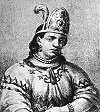 |
|
Spanish conqueror Hernán Cortés in his first meetings with representatives of Moctezuma. She was taken as a slave probably around the age of 10-12 and later given
to Cortés. She was subsequently baptized by his padre as Marina. The Mexicans refer to her as Doña Marina and
the Aztecs called her La Malinche. She apparently also was his mistress and gave birth to Cortés's first son, Martin. Cortés was often called Malinche
which William Prescott in his seminal 1843 work The Conquest of Mexico translated as Captain, and La Malinche could have been taken to
mean "the Captain's |
woman." The history of this period is complicated and La Malinche's personal reputation has varied from contemptuous to sympathetic. Although she has been reviled as a traitor to her people, it would appear that she saved thousands of Aztec lives by enabling Cortés to negotiate rather than just slaughter. Human sacrifice and cannibalism were also being practiced and La Malinche's ability to communicate furthered the introduction of Christianity which helped to reduce these practices. The genus Marina was published by Frederik Michael Liebmann in 1853.
-
marinen'se/marinen'sis: named for Marin County.
-
maripo'sa: Spanish for "butterfly" or relating to the town
of Mariposa which is in the Sierras where this taxon is said to be
located? One flora lists it as growing in Kings River Canyon which
is in the same general vicinity. Although there are several taxa in California that use a variant of this epithet such as are listed in the next entry, the only one that has this particular epithet is Arctostaphylos viscida ssp. mariposa, commonly called white-leaved or Mariposa manzanita, which inhabits yellow pine forest in the Sierras Nevadas and ranges from El Dorado County to Kern County.
-
maripos'ae/mariposa'na/mariposa'nus: of or from Mariposa County.
-
mari'tima/mari'timum/marit'imus:
growing by the sea, maritime, from Latin maritimus, "of the sea."
-
marmora'ta/marmora'tum: marbled, mottled, from the Latin marmor, "marble."
-
marmoren'se/marmoren'sis: from the Latin marmor, "marble" and marmoratus, "marbled," and -ensis, a Latin
adjectival suffix used to indicate country of origin, place of growth
or habitat. The common name of Silene marmorensis is Marble Mountain campion, and Sedum marmorense is Marble Mountain stonecrop.
-
marocca'na: of or from Morocco.
-
marrubio'ides: like genus Marrubium.
-
Marru'bium: based on an ancient Hebrew word
meaning "bitter," this was the classical Latin name for
a familiar cough remedy. The genus Marrubium was published in 1753 by Carl Linnaeus.
-
marshal'lii: named for Carl Coren Marshall (1852-1929), a school teacher,
author and publisher of textbooks on bookkeeping, business English
and commercial arithmetic, and an amateur botanist. The following is quoted from an obituary
in the Arcata Union 10 Oct. 1929: "Carl Marshall, prominent
early-day Humboldt educator, died at his home in Tujunga Sunday after
a heart attack. Mr. Marshall was an instructor in the old Eureka Academy
at Fifth and K streets after he came to Eureka more than 40 years
ago. He also taught school in Arcata. When the old academy burned
in 1893 Marshall became part proprietor of Eureka Business college,
now operated by J. J. Craddock. Later he went to Battle Creek, Michigan,
and was connected with educational journals in the east. Marshall
later returned to Ettersburg in Humboldt county where he made his
home for many years and devoted much time to botany, his hobby. At
Ettersburg he had a fine opportunity to study many wild flowers. He
was also in charge of a school on the Klamath and wrote many entertaining
newspaper articles about that section. In addition to his widow he leaves two sons and three daughters."
-
marsh'ii: named for Vernon Leroy Marsh (1906-1995), author of A Taxonomic
Revision of the Genus Poa of the United States and Southern Canada.
He was born in Ottawa, Kansas, and died near Olympia, Washington. It appears
that he was interested in both plants and birds and wrote on both
subjects. He seems to have specialized in grasses, and may have been
a botanist with the US Department of Agriculture. He married Mary Elizabeth Wright in 1929. He is listed in JSTOR as a co-collector of American botanist Fred Alexander Barkley and Charles Leo Hitchcock.
-
Marsil'ea: named for the Italian soldier,
botanist, geographer, and naturalist Luigi Ferdinando, Count de Marsigli
 |
|
(sometimes referred to as L.F. Marsili or L.F. Marsigli)
(1658-1730). The following is quoted from the Catholic
Encyclopedia: "Count Luigi Ferdinando Marsigli (Lat. Marsilius,
1658-1730), was a member of an old patrician family and was educated
in accordance with his rank. He supplemented his training by studying
mathematics, anatomy, and natural history with the best teachers,
and by personal observations. As a soldier he was sent by the Republic
of Venice to Constantinople in 1679. There he investigated the condition
of the Turkish forces, while at the same time he observed |
the surroundings of the Thracian Bosporus. Both of these matters were fully reported
by him. In 1680, when the Turks threatened to invade Hungary, he offered
his services to the Emperor Leopold. On 2 July, 1683 (the feast of
the Visitation), he fell wounded and was taken prisoner. He suffered
as a slave until he was ransomed on 25 March, 1684 (the feast of the
Annunciation). His reflections on these two feast days show his great
piety: on these days, he says, on which the august protectress of
the faithful is particularly honored, she obtained for him two graces:
salutary punishment for his past faults and an end to his punishment.
After the long war he was employed to arrange the boundaries between
the Venetian Republic, Turkey, and the Empire. During the war of the
Spanish Succession he was second in command under Count d'Arco at
the fortress of Breisach, which surrendered in 1703. Count d'Arco
was beheaded because he was found guilty of capitulating before it
was necessary, while Marsigli was stripped of all honors and commissions,
and his sword was broken over him. His appeals to the emperor were
in vain. Public opinion, however, acquitted him later of the charge
of neglect or ignorance. In the midst of his work as a soldier he
had always found enough leisure to devote to his favorite scientific
pursuits. He drew plans, made astronomical observations, measured
the speed and size of rivers, studied the products, the mines, the
birds, fishes, and fossils of every land he visited, and also collected
specimens of every kind, instruments, models, antiquities, etc. Finally
he returned to Bologna and presented his entire collection to the
Senate of Bologna in 1712. There he founded his Institute of
Sciences and Arts, which was formally opened in 1715. Six professors
were put in charge of the different divisions of the institute. Later
he established a printing-house furnished with the best types for
Latin, Greek, Hebrew, and Arabic. This was put in charge of the Dominicans,
and placed under the patronage of St. Thomas Aquinas. In 1727 he added
to his other collections East India material which he collected in
England and Holland. A solemn procession of the institute he founded
was ordered for every twenty-five years on the feast of the Annunciation.
In 1715 he was named foreign associate of the Paris Academy of Sciences;
he was also a member of the Royal Society of London, and of Montpellier.
His principal works are the following: Osservazioni interne
al Bosforo Tracio (Rome, 1681); Histoire physique de la
mer, translated by Leclerc (Amsterdam, 1725); Danubius
Pannonico-mysicus, observationibus, etc. (7 vols., Hague, 1726), and
L'Etat militaire de l'empire ottoman (Amsterdam, 1732)."
The genus Marsilea was published by Carl Linnaeus in 1753.
-
martia'na: named for Carl Friedrich Philipp von Martius (1794-1868), a German naturalist, botanist and explorer. He was born at Erlangen and his father was a court apothecary. He received a PhD from Erlangen University in 1814 where he had studied medicine, and he was also a student at the Royal Bavarian Academy. In 1817 he and Johann Baptist von Spix were sent to Brazil by Maximilian I Joseph, the king of Bavaria. He spent several years there exploring significant parts of the country and returning to Europe in 1820 to present the Munich Herbarium with 6,500 plant species. He was appointed as keeper of the botanic garden at Munich, including the herbarium. In 1826 he also became professor of botany at the University of Munich, and held both positions until 1864. The majority of his attention was devoted to the flora of Brazil and two major finely illustrated works, Nova Genera et Species Plantarum Brasiliensium published in three columes from 1823 to 1832, and Icones selectae Plantarum Cryptogamicarum Brasiliensium published in 1827, covered that subject. In 1840 he began his most consequential project, the fifteen-volume Flora Brasiliensis, with distinguished European botanists providing monographs of the various orders. This project was carried on for many years after his death by A. W. Eichler and Ignatz Urban. He published in addition works on the zoological collections carried out in Brazil and on the aboriginal populations there. He also published a major work on the palm family entitled Historia naturalis palmarum describing all known genera of the palm family which was published over the period 1823 to 1850, and a work entitled Die Kartoffel-Epidemie (1842), a study of the potato plague in Europe. In 1837, he was elected a foreign member of the Royal Swedish Academy of Sciences. He died at Munich.
-
martindal'ei: named for Isaac Comly Martindale (1842-1893), an American botanist and banker of Camden, N.J. who became an expert on the flora of the New Jersey Pine Barrens. He was born in Pennsylvania and grew up as a Quaker. He collected in his own area from a young age and began collecting in Europe, particularly Scotland and Switzerland, after traveling there because of a mystery illness. During the 1870s he traveled extensively in the United States, collecting plants in Vermont, Missouri, Illinois, Colorado, Virginia and Tennessee. At the time of his death, his collection was acquired by the Philadelphia College of Pharmacy and Science. All the time he was doing these things he worked as a clerk and cashier for the National State Bank of Camden, New Jersey, and then at the Camden National Bank in South Camden. He was a member of the American Philosophical Society in Philadelphia and was treasurer of the Academy of Natural Sciences of Philadelphia for several years. He "brought together a vast herbarium, reputed to be one of the largest private herbaria amassed in this country during the 19th century. After he died, the Martindale Collection was sold in 1894 to the Philadelphia Academy of Science and in 1964 was purchased by the United States Department of Agriculture for the National Arboretum. This collection includes approximately 80,000 specimens, plus eleven bound volumes of exsiccatae , notebooks, and a few letters. It represents both Martindale's work and that of over 900 other collectors spanning a time from the 1790s to the early 1890s." (from a website of the Herbarium of the United States National Arboretum) The size of his herbarium was said to be exceeded only by that of George Engelmann.
-
martinia'na: named for William Paxman Martin (1912-1991), a plant photographer and field companion of 20th century botanist Lyman David Benson. He was born in American Fork, Utah, and did his undergraduate work at Brigham Young University, receiving an AB degree in 1934, an MS from Iowa State College in 1936, and a PhD in soil biology in 1937. He was an assistant soil microbiologist at the University of Arizona Agricultural Experimental Station in 1940. He was vice-president of the Soil Science Society of America and professor and head of the Department of Soil Science at the University of Minnesota. He died in Tucson.
-
martin'ii: David Hollombe
reports that this name refers to Martin's Camp in the San Gabriel
Mountains, located in the saddle between Mt. Wilson (then called Wilson's
Peak) and Mt. Harvard, originally begun around 1889 by a young Pasadena
restauranteur named Peter Steil. Steil sold the camp to Clarence Sinclair
Martin in 1891 and it was henceforth called Martin's Camp. Martin
(1852-1911) was a former printer from Boston who later rebuilt Switzer's
Camp in the Arroyo Seco in 1905 and ran it until his death.
-
Martynia'ceae: named for John Martyn (1699-1768), a British botanist born in London. He was schooled early near
 |
|
his home and went to work for his merchant father when he turned 16. He turned away however from a business path to one involving medicine and botany. An acquaintance with an apothecary triggered an interest in botany. In the 1720s he was working as an apothecary and introduced the plants valerian and black currants and the use of peppermint water into pharmaceutical practice. The first edition of his Historia plantarum rariorum (1728) described and illustrated English plants. He was essentially self-taught in botany, and in 1721 and 1726 he gave some botanical lectures in |
London. Shortly thereafter he was elected a fellow of the Royal Society of London. In 1732 he was appointed professor of botany at Cambridge University and in 1768 resigned in favor of his son Thomas and presented the University with a number of his botanical specimens and books. Although never having received a medical degree, he practiced for many years as a physician in Chelsea. He is best known for his Historia Plantarum Rariorum (1728–1737), illustrated by Jacob van Huysum, and his translation, with valuable agricultural and botanical notes, of the Eclogues (1749) and Georgics (1741) of Virgil. His son Thomas was also an eminent botanist, an ordained deacon, a university professor and author of Flora rustica, published in 4 volumes, and Plantæ Cantabrigiensis (1763). His professorship at the University lasted 63 years. John Martyn died at Chelsea in 1768. His name is on the family Martyniaceae published by Paul Fedorowitsch Horaninow and the genus Martynia.
-
marvin'ii: named for Cornelius James Marvin (1888-1944), a chemist and
amateur photographer. The following is from an obituary in the Pasadena
Post 28 April 1944: He was "assistant manager of the Du Pont
plant in El Monte. Since his graduation from the University of Colorado
in 1913, he had been with that company, and for the past 25 years
he specialized in the chemical engineering field. A leader in civic
and cultural activities, Mr. Marvin played in the first violin section
of the Pasadena Civic Orchestra, pioneered in the field of color photography
and was recognized for his outstanding reproductions of rare flowers.
An active member of the American Chemical Society for the past 20
years, he was a member and director of the South Pasadena Oneonta
Club." 'Oneonta' is a native American name meaning 'place of peace,' It is a town name in New York where Henry Huntington had his home. Mr. Huntington brought the name with him when he moved to California. The club which was formed in 1923 is still in existence 101 years later.
-
mason'ii: named for Herbert Louis Mason (1896-1994), a professor of botany
at Berkeley. The following is quoted
 |
|
from a memorium essay by Lincoln
Constance and Robert Orduff: "Herbert Mason joined the
Berkeley department of botany in 1925, and served there continuously
until his retirement in 1963, the last twenty-two years as professor
of botany and director of the herbarium. He was born in Fond du Lac,
Wisconsin, on January 3, 1896, one of a pair of identical twins who
were the eighth and ninth children of Thomas and Harriet Mason. His
interest in botany was developed as a child through his mother's enthusiasm
for gardening and her informal teaching about plant life. The twins |
entered Stanford University from high school, but volunteered for
World War I, and were stationed at an army hospital at Beaune, France.
Returning to Stanford after the war, Herbert received the AB in
1921. He obtained an MA from Berkeley in 1923, and then taught during
1923-1925 at Mills College, an institution for which he retained a
life-long affection. Summers, he worked for the Carnegie Institution
of Washington, first assisting in Frederick E. Clements' altitudinal transplanting
program in Colorado (subsequently transferred to California) and later
hunting fossils in the John Day formation of Central Oregon with R.W.
Chaney. Mason's initial appointment at Berkeley was that of an associate
in W. L. Jepson's Phenogamic Laboratory, where he acted as a back-up
for Jepson's instructional duties, in view of Jepson's failing health.
In 1931, Mason married Lucile Roush, a fellow Stanford graduate and
Berkeley graduate student who was working on coralline algae with
W.A. Setchell, and was in charge of elementary laboratories. Both
Herbert and Lucile were awarded the PhD degree the following year.
His thesis, which dealt with western American Tertiary paleobotany,
was administered by a committee comprising Willis Linn Jepson (chairman),
Ralph Works Chaney, and C.L. Camp. Mason was named instructor and assistant
curator in the herbarium in 1933, assistant professor and associate
curator in 1934, associate professor and curator in 1938, and professor
and director in 1941, the position he held until attaining emeritus
status in 1963. Mason's teaching responsibilities and research interests
were closely intertwined and nourished each other. He published a
substantial number of papers either alone or in association with Chaney
on the Tertiary history of western American coniferous trees, particularly
the so-called "closed-cone" pines. He was very knowledgeable
concerning living western floras, but his most ambitious taxonomic
work was his masterly treatment, in association with Alva Day Grant,
of the Polemoniaceae (Phlox family) in Abrams' Illustrated Flora of
the Pacific States. Although a self-professed taxonomist, Mason was
always more interested in the causes underlying plant evolution and
distribution, both past and present, than he was in details of classification.
His efforts shifted more and more to what he termed 'plant geography'
to distinguish it from the then mainstream plant ecology, which was
for many years dominated by the ideas and overblown terminology of
F.E. Clements. Mason stressed the direct relationship of environmental
factors to the varied tolerance capacities of the plants comprising
a given community, and rejected the almost organismal interpretation
of 'associations,' 'climaxes,' and other phytosociological
abstractions. One of his most productive accomplishments was the isolation
of the role of soil minerals in the development and restricted distribution
of plants on California's rich serpentine deposits. Jenny, Vlamis,
and Walker were inspired to investigate the physiological basis of
serpentine tolerance, while Kruckeberg and McMillan explored the genecological
basis of plant response to serpentine soils. Mason was a particularly
effective critic in the ecological field, where his influence was
often considerable, as on the organization and content of Stanley
Cain's landmark Foundations of Plant Geography, and in the
writings of R. H. Whittaker. In 1949 and 1950, Mason joined A. H.
Miller and R. A. Stirton in an expedition to the Magdalena Basin of
Colombia, sponsored by the Associates in Tropical Biogeography. The
objective was to study periodic phenomena under tropical conditions
without marked seasons; we assume that the results with respect to
plants were inconclusive. The State Division of Fish and Game commissioned
a botanical survey of California wetlands carried out by Mason and
his graduate students. It culminated in the production of A Flora
of the Marshes of California (1957), doubtless his best-known
work. Throughout his career, but more prominently in his later years,
Mason became interested in various theoretical and philosophical issues.
As editor of Madroño, Journal of the California Botanical Society,
he served as director of this project, which he found richly rewarding,
and which has had an important impact on science education in the
United States. Mason was affiliated with a number of professional
and conservation organizations during his career, and served as president
of the Western Society of Naturalists, the Western Section of the
Ecological Society of America, the Regional Parks Association, the
California Botanical Society, and the American Society of Plant Taxonomists.
The Masons, famous for their hospitality, were continuously involved
with students, colleagues, and long-time friends. Shortly after his
retirement, they moved to Bellingham, Washington, to be near their
son, David, a professor in Fairhaven College of Western Washington
University. Lucile Mason died in 1986." Herbert Mason was the
namer of Linanthus killipii. (Photo credit: Chrono-Biological Sketches)
-
Matele'a: David Hollombe contributes the following:
"Aublet did not explain Matelea and it is assumed it was a name
of the plant in some native language in French Guiana. Aublet collected
a lot of information on the uses of plants by native and other groups.
Often, when he shortened or modified a native name to name a new genus
he listed the original word, but he left many others unexplained."
The Aublet he refers to was French botanist Jean Baptiste Christophore
Fuséé Aublet (1720-1778) who was the first European
to document the flora of French Guiana and was the author in 1775
of Histoire des Plantes de la Guiane Francoise and the genus name Matelea, which is called milkvine or spinypod.
-
math'ewsii: possibly named for Ferdinand Schyler Mathews (1854-1938), an American botanist, artist and prolific author of more than a dozen books including Familiar Flowers of Field and Garden, The Fieldbook of American Wild Flowers, and The Fieldbook of Trees and Shrubs. He was born in Staten Island, New York, and died at Campton, New Hampshire. He was educated at public schools and at the Cooper Institute, New York, and other institutions, and traveled in Italy for art education. For someone who wrote so many books, there almost nothing available about him to be found on the internet. The author, John Kunkel Small, did not indicate for whom it was named, but it was published in 1933 which would fit. The species here is Chamaesyce matthewsii.
-
mathews'ii: named for William Charles Matthews (1890-1980?). Born in Mendocina, California and died at Yountville, California. He was a forestry student at UC, and later worked in the lumber industry. He was in the US Navy in WWII. He collected the type specimen of Amsinckia mathewsii at Ft. Bragg in 1914.
-
mathias'iae: named for Dr. Mildred Esther Mathias (1906-1995), a plant taxonomist
and naturalist. "Mildred Esther Mathias was born on September
19, 1906, in Sappington, Missouri, then a rural truck farming area
just south of St. Louis. Her father, Oliver John Mathias, was a teacher,
and the family moved around eastern Missouri, to Cape Girardeau, Ste.
Genevieve, Festus, and Desloge, as Mildred was growing up. She showed
an early interest in nature and gardening and a love to learn. In
Desloge, where her father was school superintendent, Mildred graduated
from high school in the class of 1923 and presented the valedictory
address. Remarkably, while still a senior in high school, she was
the first student to enroll at the nearby, newly established Junior
College of Flat River; each day Mildred attended her high school typing
class at 7:00 a.m. before catching a train to college. That intensity
to learn never changed. Mildred transferred to the State Teachers
College in Cape Girardeau, and then registered in fall, 1923, at Washington
University in St. Louis. Her family relocated to St. Louis so that
Mildred could live at home while attending WU. There Mildred majored
in mathematics until her junior year, but switched to botany when
classes for her major were unavailable, and when the dean of engineering
would not give permission to a woman to take a math course in his
male-only college. Fortunately, Mildred was soon hooked on botany,
and at Washington University earned the AB (1926), MA (1927) and
PhD (1929) while conducting her graduate research at the Missouri
Botanical Garden. For her doctoral dissertation, Mildred Mathias,
at the age of 22, produced a very fine taxonomic monograph on Cymopterus and relatives of the carrot family (Umbelliferae). New World umbellifer
genera and species then were poorly defined and she was set to change
all that. During the summer of 1929, Mildred, in her Model T Ford,
which she could repair herself, and with two female companions, traveled
across the western United States to visit numerous populations and
type localities of Umbelliferae. After marrying Gerald L. Hassler,
a PhD in physics, in Philadelphia on August 30, 1930, Mildred carried
on independent research on the umbellifers during various research
appointments, often without pay. In 1939, Dr. Lincoln Constance at
the University of California, Berkeley, joined in the study, and from
1940 to 1981 they published together more than 60 scientific papers
on Umbelliferae of the New World, including descriptions of about
100 new species, hundreds of new combinations, and several new genera.
In 1954, an umbellifer from northeastern Mexico was named as the genus Mathiasella in her honor. Her expertise on umbellifers earned
her early international recognition in taxonomy, and in 1964 she was
elected as the first woman president of the American Society of Plant
Taxonomists. In 1944, the Hasslers permanently settled in southern
California. Mildred, now mother of four, was pleased to accept a staff
position at UCLA in fall, 1947, as herbarium botanist, under the supervision
of professor Carl Epling. In 1951, that position was elevated to lecturer,
so that her talents could be utilized to teach plant taxonomy, and
four years later Dr. Mathias was appointed as assistant professor
in the department of botany, one of very few women who then held a
faculty position at UCLA, and vice-chair of the department. As a 'young'
assistant professor, she took her first trip outside the US in 1958,
to Baja California, with an energetic UCLA botany graduate student
named Peter H. Raven. 1951 was the year that Mildred Mathias published
her first articles on California horticulture. She with several other
horticulturists began introducing nurseries and gardeners to a diverse
palette of botanically interesting and nonconventional subtropical
plants that would thrive in coastal and desert southern California.
The quality of landscape planting in Los Angeles improved immensely
thereafter, and the UCLA campus was converted into an arboretum of
exotic trees. She published and spoke often on the importance of correct
scientific identification and nomenclature of horticultural materials,
and her educational exhibits at garden shows won awards. In 1956,
Mildred Mathias was appointed director of the botanical garden, and
served as such until retirement in 1974, providing tireless service
to horticultural organizations in California and around the world,
as well as generating a huge following of landscapers and amateur
gardeners plus admiration from public and private gardens throughout
the world. Her professional career took a major turn from 1959 to
1964, when Mathias joined Dermot Taylor, chair of pharmacology at
UCLA, to collect and screen plants of tropical forests for new medicines.
She made expeditions to Amazonian Peru and Ecuador, Tanganyika, and
Zanzibar, and was able to learn about drug plants from native herbalists
and medicine men. This was when the field of ethnopharmacology was
in its infancy. Her pioneering efforts in the tropics earned the great
admiration of her colleagues and led to her selection as UCLA Medical
Auxiliary Woman of Science Award (1963), and weighed heavily in selecting
Mildred Mathias as one of twelve Women of the Year (1964) by the Los
Angeles Times. UCLA Chancellor Franklin D. Murphy called her 'one
of the great ladies of this campus.' Since her early research
days, Mildred Mathias appreciated natural areas in California, and
that interest grew at UCLA. Her earliest successful conservation effort
(1957) helped to establish Rancho Las Tunas in San Gabriel as a state
park. She used her influence to save historic oaks, and assumed leadership
in the southern California chapter of The Nature Conservancy. For
such local achievements, she received the Merit Award of the California
Conservation Council (1962) and The Nature Conservancy National Award
(1964). During the early 1960s Mildred Mathias, with several other
professors, worked diligently to establish the UC Natural Land and
Water Reserves System, now called the Natural Reserve System, whereby
important parcels of undisturbed California habitats could be acquired
and managed by UC for university teaching and research. These visionaries
helped this to become a national model for conserving natural ecosystems.
She was great at taking people on hikes through natural areas and
converting them to the cause, and a personal achievement was her conservation
effort on Santa Cruz Island, California. Mildred served as chair of
the university-wide advisory committee for 22 years, and along the
way held many other positions of leadership on advisory boards for
other conservation programs. In 1963, Mildred Mathias was speaking
critically about careless destruction of tropical forests, which are
where ;many promising drugs from plants are being lost for all
time.' She turned to the tropics, and became a major conservation
voice in the establishment of the Organization for Tropical Studies,
formed to obtain protected field sites for conducting scientific research
in the tropics. For her dedication, Mildred Mathias was chosen as
president of OTS from 1969 to 1970, and was a critical leader during
its first ten years of existence, when funding was very precarious.
She was the motivator to incorporate botanical gardens of Costa Rica
in the master plan for OTS, and helped to formalize Las Cruces Biological
Station. Beginning in the mid-1960s, demand for Mildred's time increased
dramatically as she willingly and enthusiastically served as an officer
for or on advisory boards of numerous horticultural programs. She
once wrote, 'life is a series of intermittent meetings.'
But from those long hours in board rooms and airplane cabins came
many achievements in horticulture. Among awards, she received the
American Horticultural Society Scientific Citation (1974), the Award
of Merit by the American Association of Botanical Gardens and Arboreta
(1976), the Liberty Hyde Bailey Medal (1980), awarded to an outstanding
horticulturist who has made a contribution in the fields of research
and education, the Medal of Honor from the Garden Club of America
(1982), and the Charles Lawrence Hutchinson Medal of the Chicago Horticultural
Society (1988). At UC her contributions were honored in 1979 by naming
the Mildred E. Mathias Botanical Garden on the Westwood campus. She
was also the first executive director of the Association of American
Botanical Gardens and Arboreta (1977 to 1981), which under her watch
created a certification program in horticulture that linked universities
with hands-on training at a network of horticultural gardens. Her
career of botanical accomplishments led to her receiving the Botanical
Society of America Merit Award in 1973 and being elected president
in 1984. Similarly, her interests in ethnopharmacology were rewarded
when in 1993 she was named Distinguished Economic Botanist by the
Society of Economic Botany. When she retired in 1974, UCLA Extension
persuaded Mildred Mathias to lead a natural history trip to Costa
Rica. At that time tours to Costa Rica were mostly limited to a stop
in San José and a trip up the volcano, but she led the first
group of amateurs into the field for an experience they would value
forever. Thereafter, Mildred Mathias had a new career, tour guide
for adult education, and her stamina in the field was respected and
renowned. Annually she visited Costa Rica and the Peruvian Amazon,
and she immersed her adult students in native culture as well as all
aspects of tropical biology and geography. Such tours are now a major
source of foreign money in the country, so-called 'ecotourism.'
La Selva Biological Station was a standard stop on her tours, and
while visiting there Mildred entreated tropical biologists to give
lectures to the adults on current research. Since 1974 she led 53
groups, with a thousand participants, to foreign natural areas, gardens,
and musea to more than 30 countries. Her most recent tour, at the
age of 88, was in November, 1994, to Chile, and before her death on
February 16, 1995, resulting from a stroke suffered gardening at home
in Westwood, she had scheduled group trips again to Costa Rica and
the Amazon in 1995. Many organizations-national, statewide, local,
and campus--that now are very successful and important have credited
Mildred Mathias as having played pivotal leadership roles in the early
years. This is a major reason why she had such a huge and loyal following
of admirers. Above that, she befriended all age groups, and welcomed
anybody seeking knowledge from her. Mildred Mathias never lost purpose
or direction, certainly never lost her enthusiasm and energy, and
freely expressed her appreciation for humor in any situation. This
very special person left a remarkable legacy of botanical and conservation
achievements and a wide trail of friendships around the globe."
(From the website of the Mildred
E. Mathias Botanical Garden at UCLA)
-
Matricar'ia: from the Latin matrix, "the womb,"
the plant once having been used as a cure for female disorders. The genus Matricaria was published by Carl Linnaeus in 1753.
-
matricario'ides: like genus Matricaria, the false chamomile.
-
matrona'lis: relating to March 1st, the Roman festival of the matrons
or married ladies.
-
mat'sonii: named for Gary Maurits Matson (1949-1999) who with Winfield Mowder was murdered by white supremacist brothers Benjamin Matthew Williams and James Tyler Williams because they were a gay couple. Matson earned a master of science degree in environmental horticulture from UC Davis in 1984 and with his partner founded Matson Horticulture and Florabundance Nursery in Redding. Matson also helped found the Redding Farmers Market, the Carter House Natural Science Museum, and the Redding Arboretum. An obituary by Marcia Howe, Don Burk, and Vivian Parker of the CNPS Shasta Chapter on the Find-a-Grave website says: “Gary was a charter member of the Shasta Chapter, joining CNPS in 1983. He was a visionary whose energy and enthusiasm were inspired by a deep knowledge and love of nature, especially the plant kingdom. He was an insightful observer of the world. He approached the City of Redding and obtained authorization to develop an arboretum on ten acres of city-owned land at Turtle Bay. The arboretum became a reality in 1991 under the sponsorship of the Shasta Natural Science Association/Carter House Science Museum. After many years of volunteer labor, Gary was employed as the first horticulturist at this beautiful riverside arboretum at Turtle Bay. By 1997 he had moved on to create Plantstogo.com, an online nursery specializing in plants for hot climates. Throughout his life Gary was a teacher. Besides his popular classes at Shasta College, he led hundreds of field trips and nature walks. As a volunteer and as a staff member at the arboretum, he taught numerous plant classes in identification, uses of plants, and native plant culture. Just being with Gary was a learning experience. Working alongside arboretum volunteers, he would teach them the nuances of plant propagation. Going on a casual hike with him was an adventure; inevitably one would learn something new. He was a teacher at all levels. For many years he made time to roam the Trinity Alps with a noted Dutch botanist. He maintained correspondence with plant specialists all over the world, and his expertise was sought by many horticultural and botanical professionals in the region. One of his unfinished projects was a field guide to the native flora of the area. The wealth of knowledge that Gary brought to our chapter plant sales is irreplaceable. And it is true; Gary's mind was wide-ranging; he read technical books and periodicals voraciously. But in addition to his vision and sharp mind, he had a warm-hearted, humorous, and down-to-earth quality that made him a natural teacher. He had a gift for making the love of plants accessible to all. Gary's community activities and accomplishments are immense. His roots ran deep in the Redding area, and his actions have made this a better place to live. Gary, we will forever miss you and your boundless enthusiasm, your vision, your community spirit, and your friendship.” Gary Matson and Winfield Mowder were together as a couple for 14 years. They lived in Happy Valley, California, just outside Redding. Mowder, 40, held a bachelor of science degree in anthropology and worked part-time as an associate in Orchard Supply Hardware's garden department, while also attending Chico State University. He frequently spoke at local high schools, serving as a source of knowledge and support for both gay and straight teens. The Williams brothers also committed arson attacks against synagogues and clinics. Matthew Williams committed suicide in prison and Tyler Williams was sentenced to 29 years for the murders and 21 years for the arson attacks. (Brodiaea matsonii)
-
mat'sonii: named for Randolph Matson (1904-2002), an electrical engineer with the aircraft industry who was born in Tacoma, Washington. His interest in avocados began in 1942 when the Douglas Aircraft Company transferred him from California to its Oklahoma City plant and he invested the proceeds of the sale of his Sherman Oaks home in an avocado ranch in Vista, California. Randolph, in 1948, following a downturn in the aircraft industry, moved his family to the avocado orchard in San Diego County. When he subsequently discovered diseased trees in his orchard, he began studying the problem and focused on Phytophthora cinnamomi, a soil-borne water mould that causes avocado root rot. He began working with Dr. George Zentmyer and others on the staff of the University of California at Riverside, and wrote a series of articles for Avocado Growers magazine. He was a member of the Research Committee of the California Avocado Commission and in 1981 was given an award of honor by the California Avocado Society. (Dudleya matsonii)
-
matson'ii: named for Steve Scott Matson (1953- ), amateur but highly experienced and knowledgeable botanist and superb photographer, and member of the Tahoe and Bristlecone Chapters of California Native Plant Society, serving as president of the Tahoe Chapter for a decade. He was born in Pasadena and grew up in various places around California before settling in Lake Tahoe in 1975. He attended Sierra Nevada College from 1975 to 1979 and was a graduate student in the philosophy department at UC Santa Barbara from 1983 to 1986. He became a building contractor, specializing in plumbing, electrical, and hydronic heating work, and developed a keen interest in plants in 1996. He has participated in over 50 Jepson Herbarium workshops and has been invariably generous in sharing his knowledge. He is especially skilled at photographing the diagnostic features of plants necessary for identification, and is always eager to learn about new plants. He currently spends much of his time in his beloved Owens Valley where he and his wife Eileen Burger have a second home. He is also a super nice guy and the best kind of companion to have while looking for wildflowers. (Nemacladus matsonii)
-
matthews'ii: named for Oliver Vin Matthews (1892-1979), “a classic nineteenth-century botanizer who was fanatically devoted to the study of Oregon's trees. The self-taught dendrologist and self-described 'botanical tramp' spent much of his free time driving around Oregon in his Model-A Ford, 'Old Henry,' in a search for all of state's trees, preferably the biggest and the best. Matthews's father, James T. Matthews (1864-1942), was an influential and popular professor of mathematics at Willamette University. The younger Matthews had no formal training as a botanist, and he never married. [He] served in Europe during World War I and then worked as a carpenter and an extra in the silent film industry in Hollywood. He returned to Oregon in 1928 and, except for seasonal work as a carpenter and in a Salem cannery, devoted the rest of his life to the study of Oregon's trees. His great botanical, social, and historical legacy is the large collection of his photographs, scrapbooks, and field notes held in the Oregon State University Archives. Matthews left a remarkable collection of meticulous, typewritten field notes, letters—filled with HOORAYs and exclamation marks—that ended with an increasingly large signature as his eyesight failed. He was an accomplished photographer of trees and landscapes, and most of his images are safely sequestered in the archives, along with forty-one numbered scrapbooks and extensive field trip logbooks. His scrapbooks contain everything from bills and bus tickets to letters and photographs. His letters include extensive correspondence with herbaria, state and national forest services, newspapers, and individuals. He collected hundreds of wood specimens, discovered a new cypress that bears his name, and extended the known geographical range of several trees. He also contributed extensive botanical specimens to many herbaria and located, measured, and documented the largest specimens of many trees, including Douglas fir and weeping spruce. Oliver Matthews was largely responsible for the establishment of the Miller Lake Botanical Area of the Rogue/Siskiyou National Forest. The area is at the center of Matthews’s 'Miller Lake Magic Circle,' which is twelve miles in diameter and includes eighteen species of conifers. The establishment of the botanical area was a fitting tribute to a remarkable botanical tramp." (Quoted from The Oregon Encyclopedia) (Cupressus bakeri ssp. matthewsii)
-
matth'ewsii: named for Dr. Washington Matthews (1843-1905) of the US Army who was stationed in the Owens
 |
|
Valley of California in 1875. He was an Irish-born surgeon, ethnographer, anthropologist and linguist known for his studies of the Navajo language and that of other native Americans. He was born near Dublin. After his mother died, his father took him and his brother to the United States, and he grew up in Wisconsin and Iowa. His father, who was a physician, gave his son some early training in medicine, and the younger Matthews continued along that line, graduating from the University of Iowa with a medical degree in 1864. Matthews volunteered for the Union Army |
where he served as a physician tending to Confederate prisoners. After being posted to Montana in 1865, his interest in native languages began. He served at a number of forts in the Dakota Territory until 1872. He was not merely interested in studying language including grammar and vocabulary, but in the larger sphere of ethnography. It has been suggested that he married and had a son with a Hidatsa woman, but that has not been established for certain. He participated in an expedition against the Nez Perce in 1877 and then worked at a prison on Alcatraz Island, finally being posted to the Army Medical Museum in Washington, D.C. from 1884 to 1890. At the suggestion of John Wesley Powell, he was assigned to Fort Wingate near Gallup, New Mexico, where he was introduced to the people who became the subject of his most imprtant work, the Navajo. He wrote numerous books and articles about native American culture, especially about the Navajo. ( Galium matthewsii, Loeseliastrum matthewsii)
-
Matthio'la: named for Pietro (Pier) Andrea Gregorio Mattioli (Matthiolus) (1500-1577), an Italian physician and
 |
|
naturalist. He was born in Siena, and received an MD from the University of Padua in 1523. He practiced medicine in Siena, Rome, Trento and Gorizia, becoming the personal physician to Archduke Ferdinand II of Austria and the Holy Roman Emperor Maximilian II in Vienna. He was the first person to identify cat allergy. Up until his time, other writers on botany had pretty much concerned themselves with those plants that had medical applications but he identified and described plants that had no such. His work entitled Discorsi ("Commentaries") on the Materia |
Medica of Dioscorides included woodcuts of highquality. He held a great deal of power as a result of his position as physician to rulers and used it to quench any disagreements with his pronouncements in the medical and botanical areas, and those who openly challenged him were often threatened by rebuke or pursued by the Inquisition. He carried on a practice of testing the qualities of poisonous plants on prisoners which was not uncommon in his day. He was a prolific author including De plantis epitome vtilissima with 30 editions, Petri Andreae Matthioli Senensis Medici Epistolarum Medicinalium Libri Quinque with 10 editions, Commentaires de M.P. André Matthiolus, medecin senois, sur les six livres de Pedacius Dioscoride, Anazarbeen De la matiere medicinale with 35 editions, and Il Magno Palazzo del Cardinale di Trento with 18 editions. The genus Matthiola was published by William Townsend Aiton 1in 1812.
-
Maurandel'la: the diminutive of Maurandya. The genus Maurandella was published by Werner Hugo Paul Rothmaler in 1943.
-
Maurand'ya: named for Dr. Catalina Pancratia
(Pancracia) Maurandy, a late 18th-century botany professor and physician at Cartagena,
Spain, a colleague of and married to Agustín Juan y Poveda, the director of the
Cartagena Botanic Garden. The genus Maurandya was published by Casimiro Gómez de Ortega in 1797.
-
mauritan'ica: of or from Mauritania, or more generally of North Africa,
particularly Morocco.
-
mauritian'um: while this name often means "relating to Mauritius
in the Indian Ocean," it is uncertain how it was chosen for this
species since S. mauritianum is a native of tropical South
America. It is possible that the author, Giovanni Antonio Scopoli
(1723-1788), was mistaken as to its country of origin. There is a
genus Mauritia in South America, but that may be coincidental.
The suffix 'anum' or 'anus' is also used sometimes to convert a personal
name to an adjectival commemorative epithet to be attached to a generic
name that is masculine in gender, and that may have been the case
here. Anyone with any more definitive information about this is invited
to contact me.
-
mawea'nus: named for George Maw (1832-1912), a successful British businessman, traveler, tile manufacturer, author, antiquarian and polymath who brought together disciplines as vast as tile making, art ceramics, geology, chemistry, geology, botany, archeology, watercolor painting, and gardening. His major botanical achievement was the magnificent book which he wrote, illustrated and published, A Monograph of the Genus Crocus, the original paintings for which are now in the library of the Royal Botanic Gardens at Kew. He was born in London and was sent away to school at the Royal Agricultural College in Cirencester where he was trained in the art of encaustic tile manufacture. Encaustic tiles are ceramic tiles in which the pattern or figure on the surface is not a product of the glaze but of different colors of clay. George and his younger brother Arthur bought a tile and porcelain factory in 1850 from the Worcester Porcelain Company. Maw and Company produced various kinds of tiles that were exported all over the world, and also art pottery. Getting suitable clays was both difficult and expensive so in 1852 they transferred their business to Benthall near Ironbridge, and moved again, to purpose-built works at nearby Jackfield in 1883. He was an experienced plant-hunter and accompanied Sir Joseph Dalton Hooker on a plant-hunting exhibition to Morocco and the Atlas Mountains in 1871, and returned again on his own in 1873, investigating the geology of those countries. He also wrote on the geology of western England and northern Wales. Around 1860, George and his brother moved into a handsome 16th century house called Benthall Hall situated on a plateau above the gorge of the River Severn. While living there George created a magnificent garden and amassed 3,000-4,000 distinct species of plants, principally alpines, at the Hall. He became an expert on crocus and his monograph on that genus was considered the most complete of its kind. He spent ten years traveling over all of Europe and North Africa as far as the genus extended, collecting specimens and bulbs of every species that he grew at Benthall. He recorded mosaics at the excavations of Viroconium/Uriconium at Wroxeter near Shrewsbury in the 1860s, and these influenced his designs of Roman-style tiles. He wrote about the drift-deposits of the Valley of the Severn and became a fellow of the Geological Society in 1864. He was also a member of the Linnaean Society of London. Not being willing to fill his life only with botany, geology, archeology and manufacturing, he got married to Frederica Mary Brown in 1861 and fathered nine children. He gave up his business due to ill health in 1886, but lived an additional twenty-six years in retirement before dying at Kenley in Surrey.
-
Max'ia: named for Max Orjan Nilsson (1966- ), son of Swedish botanist Örjan Eric Gustaf Nilsson (1933-2021). Orjan was born in Norrkoping. He took his matriculation degree in Ulricehamn and then studied at Lund University . After being promoted to doctor of philosophy at Uppsala University in 1971 with the thesis "Studies in Montia L., Claytonia L. and allied genera: Taxonomy, morphology, pollen morphology, cytology, reproduction and distribution, he became a docent in botany there the same year and acting first garden superintendent at Uppsala University's botanical garden in 1974. He participated in Sweden's radio's Naturväktarna and authored Fotofloran (1969), Nordic mountain flora (1986) and Coastal flora (1992). He was also for a period from 1987 the Moderate Coalition Party's environmental policy spokesperson and a member of the party board. The only information I have about Max Nilsson is that he lives in Uppsala and is married to Monica Akerlind Nilsson and apparently has a sister named Åsa Nilsson Bjervner and a son named Caspar. The genus Maxia was published by Örjan Eric Gustaf Nilsson in 1967.
-
max'ima/max'imum: largest.
-
maximilia'ni: named for Maximilian Alexander Philipp von Wied-Neuwied (1782-1867), a German explorer, ethnol-
 |
|
ogist and naturalist. He was born in Neuwied in the Rhineland. His father was the ruling count Johann Friedrich Alexander. One of his mentors was Alexander von Humboldt. Maximilian joined the Prussian Army in 1800 and rose to the rank of Major. He was given a leave of absence from the army in 1815 and led an expedition to southeast Brazil in 1815-1817. Ill health caused him to change his route and then to abandon his expedition altogether. He then was improperly detained and robbed of much of his collection of insects and plants. In 1817 he returned to Germany and |
authored Reise nach Brasilien (1820–21) and Beiträge zur Naturgeschichte von Brasilien (1825–33). In 1832 he traveled to the great plains region of North America and ventured up the Missouri River with Swiss painter Karl Bodmer, writing Reise in das Innere Nord-Amerikas (1840) on his return. He recorded much information about the cultures of native peoples that he encountered, particularly the Mandan and Hidatsu, but also the Sioux, Assiniboine, Plains Cree, Gros Ventres and Blackfoot. Bodmer’s watercolor paintings were considered among the most accurate and informative ever made and many were used in Maximilian’s 1840 work. A large number of floral and faunal specimens are still preserved in natural history collections especially at the Lindenmuseum at Stuttgart. He was honored with the genus Neuwiedia and the species names of a number of plants and reptiles. In 1845, he was elected as a member of the American Philosophical Society. He died in Neuwied, the city of his birth.
-
maxon'ii: named for William Ralph Maxon (1877-1949), an American botanist and pteridologist who spent most of
 |
|
his career at the Smithsonian Institution, ending up as the curator of the division of plants. From Wikipedia: "Between 1903 and 1926 he undertook nine major expeditions to tropical America [Cuba, Jamaica and Central America] and worked in European herbaria in 1928 and 1930. He served repeatedly as president of the American Fern Society, and was editor-in-chief of its journal from 1933 until his death. He was awarded an honorary doctor of science degree from Syracuse University in 1921, and was elected to fellowship in the American Association for the Advance- |
ment of Science and the American Academy of Arts and Sciences." He was born in Oneida, New York, the son of a newspaper editor and owner. He graduated from Syracuse University in 1898 and completed that year as an assistant at the New York Botanical Garden where he studied ferns and then an aide in cryptogamic botany at the US National Museum in 1899. He was editor of the Journal of the Washington Academy of Sciences (1919-17). He built the national fern collection from almost nothing to 150,000 specimens. He was a founder and president from 1922 to 1924 of the Washington Biologists' Field Club and a member of the Botanical Society of Washington. Some 65 species of flowering plants were named for him and the generic name Maxonia, published in 1916 by Carl Frederik Albert Christensen.
-
May'tenus: derived from maiten, mayten or mayton,
a Chilean (Araucan) name for the type species Maytenus boaria. The genus Maytenus was published by Giovanni Ignazio Molina in 1782.
-
mazimpaka'na: named for Vicente Mazimpaka Nibarere (1948- ), a botanist on the faculty of science at the Universidad Autónoma de Madrid. He was born in Rwanda and was forced to leave his country with his family at the age of 13 due to civil strife and the persecution and genocide of the Tutsi people. He was in high school and began university studies in Burundi before arriving in Spain in 1970. With little command of Spanish, he entered the Colegio Mayor Nuestra Señora de África, in Madrid and began studies of biology. In 1975 he began as a doctoral student in the botany department where he investigated the vascular flora of the Alcarria region which resulted in his doctoral thesis. At some point, possibly that same year, he was hired as a botany professor. He spent 43 years with the Universidad Autónoma de Madrid and has taught general botany, fanerogamia (the study of seed plants), cryptogamy, geobotany, phylogeny and vegetative evolution and environmental impact assessment. He also taught doctoral seminars in Italy at the University of Catania and in France at the Muséum National d'Histoire Naturelle. In the field of research, professor Mazimpaka has dedicated more than forty years to botany, particularly to vascular plants and later to mosses, investigating taxonomy, phylogeny, ecology, biogeography, bryophytes of urban environments, and epiphytes. He was responsible for creating a substantial school of Spanish bryologists and published and reviewed many articles in prestigious botanical journals.
-
mckel'veyi: named for Susan Adams Delano McKelvey (Mrs. Charles Wylie McKelvey) (1883-1964), an American
 |
|
botanist and author, plant collector and cousin of Franklin D. Roosevelt and a descendent of the Adams of Braintree and the Bradfords of Plymouth. Originally a native of Philadelphia, Susan Magoun Delano moved with her family while still a child to New York where she entered and was a graduate in 1907 of Bryn Mawr College. By birth and upbringing a member of New York social elite, she married attorney Charles Wylie McKelvey in 1907. One of her two sons died during WWI and her husband was called away to Washington, D.C. Upon his return their marriage broke |
up and she fled to Boston, where her career as a botanist began when she approached professor Charles Sprague Sargent, the founding director of the Arnold Arboretum, about a volunteer job at the arboretum. She started by washing clay pots in the greenhouses, studying the plants on the grounds, took an interest in the lilac collection in particular, and for the next four and a half decades the arboretum became her home. She engaged in collecting expeditions to the western United States and published three scholarly works. In 1921 she and her surviving thirteen-year old son participated in a difficult five-week trip to Glacier National Park which had been established in 1910 and where little botanical work had taken place. She made another trip to the White Mountains of New Hampshire in July of the following year. From both collections she shipped around 200 specimens to Alice Eastwood at the California Academy of Sciences, initiating a long and fruitful relationship. Her developing interest in the lilac collection at the arboretum led to her making visits to lilac collections elsewhere in the US, Canada, Britain and France, and communicating with lilac growers and specialists also in Germany, Italy, Switzerland, the Netherlands and other countries. Her book based on these researches entitled The Lilac: A Monograph appeared in 1928, and was greatly praised in numerous scientific and horticultural journals. After Sargent’s death in 1927, her sights turned to the American southwest and she made eight trips there over the following eight years. Her first trip was spent in the company of Alice Eastwood, visiting New Mexico and Arizona, and by the end of 1928 had made over 400 collections and a lifelong friend. On her second trip taken from January to March, 1929, she became a devout yucca and agave enthusiast, and made a total of over 500 collections before returning to Boston, and Eastwood joined her again for her third trip later in the year. Her fourth excursion took her again to Arizona and New Mexico, but also to Nevada and California. It was during this trip that she finally was awarded a divorce from her husband, from whom she had been separated, and during the drive east visited the Missouri Botanical Garden and the University of Illinois where she called on Professor of Botany William Trelease who had worked on yuccas and agaves. On subsequent trips she also traveled to Texas, Utah, Oklahoma and Colorado to study yuccas and agaves there. Her chauffeur-bodyguard-photographer Oscar Edward Hamilton who had accompanied her on so many excursions took thousands of high quality photographs of plants and landscapes that are now in the photography archives of the arboretum. In 1931 she was appointed a research assistant at the arboretum, a position she held for many years. From December 1936 when her brother Moreau died, she devoted herself to her book project about yuccas, and in mid-1938 the first volume entitled Yuccas of the Southwestern United States Part One was published. Part Two would not be released for another nine years, and both were received with overwhelming approval. Her final and crowning achievement, the classic Botanical Exploration of the Trans-Mississippi West 1790-1850, was published in 1956 when she was 73. She relinquished her position as research associate only a month before she died. It is hardly an overstatement to say that she was a very consequential figure in the history of American botany, and she had a life exceedingly well-lived. (Information for this entry taken from the wonderful essay “A Life Redeemed: Susan Delano McKelvey and the Arnold Arboretum” written by Edmund Schofield for Arnoldia. 47 (4): 9–23, 1987)
-
Mead'ia: named for Dr. Richard Mead (1673-1754), an English physician. He was born at Stepney, London, and
 |
|
studied at Utrecht for three years, then having decided on a career in medicine he went to Leiden to attend the lectures of Paul Hermann, the German-born physician and botanist who for 15 years was director of the Hortus Botanicus Leiden, and Swedish physician Archibald Pitcairne. He graduated in philosophy and physic at Padua in 1695 and returned to London the following year to set up his own practice. In 1702 he published Mechanical Account of Poisons and in 1703 was admitted to the Royal Society. He was admitted as a physician to St. Thomas’ Hospital in 1703 and by 1714 had |
become a recognized leader in the medical profession and attended Queen Anne on her deathbed. In 1720 he published A Short Discourse concerning Pestilential Contagion, and the Method to be used to prevent it which would prove to be of monumental importance for the understanding of transmissible diseases. In 1727 he was appointed physician to George II, having previously served him in that capacity when he was prince of Wales. One of his most significant achievements was the establishment of the Foundling Hospital which was a home for abandoned children that included a sick room, pharmacy and an exercise yard. He was also a fellow of the Royal Society and a Freemason (although it is not known to which lodge he belonged). At his Bloomsbury house he had a library of 10,000 volumes, some quite rare, and also a collection of paintings, classical sculpture and zoological specimens. He died at Bloomsbury which later formed the basis of the Great Ormond Street Hospital. The genus Meadia was published in 1754 by Philip Miller.
-
mead'ii: named for Giles Willis Mead, Jr. (1928-2003), director of the Los Angeles County Natural History Museum during the 1970s. He was born in New York City to Giles W. Mead, Sr., co-founder of Union Carbide and Carbon Co. The family moved to Los Angeles in 1935. Mead received a PhD in ichthyology from Stanford University and he began working for the US Fish and Wildlife Service as laboratory director in charge of fish taxonomy at the Smithsonian Institution in Washington. In the 1960s he was curator of fishes at the Museum of Comparative Zoology and a professor of biology at Harvard. He participated in many oceanographic expeditions occupying positions such as chief scientist of the National Science Foundation research vessel Anton Bruun, which operated out of Woods Hole, Mass. Mead’s catshark, Scyliorhinus meadi, was named for him. Additional activities of his included chairmanship of the California Natural Areas Coordinating Council and the Ethics Committee of the American Association of Museums. In addition to publications in the field of biology, he also authored the official publication of "Museum Ethics," now printed in six languages. During his tenure at the Los Angeles County Museum of Natural History, an $8.5-million wing was built and the adjunct George C. Page Museum was opened at the La Brea Tar Pits. Mead resigned in 1978 to return to his ranch, a 1,300-acre zinfandel and cabernet grape-growing spread near Napa that had been in the family since 1913. He married and divorced three times. One of his wives was the American biologist Sylvia Alice Earle Meade, considered one of the world's most respected aquanauts and marine scientists. She was a marine biologist, an associate in botany at the Los Angeles County Museum of Natural History, and held appointments at Harvard University, the University of California at Berkeley, and the University of Southern Florida. Mead died at his ranch.
-
mearns'ii: named for Army surgeon and naturalist Edgar Alexander Mearns
(1856-1916). "He developed an early
 |
|
interest in natural history,
studying the flora and fauna around his home in Highland Falls, New
York. Mearns was educated at Donald Highland Institute, Highland Falls,
and in 1881 graduated from the College of Physicians and Surgeons
of New York. In 1883, he was commissioned assistant surgeon in the
Medical Corps of the Army and assigned to duty at Fort Verde, Arizona.
He was transferred to Fort Snelling, Minnesota, in 1888. In 1891,
Mearns was assigned to serve as medical officer with the United States-Mexican
International Boundary Survey. From 1892 to 1894, Mearns |
explored
the boundary line from El Paso, Texas, to San Clemente Island and
collected 30,000 specimens of flora and fauna which were deposited
in the United States National Museum (USNM). From 1894 to 1903, Mearns
continued his natural history investigations while stationed at Fort
Myer, Virginia, Fort Clark, Texas, Fort Adams, Rhode Island, and Fort
Yellowstone. He also conducted field research in the Catskill Mountains
and Florida during this period. Between 1903 and 1907, Mearns served
two separate tours of duty in the Philippine Islands. While in the
Philippines he made natural history collections and participated in
expeditions to the three highest mountains in the islands, Mount Apo,
Grand Malindang, and Mount Halcon. After returning to the United States,
Mearns served at Fort Totten, New York, until his retirement from
the army on January 1, 1909. Later in that year, he was invited by
Theodore Roosevelt to accompany the Smithsonian-Roosevelt African
Expedition as naturalist. From 1909 to 1910, Mearns explored parts
of British East Africa from Mount Kenia to the White Nile. Mearns'
last expedition was in 1911, when he served as a naturalist with the
Childs Frick Expedition to Africa. Mearns' primary biological interests
were ornithology and mammalogy. He was a founding member of the American
Ornithologists Union and in 1909 was appointed honorary associate
in zoology of the USNM." (from a website of the Smithsonian
Institution)
-
Meconel'la: from the Greek mekon,
"poppy," and ella, a diminutive, therefore meaning
"little poppy." The genus Meconella was published by Thomas Nuttall in 1838.
-
medeiros'ii: named for Joseph L. Medeiros (1948- ), a professor emeritus, curator and editor, named Conservationist
 |
|
of the Year by the John Muir Association. The following is quoted from an article in YubaNet. com by Sierra College: "Medeiros secured his master’s degree from CSU Fresno in 1974 and took a full-time position at Modesto Jr. College. He taught biology and botany during spring and fall semesters while each summer, for the next nine years, he worked as a ranger in the high Sierras southeast of Yosemite at the Devils Postpile National Monument. During his 16-year tenure at Modesto College, among many other initiatives, Medeiros organized staff members and students to participate in |
conservation events and projects like restoring wetlands in California’s Central Valley. He was the principal organizer of the popular Great Valley Museum of Natural History. As he would throughout his career, he sought to foster appreciation of and concern for nature. In 1990 Medeiros came to teach botany, ecology, and environmental studies at Sierra College, comprised of three primary campuses in northern California: one at Rocklin in the Sierra’s foothills, another in Grass Valley in mid-elevation forests, and the third at Truckee near the Donner Summit. As a mentor and educator, Medeiros has organized hundreds of field trips leading several thousand students over the years into nearby mountains and forests. Through annual and wildly popular Earth Day celebrations, with lectures at high schools and colleges, and in talks to community groups, he has reached thousands of people. For several years, he has been talking about climate change—from the perspective of the oldest known tree species on Earth, the Great Basin bristlecone pine." He was also the director of Modesto Junior College's Great Valley Museum. (Photo credit: Sierra College Press)
-
me'dia/me'dium: meaning "the middle,"
because the plant is midway between two others with regard to some
identifying characteristic such as size.
-
Medica'go: derived from Medike, or
medick, the Greek name for alfalfa, which came to Greece from Medea where it is thought to have originated.
The genus Medicago was published in 1753 by Carl Linnaeus.
-
mediomonta'na: from the Latin medius, "middle,"
and montana, "pertaining to mountains."
-
me'dius: intermediate, in the middle.
-
Mees'ia: named for David Meese (1723-1770), a Dutch gardener and self-taught herbalist. He was born into a lower-class family but his skills were recognized by the University of Franeker. He was placed in charge of the academic gardens in 1752. In 1760 he published a flora of Friesland (a province of the Netherlands) entitled Flora frisica, which followed the Linnaean system of classification. His major work was the two-part Plantarum rudimenta published in 1763. He investigated moss physiology and was among the first to write an account on the morphology of spore germination.The genus Meesia was published by Johann Hedwig in 1801.
-
megacar'pus: large-fruited.
-
megaceph'ala/megaceph'alus: big-headed.
-
megaloceph'ala: big-headed.
-
megalopet'ala: with large petals.
-
megapotam'icum: from the Greek megas, "big or great," potamos, "river," and the adjectival suffix -icum,
denoting a state of belonging to.
-
megarhi'za: big-rooted.
-
meionan'thus: from the Greek meion, "less, smaller, fewer,"
and anthos, "flower."
-
Melaleu'ca: from the Greek melas, "black," and leukos,
"white," an apparent allusion to the black trunks and white
branches of some species. The genus Melaleuca was published by Carl Linnaeus in 1753.
-
melanaden'ia: I was not at all sure about the meaning of this name, but presumably it is from the
Greek melas, "black," and aden, "gland,"
which is kind of odd because one of the common names for this taxon
is red-gland spurge, but Tom Chester has uncovered the fact that although the fresh glands are red, dried glands as in voucher specimens are black.
-
melanocar'pa: black-fruited.
-
melanop'sis: from melas, "black," and -opsis,
"resembling," this taxon's common name in the Jepson Manual
is dusky willow.
-
melanox'ylon: black-wooded, from the Greek melas, "black,"
and xylon, "wood."
-
Me'lia: from Latin melia, derived from the Greek melos, "limb," and New Latin -ia, an ending of Greek and Latin nouns indicating quality of or state of being, meaning "manna ash," the common name of Fraxinus ornus. Melia was the classical name used by Theophrastus
for the flowering ash because of the similarity of the leaves. In Greek mythology, Melia was an Oceanid, daughter of the Titans Oceanus and Tethys. The genus Melia was published in 1753 by Carl Linnaeus.
-
Mel'ica: from the Greek name melike deriving
from mel or meli, "honey," and the suffix - ica, " belonging to," and applied to a kind of sorghum
or other plant with sweet sap. The genus Melica was published by Carl Linnaeus in 1753.
-
Melilo'tus: from the Greek words meli,
"honey," and lotos, a leguminous plant. The genus Melilotus was published by Philip Miller in 1754.
-
meling'ii: named for Salve (Moss) Meling (1893-1975). The second of six children in the Meling family, he was born in Britain, and came to Baja with his father in 1908, by way of Norway, Liverpool and Boston. His father was from Haugesund, Norway, and his mother from Sharpness Point, near Berkeley, England. They were married in England in 1887. Salve became a Mexican citizen and married Bertie Johnson. Her father bought a ranch called Rancho San Jose in the Sierra de San Pedro Martir, Mexico, in 1910, and Salve bought it from Harry Johnson in 1925. It became a fairly famous gathering point and is today a hotel and working cattle ranch. The botanist Ira Loren Wiggins in Contrib. Dudley Herb. Stanford Univ. i. 173 (1933) wrote "Named after Señor Salve Meling, upon whose ranch this attractive little plant was collected, and who offered us every hospitality during our stay in the Sierra San Pedro Martir region."
-
Mel'inis: Gledhill says "ashen-looking (leaves are sticky-haired." Possible roots from Jaeger's Source-book are Greek melinos, "made of apples or quinces"; Greek melinos, "ashen"; Latin melinus, "quince-colored, like quinces"; Greek melinus, "millet"; and Latin melinus, "a marten." A website of the National Parks Board says "The genus Melinis may be derived from the Greek word for black, melas), referring to the black seeds characteristic of this genus." Wiktionary says "from mel, "honey," of or pertaining to honey." The PlantZAfrica website of the South African National Biociversity Institute says "The genus name Melinis is either derived from the Greek melas, meaning "black," referring to the black seeds, or from the Latin mel, meaning "honey," as some species smell like molasses. Finally, the Jepson eflora says "from Greek: a cereal, probably millet.” I have no idea which one is correct, and they don't all contradict each other. The genus Melinis was published by Ambroise Marie Françoise Joseph Palisot de Beauvois in 1812.
-
Melis'sa: from the Greek melissa for "a honeybee, bee,
honey. " Melissa was reportedly a nymph who was supposed to have
invented the art of beekeeping. This taxon is one of those commonly
called bee balm, and the species in California is Melissa officinalis. The genus Melissa was published by Carl Linnaeus in 1753.
-
meliten'sis: of or from Malta (also referred to as Melita.)
-
mellif'era: honey-bearing.
-
melli'ta: honey-sweet.
-
me'lo: from the Latin melo, a shorted form of melopepo,
an apple-shaped melon.
-
melofor'mis: melon-shaped, from the Latin meloformis meaning "apple-shaped, globular."
-
membrana'cea/membrana'ceum: skin-like,
membranous.
-
mendocinen'sis/mendocinoen'sis/mendocin'us: of or from Mendocino County, California.
-
Meng'ea: named for Franz Anton Menge (1808-1880), a German educator, bryologist and entomologist born in
 |
|
Arnsberg. He was a student of physics, chemistry and natural history at the University of Bonn. He became professor at the Petrischule in Danzig and published Preussische Spinnen or Spiders of Prussia between 1866 and 1878. His collection of insects and spiders is in the State Natural History Museum in Gdańsk. It includes many fossil insects preserved in Baltic amber. He also published Catalogus plantarum phanerogamicarum regionis Grudentinensis et Gedanensis in 1839. The genus Mengea was published by Johannes Conrad Schauer in 1843. |
-
men'kerae: named for John Christopher Menker (1847-1940) and his daughter Edith Gertrude Menker (Mrs.
 |
|
Charles Piper Smith) (1884-1930). J.C. Menker was born in Mecklenburg, Germany. After his father died enroute to the United States in 1853, John Christopher was brought to Buffalo, New York, by his mother, who died of cholera that same year. Having worked at farming with little education, he attended then graduated from Bryant and Stratton's business college in Buffalo in 1869. After a period in Chicago, he went to California in 1872 and worked on a dairy near Carmel for five years. He returned to Buffalo in 1878 and worked for a number of years for a couple of |
confectioners businesses. He was married in 1881 and had three children. Failing health caused the family to move back to California where he purchased a couple of ranches and raised first prunes, apricots and peaches, and then berries. After a period of time back east managing his brother's confectioners business, he returned to California and bought a ranch which he managed for a while and then disposed of. This seems to have been his pattern. He next bought land and subdivided it for sale. He subsequently bought more land in Orange County. He died in San Jose. His daughter Edith (sometimes written as Edyth) was born in Buffalo and was married to botanist Charles Piper Smith (1877-1955) in 1910. He specialized in lupines and was the author of Species Lupinorum in 1938. He was a member of the San Jose high school faculty. Edith taught for a couple of years, attended lecture courses at Cornell University, and spent eight years near Washington, D.C. One of the type specimens of the below listed taxon has the names of J.C. Menker and Edith Menker Smith.
-
Menodor'a: Wikipedia provides this explanation: "Willis Jepson mistakenly suggested that the origin of the genus name was rather obscure, perhaps deriving from the Greek for "half-moon spear" for the appearance of the dehisced fruit on its pedicel. In reality, the name was specifically derived from the Greek menos, meaning "force," and doron, meaning "gift," referring to the sustenance the plants provided to the horses of Humboldt and Bonpland (1809) when they first encountered the genus in the present state of Hidalgo in Mexico." David Hollombe offers
the following which seems to confirm the latter derivation: "Menodora
is explained in the original description as "giving force"
or vigor to the cattle, sheep and mules that ate the young shoots
of Menodora helianthemoides." Another piece of information from Wikipedia that may not have any relevance to the botanical epithet is this: "Menodora , Metrodora, and Nymphodora are virgin martyrs venerated by the Roman Catholic and Eastern Orthodox churches. According to tradition, the three women were sisters from Bithynia in Asia Minor. They chose not to marry and to forsake the world. They found a home in a remote location and spent their days in fasting and prayer. When reports reached the governor of the region, Frontonius, that the ill had supposedly been healed as a result of their prayers, he ordered that they be arrested and brought before him. When they refused to forsake Christianity, the governor ordered that they be tortured and then killed." The genus Menodora was published in 1812 by Aimé Jacques Alexandre Bonpland.
-
mensan'us: from the Latin mensa, "a table," and
the suffix -anus indicating position or location, in this case
referring to a table mountain or mesa as this taxon's preferred locale. The taxon in California with this epithet is Astragalus atratus var. mensanus commonly named Darwin Mesa milkvetch.
-
mensico'la: dwelling on table mountains or mesas, and in this case
named due to the type location of Pinyon Mesa in Inyo County.
-
Men'tha: a Latin name for an unfortunate Greek
nymph named Mentha, also known as Menthe, Mintha or Minthe, who got herself turned into a mint plant, and a
genus of culinary herbs named for her, this is one of the oldest
plant names still in use. Minthe was an underworld naiad nymph associated with the river Cocytus. She was beloved by Hades, the king of the underworld, and became his mistress. But she was transformed into a mint plant by either his wife Persephone or her mother Demeter. The genus Mentha was published by Carl Linnaeus in 1753.
-
menthifo'lia: with leaves like those of
genus Mentha.
-
Mentze'lia: named for Christian Mentzel or Christianus Mentzelius (1622-1701), a 17th century German botanist, philologist, botanical author, personal physician to Friedrich Wilhelm I, the Elector of Brandenburg and father of the first king of Prussia. Mentzel was born in Fürstenwalde, Germany, the son of the mayor, and studied medicine and science at the Universities of Frankfurt/Oder and Königsberg. He traveled through Poland, the Netherlands, Italy and Malta, and received his doctorate in 1654 in Padua. After his travels he became a private doctor in Berlin. Among his works were Index nominum plantarum universalis multilinguis (1682) and Lexicon plantarum polyglottum universale. He also compiled the never-published Flora Japonica based on pictures and paintings of Japanese plants sent to him by his friend Andreas Cleyer. In the latter stages of his life he began studying Chinese history, culture and language, and was the author of a German-Chinese dictionary, Sylloge minutiarum lexici latino-sinico-characteristici. The genus Mentzelia was published by Carl Linnaeus in 1753 after the name was originated by Charles Plumier in 1703.
-
mentzel'lii: named for Gottfried Menzel (1798-1879), a German Catholic priest and natural scientist. He dealt with botany, zoology, geology and the climate of northern Bohemia, and published scientific works about them. He was born in Schonwald, Czechoslovakia. He attended the Piarist school in Jungbunzlau, the secondary school in Prague's lesser town and, in 1824, the seminary in Litoměřice. He then became a chaplain in Grottau. In 1831, during his time as a catechist at a girls' school in Reichenberg, he published his first scientific work. In 1834, Menzel became pastor in Neustadt. Even as a pastor, Gottfried Menzel devoted a large part of his time to the natural sciences. Among other things, he dealt with the mulberry as a useful plant, astronomy and naturopathy. He made the results of his research available to schools and interested parties. As the population's interest in the United States grew in the middle of the 19th century, Menzel traveled to Texas at his own expense from 1849 to 1851 to collect information about the conditions there. He then published his work The United States of America, written based on his own views, with particular regard to German emigration, in which he describes natural, economic and social conditions. After his return to Neustadt he was appointed dean. In 1854 he retired from office because of an eye disease. He lived again in his birthplace Schönwald for several years, but returned to Neustadt an der Tafelfichte in 1875, where he died in 1879. Gottfried Menzel received a Gold Cross of Merit with the Crown from Franz Joseph I. He was also an honorary member of scientific societies, including the Natural Research Society of Upper Lusatia. During his lifetime he received the rarely awarded honorary citizen of Neustadt. The taxon Nama hispida var. mentzelii was published by August Brand in 1913. To account for the fact that the varietal epithet of Nama hispida var. mentzelii is spelled "mentzelii" while the collector's name was Menzel, David Hollombe offered this: "Brand gave the collector's name as 'Mentzel.' There is only one well documented person recorded as collecting in Texas, with either name [Mentzel or Menzel]," and that person was the above listed Gottfried Menzel. So this was likely an error on the part of the author.
-
Menyan'thes: according to Umberto Quattrocchi, Menyanthos was a classical
Greek name for a water plant and he suggests that the derivation is
either from mene, "moon, crescent moon" and anthos,
"flower," or from minyos, "small, tiny"
and anthos. Wikipedia however says "The name Menyanthes comes from the Greek words menyein, meaning "disclosing", and anthos, meaning "flower," in reference to the sequential opening of flowers on the inflorescence," and the Jepson eflora echoes this meaning. The genus Menyanthes was published by Carl Linnaeus in 1753.
-
Menzies'ia/menzies'ii: named for Archibald
Menzies (1754-1842), a Scottish botanist and surgeon. The following
 |
|
sketch is from the Mediterranean
Gardening Society: "Archibald Menzies was born in 1754
at Styx, an old branch house of the Menzies of Culdares near Perthshire
in Scotland. Nearly all of the Menzies in the vicinity of Castle
Menzies were either gardeners or botanists; an old record shows that
seven of this name were employed at the same time at the Castle gardens.
It was here that Archibald Menzies received his first lessons
in botany, and where he later added new varieties of trees discovered
during his travels. Menzies studied both botany and medicine
in Edinburgh, and |
later became assistant to a surgeon in Carnarvon.
He entered the Royal Navy and served on the Halifax Station
in Nova Scotia. 'He has been several years on the Halifax Station
in His Majesty's service as a surgeon, where he has paid unremitting
attention to his favourite study of botany, and through the indulgence
of the commander-in-chief had good opportunities afforded him,' stated
a 1786 letter of introduction to Sir Joseph Banks of Kew Gardens.
[It appears that Menzies was another one of the many botanists
who benefited from the influence of the great British naturalist .]
Menzies was delighted to be appointed surgeon to an expedition
around Cape Horn to the North Pacific with the ship Prince of Wales,
a voyage which took nearly three years. He sent back plants
and brought home a ship's company in good health. Menzies had
attained some fame as a botanist, and was appointed by the British
Government in 1790 as naturalist to accompany Captain Vancouver in
the Discovery on a voyage around the world [1791-1795]. When
the surgeon aboard the Discovery became ill and was sent home,
Menzies was appointed in his place. Captain Vancouver commended
his services, stating in the preface to his journal of the voyage
that not one man died of ill health under his care. Menzies'
formal instructions for the voyage were detailed and extensive. He
was to investigate the whole of the natural history of the countries
visited, enumerate all trees, shrubs, plants, grasses, ferns and mosses
by their scientific names as well as the language of the natives,
and in view of the prospect of sending out settlers from England,
ascertain whether plants cultivated in Europe were likely to thrive.
He was to dry specimens and collect seeds, and any curious or
valuable plants that could not be propagated from seeds were to be
dug up and planted in the glass frame provided for the purpose aboard Discovery. Menzies was charged with keeping a regular
journal of all occurrences, together with a complete collection of
specimens of animals, vegetables and minerals, as well as clothes,
arms, implements and manufactures of the native peoples. Menzies'
work on the voyage was considered by the government as one of the
most important objectives of the expedition. Captain Vancouver and
Menzies were usually on good terms, although some conflicts arose.
The welfare of the plants in the glazed frame on the quarter
deck once induced such a heated dispute that Vancouver threatened
to have Menzies court-martialled. [Banks had warned Menzies
about Captain Vancouver, with whom he had sailed on Captain Cook's
first Pacific voyage, and specifically about his prickly nature. On
the last leg of their return journey to England, some of the on deck
plant frames were left uncovered and many of the plants contained
therein were damaged or destroyed. Menzies wanted Captain Vancouver
to punish the man responsible, and apparently spoke to Vancouver in
what the Captain considered to be an insolent and disrespectful manner.
A month later, after receiving an apology from Menzies, Vancouver
withdrew his charges.] After the voyage of the Discovery,
Menzies served with the Navy in the West Indies. He received
the degree of MD at Aberdeen University in 1799, and upon retiring
from the Navy followed his profession of doctor and surgeon at Notting
Hill, London. Menzies died in 1842 at the age of 88. Genial
of disposition and painstakingly thorough in his work, Archibald Menzies
was held in high regard throughout his long life." One
of Menzies' more curious finds resulted from a dinner while in Chile,
during which he was introduced to some nuts which he was unable to
identify. He placed some in his pocket and several sprouted
on the voyage home. It was thus that the monkey puzzle tree Araucaria araucana came to be introduced into Europe. A
tree seen before by visiting naturalists from offshore in the American
northwest is what has come to be known as Pseudotsuga menziesii or the Douglas-fir, samples of which were first collected by Menzies
on the island which bears the name of Captain Vancouver. This
species is not a true fir, but a distinct species, and bears the name
of the Scottish botanist David Douglas who identified it in 1826.
Menzies collected thousands of specimens but it was not always
with the assistance of Captain Vancouver who apparently sometimes
confined Menzies to the ship when he sent other sailors ashore. However,
Menzies arranged to have specimens smuggled on board. His large
collection may be seen today at The Linnaean Society in London. An unabridged note in the online Jepson Manual 2 says: "In Scottish, Menzies pronounced "Mingis", with a soft "g", spoken as in "singer," so the proper pronunciation of this epithet, following the guideline that the original pronunciation of the name should be maintained in the epithet as much as possible, should be 'Ming-is-ee-eye,' but probably only a few people will follow this. The genus Menziesia was published by James Edward Smith in 1791.
-
mephit'icus: from the Latin mephitis, "bad odor," the common name of this taxon being 'skunky monkeyflower.'
-
Mercey'a: named for French botanist, bryologist and plant collector Albert Bourgeois de Mercey (1838-1893). The moss genus Merceya was published in 1876 by Wilhelm Philipp Schimper.
-
Mercuria'lis: named for Mercury, the Roman messenger god, called
Hermes by the Greeks. The genus Mercurialis was published by Carl Linnaeus in 1753.
-
meria'na: named for Maria Sibylla Merian (1647-1717). The following is
quoted from a website of Memorial Library
 |
|
at University of Wisconsin-Madison:
"Born in Frankfurt to an etcher and book publisher father who
died when she was three, Maria Sibylla Merian first studied flower
painting with her stepfather, Jacob Marrel. She married in 1665 and
began her own botanical and entomological work after she and her family
moved to Nuremberg in 1670. To facilitate her studies, Merian raised
and kept live specimens and was therefore able to show the insects
at each stage of their development. Merian left her husband in 1685 and with her children joined
a Labadist sect [a 17th-century Protestant |
religious community] in Frankfurt. In 1699 she traveled with her daughter
Dorothea to a Labadist mission in Surinam where she completed a series
of paintings detailing the tropical flora and fauna. After a bout
with yellow fever, she moved to Amsterdam in 1705 and published a
series of engravings from her watercolors in Metamorphosis Insectorum
Surinamensium. Merian died in poverty in 1717."
-
meridiona'le/meridiona'lis: based on information in David Gledhill's Names of Flowering Plants and Stearn's Dictionary of Plant Names, I was under the belief that this epithet meant "flowering at mid-day." However, a more like explanation has come to me thanks to Michael Simpson. Meridionalis derives from meridies, "south or noon," and alis, from the earlier medidies, derived from medius, "middle," and dies, "day." According to the Jepson Manual, Eriogonum douglasii var. meridionale has the common name of southern wild buckwheat, and the authors specifically refer to its southern range as opposed to the northern var. douglasii. Another taxon is Salvia pachyphylla subsp. meridionalis which subspecies is the southernmost of the group. The epithets meridionalis and meridionale are ones that have been used frequently for fishes, ants, mammals, sea urchins, beetles, mushrooms, snails, fungi, and birds as well as plants, and would appear in many cases to refer to some geographical species distribution rather than to a blooming time which in any event would refer only to plants. The International Plant Name Index lists literally dozens of examples of these names being used at the specific and subspecific level. One final point about the etymology of meridionalis is that there could be a connection between the derivations "south" and "noon" in that noon is when the sun (in the northern hemisphere, north of the tropic of Cancer anyway) is directly to the south, although this seems like a tenuous connection.
-
Merim'ea: named for Prosper Mérimée (1803-1870), a French archaeologist, historian, civil servant and writer born in
 |
|
Paris. His novella Carmen became the basis for Bizet’s opera. His father was a painter and professor of design at the École Polytechnique. At the age of seven, Prosper was enrolled in the Lycée Napoléon, where one of his friends and classmates was Adrien Jussieu, son of famous botanist Antoine Laurent de Jussieu. He was fluent in English by the age of 15 and had a marked talent for languages, mastering classical Greek and Latin, and later developed a fluency in Spanish, and could speak passable Serbian and Russian. He was also fascinated with history and in 1820 began to study |
law, receiving his license to practice in 1822, but soon turned to writing his own works and translating those of others. He became acquainted with such luminaries in the emerging movement known as Romanticism as the writers François-René de Chateaubriand and Marie-Henri Beyle (aka Stendhal) and the painter Eugene Delacroix, and then through a student demonstration against the authoritarian policies of the new King Charles X met and associated with Victor Hugo. By 1829 he was involved in the relatively new art form called the novella, a long short story or short novel. From 1830 to 1831 he was traveling in Spain where he met the Countess of Montijo whose young daughter would become the Empress Eugénie, wife of Emperor Napoleon III. After returning to Paris he began occupying a series of positions including chief of the secretariat of the Ministry of the Navy, director of fine arts, and chief of accounts for the State Council. For a time he was in the Interior Ministry where he administered the government response to the cholera outbreak that killed 18,000 Parisians. In 1833 he was named Inspector-General of historical monuments, a position he held for 27 years. Hundreds of churches and monasteries had been damaged or destroyed during the Revolution, and Mérimée traveled around the country diligently describing and cataloging the monuments he saw, recording the extent of the damage, and assessing the needs for reconstruction. Between 1834 and 1852 he made nineteen inspection tours to different regions of France. He produced a number of scholarly works including a survey of the religious architecture in France during the Middle Ages (1837) and of military monuments of the Gauls, Greeks and Romans (1839), and also wrote a series of books for a popular audience about the monuments of each region. He described vividly a France that he declared was "more unknown than Greece or Egypt.” Through his concern for the works of art and shrines of national history, he was able to preserve the medieval Palace of Estates in Dijon and the medieval ramparts along the Rhône River in Avignon. He began to be assisted by the young architect Eugène Viollet-le-Duc who designed a solution which prevented the collapse of the medieval Vézelay Abbey and restored the facades of the Cathedral of Notre-Dame de Paris. Mérimée also returned the statues which had been removed during the French Revolution, and later restored the spire. His love of history morphed into one of archeology, and in 1840-1841 he traveled extensively through Italy, Greece and Asia Minor, visiting and writing about archaeological sites and ancient civilizations which earned him a seat in the Académie française des Inscriptions et Belles-Lettres. He also won a seat in the Académie Française in 1844 because of his stories and novellas. After the Revolution of 1848 Louis Napoleon Bonaparte was elected president of the Second Republic, and when he was prevented constitutionally from being elected again, he organized a coup and became Emperor Napoleon III. Mérimée accepted the coup, fearing anarchy more than monarchy, and was estranged from some of his former friends like Victor Hugo. Louis Napoleon was a supporter of the work that Mérimée had done with national monuments, and he continued restoration work on Notre Dame Cathedral. When his friend Eugénie Montijo became Empress Eugénie, Mérimée received numerous honors and was made a senator of the empire, with a salary of 30,000 francs a year, and became the confidant and closest friend of the young Empress. During his 17 years as a senator he only spoke in the chamber three times. In 1870 France and Prussia went to war, and the French Army and the Emperor were surrounded, the army capitulated and Louis Napoleon was taken prisoner, thus initiating the Third Republic. Mérimée died later that year, and in May 1871, during the Paris Commune, a mob burned his home, along with his library, manuscripts, archaeological notes and collections because of his close association with the deposed Napoleon III. He was a vastly consequential figure in a turbulent era of French history. The genus Merimea was published by his friend, the botanist Jacques Cambessèdes in 1829.
-
me'ris: a part, as in "five-merous" or having five parts.
-
meri'ta: having parts.
-
merriam'ii: named for Clinton Hart Merriam (1855-1942), an American zoologist, mammalogist, ornithologist,
 |
|
entomologist, ethnographer, and naturalist. He was founder and chief of the US Bureau of Biological Survey, and originator of the life zones concept of plant communities in the 1890s. In 1891 he conducted the first in a series of biological surveys of the west, crisscrossing the Death Valley region, his goal being to define life zones that could be used to assess the suitability of land for farming and ranching. In 1898 he led the US Biological Survey to Mount Shasta to study its geology, mammals, birds and plants, and collected with the likes of Alice Eastwood, Vernon Bailey, |
and Edward Lee Greene. He was interested in comparing the specimens from Mount Shasta with those he had collected in the southern Cascades and the Sierra Nevada, something which contributed to his understanding of elevational life zones for plants. Five of Merriam's seven 'life zones' occurred on or near Mt. Shasta. He was born in New York City to a US congressman and a judge’s daughter. He grew up in his family home in Lewis County near the Adirondack Mountains where his love of natural history began. At a young age he learned the skills of taxidermy, and at the age of 15 met Spencer Baird at the Smithsonian, a person who was impressed by his collection and became a mentor. It was through Baird that he was appointed when only 16 to be naturalist of the Hayden Geological Survey of 1872 which explored the area of the Wasatch Mountains of Utah, the Teton basin through Idaho, Wyoming and Montana, and Yellowstone National Park. He brought back 313 bird skins and 67 nests with eggs, and his report on this expedition was his first major contribution to zoological literature. He attended Pingry Military School in New Jersey and Williston Seminary in Massachusetts, following which he attended the Sheffield Scientific School of Yale University where he was a student of among others Daniel Cady Eaton. He published papers on the ornithology of the South and the birds of Connecticut. He and his fellow students practiced anatomy by dissecting corpses and this interest in medicine led him to attending the College of Physicians and Surgeons of Columbia University in 1877. He helped to organize and became the first president of the Linnaean Society of New York and an early member of the Nuttall Ornithological Club. Graduating with an MD he returned to his boyhood home area to begin practicing medicine. Working as a country doctor, he invented scientific and surgical instruments while continuing to collect animal specimens and publishng works on the birds and mammals of the Adirondacks. His collection of mammals totalled some 7,000 specimens and rivaled any public collection at the time. He was elected secretary and treasurer of the newly formed American Ornithologists' Union. He was married in 1886 and his wife frequently accompanied him on field excursions as did one of his daughters. His sister was a pioneering ornithologist who introduced popular bird field guides. He became the first chief of the Division of Economic Ornithology and Mammalogy of the United States Department of Agriculture, a predecessor of the USFWS. He was a notorious splitter, dividing for instance brown bears in North America into many different species. In 1899 he helped organized the Harriman Alaska Expedition in which they explored the coast of Alaska from Seattle to Siberia. While traveling in the west and being aware of the precipitous decline in the populations of native American tribes, he became very interested in their languages and cultures. His entire focus shifted from mammalogy to anthropology and ethnology. He gathered a huge amount of information about the cultures of the tribes, especially in California, and his field notes, largely unpublished, are today stored at the University of California Berkeley Anthropology Museum. At the beginning of the 20th century, scientists W.W. Orcutt and F.W. Anderson recognized the collected bones at the La brea Tar Pits and contacted Merriam, who secured funds in 1912 for the first large-scale excavations which yielded thousands of specimens. He died at the age of 86 in a nursing home in Berkeley. He was truly one of the giants of the American natural history world.
-
Merten'sia: named for German botanist Franz Karl
Mertens (1764-1831). "Franz Carl [Karl] Mertens was born on 3
 |
|
April, 1764 in Bielefeld and died in Bremen 19 June, 1831. His father,
Clamor Mertens, was the only son of a distinguished but impoverished
noble family. Because there was no money to send Franz Carl to school,
he was taught at home by his father, but his mother was determined
that Franz Carl would attend classes to prepare him to enter a university.
Through her efforts with various city officials, she was able to arrange
that Franz Carl take classes with the son of an official. Once given
the opportunity, Mertens' intelligence and industriousness attracted the attention of individuals able |
to guide and assist him with the
financing of his education. He studied theology and language at the
University of Halle and was offered a teaching position at Bremen
Polytechnic College. His days were taken up with lessons and preparing
class lectures, but he devoted every spare minute to his main interest
- the study of botany. Through a friend he met Albrecht Wilhelm Roth
(1757-1834), German physician and botanist at Oldenburg. Mertens and
Roth went on collecting trips together, and Mertens described a number
of algal species and illustrated all of the algae in the third volume
of Roth's Catalecta botanica (1806). Mertens traveled throughout
Europe and Scandinavia visiting botanists and gardens. He exchanged
letters and specimens with many notable natural scientists."
[from the Bulletin
of the Hunt Institute for Botanical Documentation, Vol. 11,
No. 1 (spring 1999)] It was in 1961 that Dr. Mildred Mathias of UCLA
learned that a collection of these letters was in the possession of
ancestors of Mertens who by coincidence lived in Los Angeles, and
in April 1962, the Mertens collection was purchased by Mr. and Mrs.
Roy A. Hunt and deposited in the Archives of the Hunt Botanical Library.
The genus Mertensia was published by Albrecht Wilhelm Roth in 1797 and is called bluebell.
-
mertensia'na/mertensia'nus/mertens'ii: named for Karl Heinrich Mertens (1796-1830), German botanist
and naturalist, and son of Franz Karl Mertens (see Mertensia above).
K.H. Mertens was a member of the crew of the Russian sloop of war Senyavin under Captain Lieutenant Fedor Petrovich Litke on
a voyage to explore the coasts of Russian America and Asia. "Litke's
voyage in Senyavin was among the most productive voyages of
discovery sent out by any country in the nineteenth century. In addition
to the survey work on the Asian coast, the expedition discovered twelve
island groups and described another twenty-six in the Carolines. Experiments
with an invariable pendulum enabled the company to determine the degree
to which the earth flattens at the poles. Naturalist Karl Heinrich
Mertens, ornithologist Baron von Kittlitz, and mineralogist Alexander
Postels described over 1,000 new species of insects, fish, birds,
and other animals, and more than 2,500 different types of plants,
algae, and rocks. In addition, they also collected ethnographic artifacts
and made more than 1,250 sketches of their findings. Shortly after
the conclusion of the voyage, Senyavin was dispatched on a
second scientific expedition to Iceland, again under Litke. The expedition's
chief scientist Mertens died two weeks after the ship's return to
Kronstadt in September, 1830." (from Ships of the World: An Historic
Encyclopedia) Mertens also discovered the hemlock named for him (Tsuga
mertensiana) at Sitka, Alaska in 1827. He collected plants in
France, Germany, Italy, Hungary, North America, the Pacific Islands
and South Africa.
-
mertensia'nae: see previous entry.
-
Mesembryan'themum: either (1) derived
from 2 words: mesos, "middle," and embryon,
"fruit," indicating a flower with its fruit in the middle,
and/or (2) afternoon-blooming. The original name was Mesembrianthemum,
from mesembria or "mid-day" alluding to the
belief that the species only bloomed in the sunlight. After night-blooming
species were discovered, the spelling of the name was changed to its
current form. The genus Mesembryanthemum was published by Carl Linnaeus in 1753.
-
mesochore'a: presumably from the Greek mesos, "middle,
half," and possibly either choreo, "to spread"
or choresis, "taking, receiving." Chorea is
also Latin for "dance" derived from the Greek khoreia, and chore is also Greek for to go or withdraw. David Hollombe sent the following:
'middle-country' - a replacement name for Carex mediterranea Mackenzie, not Clarke, referring to 'middle' USA (from District
of Columbia to Kansas), not to 'the' Mediterranean." So this
basically means, "from the inland."
-
metelo'ides: indicates a resemblance to the plant Datura metel of India.
-
Metzger'ia: named for Johann Baptist Metzger (1771-1844), a German engraver and art dealer. He was born in
 |
|
Staufen im Breisgau the son of dyer Fridolin Metzger, and moved to Florence around 1796. He sought to study and learn the engraving business. Until at least 1825 he was constantly in need of money, although from 1813 he did receive monthly support from Ludwig I of Bavaria. He also gained some income from art sales to German collectors and from his copper engraving work. At some point he married and had three sons and a daughter. He became one of the most important art dealers in Florence. The turbulent era of the early 19th century in Europe raised the demand not |
only for the restoration of art works but also for new works for churches and monasteries in England, France, Austria and Germany. His contacts with Ludwig I from 1808 until his death no doubt contributed greatly to his finances and to his reputation. He died in Florence. The genus Metzgeria was published by his friend, the important botanist Giuseppe Raddi in 1818.
-
metz'geri: named for Johann Christian Metzger (1789-1852), a German landscape architect, gardener and pomologist.
 |
|
He was born at Lahr in the Black Forest of Germany, the son of gardener Johannes Metzger. He was married twice, the first marriage ending in his wife’s death after eighteen months having produced a daughter who only lived six months, and the second coming only a year after his first wife’s death and also producing a single daughter. He completed a gardening apprenticeship with a court gardener in Karlsruhe and in 1810-1811 became a senior gardener and then a plantation inspector. Several positions followed, gardener at Heidelberg Castle in 1812, garden inspector in 1830, and |
Grand Ducal Garden director in 1843. He was the administrator of the Agricultural Experimental Garden of the Agricultural Association in Heidelberg before it was moved from Heidelberg to Karlsruhe. He dealt with many agricultural issues such as grape and other fruit cultivation and arable farming, also tobacco growing. Philosophically and politically he had a liberal bent and was of the opinion that there was a demonstrable relationship between successful agricultural practices and successful constitutional governance. He received two awards from the Margrave of Baden, the Grand Civil Service Medal in Gold in 1833 and the Knight's Cross of the Order of the Zähringer Löwen in 1851. His second wife predeceased him in 1847, and the daughter of that marriage died the same year.
-
mewuk'ka: since the common name of this taxon is indian manzanita,
I suspect that this may be a Native American name. There is a tribe
or band of Mewuk Indians who traditionally lived in the Yosemite region
and Bridgeport Valley.
-
mexica'na/mexica'num/mexican'us:
of or from Mexico.
|


