-
mi'cans: from the Latin mico, "to shine," meaning "twinkling or glittering."
-
michael'ii: named for George Wilfred Michael (1851-1921).
David Hollombe sent me the following information: "G. W. Michael
was born in Illinois and crossed the plains to California with his
parents and cousins in 1862 (Ada Millington, "Journal kept while
crossing the Plains," edited by C. G. Clark, published in Southern
California Quarterly, vol. 59) . About 1872 the family settled
at Moro Bay, where 'Wilfred' ranched and may also have worked as a
printer, and his father (George Washington Michael) ran a mill. In
addition to plants, he also collected shells, and advertised in Orcutt's
West American Scientist 'Californian shells and echinoderms to
exchange for marine shells from any part of the world. Also a large
number of eastern U. S. land, freshwater and marine, and foreign land
and marine. Lists furnished on application. Correspondence with west
coast collectors specially desired. G. W. Michael, Jr. Morro, San
Luis Obispo Co., Cal.' About 1895 he moved to San Francisco and
took a job as a post office clerk. One of his sons, Charles Wilson
Michael, became assistant postmaster at Yosemite and a well-know amateur
ornithologist and Charles' wife, Enid Reeve Michael was the park's
first woman ranger-naturalist." I am confused about the listing
of his name as George 'Wilfred' Michael, when in his own advertisement,
it says G.W. Michael, Jr. and his father's name was George Washington
Michael. Therefore, I suspect that his name was actually George Washington
Michael, and that Wilfred was a nickname or some other name that he
had or used.
-
michauxia'na/michauxia'nus: named for French botanist and explorer André Michaux (1746-1802), most noted for his
 |
|
study of North American flora. He was born in Satory near Versailles in France where his father managed farmland on an estate owned by the king. He was trained in agricultural sciences but also learned some Latin and Greek. When he was 23 he married but his wife died a year later in giving birth to his son. He took up the study of botany and became a student of Bernard de Jussieu. Some years later he studied botany in England and then in France and Spain. He went on a botanical mission to Persia in 1782, returning two years later with an extensive herbarium of plants. He was |
appointed Royal Botanist by Louis XVI and sent to America in 1785. He collected plants in New Jersey, Pennsylvania and Maryland, and sent many plants and live game birds back to France. A botanical garden he established near Hackensack, New Jersey, failed due to harsh winters, but he perservered and established another on a plantation he purchased near Charleston, South Carolina in 1787 which he made his headquarters because it had a milder climate. He discovered the great floristic bounty of the Southern Appalachians and the Blue Ridge and made at least five visits to western North Carolina including Black Mountain and Grandfather Mountain. Over the period 1785 to 1791 he shipped 90 cases of plants and seeds to France while at the same time introducing many species into America from elsewhere including crepe myrtle. He also made scientific expeditions to Florida, the Bahamas and the Hudson Bay. One of his most important contribution to western North Carolinians was in introducing them to the commercial value of ginseng, a plant valued by the Chinese for its medicinal qualities. He lost a good part of his source of income after the French monarchy collapsed, but Thomas Jefferson invited him to undertake an expedition of western exploration. The 18-year old Meriwether Lewis asked to be included but was turned down by Jefferson. He returned to France in 1796 and survived a shipwreck off the coast of Holland. In 1800 he sailed en route to Australia but left the ship in Mauritius, going on to explore the flora of Madagascar, where he became ill with fever from overexertion and died several months later at the age of fifty-six. Michaux wrote the first systematic botanical description of eastern North America, Flora Boreali-Americana, published posthumously in 1803. He was also the author of The History of North American Oaks, published in 1801.
-
michel'ii: named for Pier Antonio Micheli (1679-1737), a noted Italian botanist, professor of botany in Pisa, curator of
 |
|
the Orto Botanico di Firenze, and author of Nova plantarum genera iuxta Tournefortii methodum disposita. He was born in Florence into a poor family and his father was a dyer. He taught himself Latin before beginning a study of plants. He was apprenticed to a bookseller and was not able to receive any formal education. His interest in plants was greatly furthered by the botanically knowledgeable Abbot of Valombroso. He conducted an extensive correspondence with both Italian and foreign botanists, and in 1699 met with William Sherard, the foremost British botanist at the |
time, with whom he formed a long friendship. In 1706 he was appointed botanist to Cosimo III de' Medici, Grand Duke of Tuscany, and a professor at the University of Pisa. His position at the garden was at first modest but later he would become its director. He was influential in founding, in 1716 with a group of friends, the Società Botanica Fiorentina, most likely the world’s first botanical society. Wikipedia says “His Nova plantarum genera (1729) was a major step in the knowledge of fungi. In this work, he gave descriptions of 1,900 plants, of which about 1,400 were described for the first time. Among these were 900 fungi and lichens, accompanied by 73 plates. He included information on the planting, origin and growth of fungi, mucors, and allied plants, and was the first to point out that fungi have reproductive bodies or spores. His work was met with skepticism by other botanists of the time.” His other interests included zoology, especially sea life, paleontology and geology, but it was his work in botany that caused Sherard to describe him as the leading botanist of the day. The Grand Duke sent him in 1708 on a collecting trip to Germany, and on his last collecting trip in 1736 he contracted pleurisy and died the following year. Carl Linnaeus named the plant genus Michelia in his honor in 1737. Although he never received an academic degree, for his funeral he was dressed in a doctoral gown.
-
michen'eri: named for Charles Gerald Michener (1869-1911), a California plant collector who worked with Frederick T. Bioletti. He was born in Sacramento, got a BA from the University of California, was also a student at Stanford, and became a lawyer. Willis Linn Jepson apparently had considerable disregard for Michener although he respected his intelligence. He alluded to the fact that Michener and Bioletti started in the herbarium the year after he himself began as an assistant there. He said that “With one or two exceptions no other person ever flung nasty remarks at me as maliciously and continuously as C.G. Michener,” and referred to Michener’s “intense malevolence,” which lasted a lifetime. Michener’s sister Marion was also into botany, having received a BS degree in natural sciences from UC in 1900. Both of the taxon listed here named for him were published by Edward Greene.(Lupinus micheneri, Potentilla micheneri)
-
micraden'ia: from mikros, "small," and aden,
"a gland."
-
micran'tha/micran'thum/micran'thus:
small-flowered.
-
Micran'thes: small flowered, from Greek mikros, "small," and anthos, "flower." The genus Micranthes was published by Adrian Hardy Haworth in 1812.
-
micran'thos: small-flowered.
-
micro-: small.
-
microbot'rys: from mikros, "small,"
and botrys, "a bunch of grapes."
-
microcar'pa/microcar'pus: having small fruits
or seed pods.
-
microceph'ala/microceph'alum:
forming small heads.
-
microda'sys: from the Greek mikros, "small," and dasys, "hairy, shaggy."
-
mi'crodon: probably means "small-toothed" and refers to
the small serrations on the leaf margins.
-
microglos'sa: small-tongued, from mikros, "small,"
and glossa, "a tongue," in reference to the very
small ray flowers.
-
micromer'a/micromer'es: having a small number
of parts.
-
Micromonol'epis: from the Greek mikros, "small, little,"
and the genus Monolepis. The genus Micromonolepis was published by Oskar Eberhard Ulbrich in 1934.
-
microphyl'la/microphyl'lum/microphyl'lus:
small-leaved.
-
micropo'ides: like genus Micropus.
-
microp'tera: small-winged.
-
Micro'pus: from the Greek mikros, "small,"
and pous, "foot," possibly alluding to the tiny receptacles. The genus Micropus was published by Carl Linnaeus in 1753.
-
Micros'eris: from the Greek mikros,
"small," and seris, "a lettuce-like plant,"
hence a small Seris. The genus Microseris was published by David Don in 1832.
-
microsper'ma/microsper'mus: small-seeded.
-
microsta'chya: small-eared or -spiked.
-
microsta'chys: from the Greek words mikros for
"small" and stachus, "ear of corn, or spike."
-
Micros'teris: former genus now included by Jepson in Phlox,
uncertain etymology. One source that I can no longer find says that it derives from Greek mikros, "small," and aster, "star,"
but the Jepson eflora says "Greek: small, to support, presumably referring to small size" and Southwest Colorado Wildflowers says "Greek for "small stem." Most of the usual sources like FNA, CasaBio, Stearn and Gledhill don't offer any etymology. The genus Microsteris was published by Edward Greene in 1898.
-
microthe'ca: from the Greek mikros, "small," and theke, a structure resembling a small cap, case, box or sheath.
-
Mielichhofer'ia/mielichhoferia'na: named for Mathias Mielichhofer (1772-1847), an Austrian botanist, mineralogist
 |
|
and mountaineer born in Salzburg. He graduated from the University of Salzburg. From 1803 to 1805 he traveled through central Germany to study the mining industry. He collected plants and made some important discoveries which gave his work more than regional attention, including a willow species named for him by Anton Eleutherius Sauter. While in Salzburg as a young officer of the prince's administration, he tried to improve the working conditions in the various mining companies in Salzburg. He was a great friend of Alexander von Humboldt. He created several |
collections of exsiccatae, and a large part of these specimens are preserved in the herbarium of the Staatliches Museum für Naturkunde in Karlsruhe, Germany. The moss genus Mielichhoferia was dedicated to him by Christian Gottfried Daniel Nees von Esenbeck and Christian Friedrich Hornschuch in 1831. (Photo credit: Institut für Neuzeitund Zeitgeschichtsforschung - Österreichisches Biographisches Lexikon)
-
miguelen'se/miguelen'sis:
of or relating to the environs of San Miguel Island off coastal California.
-
mikanio'ides: the 'oides' ending means resembling the climbing hempweed Mikania, which was named for the Austrian-Czech botanist Josef Gottfried Mikan (1743-1814), who was born in Böhmisch-Leipa (Česká Lípa). He was a student in Dresden, Prague and Vienna, and served as a spa physician in Teplice. In 1773 he became an associate professor, and two years later was appointed a full professor of botany and chemistry at the University of Prague. In 1798 he became rector of the university. He was the author of Catalogus plantarum omnium (1776), which he dedicated to the botanical garden in Prague. He was the father of zoologist Johann Christian Mikan (1769-1844).
-
Mildeel'la: a diminutive name referring to genus Mildea, which was named for Carl August Julius Milde (1824-1871),
 |
|
a German bryologist and pteridologist born in Breslau (now called Wroclaw, Poland). He obtained a medical doctorate from the University of Breslau, and from 1853 was a secondary school teacher in Wroclaw. Milde specialized in research of cryptogams, particularly mosses and ferns and wrote Botrychiorum Monographia (1869), Die höheren Sporen- pflanzen Deutschland's und der Schweiz (The higher spore plants of Germany and Switzerland, 1865), and Bryologia silesiaca (Silesian bryology, 1869). He suffered from respiratory ailments for most of his adult life, and died at the |
age of 46 in Meran, location of a popular spa that he sometimes visited for treatment. The moss genus Mildeella was published in 1885 by Karl Gustav Limpricht with whom he collected. His name was also on the fern genus Mildella published by Vittore Benedetto Antonio Trevisan de Saint-Léon in 1877, and several genera named Mildea were published for him in other families.
-
mildred'iae: named for Mildred Gertrude Heller (1904-2000), daughter
of Amos Arthur Heller (see helleri) and wife of Frank Ide Pritchett.
From an obituary: "Born June 27, 1904, in Los Gatos, she moved
to the area in 1928. She worked as a teacher for the Vacaville Unified
School District for 20 years. She was a member of the Rebekah's, Daughters
of the American Republic and the Delta Kappa Gamma Society International.
'She was a rock hound and a good Republican,' said her daughter, Margaret
Coyer."
-
milesia'nus: named for Mary Mabel Miles (1858-1941), wife of James Harvey
Boney, a schoolteacher and amateur collector. She was born in Auburn
or Lincoln, CA. Her father farmed there and later in Fresno County
and near San Luis Obispo, where Mabel appears to have begun teaching.
She later taught in Orange County before marrying a farmer. They lived
in Chatsworth until her husband's death.
-
milia'cea/milia'ceum: pertaining to millet,
or millet-like.
-
Mil'la: named for Julian Milla (?-1799), senior gardener at the Jardin Botánico de Madrid. The genus Milla was published in 1793 by Antonio José Cavanilles.
-
milleflor'um: many-flowered.
-
millefolia'ta: same as next entry.
-
millefo'lia/millefo'lium/millefo'lius: with
many leaves, or leaf segments, literally "a thousand leaves."
-
mil'leri: named for American zoologist Gerrit Smith Miller, Jr. (1869-1956).
The following is taken from a website of
 |
|
the Archives
of the Smithsonian Institution: "...born in Peterboro, New
York, [he] grew up on a large estate in central New York. In this
relatively isolated setting and through the influence of his great
uncle, an ornithologist, Miller developed an early interest in natural
history. Following his graduation from Harvard in 1894, Miller joined
the Biological Survey in the Department of Agriculture and worked
under Clinton Hart Merriam. In 1898 he joined the United States National
Museum as assistant curator of mammals and in 1909 became curator
of that division. He continued |
in that position until 1940 when he
retired and remained as an associate in biology at the Smithsonian
Institution until his death. Miller's major contributions to mammalogy
were his series of checklists of North American mammals, 1901, 1912,
and 1924; The Families and Genera of Bats, 1907; and the Catalogue
of the Mammals of Western Europe in the Collection of the British
Museum, 1912. He also was an early critic of the claimed discovery
of the Piltdown Man in England. He published several papers on the
controversy and corresponded with many of the principal investigators.
Another of his fields of interest was primate behavioral patterns
and their possible influence on the beginnings of human social development.
(Photo credit: GoodReads)
-
milliken'ii: named for lawyer Edward Redington Milliken (1881-1956). He was born in Maynard, Massachusetts,
 |
|
to a father who was a clergyman. He attended the preparatory Mt. Hermon School in Gill, Massachusetts, and received a BA degree from Pomona College in 1904 and a JD from Stanford in 1908, being admitted to the bar that same year. He practiced his profession in Pasadena until the end of his life. He was a lifelong lover of the Sierra Nevada, and following his graduation from Pomona, he and a classmate, James Culbertson, undertook the collection of Sierra Nevada plants at the request of Professor Charles Fuller Baker. The type of Senecio millikenii was collected by |
Culbertson in Natural Bridge Meadows, Tulare County, in 1904, and published by Alice Eastwood. Milliken died in Pasadena. (Photo credit: National Cyclopaedia)
-
miloba'keri: named for Milo Samuel Baker (1868-1961),
a botanist who listed thousands of North Coast plants, among
them the endangered wildflower Blennosperma bakeri, which has
had a major impact on the development of Sonoma County's seasonal
wetlands. He is revered by those who love the wildflowers carpeting
the Sonoma County landscape in spring. During decades of ground-combing
research, he carefully collected and identified some 15,000 specimens
that now are mounted at Sonoma State University. A Santa Rosa
Junior College teacher, he cataloged the flora of Sonoma County and
was one of the most respected botanists in the state. But he
may be remembered chiefly as the man who identified a small yellow
flower with the might to stop bull-dozers. The little Sonoma
Sunshine, partial to the hog wallows of spring, is one of three native
Sonoma wildflowers listed as rare and endangered. The fragile
flower has altered the course of development in the 55,000-acre Santa
Rosa plain stretching from Cotati to Windsor. In the 1980s and
1990s, the words Blennosperma bakeri were almost blasphemy
to developers and farmers who discovered the daisy-like flower on
their land, and ran up against stiff state and federal laws aimed
at protecting them and the dwindling number of vernal pools where
they thrived. Milo Baker died a quarter-century before the flower
that bore his name -- like the spotted owl in North Coast forests
-- became the axis in a battle between environmentalists and developers.
Endangered species weren't discussed in his lifetime. Yet,
he fought his own uphill battles at the junior college to gain support
for his growing herbarium and a life's work seen as esoteric. After
he died, a science wing was named for Baker, but it wasn't big enough
to house his collection, which eventually went to Sonoma State. ''He
was pretty much alone, caring for those wildflowers,'' former student
and longtime assistant Vanette Bunyan once lamented. ''He had
a show every year, and more people came from out of town than from
in town.'' With a digging tool, a field press and newspaper,
he embarked on weekend botanical treks to list North Coast plants.
It was a massive project, he said, ''undertaken for the sheer
pleasure of finding out what seed plants grow in this vast and varied
region.'' Although in death he would be most closely associated
with Baker's blennosperma, violets were his first love. The
wildflower garden at his Kenwood ranch flourished with violets grown
from seeds sent by correspondents all over the world. Baker,
an Iowa native, came to California as a child. It was on a 100-mile
walk to his first teaching job in Modoc County that he began to collect
his first specimens. Much of the flora of eastern Shasta, Modoc
and Lassen counties was made known through his work, including the
Modoc cypress, named Cupressus bakeri in his honor. He
moved to Sonoma County in 1901, beginning a 20-year period he called
''my Rip Van Winkle sleep.'' During that time, he developed
his wildflower garden, earned a master's degree from Stanford, and
was a trustee of the new Santa Rosa Junior College until he was recruited
for the faculty. Still, he never let up on his field studies,
leading students on scouting trips in his black Model-A Ford for several
weeks every April, then sending them out the day before his annual
wildflower show to gather specimens he then spent all night meticulously
identifying. It was a single-minded pursuit that blurred the
lines between work and leisure. That didn't matter to Baker.
After retiring in 1945 he remained curator of the North Coast Herbarium,
served as president of the California Botanical Society and occasionally
taught. His scientific ambitions exceeded his declining physical
abilities, a fact he defied. He taught his last class in field
botany at 90. Weeks before his death, he was planning a trip
to the Trinity Alps and still hoping to collect violets on Alaska's
Mount Whitney. Curious to the end, he urged an assistant just
before he died, ''Come again, and tell me all of your secrets.''
Baker was enamored of the mysteries of the natural plant world
in the way his contemporary Luther Burbank was beguiled by how man
could improve on nature. His was an irrepressible drive to understand
the intricate life under his feet. He once wrote in one of his
plant lists that "the names may change from time to time but
the plants remain unchanged and unmindful of attempts to classify
them.'' Baker did not foresee the development that would one
day threaten those fields of wildflowers. But his meticulous documentation
was a key step in saving them so many years later." [This entry
was largely extracted from a website entitled 50
Who Shaped Our Century put online by the Santa Rosa, California,
Press Democrat].
-
Miltit'zia: named for Friedrich Joseph Franz Xaver von Miltitz (1787-1840), a botanical writer of nineteenth century Dresden. The genus Miltitzia was published by Alphonse Louis Pierre Pyramus de Candolle in 1845.
-
Mimetan'the: apparently derived from mimus, a diminutive of mimulus, "a mimic," and so meaning something like a flower that mimics. Greene published this name in 1886 and Mike Simpson commented that "[He] alludes to the corolla simulating that of Mimulus, which itself might mean 'mimic', so mimicing the mimic? Or just flowers like Mimulus?" FNA echoes this by saying "Greek mimos, 'imitator,' and anthe, 'flower,' alluding to Mimulus-like corolla." Meanwhile the common name monkey flower got its name because the flowers have a mouth-like shape, and to some resemble the face of a monkey. The genus Mimetanthe was published by Edward Greene in 1886.
-
mimosifo'lia: with leaves like genus Mimosa
-
mimulo'ides: having the appearance of genus Mimulus.
-
Mi'mulus: may come either from the Greek mimo,
"an ape," because of a resemblance on the markings of the
seeds to the face of a monkey, or, more likely, from the Latin mimulus, diminutive of mimus, "an
actor or mime," because the flower is like the mouthpiece of
one of the grinning masks worn by some classical actors. The genus Mimulus was published by Carl Linnaeus in 1753.
-
minganen'se: named for the islands of the Mingan Archipelago in the
Gulf of St. Lawrence in eastern Quebec because the plant that bears
this name (Botrychium minganense or Mingan moonwort) does extend
to eastern N. America.
-
minia'ta: saturn-red, flame scarlet, from Latin miniatus, "colored with cinnabar or vermillion." While I had thought originally that the word had something to do with miniature and therefore for something small, which did not seem to apply to this plant, it actually derives from the Latin miniatus, past participle of miniare, "to color with minium," from minium, "red lead." Minium is the naturally occurring form of lead tetroxide, otherwise known as red lead, which was named for the Iberian river known to the Imperial Romans as Minius. Miniatures were small portraits or illuminated paintings in books or manuscripts, and in Italian the word miniatura refers to the art of illuminating manuscripts. Cinnabar and vermillion were both pigments that yielded a bright red color. Hence is the connection between 'small' and 'red.'
-
min'ima/min'imus: of diminutive
size.
-
minis'cula: very small, from the Latin minisculus.
-
mi'nor: smaller, lesser (see major).
-
minthorn'iae: named for Maud Aileen Minthorn (1883-1966), who collected in the Santa Susanna Mountains 1905-1923. She was born in Plymouth County, Iowa, and graduated from the State Normal School in Los Angeles in 1904. She taught school and collected plants in and around Lundy, California, near Mono Lake. She received a masters degree from UC Berkeley and taught high school mathematics for many years. She collected the type specimen of Astragalus minthorniae at Pioche, Lincoln County, Nevada. She died in Pinellas Park, Florida, in 1966.
-
minthorn'ii: named for Theodore Wilson Minthorn (1886-1967), who collected in the Santa Susana Mountains 1905-1923. He was the brother of Maud Aileen Minthorn, see above. David Hollombe sent me the following: “Theodore Wilson Minthorn was born March 18, 1886, at Elsinore, California. By 1905, his family had moved to Adams Boulevard near Compton Avenue in Los Angeles. Minthorn began studying wild plants and sending specimens to the University of California for identification, and continued to do so until 1923. In 1921 he received his BA in botany at USC and, in December 1922, submitted his masters thesis, "A Study of the Morphology of the Haustoria of Some of the Partial Root Parasites of the Rhinanthidae," to the University of California. He also experimented at cultivating Dudleya and influenced Jepson's treatment of that genus. About 1935 his family moved to Northridge. In 1960 he retired to the town of Ramona, California. He died March 24, 1967.”
-
Minuar'tia: named for Joán Minuart i Parets (1693-1768), a Spanish (Catalan) apothecary-pharmacist and botanist at Barcelona and Madrid. He joined the army as a military apothecary, and traveled extensively through Spain, France, Italy and North Africa preparing with José Quer y Martínez a large herbarium with a multitude of seeds and live plants, with which they established a primitive botanical garden in Madrid. Fernando VI counted on him for the foundation of the Royal Botanical Garden of Madrid in 1755, moving the primitive garden of Aranjuez, founded by Felipe II, to a site in the grove of Migas Calientes, of which he was appointed second professor (with José Quer y Martínez as first professor) and where he began teaching botany. He was a friend and correspondent of the great Linnaeus. The genus Minuartia was published by Pehr Loefling in 1753.
-
-
minus'cula: from the Latin minusculus, "very small, trifling."
-
minu'ta/minu'tum: from the Latin minutus, very small, minute, also with the meanng of the sixtieth part of an hour.
-
minutiflor'a/minutiflorus:
minute-flowered.
-
minutifo'lia/minutifo'lius:
small-leaved.
-
mirab'ile/Mirab'ilis: Latin for "miraculous, amazing, wondrous
or wonderful," from mīror, “to marvel at,” from mirus, “wonderful," and -bilis, “able.”
-
Miscan'thus: from the Greek mischos, "stalk," and
anthos, "flower," referring to the spikelets and the tiny flowers on the dramatic plumes. The genus Miscanthus was published by Nils Johan Andersson in 1855.
-
mi'ser/mi'sera: wretched, from Latin miser.
-
miserri'ma: very wretched.
-
missourien'se/missourien'sis: of or from
Missouri.
-
missur'ica: of or belonging to Missouri. The taxon in California with this epithet is Synthyris missurica which may or may not be a synonym of Vernonia missurica.
-
mitch'ellii: named for William Warren Mitchell (1923- ). He received a BA in 1957 and a master's degree in botany
 |
|
in 1958 both from the University of Montana and a doctor of philosophy degree in botany and plant pathology from Iowa State University in 1962. He was at both the Institute of Agricultural Sciences in Palmer, Alaska, and the University of Alaska at Fairbanks. He conducted a plant ecological survey of the northern section of the proposed oil pipeline route for Alyeska Pipeline Service Company. He was assistant professor of taxonomy and ecology at the Alaska Agricultural Experiment Station. An obituary in the Anchorage Daily News provides this information about |
him: “Bill was born in Butte, Montana, on March 10, 1923, but was raised by his grandparents in Roundup, Montana. He had great respect and love for his grandfather and the town of Roundup. After a semester of university, World War II began, and Bill was eager to serve his country. At the age of 18, Bill enlisted as a Marine and was deployed to the Pacific Theater. Bill's selfless love of country has been an enduring part of his character. After his service, Bill returned to Roundup and spent time as a ranch hand and working for the local newspaper. He was a jack-of-all-trades at the newspaper, as a reporter, an advertising salesman and a printing press operator. While in Roundup he took a fancy to Zorka Mastorovich, a smart, capable and pretty woman who became his wife of 50 years. Zorka recognized Bill's intelligence and nudged him back into academic pursuits. Bill received his Ph.D. in botany at Iowa State in 1962. Bill, Zorka and two young children came north via the Alaska Highway, arriving in Palmer in June 1963, where Bill joined the staff of the University of Alaska Agricultural Experiment Station. During his 25 years of research work there he became an expert on northern grasses. His research took him to Iceland, Russia, and on a two-month biological survey of the proposed oil pipeline route. One of the most enduring loves that Bill had was a love for animals. Bill had dogs and a cat as a child, rode horses and "rounded up" cattle in Roundup as a young adult, and shared care of his grand-dogs, cats, horses and goats into his late 80s. His connection to animals for nearly a century made for many hilarious stories of mishaps and harrowing rides. Most importantly, he shaped the future of his children and grandchildren by embedding in their DNA this love for the gentle creatures. Bill's living room chair is surrounded by bookcases with shelves sagging from the weight of over 400 books. His intellectual curiosity focused on politics, natural and human history. He looked forward to the weekly Palmer Chamber of Commerce meetings and always had insightful questions for the presenters there. He gave back to the community by providing substantial financial support to the Palmer Public Library. Bill developed a passion for running during the middle years of his life. He held the record in the Master's division of the Anchorage Mayor's Marathon for a short time, and he qualified for the Boston Marathon. Earlier in life, Bill played a decent game of golf. He again enriched Palmer with his passion by helping start the Palmer Golf Course through service on its initial Advisory Board.” He died in Palmer, Alaska, at the age of 97.
-
Mitel'la: diminutive of the Greek mitra, "a bishop's
cap," in reference to the fruits. Wikipedia says the genus name means "little mitre," from Latin mitra with the diminutive suffix -ella, since the flowers are said to resemble bishop's headdresses. Latin mitra comes from Greek mítra, "girdle, headband, or turban." The genus Mitella was published by Carl Linnaeus in 1753.
-
Mitellas'tra: derives from small cap, from the fruit, and star for the flower shape. The genus Mitellastra was published by Thomas Jefferson Howell in 1898.
-
mi'tis: not spiny. Gledhill says "gentle, mild, bland, not acid, without spines."
-
mitracar'pa: from the Greek words for cap and seed.
-
mix'tum: mixed.
-
Mni'um: from Greek mnion, "moss."
-
modes'ta/modes'tus: modest.
-
Modio'la: from the Latin modiolus, "the nave of a wheel,"
because of the shape of the fruit. The genus Modiola was published by Conrad Moench in 1794.
-
modocen'se/modocen'sis: presumably for
Modoc County.
-
Moehring'ia: named for German physician, botanist and ornithologist Paul Heinrich Gerhard Möhring (1710-1791).
 |
|
He was born in Jever in Lower Saxony the eldest of eight children, and the son of a rector and pastor. He studied medicine at the Gymnasium Academicum in Danzig and then attended the University of Wittenberg graduating with a doctorate in 1733. He then began practicing general medicine in his hometown. Prince Johann Ludwig II of Anhalt-Zerbst appointed him in 1743 as his personal physician and in that same year he married. In 1752 he published a work of ornithology on the systematics of birds entitled Avium Genera which divided birds into four classes, prefiguring |
modern systems of avian classification. He carried on a correspondence with naturalists such as Wolther van Doeveren, Albrecht von Haller, Lorenz Heister, Carl von Linnaeus, Hans Sloane, Christoph Jacob Trew and Paul Gottlieb Werlhof. He became blind at the age of 68 but continued his work with the help of one of his sons and nephew until his death. The genus Moehringia was named for him by Carl Linnaeus in 1753.
-
Moench'ia: named for German botanist, chemist, pharmacist and university teacher Conrad Mönch (1744-1805),
 |
|
professor of botany at Marburg University in Austria from 1786 until his death. He was born in Kassel, Hesse, Germany, and went to the Latin School there until 1756. While a youth he made a small collection of plants and minerals. In 1760 Moench broke off this training and became a non-commissioned officer with the Hessian Infantry Regiment. After a serious illness, however, he gave up his military career that same year. He apprenticed with his pharmacist stepfather. Over the next few years he worked in several pharmacies in Hanover and Strasbourg. In the latter city he attended |
chemistry, pathology and pharmacy lectures. He returned to Kassel in 1770 and two years later took over his father’s pharmacy. From 1773 to 1780 he spent much time taking botanical hikes in the surrounding vicinity and continued his education in the fields of chemistry and physics. In 1780 he was appointed as assessor of the Medical College and the following year as professor of botany at the Collegium Carolinum while at the same time receiving his doctoral degree. In 1785 he was appointment as professor of botany at the University of Marburg, a position he held until his death in 1805. In 1802 he named the plant Gillenia trifoliata in a supplement to a local flora of the city of Marburg. He wrote ' Methodus Plantas horti botanici et agri Marburgensis' in 1794, an arranged account of plants in the fields and gardens of Marburg. That same year he also named the plant genus Echinacea. He was a member of the Institute of Political Science of the University of Marburg from its foundation, and the author in 1777 of Enumeratio plantarum indigenarum Hassiae. He died in Marburg. The genus Moenchia was named in his honor by Jakob Friedrich Ehrhart in 1783.
-
Moha'vea: for the name of the Mojave river where
the first species was collected by John C. Frémont. The genus Mohavea was published by Asa Gray in 1857.
-
moha'vea/mohaven'se/mohaven'sis/mojaven'sis:
of the Mojave (Desert or River?).
-
moh'ri: named for Charles Theodore Mohr (1924-1901), a chemist, pharmacist, pharmaceutical manufacturer,
 |
|
botanist, and geologist of German descent. He was born in Esslingen am Neckar, Germany, the fourth child of a lamb farmer. In 1833 the family moved to nearby Denkendorf where August Mohr founded a mustard and vinegar factory, and died later that same year. The following is quoted from the Encyclopedia of Alabama: “He studied chemistry, pharmacy, and mineralogy at the polytechnic school in Stuttgart, and after his graduation in 1845, he joined German entrepreneur August Kappler on a trip to Dutch Guiana (now the independent nation of Suriname) to collect botanical specimens, |
an interest that would continue throughout his life. Like many of his German colleagues in the sciences, Mohr left Germany during the revolution of 1848 to seek his fortune in the social and political stability of the United States. He settled for a time in Cincinnati, a large German enclave, and obtained a position as a chemist. Following an unsuccessful venture to California during the gold rush of 1849, he returned east to Louisville in 1852, married Sophia Rhoemer on March 12 of that year, and became a pharmacist. He and Sophia had five children. In 1857 the family moved to Mobile, Mobile County, where Mohr established a successful pharmacy and a modest but prosperous business producing drugs and perfumes. During the Civil War Mohr operated an important laboratory producing medicines and supply table materials for the Confederate government and inspected imported drug supplies destined for the Confederate medical corps. After the war, Mohr continued his botanical interests, publishing nearly 100 articles on the subject. Because most of the medicines used by physicians in the nineteenth century were botanical in nature, it was an appropriate and complementary pursuit that also enhanced his pharmacy career. His "Medicinal Plants of Alabama," published in May 1890 in the Proceedings of the Alabama Pharmaceutical Association, remains one of the most complete treatments of the topic. That same year, Mohr was appointed a member of the important United States Pharmacopoeia Committee of Revision, which was responsible for establishing the official medicines of the United States. In addition to his work in the field of pharmacy, Mohr also made significant contributions to Alabama botany and the natural history of the South. His extensive treatise, Plant Life of Alabama, written in Mobile, is considered his single most important work, and is one of the most complete compendia on botany in the state. Mohr's reports for the state on the forests and geology (including mineral resources) of Alabama are considered foundational sources on the natural resources of the region. His extensive collections are on permanent loan to the University of Alabama Herbarium. Described by Eugene A. Smith, his longtime collaborator at the Geological Survey of Alabama, as "the most lovable and unselfish of men," Mohr's failing health sent him to Asheville, North Carolina, where he spent the final months of his life working at the Biltmore Herbarium. He died in Ashville on July 17, 1901, and was buried in the city's Riverside Cemetery. The University of North Carolina offers an herbarium internship fund that bears his name.” ( Phaeoceros mohrii) (Photo credit: Encyclopedia of Alabama)
-
mohrio'ides: Mohria was a genus of ferns named for German botanist Daniel Matthias Heinrich Mohr (1780-1808), and so mohrioides, meaning "like Mohria," was indirectly named for him. He was born in Quickborn as the son of a Protestant minister. Wikipedia says “As a young botanist from Schleswig-Holstein, [Mohr] started his career as a pupil of [entomologist] Johan Christian Fabricius at [the University of] Kiel and Heinrich Adolf Schrader at the University of Göttingen. He later became a professor of zoology and botany, and his research projects focused on algae and bryophytes. He named many species (often together with Friedrich Weber) and was among the first to systematise algae by means of their reproduction. [He began as a student of theology at Kiel but spent most of his time studying the natural sciences]. In 1803 he obtained his doctorate from the University of Kiel with the dissertation Observationes Botanicae quibus plantarum cryptogamarum ordines. In the summer of 1803, with Weber, he toured southern Sweden and made the acquaintance of Erik Acharius, Olof Swartz, Carl Peter Thunberg and Adam Afzelius. As a result of the journey, Mohr and Weber published Naturhistorische Reise durch einen Theil Schwedens (1804). In 1807 he became an associate professor at Kiel, but died the following year at the age of 28.” (Polystichum mohroides)
-
Molen'doa: named for German botanist and muscologist Ludwig Molendo (1833-1902), a newspaper editor and writer in Bayreuth, Passau, Regensburg and Munich. He studied bryophytes in the Alps and with August Holler and Otto Sendtner and made the first comprehensive studies of the bryoflora there, worked for German botanist Carl Friedrich Philipp von Martius and Swiss botanist Karl Wilhelm von Nägeli, and collected for Paul Günter Lorentz (1835-1881) and others. He was the author of Moos-Studien aus den Algäuer Alpen: Beiträge zur Phytogeographie (1875) and Bayerns Laubmoose. Vorläufige Uebersicht mit besonderer Rücksicht auf Niederbayern (1875). The genus Molendoa in the Pottiaceae was published in 1878 by Swedish botanist Sextus Otto Lindberg but sold much of his herbarium because he lived under difficult financial circumstances. The genus Molendoa was published by Sextus Otto Lindberg in 1878.
-
moles'ta/moles'tum: molestus is the Latin root meaning
"disturbed." David Hollombe sent me the following: "molesta=
troublesome, annoying, unmanageable (taxonomically or agriculturally?)," which Gledhill echoes. Etymonline says " from Latin molestare, "to disturb, trouble, annoy," from molestus, "troublesome, annoying, unmanageable."
-
Moli'na: named for Juan Ignácio Molina González (1740-1829), a Chilean priest, naturalist, geographer and
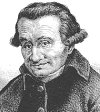 |
|
chronicler, also known as Abbé (Abate, Abbott) Molina and in Italy as Giovanni Ignazio Molina. He was born in Villa Alegre, Chile. He was skilled in languages, Greek, Latin, Italian, French and Spanish, and was accepted by the Jesuits at the age of fifteen and educated at their college in Concepción. The Jesuit order was expelled from the Kingdom of Spain and he was forced to leave Chile in 1768. His exile from his native land scarred his life forever, particularly since he was never again to see his mother. He settled in Bologna, Italy, where due to his linguistic abilities he was |
awarded the position of chair of Greek language at the University of Bologna and that of natural history in the Institute of the same city. He produced two works, the Compendium della storia geografica, naturale e civile del regno del Cile in 1776, and the Saggio della storia civile del Cile in 1787, and gained a high reputation as a historian and geographer. The latter work described for the first time the natural history of Chile and introduced many species native to that country to science. In 1803 he became a professor of natural sciences and later a member of the Royal Italian Institute of Sciences, Letters and Arts. Ruiz and Pavón dedicated to him the plant genus Molina in the Asteraceae, later considered a subgenus of Baccharis by Wilhelm Heering (Reiche 1902), and recently recreated as Neomolina by F.H. Hellwig and ranked as genus. His last work before passing away was Memoirs of Natural History published in 1829. His death, which took place in Bologna at the age of 89, caused a great impact on the European intellectual media. A species of Chilean lizard, Liolaemus molinai, was named in his honor. The genus Molina in the Malpighiaceae was validly published by Antonio José Cavanilles in 1790.
-
mol'le: from the Peruvian vernacular name from Quechua mulli.
-
mol'le: from Latin molle or mollis for soft, smooth.
-
mollifor'mis: having a soft, silky or velvety form, named for its
close resemblance to Bromus mollis.
-
mol'lis: smooth, or with soft velvety hair, from Latin mollis or molle, "soft."
-
-
Mollu'go: an old name for the genus Galium and transferred to this
genus in the family Aizoaceae possibly because of the similarly
whorled leaves, and now placed in its own family, the Molluginaceae or carpet-weeds. The name was originally applied to the species Galium mollugo. Merriam-Webster says it derives from the Latin for stickseed, from mollis, "soft." The genus Mollugo was published by Carl Linnaeus in 1753.
-
Moluccel'la: Umberto Quattrocchi says: "Presumably from an Arabic
word meaning "king" or a diminutive of Molucca." The
Jepson Manual says often and mistakenly named for the Molucca Islands of Indonesia. However Moluccella is a genus of annual and short-lived perennial plants native to Central and Southwestern Asia and the Mediterranean. The Jepson eflora lists Moluccella laevis as a name for a taxon occurring in California only as a waif and/or garden escape, not naturalized. For some reason its common name is bells of Ireland although it is native to western Asia, around Turkey, Syria and the Caucasus, not Ireland. The genus Moluccella was published by Carl Linnaeus in
1753.
-
monan'drum: one-stamened.
-
Monanthochlo'e: from the Greek monos,
"one," anthos, "flower," and chloe, "grass," meaning the
grass with one flower. The genus Monanthochloe was published by George Engelmann in 1859. The current name of Monanthochloe littoralis is Distichlis littoralis.
-
monan'thos/monan'thum: single-flowered.
-
monarchen'se: referring to monarchs, and in this case named for the
type location, the Monarch Wilderness Area in Fresno County, California.
-
Monar'da: named for Nicholás Bautista Monardes (1493-1588), a botanist and the most widely read Spanish physician
 |
|
in Europe. He was born in Seville, Spain, the son of an Italian bookseller. He received a bachelor of arts degree in 1530 and a degree in medicine in 1533, both from the University of Alcalá de Henares, following which he began practicing medicine in Seville. In 1547 he graduated from the University of Alcalá de Henares with a doctorate in medicine. He married Catalina Morales who was the daughter of a professor of medicine at Seville. He became involved in the publishing of medical works and was particularly interested in drugs and herbs that came to Spain from the |
Americas. His book De Secanda Vena in pleuriti Inter Grecos et Arabes Concordia published in 1539 concerned Greek and Arab medicine. Other topics he wrote about included toxicology, therapeutics, phlebotomy, iron, and snow. His medical practice was successful and he also maintained businesses which included the import of medicinal drugs. He apparently believed that tobacco smoke was a cure for many troubles. His best known work was Historia medicinal de las cosas que se traen de nuestras Indias Occidentales which was translated into English with the name Joyfull News out of the New Found World. He gathered information about these new herbs from soldiers, merchants, Franciscans, royal officials, women and other people he met who were hanging around the Seville docks where the ships came in. He also published works on blood-letting and cases of pleuritis, and the medical application of roses. In 1570 Francisco Hernandez was sent to the New World by King Philip II and Monardes may have played a part in encouraging this assignment. He died of a cerebral hemorrhage in 1588 eleven years after the death of his wife. The genus Monarda was published by Linnaeus in 1753. (Photo credit: Real Academia Nacional de Medicina de Espana)
-
Monardel'la: a diminutive of Monarda, having
the general appearance of dwarfs of that genus. The genus Monardella was published by George Bentham in 1834.
-
monckton'ii: named for British geologist and botanist Horace Woollaston
Monckton (1857-1931). He was born in Ireland and was educated at Wellington College in England, where his father built a house on the college grounds. Monckton and his sister lived there for the remainder of their lives. He was a lawyer, first fellow then vice-president and treasurer of the Linnean Society, and fellow and vice-president of the Geological Society of London. An obituary in Nature, Feb. 7, 1931, says: "Though so long officially connected with the Linnean Society, he did not publish much of botanical interest. He made considerable collections of plants, however, and was specially interested in mosses. In the few contributions he made on this subject, his idea was to link up botany and geology by making lists of plants growing on particular geological soils. Besides geology and botany, Monckton was interested in archeology and was an excellent photographer. He made his own slides and was always ready to give a lantern lecture to the Wellington College boys or others. He wrote the volume on Berkshire for the Cambridge County Geographies, and the article on geology in the Victoria County History. He was also a fellow of the Royal Numismatic Society and made a carefully selected collection of English silver coins. He was an indefatigable leader of excursions of the Geologists' Association and various field clubs. Monckton's activities were not confined to England. He went annually to Norway for a number of years, and studied especially theglacial phenomena there. He organised an excursion of the Geologists' Association to that country, and devoted one of his presidential addresses to theAssociation to the district round Bergen."
-
monds-coul'teri: named for Samuel Elderslie Monds Coulter (1860-?), professor of botany at Washington University and the University of Denver. He was the author of ""An Ecological Comparison of Some Typical Swamp Areas" while at Washington University in 1904. He was married twice; first to Nellie M. Boyd until her death in 1929, and secondly to Pearl J. Parvin, a research assistant who became the Director of Public Health Nursing at the University of Colorado.
-
monel'li: named for French horticulturist Jean Monelle. He was responsible
for introducing a number of plants into France, including the
pimpernel with the large blue flowers named for him by Linnaeus.
-
Mone'ses: from the Greek monos, "single, one," and esis, "a sending forth, delight," thus meaning "a
single delight" in reference to the solitary flowers. The genus Moneses was published by Richard Anthony Salisbury in 1822.
-
monnier'i: named for French botanist, physicist, university teacher, and physician Louis Guillaume Le Monnier
 |
|
(sometimes
written as Lemonnier) (1717-1799). He was born in Paris, the son of Pierre Le Monnier, professor of philosophy at the Collège d’Harcourt and member of the Académie des Sciences. He had been a student of Bernard
de Jussieu and was a close acquaintance of de Jussieu’s nephew,
Antoine-Laurent. He was also a colleague of the botanist Andre Michaux.
In 1745 he took Linnaeus botanizing in the forest of Fontainebleau with Antoine and Bernard de Jussieu. In 1758 he became professor of botany at the Jardin des Plantes (on
the death of Antoine de Jussieu). He was chief |
physician of the Hanoverian army (1756) and then first physician in ordinary both to Louis XV and to Louis XVI. He became first physician to the latter in 1788. Through kindness he also dispensed medical care to the poor. In 1786
he was succeeded as professor of botany by René Louiche Desfontaines.
He was appointed by King Louis XV head of the botanical garden of
the Trianon at Versailles and introduced many plants to French horticulture.
His work in physics included the Leiden jar experiment, by which he established that water is one of the best electrical conductors and
that the surface area, not the mass, of a conducting body determines
its electrical charge. His research on electricity produced by storms
confirmed the theories of Benjamin Franklin. His publications include Leçons de physique expérimentale, sur l'équilibre
des liqueurs et sur la nature et les propriétés de l'air (1742) and Observations d'histoire naturelle faites dans les provinces
méridionales de France, pendant l'année 1739 (1744).
He was a member (and fellow) of the Royal Society, the French Academy of Sciences and the Royal Prussian Academy of Sciences. In Montreuil near Versailles, Le Monnier lived on the property of the Comtesse de Marsan, governess of the royal children. He had saved her life in a serious illness and her interest in botany helped him in his career. He also had an apartment in the Tuileries and on 10 August 1792, during the attack on his palace, his life was miraculously saved by an unknown individual. Destitute, he retired to Montreuil, where he lived a miserable existence on the income from an herbalist’s shop which the opened. After the death of his wife in 1793 he was cared for with devotion by a niece, who eventually married him. His brother was the astronomer Pierre Charles Lemonnier. Louis died in Versailles. (Informationmostly from encyclopedia.com)
-
mono-: in compound words signifying "one or single."
-
monoceph'alus: with one head.
-
Monochor'ia: from the Greek monos, "alone, lonely,"
and choris, "separate, apart" or chorizo,
"to separate," referring to the one stamen that is larger
than the others. The genus Monochoria was published by Carl Bořivoj Presl in 1827.
-
monoen'sis: probably meaning of or from Mono
(County?).
-
monogy'na: with one pistil.
-
monogy'ra: in or with one circle, as in this species which has an
inflorescence composed on one central whorl.
-
Monol'epis: from the Greek monos,
"one," and lepis, "scale," because of the
single sepal. The genus Monolepis was published in 1830 by Heinrich Adolph Schrader.
-
Monolop'ia: from the Greek monos,
"one," and lopos, "covering," thus meaning
something like "single husk" and describing the uniseriate
involucres. The genus Monolopia was published in 1837 by Augustin Pyramus de Candolle.
-
monophyl'la/monophyl'los: single-leaved.
-
Monop'tilon: from the Greek monos,
"one," and ptilon, "feather," referring
to the pappus of the original species which is a single bristle-like
structure. The genus Monoptilon was published by John Torrey and Asa Gray in 1845.
-
monosper'mum: one-seeded.
-
Monotro'pa: from the Greek monos, "single," and tropos, "a turn" or trope, "a turning,"
thus meaning "turned or directed to one side," alluding
to the one-sided inflorescence. The genus Monotropa was published in 1753 by Carl Linnaeus.
-
monspelien'sis: Stearn's Dictionary
of Plant Names says: "Of Montpellier in southern France,
Latinized as Mons Pessulanus."
-
monspessula'na: of or from Montpellier,
France.
-
monta'na/monta'num/monta'nus: of the mountains.
-
montaraen'sis: of or from the area of Montara Mountain in San Mateo
County south of San Francisco.
-
montereyen'sis: of or from the Monterey, California, area.
-
monteviden'sis: of or from Montevideo,
Uruguay.
-
Mon'tia: named for Giuseppe Monti (1682-1760), Italian botanist and professor of botany at Bologna. He was born in
 |
|
Bologna, and from his adolescence he was educated in Latin literature, then he devoted himself to the studies of chemistry and botany. Until the age of 40 he worked as a chemist. He was a passionate student of botany, and corresponded with the major naturalists of his time, William Sherard, Herman Boerhaave, Jan Commelin, the Jussieus, Michelangelo Tilli, and Giulio Pontedera. In 1719 he wrote the first catalogue of the plants growing in the Bolognese countryside, giving special attention to grasses and similar of which he annotated the etymology, the distinctive |
characters, the medical proprieties and the synonyms. Thanks to his fame, he was appointed as professor at the new Instituto Bolognese, being already a member of the Academy of Sciences of which he was elected president in 1730 and 1736. After two years he got the teaching post of natural history and botany. From 1722 until his death he was the director of the Bologna Botanical Garden. His son Gaetano Lorenzo Monti (1712–1797) was also a botanist who continued work at the same botanical garden. His herbarium consisted of 10,000 specimens representing 736 genera and more than 2,500 species. His collection also included specimens from Ulisse Aldrovandi, an Italian naturalist and the moving force behind Bologna's botanical garden, one of the first in Europe. Monti discovered a fossil jawbone in the Alps and used it as support for the Biblical flood and both he and his son were among the last defenders of diluvialism among the naturalists of the period. In 1753, Carl Linnaeus published the genus Montia in his honor and then in 1898, botanist Otto Kuntze published Montiopsis, a genus of flowering plants from South America belonging to the family Montiaceae. (Photo credit: Orto Botanico ed Erbario - Università di Bologna).
-
Montias'trum: see Montia above, also from astron, "star."
The genus Montiastrum was published by Per Axel Rydberg in 1917.
-
montico'la: living
in the mountains, from mons, "mountain," and colo, "to inhabit."
-
montig'ena/montig'enum: mountain-born.
-
montio'ides: the most likely derivation of this name is the genus Montia, and thus "resembling Montia," which is supported by one of its common names, montia-like monkeyflower.
-
Montoliv'aea: named for Father Justin-Ignace Montolivo (1809-1881), a librarian of the city of Nice, born and raised in Nice and spent most of his life there. He was apparently very interested in botany and prepared a list of the plants that grew around the Nice area. He provided much useful information to French botanist Honoré Jean Baptiste Ardoino and Italian botanist Giuseppe De Notaris. In addition to being a guide for botanists visiting the Nice area, he spent much time at the Villa Thuret in Antibes and went on many explorations with the scientists who lived there. Today on the grounds of this villa is the Jardin Botanique de la villa Thuret, a renowned botanical garden containing approximately 2,500 trees and shrubs in its collections, representing some 1,600 exotic species from Mediterranean or hot climate countries including South Africa, Australia, California, Chile, and Mexico. Montolivo had a great knowledge of the country and was a most useful guide for botanists who visited Nice. He maintained a herbarium of the plants of the department of the Alpes-Maritimes, the department of France along the southeast Mediterranean coast that includes such localities as Nice, Cannes and Antibes. The genus Montolivaea was published by Heinrich Gustav Reichenbach in 1881.
-
moor'ei: named for Dwight Munson Moore (1891-1985), a longtime Arkansas botanist and member of the Arkansas Academy of Science. He was born in Zanesville, Ohio, and graduated from Denison University, Granville, Ohio, in 1914. He served as high school principal and teacher at Monroeville, Ohio, during 1914-1917. In 1917 he was a chemistry instructor at Zanesville High School until a December enlistment in the Army. When World War I ended, Dwight remained in France where he studied at the University of Montpellier and received a certificate in 1919. He returned to Ohio in 1919, again teaching at Zanesville High School during 1919-1920. He returned to Denison University in 1920-1923 as a biology instructor while studying there for a master's degree in botany (with a minor in chemistry), completing the degree in 1921. He served as a botany instructor at Ohio State University in 1923-1924 while pursuing a doctorate in plant physiology (with a minor in plant chemistry). Upon completion of the doctorate in 1924 he and his wife moved to Fayetteville. His initial appointment at the University of Arkansas, Fayetteville, was as assistant professor of botany, however, he was promoted to professor of botany and chairman of the department in 1926. In 1950 the botany program was combined with the bacteriology department and at that time Dr. Delbert Swartz replaced him as department chairman. From 1950-1957 Dr. Moore's appointment was as professor and curator of the herbarium, the position he held until his retirement at the mandatory retirement age of 65 in 1957. He was for many years an extremely popular speaker among the garden clubs and nature groups of Arkansas, Louisiana, and Missouri. He also will be remembered as a humorous and gentle man who had a love for the classics, fine music, poetry recitation, ocarina playing, and good conversation. Those who did not know him well may be surprised to learn that at the age of 15 he made a satin-stitch embroidery picture of a bouquet of flowers which today looks as though it had been made by a professional needlework artist, that in his early years at Fayetteville he served as a church choir director and directed a production of Handel's Messiah, or that at the age of 85 he played the piano for church services for a period of six months (at Newberry Chapel near Alma). (From a memorial in the Arkansas Academy of Science, Vol. 39, 1985) (Mimulus floribundus ssp. moorei)
-
moor'ei: named for Glen Moore (1917-2012), an American botanist, who was born at Spanish Fork, Utah. He received
 |
|
his doctorate in botany and was employed by the Church College of Hawaii, and then transferred to the botany department at Brigham Young University until his retirement. He was particularly interested in cacti and desert flora and was in the Navy during World War II. He was married to Blanche Duke Anderson and had two sons, three daughters, and many grandchildren and great-grandchildren. He was the co-author with Bertrand Harrison and Stanley Welsh of Plants of Arches National Park and co-author with Michael Treshow and Stanley Welsh of Woody Plants of the |
Mountain States. Stanley Welsh in The Great Basin Naturalist Vol. 30 No. 1 refers to a collecting trip he took with Dr. Moore in 1968 where they found Cycladenia humilis var. venusta. Stanley Welsh was his department colleague at BYU and with Moore also wrote the textbook Utah Plants: Tracheophyta. The taxon Sphaeralcea grossulariifolia var. moorei was published by Stanley Welsh. Moore died in Orem, Utah, at the age of 95. (Photo credit: Legacy.com)
-
moquin'ii: named for French botanist, entomologist, ornithologist, poet and doctor Christian Horace Benedict Alfred
 |
|
Moquin-Tandon (1804-1863). He was born in Montpellier and got his medical degree in 1829. Wikipedia says: "Moquin-Tandon was professor of zoology at Marseilles from 1829 until 1833, when he was given the appointment as professor of botany and director of the botanical gardens at Toulouse, a position he held until 1853. In 1850 he was sent by the French government to Corsica to study the island's flora. In 1853 he moved to Paris, later becoming director of the Jardin des Plantes and the Académie des Sciences.” His books included L'Histoire Naturelle des Iles Canaries |
(1835-1844), co-authored with Philip Barker Webb and Sabin Berthelot." He also authored Histoire Naturelle des Mollusques Terrestres et Fluviatiles de France Contenant (Paris, 1855) and Le Monde de la Mer (Paris, 1865). He was one of the founders of the Société Botanique de France, and he contributed to A.P. de Candolle’s Prodromus. One of his specialties was the family Amaranthaceae. He was a distinguished ornithologist and conchologist as well as a botanist. He died in Paris.
-
Morae'a: the genus Morea was originally published by Philip Miller in 1758 in honor of the British amateur botanist, academic, politician and natural historian Robert More (1703-1780), traveller and fellow of the Royal Society of London, but the name was changed in 1762 to Moraea by Linnaeus in 1762, and it has been frequently stated that it was done in honor of Sara Elisabeth Moraeus (1716-1806), daughter of Dr. Johan Moraeus, the town physician of Falun. The story goes that when Carl Linnaeus originally proposed to Sara in 1735, Dr. Moraeus agreed but insisted that before any marriage took place, Linnaeus should get qualified. Four years later, in 1739, when they married, Linnaeus had obtained a doctorate in medicine and had published his major work Systema Naturae, and so had gained a considerable reputation and won Dr. Moraeus’s approval. Twenty-three years later he honored his wife with the name. That’s the story that is probably not true. For one thing he had received a doctoral degree in 1735 so was already qualified. It is possible that Linnaeus was just Latinizing the name, or some misspelling crept into his work as a result of the similarity of the name to his wife’s maiden name. He was apparently opposed to the naming of plants after random people who were undeserving of such honor. The International Plant Names Index (IPNI) records that Miller published the name Morea in Figures of the most Beautiful, Useful, and Uncommon Plants Described in the Gardeners Dictionary Vol. II, but then in the same year, apparently in the same publication, he published the name Moraea. So it’s possible that Linnaeus was just going with this latter publication. In any event, the name commemorates Robert More, the son of London merchant Robert More and the grandson of Samuel More. He entered Queens College in Cambridge in 1721, graduating with a BA in 1725 and an MA in 1728. Wikipedia says: “He traveled widely in Europe; in Spain he became intimate with Benjamin Keene and Spanish ministers, and promoted administrative reform. He was Member of Parliament for Bishop's Castle from 1727 to 1741, and for Shrewsbury from 1754 to 1761; he was mayor of Shrewsbury in 1737. He encountered local opposition in the 1730s from John Walcot, his nephew, who had acquired the manor of Bishop's Castle.” A botanical friend of his, Littleton Brown, shared an interest in bryology and offered to take any moss samples that More could not identify to Oxford.
-
moran'ii: named for Reid Venable Moran (1916-2010), curator of botany at the San Diego Natural History Museum
 |
|
from 1957 to 1982 and specialist on the Crassulaceae. He was born in Los Angeles and raised in Pasadena where his interest in botany began. His father was a petroleum geologist. He received a BA degree in biology from Stanford University in 1939 and an MS in botany from Cornell in 1942. His academic career was interrupted by World War II when he served as a flight navigator in the Army Air Corps from 1942 to 1946. He was awarded the Distinguished Flying Cross after his aircraft was shot down over Yugoslavia during World War II. He and the rest of the crew completed |
their bombing mission before being ordered to bail out of their damaged B-24. They parachuted into German-controlled territory but were able to escape unharmed. Following the war he was awarded a PhD in botany from UC Berkeley in 1951 with a dissertation entitled "A Revision of Dudleya (Crassulaceae)." Wikipedia says: “Moran was the world authority on the Crassulaceae, a family of succulent plants, and in particular the genus Dudleya, the subject of his PhD dissertation. He named at least 18 plants new to science — some in that family and some not — and published many papers elucidating relationships within the Crassulaceae. As a mark of the respect he earned among his peers, more than a dozen plants have been named for him. Jane Goodall described Moran as ‘a sort of living myth in botanical exploration in Baja California and the Pacific Islands of Mexico,’ citing specifically his analysis of the environmental impact of introduced species (especially goats) on the flora of Guadalupe Island [which he described as the most beautiful island he had ever known]. Moran conducted a botanical survey of the Channel Islands for the Los Angeles County Museum of Natural History and performed taxonomic work for the Santa Barbara Botanical Garden and the Bailey Hortorium at Cornell University before joining the San Diego Museum of Natural History as curator of botany, succeeding Ethel Bailey Higgins in 1957. Moran specialized in the systematics of the Crassulaceae (the stonecrop family), and in the floristics of the Baja California peninsula. In addition to a large number of technical research papers, Moran published The Flora of Guadalupe Island and the treatment of the Crassulaceae for the Flora of North America (Vol. 8, published in 2009). He co-authored (with Frank W. Gould) The Grasses of Baja California, Mexico in 1981 and (with Geoffrey A. Levin) The Vascular Flora of Isla Socorro, Mexico in 1989.” An obituary in the San Diego Union-Tribune added: “Dr. Moran kept extensive field notebooks documenting his travels and his botanical collections, said Judy Gibson, botany department collections manager for the Natural History Museum. He also gained a devoted following among museum members as a leader of field trips throughout Baja California. During his 25-year tenure with the museum, Dr. Moran was instrumental in more than doubling the museum’s botanical collection from 44,000 specimens to 108,000 specimens. In 1965 the Smithsonian Institution selected an exhibit he designed for a three-year national tour of other museums and universities. The exhibit featured a family of succulents known as stonecrops. He had collected the succulents in California, Mexico, the Mediterranean and eastern Asia. Colleagues said Dr. Moran’s strength and stamina allowed him to work in isolated areas, hiking up mountains and collecting specimens for weeks at a time. ‘He was hiking through steep canyons and rough terrain when he was in his 70s,’ Oberbauer [botanist with the San Diego County Department of Planning and Land Use] said. ‘He didn’t mind spending a lot of time alone with his work, but he also seemed to appreciate being around people and could be the life of the party,’ Oberbauer said. ‘He had a dry sense of humor, and he liked to play the guitar and sing songs.’ Dr. Moran was a longtime member of the San Diego Folk Song Society and had an interest in Australian and English folk songs. In addition to writing about his findings, Dr. Moran became adept at photographing his collections, and many of his photos have been part of his exhibits.” He was married and divorced, and had a daughter and a stepson. He died of pneumonia in Clearlake, California.
-
morefield'ii: named for James David Morefield (1961- ), president, webmaster
and rare plant chair of the Nevada Native Plant Society. The following
is from the 2005 Jepson workshops program web page: "Jim Morefield
began studying botany as a student at Deep Springs College and spent
many field seasons during the 1980s exploring and revising the flora
of the White Mountains. After finishing a degree in botany and geology
in Flagstaff, Arizona, he completed a PhD at Rancho Santa Ana Botanic
Garden, where he studied Stylocline and related genera of composites.
He contributed the Jepson Manual treatments for these genera plus Chaenactis. Currently, Jim works as the botanist for the Nevada
Natural Heritage Program."
-
more'hus: named for the Biblical 'oak of Moreh' or 'Plain of Moreh', the location of the first recorded halting-place of Abraham after his entrance into the land of Canaan, where God revealed Himself to Abraham with the promise to give Canaan to his descendants. This taxon has been referred to as Abram's oak, Abram being a shortened version of the name Abraham. As to why this taxon is called oracle oak, thanks to Bob Allen for supplying the answer when he wrote "this species was named for the biblical Oak of Moreh (Hebrew, moreh, derived from yarah = to teach or direct, also one who directs or gives 'oracular' answers."
-
Morel'la: probably a diminutive of Morus, the mulberry. The genus Morella was published by João de Loureiro in 1790.
-
morrison'ii: named for American botanist John Lawrence Morrison (1911-2001). He was born and raised in the midwest, and
was educated at the University of Nebraska. He got his graduate
degrees from the University of California, Berkeley, including a PhD in 1941. He was an instructor in
botany and ecology at the State University of New York College of Forestry in
Syracuse, 1946-1947, assistant professor 1947-1949, associate professor
1949-1959, and full professor beginning in 1959. His specialties were
the taxonomy of Streptanthus and the Brassicaceae, and the
ecology of Thuya occidentalis. An obituary says that a generation of students was inspired by his passion, guided by his sound science, and won over by his quiet attention to their personal lives. He taught the whole person. John retired to Occidental in 1972 and was active in Masters swimming for many years and an annual climber of Yosemite's Half Dome.
-
morroen'sis: of or from the area of Morro Bay, California.
-
Morton'ia: named for Dr. Samuel George Morton (1799-1851), an American physician, anatomist, natural historian
 |
|
and writer, sometimes referred to as the father of American physical anthropology. He was born in Philadelphia, Pennsylvania, into a family of somewhat successful merchants. Only six months after his birth, his 43-year old Irish-born father died during an outbreak of yellow fever. Of the nine children in his family, only he and one sister survived to adulthood. His mother, originally a Quaker, converted to the Episcopal faith when she married Morton’s father, but soon after his death she remarried a Quaker. Samuel was educated at Quaker schools in New York City, Westchester, PA, |
and Burlington, NJ. Originally destined for commercial pursuits, he instead decided to study medicine and graduated from the medical department of the University of Pennsylvania in 1820, and subsequently gained an advanced degree from the University of Edinburgh in Scotland in 1823. While in Europe he was twice struck by attacks of a nearly fatal disease which rendered him weak and sickly for the remainder of his life. On his return to Philadelphia the next year he began the practice of his profession, and became an active member of the Academy of Natural Sciences, was recording secretary of that body in 1825, and president in 1850. He was one of the founders of the Pennsylvania Medical College and was a professor of anatomy there from 1839 to 1843. For several years he was a clinical teacher at the city Almshouse Hospital (later to become the Philadelphia General Hospital), where he began a collection of skulls in 1830. He developed the controversial theory that the so-called races of man had been created independently from each other, and believed that he could determine the intellectual capacity of various groups by the shape of their skulls. This theory was quite popular at the time, placing as it did Caucasians at the top of the racial ladder and Negroes at the bottom. His efforts resulted in the largest museum of comparative craniology in existence, containing about 1,500 specimens, 900 of which were human, and which were obtained from widely separated regions. This collection is now housed at the Museum of Archeology and Anthropology at the University of Pennsylvania. His work later came under significant scrutiny which seemed to indicate a racial bias on his part which called many of his conclusions into question. He was a member of the American Philosophical Society and the American Antiquarian Society. An attack of pleurisy in 1848 left him further weakened and three years later, he succumbed. After his death in Philadelphia, his researches were warmly received by none other than Louis Agazziz but roundly criticized by Charles Darwin and Stephen Jay Gould, and there is currently little or no evidence supporting the validity of his lifelong-held beliefs. The genus Mortonia was published by Asa Gray in 1852.
-
mortonia'na/morton'ii: named for newspaperman, farmer and President Grover Cleveland's
secretary of agriculture
 |
|
Julius Sterling Morton (1832-1902). The following
is quoted from Wikipedia: "Morton was born in Adams, Jefferson
County, New York. He was raised in Detroit and attended the University
of Michigan. After receiving his diploma in 1854, he moved with his
bride to Nebraska, which was not yet organized as a territory, and
staked a claim in Nebraska City. Respected as a qualified agriculturalist,
he sought to instruct people in the modern techniques of farming and
forestry. Among his most significant achievements was the founding
of Arbor Day. He became well known |
in Nebraska for his political, agricultural, and literary activities and from there was appointed
as secretary of agriculture by President Cleveland. He is credited
with helping change that department into a coordinated service to
farmers, and he supported Cleveland in setting up national forest
reservations. In 1897 Morton planned and began to edit the multivolume Illustrated History of Nebraska. He also published a weekly
periodical, The Conservationist. He died on April 27, 1902,
in Lake Forest, Illinois, where he was seeking health treatment. His
home in Nebraska City is now a state park, the Arbor Lodge State Historical
Park and Arboretum. In 1937, the state of Nebraska donated a bronze
statue of Morton to the US Capitol's National Statuary Hall Collection.
Morton is a member of the Nebraska Hall of Fame."
-
Mor'us: from the classical Latin name morum for Morus nigra, the mulberry. The genus Morus was published by Carl Linnaeus in 1753.
-
moscha'ta/moscha'tum/moscha'tus:
from Latin moschatus, "having a musky scent."
-
mosier'i: named for South Florida naturalist Charles A. Mosier (1871-1936), the first superintendent of Florida’s first state park, Royal Palm State Park, now a part of Everglades National Park.
-
mosquin'ii: named for Canadian botanist Theodore Mosquin (1932- ) of
the department of botany, University of
 |
|
California. David Hollombe
sent me a brief bio in French from a Canadian website which I was
able to have translated as follows: "Theodore Mosquin (BSc,
1956, University of Manitoba; PhD, 1961, U.C.L.A.) was born at Brokenhead
in Manitoba in 1932. The studies which he made in Los Angeles related
to the cytogenetics and evolution of the genus Clarkia. He
entered the Botanical Institute of Research in 1963 where he studied
the cytology and biology of reproduction of the genera Linum and Epilobium. In 1968-1969, he took a sabbatical leave and
became part-time |
lecturer associated with the University of California
in Berkeley. His keen interest in natural history led to the post
of editor of Canadian Field-Naturalist from 1968 to 1972 and
he became president of the Ottawa Field-Naturalists' Club in 1970.
In March, 1972, he took a second sabbatical leave to take up the duties
of first executive director of the new Canadian Federation of Nature.
In April 1973, he decided to remain with the Federation and gave his
resignation to the Ministry [of the Environment?]" He was also a director of the Canadian
Wildflower Society, a chairmain of the Canadian Audubon Society, and
a president of the Canadian Parks and Wilderness Society. He was co-author
in 1989 of On the Brink; Endangered Species in Canada and in
1995 of Canada's Biodiversity: The Variety of Life, It's Status,
Economic Benefits, Conservation Costs and Unmet Needs. (Photo credit: Research Gate)
-
mougeot'ii: named for Jean Baptiste Mougeot (1776-1858), a French physician, geologist and botanist from Bruyères
 |
|
(Vosges). He was stationed from 1798 to 1802 in Germany as an army health officer, and then returned to his hometown where he settled as a physician. From 1833 until his death, he was a member of the conseil général for the Département of Vosges. JSTOR says: “As a botanist, he was mainly known as a collector of cryptogamic exsiccatae, a tradition carried on by his son, but he also collected some phanerogams. Cryptogamic exsiccatae were purchased by both the British Museum and the Royal Botanic Gardens at Kew (c. 1823-1858). Algae, bryophytes and lichens would have |
been transferred from Kew Gardens to the British Museum (c. 1961) under the terms of the Morton Agreement and a reciprocal transfer of fungi would have been made from the British Museum to Kew.” The algal genera Mougeotia and Mougeotiopsis were published in his honor, as well as taxa with the specific epithet mougeotii.
-
mox'leyi: named for botanist George Loucks Moxley (1871-1963). He was born in Jefferson, New York, and was a student of southern California flora from 1898 to 1923. He was married in Los Angeles to Ada Ruth Snyder in 1895 and collected on Santa Catalina Island in 1919. His education consisted of four years of high school. From 1895 to 1896 he was a Methodist missionary in Liberia. He was a member of the Lorquin Natural History Club (now called the Lorquin Entomological Society) founded by Fordyce Grinnell Jr. in 1913. His occupations included bookkeeper, and collector then clerk for a gas and electric company. He moved to the Salem/Eugene area in the 1930s where he was an elder in the evangelist United Brethren church. He was a co-author with Anstruther Davidson of Flora of Southern California published in 1923. He died in Eugene, Oregon.
-
mucrona'ta/mucrona'tus: mucronate, with a
short, abrupt tip, from Latin mucronatus, "pointed."
-
Mucro'nea: from the Latin mucronis for "sharp-pointed" and mucro, "a sharp point,"
in reference to the awns of the bracts and involucres. The genus Mucronea was published by George Bentham in 1836.
-
Muehlenbeck'ia/muehlenbeck'ii/muhlenbeck'ii: named for Heinrich Gustav Muehlenbeck (1798-1845), an Alsatian botanist and physician who collected plants and studied the flora of Alsace. He was born in Sainte-Marie-aux-Mines in France and died in Mulhouse close to the Swiss and German borders. He was particularly known for his work with bryophytes. He studied medicine in Strasbourg and Paris, and took up a general practice in Gebweiler, another town in northeastern France. The Wikipedia article on him is a little ambiguous because it says he died in ‘Mulhouse,’ which is in France, but it also says “from 1833 onward, [he] lived and worked in Mühlhausen, which is a town in northwestern Germany. Perhaps borders have changed since then and these two references are actually to the same place. In 1839 he accompanied Philipp Bruch and Wilhelm Philippe Schimper on a botanical excursion to the Alps. He was the author of Dissertation sur la docimasie pulmonaire and Swiss botanist Carl Meissner named the genus Muehlenbeckia in his honor in 1841. He has been variously described as French, Swiss and Alsatian, which implies to me that this was an area that does not exactly correspond to today’s national borders or populations. He died at the early age of 47. The genus Muehlenbeckia was published in 1841 by Carl Daniel Friedrich Meisner.
-
muehlenberg'ii/muhlenberg'ii: see Muhlenbergia.
-
muel'leri: named for Carl August Friedrich Wilhelm Müller (1818-1899), a German pharmacist and bryologist born in Allstedt. He worked as a pharmacist at several locations in Germany (Kranichfeld, Jever, Detmold and Blankenburg am Harz) and then studied botany at the University of Halle from 1843 to 1846. In 1843 he became an assistant editor of Botanische Zeitung, and in 1852 was co-founder of the journal Die Natur. During his career he amassed a moss herbarium consisting of 12,000 bryological species. His herbarium at the Botanischer Garten und Botanisches Museum Berlin-Dahlem, Berlin, was destroyed in the Second World War, but duplicates survive at a number of herbaria. (Lophozia muelleri)
-
muel'leri: named for Baron Ferdinand Jacob Heinrich von Müller (Mueller) (1825-1896), a German-Australian
 |
|
physician, geographer, and botanist. He was born at Rostock in the Grand Duchy of Mecklenburg-Schwerin. His early education was provided in Tönning, Schleswig by his grandparents after the death of his parents. At the age of 15 he was apprenticed to a chemist and subsequently passed his pharmaceutical examinations and studied botany under Professor Ernst Ferdinand Nolte. In 1847, he received a doctoral degree from Kiel for a thesis on the plants of the southern regions of Schleswig. Because his sister Bertha had been advised to seek a better climate for her health, Müller |
sailed from Bremen to Adelaide, Australia in 1847 and gained employment with a chemist. In 1851 he moved to Melbourne, capital of the new colony of Victoria and in 1852, sent a paper to the Linnean Society of London on "The Flora of South Australia," thus beginning to be well known in botanical circles. The following year he was appointed as government botanist for the state of Victoria. He began exploring its flora, in particular the alpine vegetation which was essentially unknown. He covered some 1,500 miles during his trip across Victoria. That same year he established the National Herbarium of Victoria. A few years later he explored the Victoria River and other portions of north Australia, then reached Moreton Bay. He found nearly 800 species new to science, and published his Definitions of Rare or Hitherto Undescribed Australian Plants. From 1854 to 1872, Müller was a member of the Victorian Institute for the Advancement of Science, and in 1859 he became president of what would become the Royal Society of Victoria. He was an active member of the committee which initiated the Burke and Wills expedition of 1860 which was the first to cross the continent. In 1857, Mueller applied for and was granted the degree of Doctor of Medicine of the University of Rostock. From 1857 to 1873, he was director of the Royal Botanic Gardens, Melbourne, and not only introduced many plants into Victoria, but promoted the good qualities of the blue gum all over the world, introducing it into the south of Europe, North and South Africa, California, and the extratropical portions of South America. He became a fellow of the Royal Society in 1861, but was dismissed from his position as director of the botanic gardens on 31 May 1873. It was thought that a more aesthetic approach was needed. He was a prolific author and published 11 volumes of Fragmenta phytographica Australiae (1862–1881), two volumes of the Plants of Victoria (1860–1865), and other books on the Eucalyptus, Myoporaceae, Acacia, and Salsolaceae, all profusely illustrated. He also participated in the production of George Bentham's Flora Australiensis. He described many novel plant species sent by botanists from other parts of Australia, and encouraged settlers to send plants to him. He never married and died in Melbourne. ( Atriplex muelleri)
-
muel'leri: named for Franz August Müller (Mueller) (1798-1871), a German apothecary and collector of mosses. He was born in Lausigk and was the owner of a pharmacy in Schneeberg. He was a plant collector and a cryptogam researcher. He made botanical trips to Illyria in the western part of the Balkan peninsula in 1826 and to Sardinia in 1827-1828. He died in Schneeberg. (Barbula muelleri, Leontodon muelleri)
-
muelleria'na: named for Karl Müller (Mueller) (1881-1955), German botanist, biologist, agronomist, and oenologist (a person who studies wine and wine-making). He was born in Messkirch, the son of a forestry director, and attended secondary school at Freiburg and then the Universities of Freiburg and Munich. He studied botany and chemistry and received a doctorate in 1905. After military service, he was assistant in 1907 at the Kaiser Wilhelm Institute (Institute of Phytopathology) in Bromberg, In 1909 he was a researcher at the Baden Augustenberg Agricultural Research Institute in Grötzingen (now part of Karlsruhe). After being appointed head of the Center for the Protection of Plants in Baden, he was head of a vineyard at the Jesuit castle in Freiburg, and was senior director of state control of phylloxera, a plant louse that is a pest of vines. In 1921 he directed the newly created Enological Institute of Freiburg, and retired from that position in 1937 due to an ear disease. In 1951 he became a professor. His researches extended beyond viticulture and he became one of the most outstanding experts of the Hepaticophyta (liverworts) of Europe. He also worked on Gottlob Ludwig Rabenhorst’s flora of cryptogams, with particular regard to mosses. He died in Freiburg at the age of 73.
-
Muhlenberg'ia/muhlenberg'ii: named for Gotthilf Heinrich
Ernst Muhlenberg (1753-1815), son of Henry Melchior
 |
|
Muhlenberg, a
German Lutheran minister who came to the United States in 1742. Gotthilf
was born in Trappe, Pennsylvania, educated with his brothers in Halle,
Germany, and returned to America in 1770, at which time he was also
ordained a Lutheran minister and worked for several years as his father's
assistant. He labored as a pastor for several congregations throughout
his life, but devoted his leisure hours to the study of the natural
sciences, botany in particular. He was a pioneer botanist of the highest
rank and was honored by having a number of plants and even a genus
named for him. |
His flora of the Lancaster, Pennsylvania, area entitled Flora Lancastriensis included
some 450 genera and 1,000 species, and his first formal publication, Catalogus plantarum Americae septentrionalis, was released
in 1813. He corresponded with many of the leading botanists of the
day, and was visited, among others, by Alexander von Humboldt. He
sent numerous specimens to Carl Ludwig Willdenow who published many of
his discoveries in his Species plantarum. He was a member of
a number of scientific societies in several countries, and his works
are considered standards in the field. His manuscript on grasses was
published two years after his death. He was the first president of
Franklin College, serving in that capacity from 1787 to 1815, and
both his son and grandson became Lutheran ministers, the latter, Frederick
Augustus, becoming the first president of Muhlenberg College. He was also the author of Descriptio Uberior Graminum et Plantarum Calamariarum Americae Septentrionalis Indiginarum et Cicurum which was published in 1817, and the discoverer of the bog turtle which was named Clemmys muhlenbergii in his honor. He suffered a paralytic stroke in 1815 which hindered his activities, and a subsequent series of strokes took his life not long after. The genus Muhlenbergia was published by Johann Christian Daniel von Schreber in 1789.
-
Muil'la: a western plant that looks like an
onion (genus Allium), that was humorously given the same name
spelled backwards. The genus Muilla was published by Sereno Watson in 1883.
-
muiria'na/muir'ii: named for John Muir (1838-1914), the great Scottish-born American naturalist, environmental
 |
|
philosopher, author, glaciologist, and early advocate for the preservation of wilderness in the United States. He was born in Dunbar, Scotland, the third of eight children. As a boy he took walks with his grandfather and hunted for bird’s nests. He always maintained a love for Scotland and his Scottish accent. He returned to Scotland on a trip when he was 55 and visited his boyhood haunts. When he was 11 his family emigrated to the United States where he settled near Portage, Wisconsin. He enrolled at the University of Wisconsin at Madison at the age of 22 and it was here |
that his true love of botany began. He was also interested in chemistry, geology and the other sciences. He was a somewhat pecular student, taking an unusual selection of classes, and was never listed as more than a first-year student, an “irregular gent” as they called him, and he never graduated, although he learned a great deal about the natural sciences that propelled him forward into his exploring life. His brother Daniel left Wisconsin and went to Ontario to avoid the draft during the Civil War and John followed him, rambling around the woods and swamps and collecting and cataloging plants near Lake Huron. He worked intermittently at a sawmill and rake factory. He returned to the United States in 1866 and settled for a time in Indianapolis, working in a wagon wheel factory. In 1867 came his famous walk from Kentucky to Florida which he recounted in his A Thousand Mile Walk to the Gulf. In 1868 he sailed for Cuba, studied shells and flowers, and visited the Havana Botanic Garden, thereafter sailing for Panama, across the Isthmus and on to San Francisco. He served for a time as an officer in the United States Coast Survey. In California he walked across the San Joaquin Valley and entered the Sierra Nevada for the first time, describing it as a range of light and the most beautiful mountain range he had ever seen. An article by Brent D. Mishler in the Jepson Globe, Volume 33, Number 2, Fall 2023, quotes John Muir: “The Great Central Plain of California, during the months of March, April, and May, was one smooth, continuous bed of honey-bloom, so marvelously rich that, in walking from one end of it to the other, a distance of more than 400 miles, your foot would press about a hundred flowers at every step.” He made his home in Yosemite, herded sheep, explored the mountains, discovered glaciers, and developed his theory about the glaciation that sculpted Yosemite Valley, a theory that was much discounted at the time but later proved to be true. Great men of his day such as Joseph LeConte, Asa Gray, Theodore Roosevelt and Ralph Waldo Emerson arrived at his door. He visited Alaska for the first time in 1879 and discovered Glacier Bay, then married in 1880, moving to Martinez, California, to raise their two daughters and go into partnership with his father-in-law on a family fruit ranch. The domestic life however only satisfied him to an extent and his wanderlust took him numerous times to Alaska, to Australia, South America, Africa, Europe, China, Japan, and again and again to his beloved Sierra Nevada. A year before he died, he and his supporters lost their battle to prevent the damming of Hetch Hetchy Valley. He was America’s most famous naturalist and conservationist. He co-founded the Sierra Club, and his letters, essays, more than 300 articles and a dozen books describing his exploits in nature helped to preserve Yosemite, Sequoia National Park and many other wilderness areas. He died in Los Angeles of pneumonia.
-
Mulge'dium: from the Latin mulgeo, "to milk." The genus Mulgedium was published by Alexandre Henri Gabriel de Cassini in 1824.
-
multi-: a prefix indicating many.
-
multica'va: with many hollows, from the Latin cavea, "a
cave or excavated place."
-
multicos'ta: many-ribbed.
-
multicau'le/multicau'lis: many-stemmed.
-
mul'ticeps: with many heads.
-
mul'ticolor: with many colors.
-
multicosta'ta: with many ribs.
-
multi'fida/multi'fidum: divided many times.
-
multiflor'a/multiflor'um:
many-flowered, from multi-, "many," and florum, "flower."
-
multiglandulo'sa: with many glands.
-
multiju'ga: many yoked together, generally referring to leaves with
many pairs of leaflets.
-
multiloba'ta/multiloba'tus: many-lobed.
-
multinerva'tus/multiner'via: many-nerved.
-
mul'tiplex: much folded, hence doubled.
-
multiradia'ta: from the Latin meaning
"many-rayed."
-
multiscapo'ideum: with many scapes.
-
multise'tus: with many bristles.
-
muncien'sis: named for Muncy, Nevada, a mining town in White Pine County.
-
mun'dula: trim, neat, adprmed, diminutive of mundus. "clean, pure, neat, decorated, adorned."
-
muni'ta/muni'tum: armed,
fortified, from munio, "to fortify."
-
Munro'a: named for William Munro (1818-1880), a senior English Army officer and plant collector, botanist and
 |
|
agrostologist, who "made his career in the British army, entering in 1834 and advancing to the rank of General in 1878. He served in India, the Crimea and the West Indies. In his spare time he studied botany, collecting plants in India in the 1840s and in Barbados, 1870-1875. He become an authority on grasses and was planning to contribute a monograph on bamboo to DeCandolle's Prodromus at the time of his death." (from a Harvard University Library website) He was born in Druid Stoke, Gloucestershire, and joined the 39th (Dorsetshire) Regiment of Foot as an ensign in 1834, becoming |
promoted subsequently to Lieutenant, Captain, Lieutenant Colonel and finally General. He conducted botanical work in Bangalore and the Nilgiri Hills, was in Kashmir in 1847, performed distinguished service during the Crimean War, then commanded the 39th in Canada. Munro became a fellow of the Linnean Society of London in 1840. His main research field was tropical grasses, including the bamboo species of which he published a monograph in 1868. The genera Munroa, Munronia and Munrochloa are named in his honor. Munro died in Somerset at the age of 62. The genus Munroa was published by John Torrey in 1856. (Photo credit: Botanics Stories)
-
munroa'na: named for Donald Munro (c.1788-1853), curator of gardens at the Horticultural Society of London from which he retired in 1850, fellow of the Linnean Society, gardener-in-chief for British botanist John Lindley.
-
munsonia'na: named for Thomas Volney Munson (1843-1913), often referred to as T.V. Munson, an American horti-
 |
|
culturist and breeder of grapes in Texas. He was born in Astoria, Illinois. In the 1860s he taught school in Illinois for three years, and in 1870 he graduated from the University of Kentucky in Lexington where he worked as a professor of science in 1870–1871, a position he held for only a year due to his desire to be fully involved with the grape industry. Following the completion of his education, he married and moved to Lincoln, Nebraska, where he began investigating various species of native grapes and the possibility of producing new varieties by cross-pollination and |
hybridization. These experiments were not successful and in 1876 he moved to Denison, Texas, to join two of his brothers who were involved in insurance and real estate businesses. He soon became heavily engaged with grapes, and for the rest of his life he traveled extensively throughout Texas and forty other states, as well as Mexico, covering more than 50,000 miles by rail and hundreds of miles on horseback and by foot. He once wrote that these trips "rekindled my passion for experimental work with grapes." He was the founder of the Texas Horticultural Society and its president, a life member of the American Horticultural Society, and vice-president of the American Pomological Society. He wrote Native Trees of the Southwest under the direction of the United States Department of Agriculture and submitted a similar thesis in 1883 to satisfy requirements for his master's degree at the Kentucky Agricultural College. In the 1880s, Munson worked on a monograph on native grapes that was to be illustrated by William Henry Prestele, the first artist appointed to the staff of the recently formed Pomological Division of the United States Department of Agriculture in Washington, D.C. This work was never published in its intended form, but was the basis of the book he published in 1909, Foundations of American Grape Culture, regarded as one of the founding texts of American grape breeding and widely referenced even today. In 1885 he exhibited in New Orleans for the American Horticultural Society a complete classified herbarium of all known species of American grapes, and in 1893 he exhibited his collection of grape species at the Columbian Exposition in Chicago. In 1888, Munson was the second American, after Thomas Edison, to be named a Chevalier du Mérite Agricole by the French government, an honor which resulted from his work providing European grape growers with phylloxera-resistant rootstocks which allowed them to recover from the devastating epidemic of the late 19th century. In 1898 he was elected as a foreign corresponding member of the Société Nationale d'Agriculture de France and as an honorary member in the Société des Viticulteurs de France. In 1906 the University of Kentucky gave him a doctor of science degree. He died in Denison and in 1975 Grayson Community College in the Sherman-Denison area established a Thomas Volney Munson Memorial Vineyard to recognize his contribution to horticulture and to cultivate and preserve many of the Munson grape varieties. In 1988 the T. V. Munson Viticulture and Enology Center opened next to the vineyard. He had seven children. (Photo credit: Find-a-Grave)
-
Munting'ia: named for Abraham Munting (1626-1683), a noted botanical illustrator. The website of Carolina Antinque Maps and Prints has this to say about him: "A Dutch physician and botanist, was professor of botany at the University of Groningen. Munting established and directed (1658-1683) the botanical garden his father Henricus Munting had founded. It was known as the 'Paradise of Groningen' and became one of the most extensive gardens of the period. His numerous botanical friends had sent the seeds of many of these plants to him from the Dutch East and West Indies, Africa and the Americas. It was in this beautiful garden that his daughter Hester died eating deadly nightshade. During the summer Munting gave botanical lectures to his students four times a week. Munting wrote a number of works on medical/botanical topics, but his posthumously published 'opus magnum', the Naauwkeurige, enjoyed particular success, at least in part due to the novelty of the plates, which in a radical departure from the iconography of the traditional florilegium, presented its plant species against a charming series of landscape backgrounds. The illustrations are remarkable for their elegance and originality. Each plate shows a different plant in flower, including many exotic species from America and other distant lands. The plant dominates the foreground, filling the entire page, often with a detail of the fruit or flower presented on a smaller scale. In some cases the plants are presented 'à trompe l'oeil,' while in others they have been arranged in decorated urns. Sometimes gardening tools are depicted as well. The name of each plant appears written on an elegantly fluttering ribbon or cartouche, or on a crumbling marble plaque.” The genus Muntingia was published by Carl Linnaeus in 1753.
-
munz'ii: named for Philip Alexander Munz (1892-1974), a botanist at Rancho Santa Ana Botanical Garden, professor
 |
|
of botany at Pomona College and dean of the college for three years, and author of A Flora of Southern California, California Mountain Wildflowers, California Desert Wildflowers, California Spring Wildflowers and Shore Wildflowers of California, Oregon and Washington. He was born in Wyoming and grew up in Denver, where he finished high school at the age of 16 and entered university at 17. He received an undergraduate degree and an MA at the University of Denver, and then completed graduate work with a major in entomology and a minor in botany at Cornell. He |
moved to Claremont in 1917 and began teaching botany at Pomona College. He explored and studied the local flora, established the Pomona College Herbarium and in 1935 published his A Manual of Southern California Botany. After returning to Cornell to teach in 1944, he was offered two years later the position of director of Rancho Santa Ana Botanic Garden . He merged the herbaria and library of Pomona College with that of Rancho Santa Ana Botanic Garden, which is now the largest in the world featuring California native plants. He became director emeritus in 1960. He was unquestionably one of the most significant figures in California botany. (Photo credit: Desert Wildflower)
-
Munzotham'nus: from the name Munz and the Greek thamnos, "shrub," hence "Munz's shrub," see munzii above. The genus Munzothamnus was published by Peter Raven in 1963.
-
mura'le/mura'lis: growing on walls, from Latin murus, "a wall," and muralis, "of a wall."
-
murica'ta/murica'tus: muricate, as in a surface
roughened by means of hard points or sharp projections. A website of the San Diego State University adds "muricate, with coarse, radially elongate, rounded protuberances, longer than wide." The Wiktionary website says the Latin muricatus has several meanings, among which are having a pointed shape and rough with short, hard points, and comes from murex, "a pointed rock or stone." Merriam Webster gives the current definition of muricate as roughened with sharp hard points, and says its etymology is "from Latin muricatus, pointed like a purple fish, from muric- or murex, "purple shell," and -atus, "-ate." I think the botanical sense is simply " covered with short, sharp points."
-
muri'na/muri'num: of mice, mouse-gray, like
a mouse, from Latin mus or muris, "a mouse," and murinus, "belonging to mice, mouse-like."
-
murraya'na: most sources say this was named for Andrew Dickson Murray (1812-1878), a Scottish lawyer, botanist,
 |
|
zoologist, entomologist and conifer expert. Wikipedia provides the following information: He was born in Edinburgh, educated for the law, and became a writer to the Signet [apparently a judicial officer who prepares warrants, writs, etc., originally a clerk in the office of the secretary of state, a signet being a seal used to attest to the validity of documents]. He joined the firm of Murray & Rhind, and for some time practiced in Edinburgh. His earliest scientific papers were entomological, and did not appear until he was forty. On the death of the Rev. John Fleming, professor of natural science in New College, Edinburgh, in 1857, Murray took up his work for one session. On the foundation of the Oregon Exploration Society he became its secretary, and this apparently first aroused his interest in western North America and in the Coniferae. In 1858-59, he was president of the Botanical Society of Edinburgh, and in 1860 apparently left the legal profession and went to London to became assistant secretary to the Royal Horticultural Society. In 1861 he was elected a fellow of the Linnean Society. In 1868 he joined the scientific committee of the Royal Horticultural |
 |
Society, and began the collection of economic entomology for the science and art department, now at the Bethnal Green Museum. In 1869, he went to St. Petersburg as one of the delegates to the botanical congress, and in 1873 he visited Utah and California to report on some mining concessions. This latter journey seems to have permanently injured his health. Among his works was The Pines and Firs of Japan [published in 1863 and illustrated by more than 200 woodcuts] but major works on conifers were never completed. His younger brother, William (born 1819), was in California at least from 1854-1860 and botanized in the same area as John Jeffrey and carried on with some of his unfinished work, the latter having died at the early age of 28. He apparently was in and out of California right up to his death in San Francisco in 1896. Andrew Murray was an opponent of the Darwin-Wallace model of natural selection, preferring to believe that hybridization was a better explanation. However, David Hollombe has unearthed some information that casts doubt on the foregoing derivation. Elmer Luther Little Jr. had a different opinion as he wrote in an article entitled “Notes on Nomenclature in Pinaceae” in The American Journal of Botany (1943). The article discussed a committee formed by the Edinburgh Oregon Botanical Association (aka Oregon Exploration Society) in 1849 which was chaired by John Hutton Balfour and had as its secretary Andrew Murray. The Committee hired John Jeffrey to be the collector for the expedition to Oregon. The eleven reports of the Botanical Expedition to Oregon (1849-1859) were primarily prepared by Andrew Murray, so it might be thought that he was the one honored with the name. However, Little, referring to Pinus murrayana, wrote “A third species in this report is sometimes regarded as distinct but usually reduced to a variety under an older name. Incidentally, it apparently was named for Lord Murray, one of the organizers of the Committee, and not for Andrew Murray, the secretary." Lord Murray was John Archibald Murray (1779-1859), Scottish judge and senator of the College of Justice. He was born in Midlothian, the second son of Alexander Murray, Lord Henderland, Lord of Session and Justiciary. Wikipedia provides the following: “Murray was educated successively at the Edinburgh High School, at Westminster School, and at the University of Edinburgh. In 1799, Murray passed the Scottish bar. When the Edinburgh Review was founded, Sydney Smith, Francis Horner, Francis Jeffrey, Thomas Brown, and he, met for a time as joint editors in Jeffrey's house. He continued as contributor. His early career at the bar was distinguished, but he had no need to develop it further. A liberal, Murray threw in his lot with the young Edinburgh Whig lawyers, and took part in the agitation before the Reform Bill of 1832. In December 1832, he was returned unopposed for Leith Burghs, which had been enfranchised under the bill. He was appointed recorder of the great roll and clerk of the pipe, a sinecure in the Scottish exchequer which he did not long hold. On the elevation of Jeffrey to the bench in 1835, Murray succeeded him as Lord Advocate. He introduced a large number of bills into the House of Commons, including measures for the reform of the universities, for giving popular magistracies to small towns, for enabling sheriffs to hold small debt circuits, for the reform of the court of session, and for amending the bankruptcy law, but only succeeded in carrying a few minor reforms. In 1839, he was savagely attacked in Parliament by his old friend Brougham for his conduct in the case of five cotton-spinners who were tried on a charge of murder arising out of a trade-union dispute. He answered the charges in the House of Commons. Murray in 1839 left Parliament for the Court of Session. He was knighted that year, adopting the courtesy title Lord Murray. In 1844 Murray was elected a fellow of the Royal Society of Edinburgh his proposer being Thomas Stewart Traill. He served as the Society's vice-president from 1849 to 1857.” Considering that they shared the same last name, both had brothers named William, and both were involved in the Oregon exploration project, it is perhaps understandable that there appears to have been some confusion as to who the name murrayana refers to, and at this point the derivation could be to either. The picture on the top left is of Andrew Murray (photo credit: Chrono-Biological Sketches) and on the bottom left is John Archibald Murray.
-
Muscar'i: Umberto Quattrocchi's World Dictionary of Plant Names says: "A Turkish name recorded by Clusius in 1583; Latin muscus,
"moss, musk;" and Stearn's Dictionary of Plant Names says: "Turkish name recorded by Clusius in 1583, the bulbs of Muscari muscarimi (M. moschatum) being received from
Constantinople under the names Muscari, Muschorimi or Muscurimi, meaning musk of the Romans (i.e. Greeks), or Muschio
greco (Greek musk), referring to the sweet aromatic scent of the
flowers, hence from Persian mushk, Sanskrit mushka,
testicle. The source of musk is a scent gland or 'pod' of the male
musk-deer (Moschus moschifer)." The following is quoted
from the Encyclopaedia
Romana: "Humanist and botanist, Carolus Clusius, the Latinized
version of Charles de l'Ecluse (1526-1609), was most responsible for
introducing the tulip (and the potato) to the Netherlands, transforming
gardens there and throughout northern Europe. In 1573, he had been
invited by the Holy Roman Emperor Maximilian II to establish a botanical
garden in the capital at Vienna. At the time, botany was not a discipline
in its own right but was considered a branch of medicine, the plants
themselves of interest only for their medicinal properties. Clusius
was one of the first to recognize them for their own sake, classifying
plants according to their color and shape. Indeed, Clusius had become
a physician to better study botany, traveling all over Europe in search
of new specimens." The genus Muscari was published by Philip Miller in 1754 and is called grape-hyacinth.
-
musco'ides: although Stearn says "fly-like," Gledhill says "moss-like," and this is apparently correct because it seems to have been derived from the Latin muscus, meaning "moss," and -oides, meaning "resembling." The Dictionary of Word Roots and Combining Forms does however give both 'fly' and 'moss' as meanings of the root word musca or musci, and for muscari, "of a fly," or "a clothesbrush." Although the Jepson eflora lists it as squarestem phlox, Phlox muscoides, which is the only taxon in California with this epithet, also has the common name of moss phlox or musky phlox among others. The foliage mats are cushion-like, resembling moss. It doesn't appear to have any musky characteristic, and probably is occasionally referred to as musk phlox because the specific epithet is from muscus.
-
musteli'na: from the Latin mustela, "a weasel,"
either weasel-colored, tawny, or weasel-odored.
-
mutab'ilis: varied, changing in form or color, from Latin mutabilis, "changeable," from mutare "to change."
-
mut'icus: Stearn says "blunt, without a point." The Dictionary of Word Roots and Combining Forms gives muti or mutic as "cut off." Wiktionary says that the derivation is unknown but possibly comes from the Proto-Indo-European mut-, “cut short.”
-
mut'ilum: divided as though torn, cut off, said of some leaves, from Latin mutilus, "mutilated."
-
Mycel'is: FNA says from Greek mycel-, "fungus or mass of threads," and -is, "association," alluding to the tuft of long fine hairs at the junction of the corolla tube and limb. The genus Mycelis was published by Alexandre Henri Cassini in 1824.
-
myers'ii: named for John Wescott Myers (1911-2008), son of Chief Justice
Louis W. Myers of the California State
 |
|
Supreme Court. He was a graduate of
Stanford (1933) and Harvard Law School (1936), an officer in the field artillery,
and did legal work for O'Melveny and Myers, some of whose clients in Hollywood
were Columbia Broadcasting Systems, Paramount Pictures, Bing Crosby,
Andy Devine and Edgar Bergen. He was also a test pilot for Lockheed and Northrop
Aviation during World War II and then a close friend of Charles Lindbergh. He
sold Cessna aircraft and built aircraft hangers, and continued flying
at least into his 90s. This taxon was discovered on his 18,000-acre Flying M |
cattle ranch in the San Joaquin Valley near Merced. The namers of the taxon Navarretia myersii,
Perry S. Allen and Alva George Day, said, "This is in recognition of his
persistence in protecting the area from overgrazing and other potential
environmental disturbances, and for courtesies extended to interested
botanists of several California research and conservation organizations."
He donated 5,000 acres to the Nature Conservancy and also donated land for the new UC Merced campus along with its first $1,000,000 contribution. He was also a philanthropist to the Thacher School in Ojai (which he attended), Pomona College, St. John's Health Center in Santa Monica, and the National Air and Space Museum of which he was a board member. (Photo credit: Airport Journals)
-
My'lia: named for Willem van Mylius (1674-1748), a German-Dutch poet and physician in Leiden, Netherlands. He was born in Hamburg, Lower Saxony, and died in Leiden, and was the author of De Veldgezangen van Thyrsis. He was a patron of the noted Italian botanist Pier Antonio Micheli. He was married in 1707 in Amsterdam and had one daughter. The genus Mylia was published by Samuel Frederick Gray in 1821.
-
Myopor'um: from the Greek myein, "to
close," and poros, "a pore," and referring to
the translucent dots on the leaves. The genus Myoporum was published in 1786 by Johann Georg Adam Forster.
-
Myoso'tis: from the Greek myos, "mouse," and ous or otos, "ear," from the shape of the leaves. The genus Myosotis was published by Carl Linnaeus in 1753.
-
myosoto'ides: like genus Myosotis.
-
myosuro'ides: like genus Myosurus.
-
Myosu'rus: from the Greek mus or myos, "mouse,"
and oura, "tail," for the mousetail-like appearance
of the receptacle in fruit. The genus Myosurus was published in 1753 by Carl Linnaeus.
-
Myrceugen'ia: named for Prince Eugen Franz von Savoyen-Carignan (1663-1736), a book collector, patron and
 |
|
promoter of botany and science, and teacher of Frederick the Great. He fought against the Turks in central Europe and the Balkans, and against France in the War of the Grand Alliance and in the War of the Spanish Succession, being involved in at least twenty-four battles, seven of major historical significance, and being wounded thirteen times. He was Generalfeldmarschall of the Imperial Army, a statesman of the Holy Roman Empire and the Archduchy of Austria. He was one of the most successful military commanders in modern European history, rising to the highest offices of |
state at the Imperial court in Vienna. He was born in Paris and having been rejected by Louis XIV for service in the French army, moved to Austria and transferred his allegiance to the Hapsburg monarchy and served three Holy Roman Emperors: Leopold I, Joseph I, and Charles VI. He had a large collection of books on natural history and geography in his extensive collection, although according to the Encyclopedia Britannica, “not one of the tens of thousands of volumes in his library (most of them preserved in the Nationalbibliothek in Vienna) bears any trace of having been much used…” He died in Vienna. The genus Myrceugenia was published by Otto Karl Berg in 1855 and according to David Hollombe was a combination of the names Myrtia and Eugenia.which were both genera in the Myrtaceae, although the spelling would seem to indicate that it was a combination of Myrcia and Eugenia, Myrcia being another genus in the Myrtaceae.
-
My'rica: derived from the Greek word myrike for "tamarisk," and a plant whose fruit has a greasy covering that provides
the aromatic tallow from which bayberry candles are made. The genus Myrica was published by Carl Linnaeus in 1753.
-
myricifo'lia: with leaves like those of
genus Myrica.
-
myriocar'pus: many-fruited, from the Greek myrias or Latin myrio meaning "many" and Greek karpos or Latin carpa meaning "fruit" and referring to the abundant fruit production on the plant.
-
myriocla'da: from the Greek myrios, "many," and klados, "a branch," thus "many-branched.
-
Myriophyl'lum: from the Greek myrios,
"numberless, many" and phyllon, "leaf," alluding
to the many divisions of the submerged leaves of these aquatic plants.
The genus Myriophyllum was published in 1753 by Carl Linnaeus.
-
Myriop'teris: from Greek for "myriad fern," from the much divided leaf blades, according to the Jepson eflora. The genus Myriopteris was published in 1852 by Antoine Laurent Apollinaire Fée
-
myrsini'tes: possibly from the genus Myrsine and the suffix -ites, meaning "belonging to or having to do with,"
because the leaves are toothed distally and the flowers are small
and inconspicuous. However, David Hollombe suggests that it might
instead refer to the genus Myrtus because the leaves are opposite
and the leaves are solitary in the axils and have two bracteoles.
Nuttall tried to rename it Oreophila myrtifolia, but Pursh who originally
named it wasn't clear on which meaning it had. Wikipedia says "The specific epithet myrsinites is derived from the Greek word myrsinites, which was used in Dioscorides's De Materia Medica to describe its similarity to myrsine, aka myrtle (Myrtus communis)." The only taxon in Caklifornia is Paxistima myrsinites, with the common names of mountain-lover, Oregon boxwood and myrtle boxleaf, and a Plant of the week webpage by the USDA says "Lewis and Clark first discovered mountain-lover on their westward expedition in 1805. Frederick Pursh initially described the species as a type of holly (genus Ilex in the holly family, Aquifoliaceae) based on its finely toothed evergreen leaves. Constantine Rafinesque later reclassified it in its own genus, Paxistima. The exact etymology and correct spelling of the genus have been debated for nearly two centuries. Most scholars assume the name comes from the Greek words “pachys” for thick (think of a thick-skinned elephant, or pachyderm) and stigma, in reference to the somewhat thickened stigma of the flower. Rafinesque and others have variously spelled the name as Pachistma, Pachystima, and Pachystigma, although Rafinesque’s original spelling of Paxistima is the name most widely accepted today. The species epithet, myrsinites, also comes from the Greek for “myrrh,” which the mountain-lover’s tiny flowers are said to resemble in scent." The taxon Euphorbia myrsinites is also in the Jepson eflora but only as an agricultural or garden weed.
-
myrtifo'lia: myrtle-leaved.
|


