- piattia'na: named either for Mary Frances Gunnison Peaslee (Mrs. Richard Ford Piatt) (1838-1891) or for Hannah R. Phillips Piatt (Mrs. Noah Noble Piatt) (1828-1868).
- Pi'cea: from the Latin picea, "pitch-pine," from pix or picis, "pitch." The genus Picea was published by Albert Gottfried Dietrich in 1824.
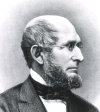
- Pickerin'gia/pickerin'gii: named for Charles Pickering (1805-1878) of the Philadelphia Academy of Sciences who
 |
|
came to California with the Wilkes Expedition as a physician and botanist. He was born in Susquehanna County, Pennsylvania and grew up in Wenham, Massachusetts. There seems to be conflicting information online regarding his collegiate career. Wikipedia says he got a medical degree from Harvard University in 1826 (when he would have been 21). JSTOR says he gained a degree in medicine at Harvard University in 1823 (when he would have been 18). And the website Chrono-Biological Sketches says he got an AB degree from Harvard College in 1823 and his MD |
from Boston Medical College in 1826. In any case, he got a medical degree and began a practice in Philadelphia. He also became the librarian and curator at the Academy of Natural Sciences in Philadelphia. From 1838 to 1842 he served as chief zoologist on the United States Exploring Expedition under its commander Lt. Charles Wilkes, an exploration of the Pacific Ocean and surrounding areas, following which it was his responsibility to organize and curate the collection which was gathered by the expedition, some of which had been mishandled and damaged or lost during shipment. These collections became part of the founding collections of the Smithsonian Institution and are housed today in the National Museum of Natural History. From 1843 to 1845 he traveled through the Mediterranean, Egypt, the Red Sea, Zanzibar, and India to research human races which he believed had developed independently, and in 1848 published Races of Man and Their Geographical Distribution, which included eleven races. In 1845 he moved to Boston and resumed a medical practice and engaged in further research. In 1854 he published what has been described as his magnum opus The Geographical Distribution of Animals and Plants which chronicled the diffusion of human populations by focusing on the plant forms they brought along with them and distinguishing them from native species. He died in 1878 and his Chronological History of Plants: Man's Record of His Own Existence Illustrated Through Their Names, Uses, and Companionship was published the following year. The genus Pickeringia was published in 1840 by Thomas Nuttall.
- pickettia'nus: named for Fermen Layton Pickett (1881-1940), a professor of botany at Washington State University. He was born in Bakers Corners, Indiana, and obtained a doctorate at Indiana University. He taught at Washington State University from 1914 until his death. He worked mainly in bryophyta and in plant physiology. His major botanical interests were mosses and plant physiology. He served as chairman of the botany department and as dean of the graduate school for many years. His department educated several significant botanical scientists and sponsored many important research projects. His most important achievement may have been securing the herbarium of Wilhelm N. Suksdorf for the university. He was also a skilled photographer and one of the few in the 1920s who photographed a large number of natural features (geological formations, vegetations, rivers, lakes, and mountains). JSTOR lists him as a co-collector of systematic botanist Harold St. John of the University of Hawaii and Reed Clark Rollins, director of the Gray Herbarium at Harvard. He died at Pullman, Washington, and his papers are held at Washington State University.
- Picradeniop'sis: like genus Picradenia. The genus Picradeniopsis was published by Per Axel Rydberg in 1901.
- Pi'cris: from the Greek pikros for "bitter, pungent."
The genus Picris was published in 1753 by Carl Linnaeus.
- pic'ta/pic'tus: painted, brightly colored, from Latin pictus, "painted."
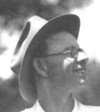
- pierc'ei: named for Wright McEwan Pierce (1886-1937), an ornithologist who assisted William Leon Dawson with
 |
|
The Birds of California, A Complete, Scientific and Popular Account of the 580 Species and Subspecies of Birds Found in the State, in four volumes. He collected a specimen of Passerella iliaca stephensi on Santa Catalina Island in 1916. The following is quoted from an obituary in the journal Condor, XXXIX July 1937 p.179: “Wright M. Pierce, member of the Cooper Ornithological Club and of its board of governors, died in April of this year. One of Wright Pierce’s most outstanding qualities was his desire to help and befriend young naturalists. His spring field |
trips into the desert region of southern California were high points in the experience of those fortunate to accompany him. Possessed of a keen eye, he could spot a motionless bird or a nest half hidden in the foliage long before most people would catch sight of it. He was careful and precise in making his records, and on collecting trips he was an indefatigable worker in spite of the severe physical handicaps which he endured but to which he never referred. Aspiring youngsters with whom he came in contact appreciated these qualities and tried to emulate them with the result that his influence has in more than one case been perpetuated in the younger generation of ornithologists.” He is buried in Pomona Cemetery and Mausoleum with his wife, Laura (1894-1984). (Photo credit: Islapedia)
- pigmae'a: pygmy, dwarf.
- pi'gra: from the Latin piger, which Wiktionary defines as "backward, slow, dull, lazy, indolent, sluggish, inactive," but which Gledhill says, perhaps in a botanical sense, for "sluggish or slow-growing."
- pil'geri: named for Robert Knud Friedrich Pilger (1876-1953), a German botanist, traveller, and botanical explorer born in Helgoland. He collected plants in the Mato Grosso of Brazil, and from 1945 to 1950 was director of the botanical garden at Berlin-Dahlem. He specialized in conifers. He was first to describe Podocarpus ledermannii in 1916 and Acmopyle pancheri in 1926. He also collected plants in Europe, especially Croatia.The genera Pilgerodendron and Pilgerochloa were named in his honor. Among his books were works on the families Taxaceae and Plantaginaceae. He died in Berlin.
- pilocar'pa: with hairy fruit.
- pilo'sa/pilo'sum/pilo'sus:
from the Latin pilosus meaning "hairy," from pilus,
"a hair," thus covered with long, soft hairs.
- pilosis'sima: very hairy.
- Pilosty'les: FNA says that the name Pilostyles derives from the Greek pilos, "cap," and stylos, "pillar or column," alluding to the style which is terminated by a caplike stigma. I wonder about this however. because the 's' can't go with both 'Pilos' and 'stylos.' But who am I to question FNA? The genus Pilostyles was published by Jean Baptiste Antoine Guillemin in 1834.
- pilo'sula: somewhat pilose.
- Pilular'ia: from the Latin pilula, "a little ball."
referring to the sporangium case. The genus Pilularia was published by Carl Linnaeus in 1753.
- pilular'is: having globules, referring either
to galls on the stems or on the flower buds.
- pilulif'erum: bearing little balls or globules,
in this case referring to the globular flowering heads.
- pimpinello'ides: like or having some resemblance or similarity to
genus Pimpinella in the carrot family.
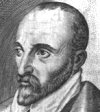
- Pinel'lia: named for the Italian botanist Giovanni Vincenzo Pinelli
(1535-1601), founder of the botanic gardens in
 |
|
Naples. The following
is quoted from Wikipedia: "Gian Vincenzo Pinelli (1535–1601)
was a humanist of Padua, a savant whose collection of manuscripts,
when it was purchased from his estate in 1608 for the Biblioteca Ambrosiana,
filled 70 cases. A mentor of Galileo, a collector of scientific instruments
whose literary correspondence put him at the center of a European
network of virtuosi, Pinelli stood out among among the early bibliophile
collectors who established scientific bases for the methodically assembled
private library, aided by the comparatively new figure—in the |
European world— of the bookseller. He was among Europe's early
botanists and also collected mathematical instruments. He had taken musical
instruction from the great madrigalist Philipp de Monte, with whom
he continued a correspondence. His kept his amanuensis Camillus Venetus
(Zanettus) busy. His love of books and manuscripts, and his interest
in optics, labored under a disability: a childhood mishap had destroyed
the vision of one eye, forcing him to protect his weak vision with
green-tinted lenses. Cautious and withdrawn by nature, detesting travel
whether by road or canal boat, wracked by the gallstones that eventually
killed him, he found solace in the library he amassed over a period
of fifty years (Nuovo 2003). Leonardo's treatise on painting, Trattato
della Pittura, was transcribed in the Codex Pinellianus circa 1585,
perhaps expressly for Pinelli who made annotations in it. Pinelli's
codex was the source for the Barberini codex from which it was eventually
printed, ostensibly edited by Raphael du Fresne, in 1651. Pinelli's
interest in the new science of optics was formative for Galileo Galilei,
for whom Pinelli opened his library in the 1590s, where Galileo read
the unpublished manuscripts, consisting of lecture notes and drafts
of essays on optics, of Ettore Ausonio, a Venetian mathematician and
physician, and of Giuseppe Moleto, professor of mathematics at Padua
(Dupre). His enormous library was probably the greatest in 16th-century
Italy, consisting of around 8,500 printed works at the moment of his
death, plus hundreds of manuscripts. When he died, in 1601, Nicolas
Fabri de Peiresc was in his house and spent some of the following
months studying his library and taking notes from its catalogues.
Pinelli's secretary, Paolo Gualdo, wrote and published (1607) a biography
of Pinelli which is also the portrait of the perfect scholar and book-collector.
Beside his Greek and Latin libraries of manuscripts his collection
included the original Arabic manuscript from which was translated
and printed the Descrizione dell'Africa of Leo Africanus. In the field of botany, he collected
herbs in his garden and corresponded with the father of Italian botany,
Luca Ghini, who pioneered the techniques of drying and pressing plant
material for a herbarium and whose papers he transcribed after Ghini's
death, while the botanists who would be considered Ghini's heirs,
like Andrea Mattioli and Ulisse Aldrovandi, clamored for them. Pinelli's
voluminous correspondence with the French humanist and book collector
Claude Dupuy was published in 2001. He is commemorated in Padua with
Via Vincenzo Pinelli and with the Aroid genus Pinellia." The genus Pinellia was published by Michele Tenore in 1839.
- pinetor'um: of the pine forests.
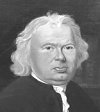
- Pin'graea: named for Alexandre-Gui Pingré (1711-1796), a French priest, astronomer and naval geographer born in
 |
|
Paris. He was educated by the priests of the Abbey of St. Vincent in Senlis, Oise, which he entered at the age of sixteen. He received ordination as a priest, and was appointed professor of theology at the school, but ran into difficulty because of his adherence to the theological movement called Jansenism because of which he was rebuked and required to submit to an interrogation by a committee of Jesuits. He was relegated to the rural parish of Rouen and was appointed as an astronomer and in 1749 professor of astronomy at the newly founded Academy of Sciences at |
Rouen, an institution founded in 1744 by the eminent surgeon Claude Le Cat. He would eventually be appointed the librarian of the Abbey of St Genevieve in Paris, and the university's chancellor. At St. Genevieve he would build an observatory, and continue to work there for forty years. He became well known because of his calculations relating to the transit of Mercury and was made a corresponding member of the Académie des Sciences. His first expedition to observe the transit of Venus near Madagascar in 1761 was unsuccessful, but in 1769 he was part of a successful expedition to Haiti to observe the same astronomical event. He had the reputation as an excellent mathematician and in 1757 he became interested in comets and published a substantial treatise on the theory and observational history of comets. He was also interested in and designed several accurate sundials. He became astronomer-geographer to the navy, and in 1767, 1768 and 1771 he went on naval expeditions to check the accuracy of chronometers with respect to the determination of longitudes. The suppression of his monastery during the French Revolution impoverished him but he managed to continue publishing until his death through the support of fellow astronomer, Jérôme Lalande, who obtained for him a grant of 3,000 francs from the National Assembly. Among his major works were Annales céleste du dix-septième siècle and Cometographie ou traite historique et theorique des cometes, a monumental work in four parts that included a history of astronomy from Babylonian and Egyptian times, with particular reference to ideas about comets. The second part was a catalog of all comets observed since antiquity, with the orbital elements of 166 for which paths had been computed, 50 of them by Pingre himself. The third section discussed cometary returns, theories about the nature of comets, and the physical effects likely to ensue from their close approach to the earth. The fourth part concerned cometary orbits and methods for computing them. The high reputation of the Cométographie was deserved, and as recently as 1950 it was officially recommended as a source book of cometary information. According to Encyclopedia.com “There is still a voluminous collection of Pingré’s unedited manuscripts at the library of Ste. Genevieve. They do not seem to be astronomical, however, but to cover his other interests, ranging from translations of Spanish voyages, history and historical criticism, and literary sketches to liturgical hymns, musical satires, and a vast amount of French and Latin poetry. It is as an astronomer, however, that Pingre is remembered.” The Pingré crater on the moon is named for him, as is an asteroid. The genus Pingraea was published by Alexandre Henri Gabriel de Cassini in 1826. (Photo credit: Bibliothèque Sainte-Geneviève)
- Pinguic'ula: from the Latin pinguis, "fat," alluding
to the greasy appearance of the viscid leaves. Wikipedia adds: "The name Pinguicula is derived from a term coined by Conrad Gesner, who in his 1561 work entitled Horti Germaniae commented on the glistening leaves: 'propter pinguia et tenera folia…' " The genus Pinguicula was published by Carl Linnaeus in 1753.
- pinico'la: an inhabitant of pine woods.
- pinifo'lia: having pine-like or needle-like
leaves.
- pinna'ta/pinna'tum: feathered or feathery,
pinnate, in reference to the leaves.
- pinnati'fida/pinnati'fidum/pinnati'fidus: pinnately cut.
- pinnatisec'ta/pinnatisec'tum: pinnately sectioned, cut or cleft.
- pinna'tum: featherlike, with leaflets on either side of a common
stalk.
- pino'rum: alternative form of pinetorum? The article "The Reproductive Biology and Host Specificity of Orobanche Pinorum" by Mark Ellis, Ronald Taylor and Richy Harrod in Madroño Vol. 46, No. 1 (1999) states: "The type specimen of Orobanche pinorum was collected by Andreas Geyer nearly 150 years ago. It seems evident that Geyer coined the epithet pinorum based on what he assumed was the host family." However, as their article points out, there is little to no evidence that coniferous species are a host to this taxon.
- Pi'nus: the ancient Latin name. The genus Pinus was published by Carl Linnaeus in 1753.
- pinz'lae/pinz'liae: named for Ann Patricia Pinzl née Gormley (1946- ), founder of the herbarium at the Nevada State Museum, curator of natural history, botanist and plant collector of the White Mountains. She was a founding member of both the Nevada Native Plant Society (of which she was later president) and the Nevada Museums Association. She was born and raised in New York City, where as a youngster she hung out at the American Museum of Natural History and observed and studied ants in the cracks of the sidewalks and washed-up marine life on the beaches. She received a bachelor's degree in forest zoology from the State University of New York in 1968, and took up botany as a component of that field. She has traveled to places such as Botswana, Namibia, India, the Amazon, Papua New Guinea and Borneo. She botanized extensively throughout Nevada. My thanks to her for providing this information.
- piorkow'skii: named for botanist Jeffrey Martin Piorkowski (1961-2006), born in Monrovia, California, and a longtime resident of Las Vegas. He graduated from UNLV a botanist in environmental studies. He died in Santa Cruz, California.
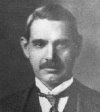
- pi'peri/Piper'ia: named for Charles Vancouver Piper (1867-1926), an agronomist
with the US Department of Agri-
 |
|
culture and an expert on Pacific northwest
flora. The following is quoted from a website of the Northwest
Digital Archives entitled "Guide to the Charles Vancouver Piper
Papers" which are held in the Washington State University Libraries:
"Charles V. Piper was born in Victoria, British Columbia, in
1867. He grew up in Seattle, and attended the Territorial University
of Washington until about 1892, although he had received his bachelor’s
degree in 1885 at the age of 18. Piper’s career as a botanist
had two almost distinct, although overlapping, phases, first as a
regional |
taxonomist in the northwest and later as an agronomist with
the United States Department of Agriculture at Washington, D.C. His
activity as a student of northwest flora began in the mid-1880s, associated
with his mountaineering hobby and supported by the Young Naturalists,
a Seattle scientific society. Piper joined the staff of the newly-opened Washington Agricultural College and School of Science, now
Washington State University, in late 1892, and spent the next decade
at Pullman, except for one year while a fellow at the Gray Herbarium
of Harvard University. At Pullman, he and his collaborator, R. Kent
Beattie, composed the first reasonably complete and authoritative
regional flora, beginning with a survey of the Palouse area of southeastern
Washington and expanding into the 1906 Flora of Washington. The investigations
Piper conducted at Pullman also served as the basis for two later
publications, Flora of Southeast Washington and Adjacent Idaho (1941) and Flora of the Northwest Coast (1915). Piper’s career as a USDA researcher
began in 1903 and continued to his death in 1926. His primary work
consisted of the location, domestication or development and introduction
of grasses. His most notable success during these years involved his
discovery of Sudan grass, a plant he found in Africa and introduced
to North America as a forage plant. As a plant scientist Piper often
attempted to take positions which placed him simultaneously in several
of the various schools of thought which characterized the bitterly
divided field of botany of his day. Throughout his career he consistently
emphasized attention to economic and agricultural plants, much to
the criticism of the purists of the profession. He also attempted
to combine various positions in the nomenclature dispute: while arguing
for the necessity of historical research to establish the validity
of original names, his Flora adhered to the names proposed by the
International Rule school. He himself undertook a great deal of the
historical research inspired by the American Rule school. He was greatly
involved in the re-discovery of Meriwether Lewis’ lost herbarium
and encouraged the publications of journals of earlier plant explorers
of the northwest, such as Archibald Menzies and David Douglas. On
one occasion, Piper even traveled to England to make a copy of Douglas’
journal, which was not then available in the United States. Piper
also took a mixed position on matters of 'splitting' and
'lumping.' While criticized as a 'splitter' and
'too anxious for new species,' he expressed opinions which
tended to encourage 'lumping.' Poor health began to restrict
Piper’s activities in his early 50s and he died at Washington,
DC in 1926." And from a website of the US
Golf Association [Piper was the first chairman of the USGA Green
Section]: "In 1888, Piper climbed Mt. Rainier in a party that
included John Muir, the Sierra Club founder. During the descent, Piper
nearly lost his life; all save Piper and Muir had crossed an ice bridge
over a crevasse, and then the expedition photographer heard a 'cry
[that] made the very blood in our veins turn cold. This time it was
Piper. He stepped into the middle of the bridge and it had given way
with him; he had thrown himself forward and caught.' 'My alpenstock
and the whole ice bridge fell into the crevasse,' remembered Piper
in 1915. 'I have often wondered what would have happened if I had
attempted to go across the bridge in the ordinary way.' It was at
this time that Piper began extensive botanical investigations that
he would carry on until his death in 1926. Botany was his passion,
and he collected and described many new species. He exchanged plant
specimens with herbaria and other collectors; with Edward Lee Greene
of Berkeley and Charles Sprague Sargent at Harvard, Piper disputed
the former’s classification of the Oregon white oak, Quercus
garryana. When President Cleveland established forest reserves in
the 1890s, Sargent wrote to Piper, noting, 'There is a very bitter
feeling in the west against these reservations and we are going to
have difficulty in holding them unless local public sentiment can
be aroused in their favor. I count on you to do everything possible
to help this good cause.' " The genus Piperia was published by Per Axel Rydberg in 1901. (Photo credit: Patuxent Wildlife Research Center)
- piperi'ta: pepperlike, tasting hot and sharp
like pepper, derived from the New Latin word piperitus, which means "pepper-like."
- pipersmith'ii: named for Charles Piper Smith (1877-1955), a Canadian-American botanist, forester, and entomologist. He received a PhD from Stanford University in 1927, and he taught from 1920 to 1940 at San Jose High School.
- Piptather'um: from the Greek pipto,
"to fall," and the word ather for "awn," thus "falling
awn." The genus Piptatherum was published by Ambroise Marie François Joseph Palisot de Beauvois in 1812.
- Piptochae'tium: from the Greek pipto, "to fall,"
and chaite, "bristle or long hair," for the deciduous awns. The genus Piptochaetium was published by Jan Svatopluk Presl in 1830.
- pirifo'lia: with leaves like the pear, from the Latin pirum,
"a pear."
- piscinen'sis: from the Latin piscis, "a fish," and
the suffix -ensis, this taxon is named by the Jepson Manual as Fish
Slough milkvetch and the habitat is given as wet soil. "Fish
Slough is a unique desert wetland ecosystem [near Bishop in the eastern
Sierra Nevadas] with rare plants and fish, an unusual geological site
with highly visible seismic and volcanic features, and an outstanding
cultural site including ancient petroglyphs and grinding stones."
(This from a website called Hands
on the Land).
- pisocar'pa: with pea-like fruit, from Greek pisos, "a pea."
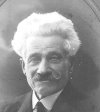
- pissard'ii: named for Ernest Francois Pissard (1850-1934), a French horticulturist born at Sallanche, Haute Savoie,
 |
|
France. He attended the Ecole d’Agriculture in 1866 and worked at the Jardin des Plantes in Paris from 1855 to 1870. He spent a time in military service and was at the siege of Paris during the Franco-Prussian War of 1870-1871 and then in Algeria. He later returned to Paris and was again at the Jardin des Plantes until 1878. At this time Nasser-al-Din Shah Qajar (1831-1896) was the Shah of Persia and in 1871 he was the first Persian monarch to visit Europe. Pissard introduced a number of Western innovations to Iran, including a modern postal system, rail transport, a banking system |
and newspaper publishing. This sovereign, who came to Paris in 1878 to visit the world exhibition, was amazed at the beauty of the gardens of Paris and Versailles. He wanted to have a French gardener. He was recommended to Ernest Pissard, accepted him and took him to Teheran where he charged him to transform the gardens of his palace. Pissard remained in Iran for several years, and brought back to Europe Prunus pissardii, or Pissard’s plum. I know little about his post-Iran life except that he married in 1884 and settled in a cottage at Arcachon. He died in Talence at the age of 84. (Photo credit: HelpMeFind.com)
- Pista'cia: Umberto Quattrocchi says this name derives from the Latin
name pistacia for a pistachio-tree and from the Greek pistake for the nut of the pistachio-tree. Both words apparently derive in
turn from an ancient Arabic or Persian name. The genus Pistacia was published by Carl Linnaeus in 1753.
- Pist'ia: from the Greek pistos, "water," alluding
to the floating or aquatic habitat of this genus, whose common name
is water-lettuce. The genus Pistia was published in 1753 by Carl Linnaeus.
- Pi'sum: the Latin name for the ancient and well-known
pea. The genus Pisum was published by Carl Linnaeus in 1753.
- pitard'ii: named for Charles-Joseph Marie Pitard (or Pitard-Briau) (1850-1934), a botanist, pharmacist and plant collector born in Laval, France. JSTOR provides the following information: “Charles-Joseph Pitard (or Pitard-Briau) was professor of pharmacy at the University of Tours, France. He collected plants in the Canary Islands and North Africa, presenting his collections to the herbaria in Geneva and Paris. Pitard took his doctorate at the University of Bordeaux in 1899, and remained working there until his appointment as professor at Tours in 1901, where he was also curator. Pitard collected in the Canaries in 1904-1906, on two separate expeditions, and explored Tunisia in 1907, 1908, 1909-1910 and 1913. He carried out fieldwork in Morocco in 1911-1913. On his return from the Canaries, Pitard worked with Louis Proust on a flora of the islands, Les Iles Canaries. Flore de l'Archipel (1908). He later published Contribution à l'étude de la Flore du Maroc (1931). As well as the collections at Geneva and Paris, a large number of duplicates of Pitard's collections were distributed to other herbaria.” He died in Tours. The species Campylostelium pitardii was first named in the article “Additions à la flore des Muscinées de la Tunisie” by Pitard and Louis Corbiere in the Bulletin de la Société Botanique de France in 1909.
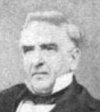
- pitch'eri: named for Dr. Zina Pitcher (1797-1872), an American physician, politician, educator, academic adminis-
 |
|
trator, and botanist. He was born in Sandy Hill, New York, was educated at local schools, studied medicine with neighboring physicians, attended medical lectures at the Castleton School, and entered Middlebury College in Vermont, graduating with a degree in medicine in 1822. While studying medicine he tutored in Latin, Greek and natural sciences. He was appointed assistant surgeon in the US Army by Secretary of War James C. Calhoun in 1822 and married Ann Sheldon of Kalamazoo County in 1824. He spent the next six years at posts in Michigan, and several more |
years at other posts. An article about him on Wikisource’s American Medical Biographies says: “During his years of army service he was stationed at different points on the northern lakes (then a savage frontier), on the tributaries of the Arkansas, among the Creeks, Cherokees, Choctaws and Osages, and at Fortress Monroe. At these places his leisure hours were spent in study of the nature around him, observation of the habits of the Indians, their diseases and the means used for their recovery. The results of these studies may be seen in works on botany, in plants named for him, on fossils bearing his name, and in a letter to Dr. Morton on the existence of consumption among the aborigines, and in his article on "Indian Therapeutics," printed in the fourth volume of Henry Rowe Schoolcraft's Information, Respecting The History, Conditions and Prospects of the Indian Tribes.” In 1835 he became president of the Army Medical Board. He resigned from the Army at the end of 1836 to take up private practice in Detroit. Among the civic positions he held were member of the board of regents of the University of Michigan, president of the American Medical Association, and two-time mayor of Detroit. From 1848 to 1867, Dr. Pitcher served as a physician at St. Mary’s Hospital and also as a surgeon at the US Marine Hospital in Detroit. In 1859 he was appointed examiner of the mint by President Buchanan. He was the editor of the Peninsular Medical Journal, 1855–56–58. He was president of the Old Territorial Medical Society during fourteen years, president of the Michigan State Medical Society, 1855-56, a founder of the Sydenham Society, and the Detroit Medical Society. In addition to these things, he was a director of the Detroit Savings Fund Institute (later Detroit Bank and Trust and now Comerica Bank), and served as trustee of the Kalamazoo Asylum, later the Kalamazoo State Hospital. Pitcher was also an excellent botanist (not uncommon for medical professionals of his day). He collected and studied plants in the Great Lakes region, and the exceedingly rare Pitcher's thistle (Cirsium pitcheri) was first collected by him from the Grand Sable Dunes during his service as an army surgeon, and subsequently named for him as well. At times Pitcher teamed with botanist Thomas Nuttall. In 1864 his first wife died and he was remarried in 1867 with Emily Backus, granddaughter of the founder of Rochester, New York, and a future acting governor of New York. The Wikisource article says further that “While in Texas he collected many fossils and forwarded them to the Philadelphia Academy of Natural Sciences. Studies of these and allied collections were the basis of Dr. Samuel George Morton's work entitled Synopsis of the Organic Remains of the Cretaceous Group of the United States. One of the specimens is known as Gryphœa pitcheri. In Gray and Torrey's Flora of the United States, several new species are named for Dr. Pitcher in acknowledgment of his service to botany. He was a frequent contributor to medical literature, treating a wide variety of subjects. His home was at the service of the sick; he was known to have taken a stranger suffering from smallpox into his home, and to both nurse and doctor him to recovery. Moreover, to him the Bible was a guide, a counsellor and inspiration.” His half-brother Nathaniel Pitcher was governor of New York. Another brother, James Pitcher, was the first Mayor of Little Rock, Arkansas. He died in 1872 from an unoperated stone in the bladder.
- pitkinen'se: named for Pitkin Marsh in Sonoma County.
- Pittospo'rum: from the Greek pitta, "resin," and sporos, "seed." The genus Pittosporum was published by Joseph Banks in 1788.
- Pityo'pus: pine foot from the Greek pitys, "pine," and pous or podos, "foot," from the habitat. The genus Pityopus was published by John Kunkel Small in 1914.
- piuten'se/piuten'sis: of or from the Piute Mts in the southern Sierra Nevadas.
- Plagioboth'rys: derived from two Greek
words plagios, "oblique or placed sideways," and bothros, "a pit or scar," hence meaning "hollow
at the side," and possibly referring to the pitted face of the
nutlets or the position of the nutlet attachment scar on P. fulvus,
the first known species. The genus Plagiobothrys was published by Friedrich Ernst Ludwig von Fischer and
Carl Anton von Meyer in 1835.
- plagioto'ma: from the Greek plagios meaning "oblique transverse, slanting," and tomos, "a cut or slice," in reference to the broad, stubby lobes of the calyx.
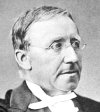
- planchon'ii: named for Jules Émile Planchon (1823-1888), a French botanist born at Ganges, Hérault. I have little
 |
|
information about his early life, but he was awarded a doctorate of science at the University of Montpellier in 1844, and then went to England where he worked as keeper of the herbarium at Kew Gardens in London. The website Victoria-Adventure.org which deals with water lilies and other aquatic plants provides the following information: “In 1849, he went to Gent as a teacher at the Institute of Horticulture and went in 1851 to Nancy, where he was appointed teacher at the University of Medecine and Pharmacy. In 1853, he finally took up the head of the department of |
botanical sciences at the Montpellier University of Sciences. In 1856 he was simultaneously appointed teacher at the University of Pharmacy and soon became the director of that institution. He left his teaching activities at the University of Sciences in 1881 and was appointed head of the department of botanics at the University of Medicine, a position which included the management of the Botanical Garden.” He remained at Montpellier University for the rest of his career. He was a corresponding member of the French Academies of Sciences and of Medicine. In 1873, he was put in charge of a scientific mission about phylloxera; he had discovered, named and studied this disease of the grape plant in 1868. His valuable achievements in this matter made his name popular in the whole of southern France. He introduced the American vine plants resistant to the disease, which brought a relief welcomed in all French vineyards after the extensive damages made by phylloxera. In scientific circles, he is much more famous because of his very important contributions to the botanical sciences, which mainly dealt with systematics as well as with affinities between plants (he wrote monographs about Ampelideae, Guttifereae, Ulmaceae, Simaroubeae, etc., and many descriptions of new species and varieties). His interests were directed to various fields of knowledge: botanical geography, organography, cryptogamy (see his research about the deseases of the vine plant), horticulture, agriculture and historical research.” The website of the Australian National Herbarium adds: “Speaking of the ‘vast’ Hookerian herbarium at Kew, ‘the chief foundation’ of the Flora Australiensis, Bentham, who was never prodigal of personal praise, says: 'The value of this herbarium for a work like the present, is also greatly increased by the notes and determinations it contains from the hands of various botanists who have worked in it, and especially of Dr. Planchon, who had examined and corrected the determination of a large portion of the specimens it contained during several years that he had charge of it.' (Preface to Flora Australiensis 8). Planchon had been Sir William J. Hooker's herbarium curator, and surely any account of the services of the early French botanists to Australia would be incomplete without a brief notice of him.” His works included American vines: their culture, phylloxera resistance and their future in Europe, Phylloxera in Europe and America, Botanical and horticultural history of Azalea plants from India, Preludia florae columbianae (1853), Plantae columbianae with Jean Jules Linden, and Prodromus florae novo-granatensis and Mémoire sur la familie des Guttiferes both with José Jerónimo Triana. He died at Montpellier.
- plani-: from the Latin planus, diminutive of planula,
"flat, level, even."
- planifo'lia: with
flat leaves.
- plan'ipes: with a flat stalk. (compare brevipes,
crassipes, gracilipes, filipes)
- planipet'ala: with flat petals.
- planispica'ta: flat-spiked.
- planispi'num: with flat spines.
- plank'ii: named for Elisha Newton Plank (1831-1907). The following is quoted from an article entitled “Elisha
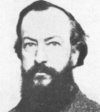 |
|
Newton Plank” by John Buchholz in The American Midland Naturalist (Vol. 21, No. 2, March, 1939): “Elisha Newton Plank was an active botanist and collector of southwestern plants during 1880-1900. He carried on his work independently without the advantages of school or college connections. The story of his life and activities have become a matter of increasing interest to systematic botanists. His better known botanical activities center in Kansas, Texas, and Arkansas, but we find that he came west from New York and was of New England parentage. He was born |
March 23, 1831 near Wolcott, Wayne County, New York, and died September 21, 1907 at Decatur, Arkansas. [He] was the youngest of several children, a descendent of New England families who had furnished soldiers to the Continental Army, and it is not surprising that at the outset of the Civil War we find that he organized a company of volunteers at Wolcott, of which he was chosen Captain, but could not himself qualify for active service because of physical defects.” Having only had a meager education in a private school at Wolcott and Falley Seminary at Fulton, New York, he embarked on a course of self study, which included botany, English literature, history and philosophy, something that he continued throughout his life. He started a botanical garden and experimented on the cultivation of plants he collected, began a local herbarium, stating that he wanted one day to be a botanist, and compiled a list of more than three hundred of the native and naturalized species of the vicinity of Wolcott. There is mention of his being engaged in the practice of law, but I have been unable to determine what his legal education might have been. He organized and promoted a local agricultural society, established a free public school, was mayor of his town for a time, was active in promoting the building of railways in Wayne County where Wolcott was located, and served as attorney for the Ontario and Lake Shore Railway. In 1879 he moved his family to Independence, Montgomery County, Kansas and later to Wyandotte, now a part of Kansas City, Kansas, and his interest in botany was energized anew by the unfamiliar flora of that area. In 1880 he delivered a lecture on Kansas forests and forestry before the Kansas State Horticultural Society, and he also contributed a paper in the Transactions of the Kansas Academy of Science in which he announced his project of a flora of Montgomery County. He became a lecturer on botanical and kindred subjects on many occasions, and addressed the 14th annual meeting of the Kansas Academy of Science on the subject of botany. He soon began expanding the areas of his botanical investigations and collected specimens in ever county in Kansas, amassing a herbarium of between 6,000 and 10,000 sheets. It was his intention to publish a flora of Kansas, but financial restrictions sadly made that impossible. Soon he started collecting beyond the borders of Kansas, and gathered several thousand sheets of specimens from Texas and Arkansas. He wrote an extensive series of articles on the flora and agriculture of Texas which were published in the journal Garden and Forest. His last contribution which was on the flora of southwestern Arkansas, appeared in the magazine Plant World in 1898 near the time when he moved his residence from Kansas City to make his home with one of his sons, E.N. Plank, Jr. at Decatur, Arkansas, where he died in 1907. Plank’s collections of southwestern plants contain many specimens which constitute the earliest known locality record for the species. (Photo credit: American Midland Naturalist, 21:2, 1939)
- Plano'des: from the Greek planos, "roaming, rambling
or wandering," because P. virginica had been placed in
so many different genera by different authors, and also because it
was distributed over such a wide area. The genus Planodes was published by Edward Lee Greene in 1912.
- plantagin'ea/plantagin'eum/plantagin'eus: resembling a plantain.
- Planta'go: a Latin name for the plantain from Latin planta which can have two meanings, "footprint or sole of the foot" or “a sprout, a shoot, a young tree or shrub that may be transplanted, a cutting,” and -ago, "resemblance," alluding to the leaf shape of Plantago major. The genus Plantago was published in 1753 by Carl Linnaeus.
- planta'go-aqua'tica: see previous
entry, plus 'aquatica' for a water plant.
- plan'um: flat.
- plasket'tii: named for Reason Alpha Plaskett (1852-1933), a plant collector born in Cherokee, California. He resided at Jolon before moving to Cambria and was a carpenter by profession, and a botanical collector. The Plasketts were large landowners in the Santa Lucia Mts in areas around Jolon and San Antonio and along the coast, and were host to Alice Eastwood when she botanized in that area in 1893 and 1897. Reason Plaskett began to collect plants around 1897 and sent them to her. His collections in less than five months included at least six new species or varieties. He died of a cerebral hemorrhage in Cambria, California, and was survived by six brothers and sisters.
- Platan'thera: from the Greek for "flat"
and "anther," hence "wide- or flat-anthered." The genus Platanthera was published by Louis Claude Marie Richard in 1817.
- Plat'anus: from the Greek name platanos for the long-lived oriental plane tree. The genus Platanus was published by Carl Linnaeus in 1753.
- platen'sis: I suspect since this taxon is supposed to be native to
Argentina that this name refers to the River Plate or to that region.
- plattia'na: named for Ralph Hilton Platt (1864-1928). He was born in Leroy, New York, and came to Santa Barbara in 1871 and to Vacaville in 1872. He sold insurance and real estate and was a justice of the peace 1910-1914 and 1918-1928. He was also a fairly prolific plant collector and observer of the flora around Vacaville, and was mentioned frequently in Willis Jepson's field books.
- platy-: a prefix signifying flat, broad or wide.
- platycar'pa: broad-nutted, with broad
fruits.
- platycar'pha: two possibilities are: (1) derived from platys,
"flat or wide," and karphos, "a dry splinter,
twig, straw," in turn from karpho, "to dry up
or wither," referring to the pappus or to the scales of the involucre;
(2) it is also possible that this is just an alternate spelling of
'platycarpa' meaning "broad-nutted."
- platycau'le: broad-stemmed.
- platyglos'sa: broad-tongued, referring
to the ray flowers.
- platyle'pis: broad-scaled.
- platylo'ba: with broad lobes.
- platyo'ta: as in the other words listed here, platy means flat or wide. -Ota is listed in Jaeger as
a suffix meaning "having," but if that is its meaning in
this case, we have a word with a prefix and a suffix with nothing
in between, unless -ota can be interpreted in a more general
sense as "being," which would make this "being broad
or flat." The only other possibility I can think of is
the root ot, which has to do with ears. If anyone has any further
information about this name, please let me know.
- platyphyl'la: broad-leaved.
- platyphyllid'ius: with flat leaflets.
- pla'tys: broad.
- platysper'ma: flat-seeded.
- Platystem'on: from the Greek platus,
"broad," and stemon, "stamens," referring
to the flattened stalks of the stamens. The genus Platystemon was published by George Bentham in 1835.
- platytro'pis: wide-keeled.
- Plaubel'ia: named for Dr. Julius August Plaubel (fl. 1828–1834), a mycologist and homeopathist of Gotha, Thuringia. The genus Plaubelia was published by Samuel Élisée von Bridel in 1826.
- playan'us: relating to a desert playa as its preferred habitat, this
taxon apparently inhabits sandy flats in the East Mojave Desert.
- Plecosta'chys: from the Greek plektis and stachys for a braided spike, from intricately branched habit. The genus Plecostachys was published by Olive Mary Hilliard and Brian (Bill) Laurence Burtt in 1981.
- plectosta'chyus: from the Greek plekto, pleko or plekein, "plaited
or twisted," and stachys, "an ear of grain, spike," in reference to the twisted and tangled growth habit.
- Plectri'tis: from the Latin plekto,
"to plait," alluding to the complex inflorescence. The genus Plectritis was published by Augustin Pyramus de Candolle in 1830.
- Pleiacan'thus: from the Greek pleios, "many, more than
one," and akantha, "thorn," h3nce "many-thorned." The genus Pleiacanthus was published by Per Axel Rydberg in 1917.
- pleniradia'ta: from the Latin for "full-rayed."
- Pleuraph'is: from the Greek for "side
needle," referring to the awn position on the lower glume of
the spikelet. The genus Pleuraphis was published by John Torrey in 1824.
- Pleuricospo'ra: from the Greek pleurikos, "the sides,
of the ribs," and spora or sporos, "a seed,
spore," thus "seeds at side" from the parietal placentas. The genus Pleuricospora was published by Asa Gray in 1868.
- pleurocar'pa: with fruit at the side or
rib-fruited. Some species have fruit with many prominent ribs.
- Pleurocoro'nis: from the Greek pleurikos,
"rib or side," and the Latin corona, "crown,"
referring to the pappus. The genus Pleurocoronis was published by Robert Merrill Robinson King and Ernest Harold in 1966.
- Pleuropo'gon: from the Greek pleuron, "side, rib, lateral,"
and pogon, "beard," referring to the awns at the
base of the palea in some species. The genus Pleuropogon was published by Robert Brown in 1823.
- plica'ta: pleated, from the Latin word plicare, "folded in plaits or braided."
- pliean'tha: possibly an alternate spelling or a misspelling
of pleiantha, from pleios, "more, many," and anthos,
"flower," thus "many-flowered." The taxon with this epithet is Navarretia plieantha.
- plocasper'ma: presumably from the Greek plokeus, "a braider,"
and/or plokos, "a lock of hair, curl, wreath," and sperma, "seed."
- Pluche'a: named for Noël-Antoine Pluche (1688-1761), a French naturalist born in Reims to the northeast of Paris.The
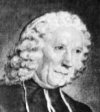 |
|
following is quoted from a website page on him at The Online Library of Liberty: "Noël-Antoine Pluche was born in 1688. After completing his studies, he became a professor first of humanities, then of rhetoric in his hometown of Rheims, before taking holy orders. The Bishop of Laon made him director of the collège (secondary school), an offer he accepted partly to escape the controversy that arose around him for his refusal to swear adherence to the papal bull Unigenitus (1713). After a lettre de cachet was prepared against him, he was provided with private tutorial positions by both |
Gasville (royal intendant of Rouen) and the Englishman Lord Stafford. After a chance discovery of information useful to the Crown, he was offered a lucrative priory by Cardinal Fleury—which he refused on principle because of his continued refusal to sign Unigenitus. Still, his teachings and writings began to gain some notoriety. He became deaf, retired in 1749 to Varenne-Saint-Maur, and died of apoplexy in 1761. His major work, Spectacle de la nature, was an eight-volume study of life and creation that was translated into virtually all European languages, still appearing in abridged editions in the early nineteenth century. His other works include Histoire du ciel (1739), La Méchanique des langues (1751), and Concorde de la Géographie des différents âges (1765), as well as works on Holy Scripture and French royal coronation ceremonies." Based on the pronunciation of the original French name Pluche, this name should probably be correctly pronounced "PLOOSH-a." The genus Pluchea was published in 1817 by Alexandre Henri Gabriel de Cassini.
- plumar'ius: feathered or plumed.
- plumatel'la: from the Latin meaning "small-feathered."
- Plumba'go: a Latin name derived from plumbum,
"lead," and ago, a common Latin plant name ending
indicating a resemblance. The genus Plumbago was published by Carl Linnaeus in 1753.
- plum'merae: named for Sara Allen Plummer Lemmon (1836-1923), a botanist and expert on ferns and seaweeds, and
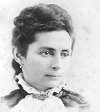 |
|
the wife of John Gill Lemmon (see lemmonii). She was born in New Gloucester, Maine, and attended the Female College of Worcester, Massachusetts, before moving to New York City, where she taught art for several years and studied at Cooper Union for the Advancement of Science and Art. She served as a volunteer nurse during the Civil War. She fell ill in 1868 and moved to California in 1869, settling in Santa Barbara where in 1871 she founded the town's first library. Operating out of a jewelry store on State Street, Plummer charged $5 membership or 10 cents |
for borrowing books, and sold a variety of art and music supplies, and held cultural gatherings including lectures and art exhibits. Five years later she met self-taught botanist, Civil War veteran and former Andersonville prisoner John Gill Lemmon who was instrumental in turning her life toward botany, and they were married in 1880. She sent him a shrub she had found near Santa Barbara and he named it Baccharis plummerae in recognition of her. She sold the library and began traveling seriously with Lemmon in pursuit of plants. In 1881, Mt. Lemmon outside of Tucson, Arizona, was named in her honor after she became the first white woman to climb it. In 1882 Asa Gray published the genus Plummera in her honor. While on their trip, the Lemmons endured several hardships and discovered and cataloged a number of species unique to the mountain, and after returning, they continued their botanical endeavors. The Lemmons co-developed the Lemmon Herbarium at their home, later donating it to UC Berkeley, where it was merged into and called the University and Jepson Herbaria. She continued her botanical illustrations, as the official artist for the California State Board of Forestry from 1888–1892, and acquired a national reputation for her work. In 1893, she lectured on forest conservation at the World’s Columbian Exposition in Chicago. During the 1890s she also advocated for the adoption of the golden poppy as the state flower of California, eventually writing the bill which was passed by the California Legislature and signed by the governor in 1903. Her husband J.G. died in 1908, and Sara Plummer Lemmon died in California in 1923.
- plumo'sa: plumed or feathery, from Latin plumosus, "covered with feathers."
- pluriflor'a/pluriflor'um: many-flowered, from Latin pluri meaning "many" and florus, '"flowers."
- plurise'ta: many-bristled.
- pluvia'lis: having to do with rain, flowering in the rainy season, from pluvia, "rain."
- Po'a: from the classical Greek name poa, poie, or poia for "grass" or "pasture
grass." The genus Poa was published by Carl Linnaeus in 1753.
- -poda: a suffix used to refer to the foot or base of a structure,
e.g. eriopoda, "woolly-footed;" brachypoda, "short-footed;"
leptopoda, "slender-footed."
- Podis'tera: from the Greek podos, "foot," and stereos,
"solid," because of its compactness. The genus Podistera was published by Sereno Watson in 1887.
- pod'perae: named for Czech botanist and Academician Josef Podpěra (1878-1954). He was born in Jilove u Prahy
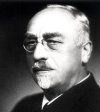 |
|
and was educated at schools in Prague. He studied floristry, bryology and phytogeography and received a doctorate at Czech University in 1903 with a dissertation on bryology. He briefly taught at grammar schools in Prague, and then relocated to Moravia where he taught natural history at a high school. In 1909 he was appointed curator of the Moravian Museum in Brno, and in 1912 became director of the botany department of the museum's collections. As a Lieutenant in the Austro-Hungarian Army in 1915, he was captured by Russian forces, and as a prisoner worked in |
the botanical department of the Gubern Museum in Ufa and later in Tomsk. He comprised great herbals from the southern slopes of the Urals and other regions of Russia and made valuable working friendships. He also gained an extensive knowledge of Russian botanical literature. From 1921 to 1951 he was a professor of general and systematic botany on the faculty of science at Masaryk University in Brno and director of its Botanical Institute, dean in 1925-1926 and 1934-1935, and rector and vice-rector in the years 1937 to 1940. He became an academician of the Czechoslovak Academy of Sciences in 1953 shortly before his death. He published over 300 works mainly with a phytogeographical focus, of which the most famous are Flora of Moravia in the past and present (1925) and Key to the Complete Flora of the Czechoslovak Republic (1928). His work in the field of systematics and geography of bryophytes, in particular the genus Bryum, was also substantial, occupying him for many years. He also produced a modern and comprehensive index of European mosses entitled Conspectus muscorum europaeorum published in 1954. He was the most influential Czech bryologist of the interwar period. Botanical names ending in 'ae' are usually for women, but there is also a convention that states that if a man's name ends in an 'a' it is to be followed by an 'e.'
- Pogo'gyne: means "bearded style,"
in reference to the hairs on the style slightly below the two stigma
lobes. The genus Pogogyne was published by George Bentham in 1834.
- pogonan'tha: from Greek pogon, "beard," and -anthus, "flowered," thus "with bearded flowers."
- Pohl'ia: named for Johann Ehrenfried Pohl (1746-1800), a German physician and botanist and the son of a physician. He was born in Leipzig and from 1763 to 1769 he studied medicine at the University of Leipzig, being awarded a doctorate in 1772. He embarked on a study trip to Strasbourg, Paris, Rouen and the Netherlands, and in 1773 he was appointed an associate professor of botany at Leipzig, then professor of pathology from 1789 to 1796 and professor of therapy from 1796 until his death. In 1788 he became personal physician to the royal court in Dresden. Among his published works were De soli differentia in cultura plantarum attendenda, Animadversiones in structuram ac figuram foliorum in plantis, De varice interno morborum quorundam caussa and Programma qua de analogia inter morbillos et tussim convulsivam. The moss genus Pohlia was published in 1801 by Johann Hedwig.
- Poincia'na: named for Philippe Blondel de Lonvilliers de Poincy (1584-1660), a naval officer, French colonial administrator and Commandeur of Oysemont for the Order of Malta (Order of St. John of Jerusalem), and one of the first governors of the West Indies. A member of the Order of Malta, a rich and powerful order of the Roman Catholic Church, he was chief officer of the Brittany squadron of ships, but lost his position due to a conflict with the archbishop of Bordeaux. In compensation, Cardinal de Richelieu then appointed him governor and lieutenant general of the islands of America where he became a champion of the cause of the Jesuits. The French government had chosen a more active role in the colonization of the Caribbean and sought to stifle the Spanish domination of the area. The Knights of Malta tried to colonize the area through the ventures of private companies that received the legislative support of the crown. Poincy was appointed Lieutenant General of the islands on February 15, 1638, and left France on January 12, 1639 for Saint-Christophe. However his taxes and the prohibition against trading with the Dutch caused much disaffection and he lost his position. A successor was appointed which he resisted, and much political turmoil ensued. At some point Poincy bought the island of Saint-Christophe and dependencies, later deeding them to the Order of Malta, and Poincy was confirmed as governor. He was responsible during the period 1650-1653 for seizing the island of Santa Cruz from the Spanish and renaming it St. Croix. It was a rich and fertile island, and all exports and imports were funneled through Saint-Christophe to Poincy's benefit, and it also was finally ceded to the Knights of Malta. Poincy was known to be generous in his charitable acts and kind deeds toward the native populations on the Caribbean islands. The island of Saint-Christophe was named in honor of the Commandeur's brother, Christophe. Poincy’s legacy is also evident on the island of Saint Martin as the Port of Lonvilliers on the northern coast of the island was certainly named in reference to the first governor and his nephew Robert Blondel de Longvilliers de Poincy who was assigned the governorship of Saint Domingue after the failure of his uncle's colony on Saint-Christophe. Saint-Christophe was eventually renamed St. Kitts by the British. The Poinciana is native to the Caribbean islands and was named for Poincy. He died on Saint-Christophe at the age of 77. The genus Poinciana was published by Carl Linnaeus in 1753.
- Poinset'tia: named for Joel Roberts Poinsett (1779-1851). He was an American physician and diplomat, the first US agent in South America, a member of the South Carolina legislature and the United States House of Representatives, the first United States Minister to Mexico, and a Unionist leader in South Carolina during the nullification crisis. He was also secretary of war under Martin Van Buren, and a co-founder of the National Institute for the Promotion of Science and the Useful Arts (a predecessor of the Smithsonian Institution). He was born in Charleston, South Carolina, spent his early childhood in England, returning to America in 1788, and was educated in Connecticut and Europe, gaining expertise in languages, the law, and military affairs. He studied medicine at the University of Edinburgh, attended a military school in Woolwich, England, and returned to Charleston in 1800. Eschewing his father’s desire that he become a lawyer and having an ardent desire to travel, he left for Europe in 1801, traveling extensively across the continent until the end of 1803 when he returned to Charleston after his father’s death. His sister was ill as well, and she subsequently died. In late 1806 he was in Russia where he met the Czar Alexander and the Empress, then traveled on through southern Russia and into the Turkik states of the Ottoman Empire and on to Persia, becoming one of the first US travellers to the Middle East. They then passed through Armenia, the Crimea and the Ukraine and eventually returned to Moscow. Of the nine that had departed on this hazardous journey, Poinsett and two others were the only survivors. He was sent to South America by President Madison in 1809 to investigate the prospects of the revolutionaries there in their struggle for independence from Spain and remained there until 1816. From 1816 until 1819 he was a member of the South Carolina House of Representatives, and then was elected to the US Congress, serving from 1821 to 1825, resigning to go into diplomatic service. After serving as minister to Mexico, he became secretary of war and used his position to authorize an expedition in 1838, led by French scientist Joseph Nicholas Nicollet with the assistance of American explorer and military officer John C. Frémont, to survey and map the region between the Mississippi and Missouri rivers. Poinsett also authorized an expedition by the explorer Charles Wilkes that reached Antarctica and sailed through the South Pacific Ocean and along the western coast of North America. Poinsett served until 1841 and then retired to his plantation in South Carolina, where he opposed the growing secessionist movement in his state. He spent his last days on a South Carolina plantation, and died on December 12, 1851. Poinsettias are native to Mexico and were introduced into the United States by Joel Poinsett in 1825. The genus Poinsettia was published by Robert Graham in 1836.
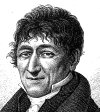
- poiret'ii: named for Jean-Louis Marie Poiret (1755-1834), a French clergyman, botanist and explorer born in Saint-
 |
|
Quentin, Picardy. JSTOR has the following: “He carried out significant exploration in Algeria in 1785-1786. The aim of the expedition, sponsored by King Louis XVI, was to produce an inventory of the flora of Barbary, and resulted in Poiret’s 1789 work Voyage en Barbarie. He later served as a professor at the École Centrale in Aisne, France. Among his other written works were Histoire philosophique, littéraire, économique des plantes d'Europe (1825-1829), Encyclopédie Méthodique: Botanique (1816, with J.B. Lamarck), and Flore médicale (1833-1835, as a co- |
author).” He died in Paris. He also had a genus Poiretia named for him in 1807 by Étienne Pierre Ventenat. (Photo credit: Stipple engraving by A. Tardieu, Wellcome Collection. CC BY)
- Polanis'ia: from the Greek polys, "many," and anisos,
"unequal," referring to the fact that the plant has numerous, long stamens of unequal lengths. The genus Polanisia was published by Constantine Samuel Rafinesque in 1819.
- Polemon'ium: may have come from the the Greek name polemonion for a (medicinal?) plant or group of plants including the Greek valerian or Jacob's ladder that was associated with the Greek herbalist and healer Polemon of Cappadocia. The genus is commonly called Jacob's ladder, the name deriving from the leaves that are pinnately compound, resembling a ladder, referring to a ladder seen in a dream by the biblical Jacob. Gledhill says the name refers to King Polemon of Pontus who may or may not be the same person. Another derivation given by some is from the Greek polemos for "war,"
of uncertain application. The genus Polemonium was published by Carl Linnaeus in 1753.
- polifo'lia/polifo'lium: gray-leaved.
- Poliomin'tha: from the Greek words polios, "hoary, whitish-gray"
and mintha, mint. The genus Poliomintha was published by Asa Gray in 1870.
- poli'ta: Stearn, Gledhill and Wiktionary all give the meaning as "elegant, polished, neat," which seems the most likely etymology, although others have been suggested.
- pollard'ii: named for Henry Minter Pollard (1886-1973). An obituary written by Elizabeth McClintock in the journal Madroño, Vol. 22, No. 8 (1974), relates the following: “Henry David Minter, born in Mendota, Illinois, and a graduate of Mendota (now Aurora) College, had a long career as a teacher of Latin and Greek. He came to California in the early 1900s and taught classical languages in Marin County, Catalina Island, the Ojai Valley in Ventura County, and the Santa Barbara area, always in private schools. During summer vacations Mr. Pollard enjoyed such out-of-door activities as hunting and fishing and he always observed the natural features, geology, plants, birds and mammals, of the areas he visited. Orleans in Humboldt County was one of his favorite fishing places during his years of teaching in Marin County. It was while teaching in Marin County that he became acquainted with John Thomas Howell and the Academy [California Academy of Sciences]. He occasionally brought plant specimens to the Academy herbarium for identification. He had no formal training in botany but his interest in plants led him to study their intricacies by himself, and Mr. Howell pointed out to him the value of making collections. While teaching in the Ojai Valley in the 1940s, Mr. Pollard began extensive collecting of the Ventura River drainage basin. It was in this area during the 1950s and 1960s that he saw the many changes brought by industry and development. These changes destroyed much of the native flora and allowed many non-native introduced weeds to become established. Later, in Santa Barbara, he saw the city grow as small, undeveloped areas within the city limits were converted to residences and shopping centers. His only published paper was a list of native plants collected in such a small area in Santa Barbara before the plants disappeared in the path of urbanization. As these developments took place he noticed that the native plants were replaced by agricultural and urban weeds. His approach to these replacement plants was not to ignore their presence but to collect them. This resulted in many first, or at least early, records of the appearance of new weeds for Ventura and Santa Barbara counties. Such information has been valuable and useful to the California Department of Food and Agriculture in its survey of the weeds of the state. Mr. Pollard made his collections by walking. Although in his early years he drove a Model T Ford, during his collecting years he did not own an automobile and he often referred to automobiles as necessary evils of modern times. Since he liked both walking and collecting, he recollected many of the same plants in the same areas. His early collections came to the Academy herbarium. The specimens, usually in duplicate sets, were used not only for deposit there but also provided useful material for exchange with other herbaria. In addition to the Academy herbarium, his major collections are at the Santa Barbara Botanic Gardens (especially collections of the 1960s and early 1970s), Santa Barbara Museum of Natural History, and Rancho Santa Ana Botanic Garden.” While he lived in Ojai, he taught at the California Preparatory School from 1942, when the school opened in Ojai within the former Foothills Hotel, until he moved to Santa Barbara to teach at the Laguna Blanca School on Hope Ranch in the early 1950s. He had planned on publishing a flora of the Ventura River watershed in collaboration with botanist John Thomas Howell, but died at the age of 88 before completing his manuscript and submitting it for publication. Although most of his work was apparently conducted away from the coast and higher in the watershed, some of his data was included in Clifton Smith’s Flora of the Santa Barbara Region, an important annotated catalogue covering coastal woodlands and the Ventura River. With the support of the Channel Islands Chapter of the California Native Plant Society, the Ventura County Board of Supervisors, and the Channel Islands Regional GIS Collaborative, Inc., in 2004 Ventura County botanist David Magney made a formal nomination to the US Board on Geographic Names (USBGN) to name the ridge between Dry Lakes Ridge and Nordhoff Ridge just west of the Rose Valley turnoff along State Route 33 as 'Pollard Point', which was officially accepted in 2005.
- poly-: in compound words signifying many or much.
- polyacan'tha: with many thorns.
- polyaden'ia: many-glanded.
- polyancis'trus: from the Greek polys, "many" and ankistron, "fish-hook," with many hooks or barbs.
- polyan'tha/polyan'thum: same as next entry.
- polyanth'emos: with many flowers.
- polycar'pa/polycar'pum/polycar'pus:
having many seeds or fruit.
- Polycar'pon: from the Greek polys,
"many," and karpon, "fruit," because of
the many fruit capsules. The genus Polycarpon was published by Pehr Loefling in 1759.
- polyceph'alus: many-headed.
- polychro'ma: of many colors.
- polycla'don: many-branched.
- Polycten'ium: from the Greek polys, "many," and kteis or ktenos, "a comb," in reference to
the structure of the leaves. The genus Polyctenium was published by Edward Greene in 1912.
- polyden'ius: from poly or polys, "much or many," and aden, "gland," thus with many glands. The glands form dots along the stem and account for the frequent common name of dotted dalea, but the 'denius' refers to glands and not dots. Other names with such roots are Cycladenia humilis, Chamaesyce melanadenia, Holocarpha macradenia, Isocoma acradenia, Osmadenia tenella, Lessingia micradenia, Quercus agrifolia var. oxyadenia, Ageratina adenophora, Calycadenia fremontii, and the genera Adenocaulon, Adenostoma and Adenophyllum.
- Poly'gala: from the Greek polys, "many
or much," and gala, "milk," since it was thought
that the presence of some of the species in a pasture increased the
yield of milk. The genus Polygala was published by Carl Linnaeus in 1753.
- polygalo'ides: like genus Polygala.
- polyg'ama: meaning polygamous, that is bearing both unisexual
and bisexual flowers on the same plant.
- polygono'ides: like genus Polygonum.
- Polygo'num: derived from the Greek words polys, "many," and gonu, "knee or joint,"
hence "many joints" because of the thickened or swollen joints on the
stem sheathed by stipules. Flora of North America says: Greek poly, "many," and gony, "knee joint" (traditional interpretation), or gone, "seed" (grammatically correct interpretation). A website of the Weed Science Society of America says "The name Polygonum is a very ancient derivative, composed of the two Greek words, polys, many, and gony, knee or joint, alluding to the numerous and conspicuous nodes in the stems of many species. Dioscorides, a Greek botanist, was the first to characterize Polygonum as having 'numerous slender branches, creeping on the ground like grass, with fruit at each leaf.' Subsequently, other Greek physicians, poets, and botanists applied the name to the knotweed/ smartweed group, and in 1753, Linneaus adopted it for the genus." The genus Polygonum was published by Carl Linnaeus in 1753.
- polymor'pha: of many forms, variable.
- polyphyl'lus: many-leaved.
- Polypo'dium: from the Greek polys,
"many," and pous, "foot," alluding to some
species that have many knoblike places on the rhizome. The genus Polypodium was published by Carl Linnaeus in 1753.
- polypo'dum: many-footed. The only taxon in California with this epithet is Eriogonum polypodum.
- Polypo'gon: from the Greek polys,
"many," and pogon, "beard," alluding to
the panicles which are hairy or bristly, i.e. "much bearded."
The genus Polypogon was published by René Louiche Desfontaines in 1798.
- polyrrhi'za: many-rooted.
- polyse'pala/polyse'palum: with many sepals.
- polysta'chyum: many-spiked.
- Polysti'chum: from the Greek polys,
"many," and stichos, "row," referring to
the rows of sori on the type species. The genus Polystichum was published by Albrecht Wilhelm Roth in 1800.
- pomeridia'num: means "of the afternoon,"
and refers to the flowers opening during that time.
- pomif'era: apple-bearing or fruit-bearing, from the Latin pomum,
"fruit of any kind, an apple."
- pomonen'sis: of or from Pomona.
- pondero'sa: heavy, ponderous, referring to
the wood.
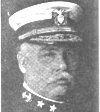
- pond'ii: named for Rear Admiral Charles Fremont Pond (1856-1929), an American naval officer and plant collector
 |
|
born in Brooklyn, Connecticut. Islapedia relates that “He was graduated from the United States Naval Academy in Annapolis in 1876. From 1879 to 1883 he did his service aboard the US Coast Survey steamer Hassler. From 1883 to 1884 Pond worked for the United States Hydrographic Office. This was followed by an engagement on the USS Hartford in 1884 and on board the USS Wachusett from 1885 to 1886. On October 2, 1885 Pond was promoted to Lieutenant Junior Grade. He provided his service to the United States Department of the Navy at Mare Island Naval Ship- |
yard. From 1887 to 1890 he served on the USS Ranger. During the survey of the Pacific coast and the islands of Baja California [Isla Cedros and Islas San Benito] with the USS Ranger, Pond collected numerous plants, which he sent to his friend, the American botanist Edward Lee Greene (1843-1915). Greene named the cacti species Mammillaria pondii in his honor. His promotion to Lieutenant First Class took place in 1891. From December 1890 to 1894, Pond was again active for the Mare Island Naval Shipyard. In April 1894 he was ordered to the USS Alert. He then worked from June 1897 at the New York Navy Yard in New York City. In April 1897, Pond was assigned to the USS Venezuela and in May 1898 to the USS Panther. On 11 April 1898 the command of the USS Iroquois was given to him. [His promotion] to Lieutenant-Commander took place on July 1, 1899. From 1912 Pond was a Rear Admiral. He retired in 1918.” Pond died on August 4, 1929 at Berkeley, California. He is buried in Mountain View Cemetery, Oakland, CA.
- pon'tica/pon'ticus: from the Latinized form of the Greek Pontos, i.e. of the south shore of the Black Sea,
the north coast of Asia Minor.
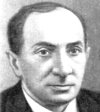
- popov'ii: named for Russian botanist Mikhail Grigorievich Popov (1893-1955), born in Volsk in present-day Saratov
 |
|
Oblast on the right bank of the Volga River. He is known for studying the flora of the Soviet Union, eastern Europe, and the far east. According to the Great Soviet Encyclopedia, he “graduated from the University of Petrograd in 1917, and taught at the Universities of Saratov and Tashkent from 1917 to 1927. Between 1927 and 1940 he worked at the All-Union Institute of Horticulture, the Kazakhstan branch of the Academy of Sciences of the USSR, and the Batumi Botanical Garden. Popov was a professor at the Universities of Samarkand (1940-44), Kiev (1944-45), and Lvov |
(1945-48). He headed a sector of the Sakhalin branch of the Academy of Sciences of the USSR from 1948 to 1950, and he became the head of the laboratory [and the department of flora and geobotany] of the Academy’s Eastern Siberian branch in 1950. Popov’s principal works were on the phylogeny, taxonomy, and historical geography of flowering plants. He developed a theory on the role of hybridization in plant evolution.” Popov was the author of more than 200 scientific publications and 10 monographs devoted to taxonomy and research on the flora of different regions of Eurasia, in particular, of Siberia, middle Asia, the Caucasus, the Carpathians, Kazakhstan, the Sakhalin Peninsula and particularly the region around Lake Baikal. Popov published about 300 new names of plants, including seven in Salix and one in Populus. During the last years of his life, he was dedicated to the study of the Siberian flora and, especially that of the northern coast of Lake Baikal which he explored in great detail. Unfortunately he did not finish this work because of his sudden death in 1955. His extensive herbarium material from the shores of Lake Baikal was used later in scientific research and cited in many publications. In a short period, under Popov’s leadership, the richest herbarium in East Siberia was created, the M.G. Popov Herbarium, named for him after his death and located within the Central Siberian Botanical Garden, Siberian branch of the Russian Academy of Sciences. The herbarium contains 249,000 specimens and specializes in vascular plants from Siberia and Asiatic Russia. The basis of this herbarium was the considerable personal collections by Popov and his followers.
- Pop'ulus: Latin for "people" because
the many moving leaves in a breeze resemble a moving populace. The genus Populus was published by Carl Linnaeus in 1753.
- porophyllo'ides: resembling or with leaves like those
of genus Porophyllum.
- Porophyl'lum: from the Greek poros,
"a passage or pore," and phyllon, "leaf,"
thus literally "pore-leaf," due to the translucent glands
dotting the leaf which give it a punctate appearance. The genus Porophyllum was published by Jean Étienne Guettard in 1754.
- porphyret'icus: purple-colored.
- porrec'tus: from the Latin porrectus, "projected, extended forward
horizontally, long."
- porrifo'lia/porrifo'lius: from Latin porrus, "the leek," meaning that the
leaves look like those of the leek, the scientific name of which is Allium porrum.
- por'rigens: two possibilities are: 1) from the Latin porrigo or porriginis, "dandruff or scurf," indicating some quality of scurfiness; or more likely, 2) from porrigo/porrigere, "to stretch out or put forth, spread out, extend, offer," of unknown application. One of the common names of Galium porrigens is climbing bedstraw.
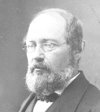
- Porterel'la/por'teri: named for Thomas Conrad Porter (1822-1901), an American
botanist, plant collector, professor,
 |
|
author and pastor. "Born
in Alexandria, Huntingdon County, Pennsylvania, 22 January. 1822, he
was graduated at Lafayette college, Easton, Pennsylvania, in 1840,
and at Princeton Theological Seminary in 1843, and was licensed to
preach in 1844. In 1846 he was pastor of a Presbyterian church
in Monticello, Georgia, and in 1848 he took charge of tile newly organized
2d German Reformed church in Reading, Pennsylvania, and was ordained
by the classis [the organization of pastors and elders that governs a group of local churches] of Lebanon. In 1849 he resigned to |
become professor
of natural sciences in Marshall college, Mercersburg, PA, held the same chair when the institution was removed to Lancaster
and consolidated with Franklin college in 1853, and was secretary
of the board of trustees until 1866, when he resigned to become professor
of botany and zoology in Lafayette. In 1877 he became pastor of the
Third street Reformed church of that town, which charge he resigned
in 1884. Rutgers gave him the degree of DD in 1865, and Franklin
and Marshall that of LLD in 1880. He was a member of various
scientific societies, and was a founder and first president of the
Linnaean society of Lancaster county, Pennsylvania. His extensive
herbarium is in the possession of Lafayette college. His reports
in connection with Dr. Ferdinand V. Hayden's collections in the Rocky
mountains in 1870-1874 were published by the government, and one of
these, 'A Synopsis of the Flora of Colorado,' prepared with
Professor John M. Coulter, has been issued in a separate volume (Washington,
1874). He also furnished a summary of the flora of the state
to 'Gray's Topographical Atlas of Pennsylvania' (Philadelphia,
1872), and to 'Gray's Topographical Atlas of the United States'
(1873). In addition to contributions to the 'Mercersburg
Review,' he has published a prose version of Goethe's 'Hermann und Dorothea' (New York, 1854); translated 'The
Life and Labors of St. Augustine,' from the German of Dr. Philip
Schaff (New York, 1854-1855), and 'The Life and Times of Ulric
Zwingli,' from the German of Hottinger (Harrisburg, 1857); and
contributed several hymns from the German and Latin to Dr. Philip
Schaff's 'Christ in Song' (New York, 1868). He was
an active member of the committee that framed in 1867 the order of
worship that is now (1888) used in the German Reformed church in the
United States." (From Virtuology.com
Famous Americans) He was the author in 1903 of The Flora
of Pennsylvania. In 1855, two weeks after the publication
of Song of Hiawatha by Longfellow, Porter stunned the literary
world when he charged that the famous poet had cribbed "the entire
form, spirit, and many of the most striking incidents of the Finnish
epic [Kalevala]" (which first appeared in 1849) and applied them
to the Americans indians. "[Porter] was a scholar of rare
ability and lofty attainments... and made extensive researches in
various fields of study, especially in botany, and many contributions
of permanent value issued from his prolific pen. He was a linguist
of note, an expert in Finnish and other obscure literature. He
was an authority on ecclesiastical history and enriched the literature
of his church with valuable contributions. Although bearing
an Anglo-Saxon name, he nevertheless was proud of his German ancestry
and at the time of his death was the president of the Pennsylvania-German
Society." (From a website on famous Pennsylvania Germans and
specifically on the Rev. John Conrad Bucher, a maternal ancestor of
Porter's). The genus Porterella was published by John Torrey in 1872. (Photo credit: Find-a-Grave)
- por'tula: David Hollombe contributes the following: "In the
British Herbal (1756), John Hill writes: 'Ray [John
Ray, 1627-1705, often referred to as the father of natural history
in Britain] calls it Portula from its having something of the aspect
of purslain' " Gledhill calls it an abbreviated form of Portulaca which Wiktionary says means “little door,” from porta, “door,” -ula, “a diminutive suffix,” and -aca, apparently because of the door-like opening of the seed capsule.
- Portula'ca: an old name, probably Latin,
from the word portula meaning "small gate or door" because of the door-like capsule
lid. The genus Portulaca was published by Carl Linnaeus in 1753.
- portulacas'trum: I infer that the meaning
of this comes from the genus name Portulaca and astrum,
"star," so would indicate a Portulaca-like plant
that has star-shaped flowers.
- post-: after, behind, later.
- Potamoge'ton: from the Greek potamos, "a river,"
and geiton, "neighbor," because of the habitat.
The genus Potamogeton was published by Carl Linnaeus in 1753.
- Potentil'la: comes from the Latin diminutive
of potens meaning "powerful" in reference to the
medicinal properties of some species. The genus Potentilla was published by Carl Linnaeus in 1753.
- potentillo'ides: resembling genus Potentilla.
- Poterid'ium: diminutive of Poterium. The genus Poteridium was published by Édouard Spach in 1846.
- Poter'ium: from Latin poterium, "cup," and Greek poterion for goblet, beaker or drinking cup. The genus Poterium was published by Carl Linnaeus in 1753.
- Pot'tia: named for Johann Friedrich Pott (1738-1805), a German botanist and professor of botany in Braunschweig, Germany, personal physician to the Duke of Brunswick, and correspondent with Linnaeus. He maintained an extensive herbarium of vascular plants that was purchased by the Botanical Museum of St Petersburg (currently the Komarov Botanical Research Institute) in 1826. The genus Pottia was published by August Emanuel Fürnrohr in 1829 based on a previous description by Jakob Friedrich Ehrhart.
- potts'ii: named for George Honington Potts (1829-1907), a British-born Scottish painter, decorator, plant cultivator and member of the Scottish Botanical Alpine Club.
- pouzin'ii: named for Martin Hugues César Pouzin (1768-1822), a French botanist and professor of botany in the Ecole de Pharmacie in Montpellier, brother of Fulcrand Nicolas Pouzin (1774-1822), a well-known botanist and physician of Montpellier, and son of Montpellier's master apothecary Hugues Pouzin. Martin was a pharmacist and also a professor at the Montpellier College of Apothecaries. In 1793 Martin fought in the French Revolutionary Wars with The Army of the Eastern Pyrenees. He was the first professor of botany and the natural history of medicine at the College, since its founding in 1803, and created the school's first botanical garden. His eldest son, the pharmacist and doctor François Hugues Roméo Pouzin (1795-1860), was also a professor of botany and the natural history of medicine, and he also served in the army, at the age of sixteen was in Egypt. He donated to the School his library, his scientific collections, his portrait and that of his father.
- powel'lii: named for John Wesley Powell (1834-1902), the famed explorer and
runner of the Colorado River through
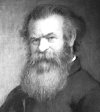 |
|
the Grand Canyon. Born in New
York, he had to be removed from public school because of the hostility
of his classmates resulting from his Methodist preacher father's stand
against slavery, and he was tutored by a neighbor, George Crookham,
a farmer and scientist who encouraged the boy to learn about nature
firsthand. After continuing his education in Wisconsin where his family
moved, he taught school for a number of years, retaining his interest
in science and making a complete collection of the molluscs of Illinois.
He joined the Army at the outset of the Civil War, was |
wounded at
Shiloh and had an arm amputated. He continued teaching as a professor
of geology at Illinois State after the war. Still believing in the direct
study of nature, he took students on a field trip to the Rocky Mountains
in 1867, where he studied, collected, took scientific measurements
and explored. Returning in 1868, he began to think about exploring
the Grand Canyon, and made his first trip through it by boat in 1869.
The river was wild, a boat was lost, and no one knew how long it would
take to emerge from the canyon. Fearing that they would die, three
men left the expedition at a place called Separation Canyon and hiked
out of the gorge, only to be killed by indians. Two days later the
remaining boatsmen sailed into Lake Mead and were met by some fishermen.
Powell conducted a second, more scientific survey of the Colorado
over 1871-1872, and the Smithsonian Institution published a monumental
account of his explorations in 1875. His research on indians led to
the creation of the Bureau of Ethnology and he became its director. He also was appointed director of the US Geological Survey in 1881
and held that post until retiring in 1894. He was founder and president
of the Anthropological Society of Washington, an early member of the
Biological Society of Washington, an organizer of the Geological Society
of Washington, and he helped establish the National Geographic Society
and the Geological Society of America, receiving honorary degrees
from several universities and becoming president in 1888 of the American
Association for the Advancement of Science. Few men in America have
combined the qualities and accomplishments of exploration and science
to the extent that he did, and he was buried in Arlington National
Cemetary.
- prae-: Latin prefix meaning "before, in front, very."
- praeal'ta/praeal'tum: very tall, very deep.
- prae'bens: both my Latin dictionary and an online Latin source gives praebeo as the root of this name, which translates as "to
hold forth, reach out, proffer, offer, tender," but I have no
idea how this applies to the name or what the namer of the taxon intended
by its use.
- praeceptor'um: from the Latin praeceptor, "teacher."
The International Plant Names Index says that this specific epithet
honors Morton Eaton Peck (see peckianum) and James Carlton Nelson
(see nelsonianum) who may have been teachers of the author. The common name of Carex praeceptorum is early sedge or teacher's sedge.
- prae'cox: (very) early (flowering) either flowering
before or developing before the usual time. Wikipedia says it is often used as a qualifying adjective in Latin binomials, and could mean "early flowering, primitive or premature."
- praegrac'ilis: I'm not sure how this should
be defined, but it derives from the Latin prae-, a prefix indicating
"before or in front," and gracilis, "slender".
Other names that use this same prefix are praealtus, which is defined
as "very high [tall] or very deep" and praevernus, meaning
"coming very early," so perhaps praegracilis means "very
slender" which this species certainly is.
- praelong'us: very long.
- praemor'sa: appearing to be bitten off at the end, from the Latin premorsus, "bitten off," past participle of premordeo, "to bite off."
- prae'stans: (very) distinguished, present participle of praestare, "to be superior, be excellent."
- praeteri'ta: passed and gone, passed over, omitted, the Latin term meaning "things gone over/past."
- praten'se/praten'sis: growing in meadows, from the Latin pratensis, "meadow."
- praterico'la: from the Latin pratum,
"a meadow," and thus meaning "meadow-loving" or
"dwelling in meadows."
- pratico'la: same as previous entry.
- prattenian'um/pratten'ii: named for the paleontologist and naturalist Henry J. Pratten
(?-1857). According to David Hollombe, "He collected plants near
Nevada City, California, in 1851. His catalog of the birds of Illinois
was reprinted in the 'Western Journal and Civilian,' March 1854, with
the following introduction: ...'The first of these contributions is
now offered in the following catalogue of the Birds of the State,
by Mr. Henry Pratten, whose extensive acquisitions in several branches
of science, made while engaged daily in the ordinary vocations of
life, may be emulated by everyone having an occasional hour to spare
from their common pursuits.' Pratten was a member of David Dale Owen's
staff during his 1848-1849 geological survey of northern states. He
was also an avid collector and trader of fossils. Upon the appointment
in 1851 of Dr. J.G. Norwood as the first Illinois state geologist,
Pratten joined his State Geological Survey, headquartered first in
New Harmony and later in Springfield. The two men co-authored three
papers that identified 31 new fossil species. His trip to California
resulted in the discovery of a new mineral near Nevada City and was
written about by Elias Durand in 1855 in Plantæ Prattenianæ
Californicæ; An enumeration of a collection of California Plants,
made in the vicinity of Nevada, by Henry Pratten, Esq., of New Harmony;
with critical notices and descriptions of such of them as are new,
or yet unpublished in America." (Journal of the Academy of
Natural Sciences of Philadelphia 3:79-104) He collected about
200 specimens, of which around 40 were considered new. One of the
species was assigned the name Stachys prattenii by Durand,
and is now Stachys ajugoides var. rigida. Little is known of
his early life except that he was apparently born in Bristol, England, and supported himself as a shoemaker for many years while pursuing scientific studies during his free time. He came to the USA in the early- to mid-1800s from the County of Gloucestershire. His wife died in 1909.
- preaux'ii: named for Jean Marie Despréaux Saint-Sauveur (1794-1843), a French botanist born in Fougères, plant collector, bryologist, algologist and mycologist specializing in cryptogams, lichens, mushrooms and algae. He was a naturalist on the French expedition to the Peloponnese, and also
collected in the Canary Islands. Wikipedia provides this: "Jean-Marie Despréaux participated in several Napoleonic campaigns. After practicing for a few years as a doctor, he got involved in politics, belonged to the editorial staff of the National and was a member of the scientific mission in Morea in 1829, within the Section of Physical Sciences led by the naturalist Jean-Baptiste Bory de Saint-Vincent. In addition to his participation in the scientific exploration of Greece, he participated later to that in the Canary Islands. He then settled as a doctor in Mexico City and created a company for the exploitation of the resin of the trees of Mayorazgo (it was a failure) and published articles in the magazine El Museo Mexicano.Jean-Marie Despréaux was a specialist of cryptogams, and in particular of lichens, fungi and algae. The species Convolvulus × despreauxii, endemic to the Canary Islands and of which he collected the nomenclatural type specimen in April 1839 in the mountains near Santiago del Teide in the Canaries Islands, was named after him." He died in Mexico City. The taxon in California with this epithet is Limonium preauxii.
- Preiss'ia: named for Balthasar Preiss (1765-1850), an Austrian/German military physician, naturalist, and botanist, born and taught in Bruchsal (FRG), and then studied in Vienna. He served on active duty at various stations. He collected plants in the Alps, in Bohemia and in Italy. He was the author of Rhizographia der Pflanzen (1823). He died in Prague. The genus Preissia was published by August Karl Joseph Corda in 1829.
- Prenanthel'la: a Latin diminutive of Prenanthes, which is
derived from the Greek prenes, "prone, prostrate, with
face downward," and anthos, "flower." The genus Prenanthella was published by Per Axel Rydberg in 1906.
- prenantho'ides: like genus Prenanthes.
- prescottia'na: named for John Daniel Prescott (1796-1837), a British merchant, botanist and horticulturist. He (and his father) worked for the famed merchant and plant collector William Cattleya, whose name is on a genus of orchids, of which he was particularly fond. Little seems to be known of the life of John D. Prescott except that he spent an inordinate period of time in Russia and devoted his life to the study of plants and the enrichment of his herbarium, considered one of the finest in Europe especially with regards to plants of the Russian empire, and including perhaps some 25,000 species. He lived in St. Petersburg. He appears to have been notably knowledgeable about the family Cyperaceae.
- pres'lii: named for Bohemian botanist Karel Borivoj Presl (1794-1852), a curator, pteridologist, bryologist, physician,
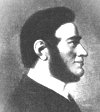 |
|
botanist, mycologist, physician and naturalist.
The following information is from his website entry on Wikipedia: He lived his entire life in Prague, and was a professor at the University of Prague. He made an expedition to Sicily in 1817, and published a flora of Bohemia entitled Flora čechica: indicatis medicinalibus, oeconomicis technologicisque plantis in 1819 with his older brother Jan Svatopluk Presl who was also a noted botanist; the journal Preslia of the Czech Botanical Society is named in their honor." Presl was custodian of botanical collections in the Prague University |
Herbarium from February 5, 1823 to August 6, 1846, but since 1832 he was also an external professor, and since 1838 an ordinary professor of natural history at Prague University. He also made botanical researches on the Apennine Peninsula, and was a collector of the National Museum. He spent nearly 15 years producing the Reliquiae Haenkeanae (published from 1825 to 1835), a work based on botanical specimens collected in the Americas by Thaddaeus Haenke. He was also the author of a number of other works.
- preuss'ii: named for George Karl Ludwig Preuss (anglicized as Charles Preuss) (1803-1854), the surveyor, topo-
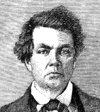 |
|
grapher and cartographer who joined John C. Frémont's western expedition in 1843-1844. He was born in Höhscheid, Prussia, and after studying the science of geodesy (which is the study of Earth’s geometric shape, orientation in space, and gravitational field) became a surveyor for the Prussian government. In 1834 he took his wife and children to the United States and worked for the Coast Survey under Ferdinand Rudolph Hassler. It was Hassler who recommended Preuss to Frémont who was about to embark on his exploration of the Rocky Mountains. He was a fine artist and |
made many of the illustrations that accompanied Frémont’s report. He made daily maps of the routes followed utilizing the astronomical determinations of their positions along the way of each of these excursions made by Frémont, and his work revolutionized western mapmaiking. He accompanied Frémont on trips in 1842, 1843-44, and 1848 and they were the first to see Lake Tahoe from Carson Pass in 1844. The 1842 expedition inlcuded Kit Carson and took five months, traveling from St. Louis to the Pacific Northwest over a route that many Oregon- and California-bound travellers would eventually take. The second expedition begun in 1843 mapped the second half of the Oregon Trail and pushed on toward the Pacific along the Snake and Columbia Rivers, and then south to Nevada. Preuss was not on Frémont’s third expedition but he joined him again for his fourth expedition in 1848 into the San Juan Mountains of southern Colorado, an expedition that ended in tragedy with eleven of thirty-five men dying in winter storms before being rescued. Preuss declined an invitation to participate in another Frémont expedition, but did join Lt. Robert Stockton Williamson on an 1853 railroad survey. Not long thereafter in 1854, back in Washington, his health failing, and after a series of depressive episodes, he hanged himself. According to a biographer of John Frémont, Preuss most likely suffered from post-traumatic stress disorder. He left behind a diary he compiled on these expeditions. It was not discovered until 1954 in Germany. (Photo credit: Find-a-Grave.)
- pric'ei: named for Overton Westfeldt Price (1873-1914) born in Liverpool, England. He was educated there and then
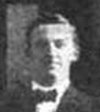 |
|
after the family moved to the United States at Episcopal High School in Alexandria, Virginia, He did special course work at the University of Virginia, worked in forestry for a year, attended the University of Munich for two years, then again did forestry work in Europe. At some point he was at the Biltmore Estate in North Carolina and at lumber camps in the north woods. In 1899 he began as an agent for the Bureau of Forestry, USDA, was promoted to superintendent, and then to associate forester to the organization that is now the Forest Service. He was the author of The |
Forests of the United States (1909), and was a member of the National Conservation Association. He died at the early age of 41 in Henderson County, North Carolina. (Photo credit: Find-a-Grave)
- primiver'is: first of spring, of springtime, from primus, "first," and veris, "spring."
- Prim'ula: from the Latin primus or primulus, "first,"
and referring to early-flowering. In medieval times, the daisy was
called primula veris or "firstling of spring." The genus Primula was published by Carl Linnaeus in 1753.
- primulifo'lia: with leaves like genus Primula.
- primulo'ides: resembling a primrose.
- pri'mum: from the Latin primus, "first."
- prin'ceps: most distinguished, from Latin princeps, "first in time or order; the first, foremost, chief, the most eminent, distinguished, or noble."
- pringlea'num/pring'lei: named for Cyrus Guernsey Pringle (1838-1911), who was born in Vermont and entered the
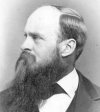 |
|
University of Vermont in 1859. The death of his brother however in his first semester ended all thoughts of college and made it necessary for him to assist his widowed mother in the running of their farm. His first nursery was assembled even before he started college which showed an incipent interest in botany and horticulture. He cross-bred potatoes, apples, sold seedlings of lilies, gladioli and wheat, seeds of Hubbard squash, and grew more than 100 varieties of iris. Despite being a Quaker he was drafted for service into the Union Army, refused to compromise his beliefs |
in non-violence, and was severely disciplined, beaten and imprisoned in a military camp in 1863. Despite Secretary of War Stanton’s refusal to discharge him, President Lincoln intervened and ordered Stanton to release him and other Quaker conscripts. A book about his experience based on his journal called The Record of a Quaker Conscience was posthumously published in 1918. After returning home, he began breeding plants on the family farm, and made significant improvements in varieties of wheat, oats, potatoes, and grapes. He also began collecting rare Vermont plants. His name came to the attention of Asa Gray at Harvard, and in 1880 he made his first western trip, collecting and studying the flora of the southwest for Gray. In 1885 Gray sent him to Mexico and he spent the remainder of his life studying the flora there. He eventually collected some 500,000 specimens that were donated to the University of Vermont and various other herbaria. Today the Pringle Herbarium is the second largest collection in New England. He worked for some of the legendary Harvard botanists, and achieved a record of botanical fieldwork in Mexico that is unsurpassed even today. In addition to the Pringle Herbarium, there are collections of his specimens at the herbaria of Texas A&M, Virginia Tech, Harvard, University of Texas, Miami University (Oxford, Ohio) and the Carnegie Museum of Natural History.
- prinophyl'lum: having leaves like genus Prinos.
- Prionop'sis: from the Greek for "saw-like," from prion,
"a saw," and -opsis, a suffix used to signify resemblance,
alluding to the leaf margins. The genus Prionopsis was published by Thomas Nuttall in 1840.
- Pritchard'ia: named for William Thomas Pritchard (1829-1907). He was born in Papeete, Tahiti, of Welsh parentage,
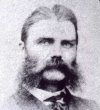 |
|
the son of George Pritchard and Eliza Aileen and was educated in Britain before returning to join his father, the British consul in Samoa. His father, the British Christian missionary and diplomat, was born in England and studied at the mission seminary at Gosport. He traveled to the Society Islands to undertake work for the London Missionary Society. In 1837 he was appointed British consul at Tahiti, advising Queen Pōmare IV. The islands were annexed by France in spite of his protests, in 1843. He was compelled to leave the islands in 1844 and returned to England. In 1845 |
he was appointed British consul at Samoa, resigning in 1856 and subsequently living in retirement in England. William Thomas Pritchard was one of many children. In Samoa, he acquired an exceptional knowledge of the Polynesian language and traditions. In 1858 he was appointed the first British consul at Fiji, and in the same year traveled to England with an offer from Seru Epenisa Cakobau, warlord and King of Fiji who created a united Fijian kingdom, to cede Fiji to the British crown. Pritchard was dismissed from his post in 1863. In 1864 he published “Notes on certain anthropological matters respecting the South Seas Islanders” in Memoirs of the Anthropological Society (London), and in 1866 he was the author of Polynesian reminiscences; or, Life in the South Pacific islands. Berthold Seemann in a foreword to Polynesian Reminiscences wrote: “My personal acquaintance with the author dates from the time when I was attached to the government mission to the Viti or Fiji Islands, when I was introduced to him by a letter from Lord Russell. During my stay in those islands, I had ample opportunities of observing the admirable tact, zeal, and industry displayed by Mr. Pritchard in his official capacity; how he used to exert himself all day long in behalf of the daily increasing number of white settlers, and of the numerous natives who claimed his interference or appealed to his love of justice; and how he used to sit up all night, writing dispatches or translating documents, so that no impediment should take place in the next day’s proceedings. He was the first who framed a code of laws for a lawless group of two hundred islands; and these laws were so admirably adapted to the primitive state of society then existing in Fiji, that every man of sense willingly submitted to them. A copy of his code may be seen in the library of the British Museum. No one can read the following pages without feeling that he was the ‘Right man in the right place.’ It is, therefore, melancholy to add that all his tact, zeal, and industry were unavailing; that a combination was formed against him, and that this combination was powerful enough, and lasted long enough, to effect his dismissal from the public service. It is satisfactory to the author’s friends, that the moment he was informed of this, he hastened to London to defend himself; but his letters, begging for a fair investigation of his official conduct, were unheeded; and after wasting more than a year in London, and spending a considerable sum of money, he was reluctantly compelled to acknowledge that no justice was to be had for him through the channel by which he sought it. In the following pages there is hardly an allusion to it, and it is only dire necessity which prompts me to mention the subject at all.” A work entitled Viti: an account of a government mission to the Vitian or Fijian Islands, in the years 1860-61 by Berthold Seemann includes the following: "On the 12th of June I went for a few days to Wairiki. The premises occupied by the mission of that place are very commodious; there are two large dwelling-houses, built about two hundred yards apart, one occupied by Mr. Waterhouse, the other by Mr. Carey. On the second day of my stay there, those two gentlemen returned from Bau, bringing a message from Mr. Pritchard, the British consul, to the effect that Colonel Smythe had as yet not arrived, and that a little schooner should be sent for me, in case I did not reach Ovalau by the 12th instant. Mr. Carey showed me his collection of native curiosities, including a fine set of clubs, spears, bows, and arrows. I also saw here for the first time a fan made of the leaf of a beautiful palm, a tree which had proved quite new to science, and which in honor of Mr. Pritchard, and as a grateful acknowledgment of the invaluable assistance he rendered to me, the name of Pritchardia pacifica has been given by Mr. Wendland and myself [the authors], -the specific name being justified by its growing in various groups of the Pacific, and Mr. Pritchard's untiring efforts to preserve the peace of that region. Fans made of this palm are used exclusively by the chiefs, and forbidden to be carried by the common people. Should Fiji ever choose a national emblem, the claims of this palm to be regarded as such, should not be overlooked." This presumably explains the genus name Pritchardia. Pritchard arrived in Mexico in 1866 and after that he spent most of his time there, except for the years 1877-1878 when he traveled throughout the United States giving lectures and writing on Mexico and President Diaz. He founded a newspaper in 1867, the Mexican Standard, and the Cosmopolitan in 1873. He was a business reporter for the English-language Mexican Herald, from 1895 until his death. He was also involved in several railroad companies. I have been unable to find anything about how he came to be honored with a generic name, aside from those details listed above. He died in Mexique, Mexico, aged 78 years old. The genus Pritchardia was published by Berthold Carl Seemann and Hermann A. Wendland in 1862.
- pro-: Greek prefix meaning "in front of, before."
- Proboscid'ea: the genus name Proboscidea comes from the Greek proboskis, "elephant's trunk," in allusion to the elongated curved ends of the fruit, derived from pro, "before," and boskein, "to feed." In addition to unicorn plant common names include devil's claw, ram's horn, aphid trap, goat's head, elephant tusks, and devil's horn. I have no idea where the name unicorn plant came from. The genus Proboscidea was published by Casimir Christoph Schmidel in 1763.
- procer'a/procer'us: tall or slender.
- procid'uum: probably from the Latin procido, "to fall
forwards, fall down," and thus something to do with being prostrate,
this taxon's common name in the Jepson Manual is 'prostrate buckwheat.'
- procum'bens: with
trailing, prostrate stems.
- produc'tum: lengthened, stretched out, from produco, "to bring forward."
- pro'lifer/prolif'era/prolif'erum/prolif'erus: bearing
or producing offshoots, proliferating.
- prolif'icum: very fruitful, prolific, from the Latin word for "many," and referring to the many stamens.
- prolix'a: from the Latin prolixus, "long, extended, drawn
out."
- propin'qua/propin'quus: related.
- propos'ita: possibly means something like "exposed" or
"easily found." Another derivation is the Latin propositus, past participle of proponere, "to set forth, propose." Another source says the Latin propositum stands for "a thing proposed or intended." Other meanings of this word appear to have nothing to do with botany.
- Prosart'es: from the Greek prosartes meaning "attached or appended," alluding to the pendulous ovules in the type species.
The genus Prosartes was published by David Don in 1839 and is called fairybells and mandarin.
- proserpinaco'ides: like genus Proserpinaca.
- proskau'eri: named for Johannes Max Proskauer (1923-1970), a bryologist and professor of botany. He was born in Göttingen, Germany, where his father was a barrister and where he was intellectually influenced by the presence in his home of many faculty members of the famed Georg-August-Universität Göttingen (University of Göttingen). Just before the outbreak of WWII, his parents sent him to England where he attended the Snaresbrook, Essex, Public (Boarding) School for a year before entering college in 1940. He attended the University of London, which awarded him a BSc in 1944, a PhD in 1947, and a DSc in 1964, all in the field of botany. His thesis research was concerned with the biology and morphology of the British species of the hornwort Anthoceros. Much of his life's work focused on this group, and in 1951, he recognized and defined the genus Phaeoceros for the first time. He continued to work at Berkeley on the morphology and cytology on the hornworts and also the liverworts. While working on his PhD thesis, Proskauer served for a short time as laboratory steward (1944) in the department of botany of University College of North Wales, Bangor, and as lecturer in botany (1945-1948) at South East Essex Technical College, Dagenham, where he taught botany in all its branches to undergraduates. He moved to Berkeley, California, in 1948, and became an instructor in botany at the University of California. He was awarded a Guggenheim fellowship in 1954, a professorship in the Miller Institute for Basic Research in Science, and became a US citizen in 1957. By 1963 he was a full professor. A website of the University of California states: “His research was concerned with the variation, cytology, sex-distribution, reproductive processes, and dehiscence of the capsule of the British species of the hornwort Anthoceros. His main life's work continued to be with this group of simple land plants, the Anthocerotales, a group occupying a seemingly critical position among the lower green land plants. He also had a deep interest and did much research on a related group of plants, the liverworts of Hepaticae, which, like the hornworts, belong to the division Bryophyta. In addition he had a very special interest in the algae (the specialty of his major professor, F.E. Fritsch, at Queen Mary College), on which he published several papers. His investigations included observations on living or preserved material from the field and study of plants from many parts of the world, which he grew in culture. In a number of instances he also studied the cytology and genetics of selected taxa. Proskauer was a gifted and dedicated teacher. Many hours were spent before each laboratory period examining and preparing the material, mostly living, to be studied that day. He was an enthusiastic and eloquent lecturer who studied his notes before his lectures and never used them during the lectures. He rarely used lantern slides, preferring to illustrate his lectures with skillful blackboard drawings which the student could easily copy. Through Professor Proskauer's death the world lost a brilliant botanist of unsurpassed versatility and a scholar of extraordinary breadth, not only in science but in many areas of knowledge. His passing, in the prime of his life, was a deeply felt personal loss to his friends on the faculty, his own former students, and many others who valued his generously given help and counsel.” He died at the early age of 47.
- Prosop'is: a Greek name for the burdock, but
unknown as to why it applies to this plant. The genus Prosopis was published by Carl Linnaeus in 1767.
- prostra'ta: prostrate.
- pruino'sa: glistening as though frosted, covered with a bloom or powder so as to appear to be frosted, from Latin pruinosus, "frosted," and pruina, "hoar-frost."
- Prunel'la: from a German word braun or die Bräune for "quinsy,"
a type of throat inflammation that this plant was used to treat. In the 15th and 16th centuries the Germans used the words Prunella and Brunella interchangeably, and in medieval Latin brunella, diminutive of brunus, "brown," referred to a disease causing a brown coating on the tongue, which self-heal was a reputed cure for. The genus Prunella was published by Carl Linnaeus in 1753.
- prunophi'lus: having an affinity in some fashion for plum or its
habitat? "This grows on dry slopes... with Amelanchier and Prunus demissa" (M.E. Jones, quoted in Lee Lenz's
1986 biography of Jones). Other sources say prunophilus means chokecherry-loving.
- Pru'nus: an ancient Latin name, prunum, for the plum tree. Prunus was published by Carl Linnaeus in 1753.
- psammophi'la: from psammo, "sand," and -phila,
an ending that conveys the meaning of "to love."
- Psathyro'tes: from the Greek psathurotes,
"brittleness," referring to the stems. The genus Psathyrotes was published by Asa Gray in 1853.
- pseudalha'gi: false Alhagi.
- pseudato'cion: originally published as pseudo-atocion from the Latin pseudes, "false," and atocion from the prefix a-,
"not," and tokos, "offspring," implying
that it was considered to be either a contraceptive or an abortifacient.
- pseudaur'eus: false gold.
- pseudiodan'thus: for its resemblance to Astragalus iodanthus.
- pseudo-: a prefix meaning false in some sense, from Greek pseudes, false, deceptive.
- pseudoaca'cia: false acacia.
- pseudoacor'us: from the word for "false"
and genus Acorus, common name "sweet flag," so Iris
pseudoacorus is the Iris that looks like Acorus.
- Pseudoba'hia: from the Greek pseudes, "false," and
the genus Bahia. The genus Pseudobahia was published by Per Axel Rydberg in 1915.
- Pseudognaphal'ium: literally false Gnaphalium, this is the
new genus name for several species of Gnaphalium, and refers to a superficial resemblance
to genus Gnaphalium. The genus Pseudognaphalium was published by Moisey Elevich Kirpicznikov in 1950.
- pseudolavater'a: false Lavatera.
- pseudomaja'lis: false (or different) majalis, referring to the taxa Convallaria majalis (published by Linnaeus in 1753) and C. pseudomajalis (published by John Bartram in 1810). C. majalis is a species of Eurasia that has been planted in and escaped from cultivation from areas in the eastern United States, and so when "lily-of-the-valley" was collected there, it was assumed that it was an escape from places of human habitation, but botanist Alan Weakley and others have indicated that there is a wide suite of distinctions between majalis and what is now called pseudomajalis, and that the latter has been found in places that are far removed from any populated locales. The species C. pseudomajalis in the Flora of Virginia is called American lily-of-the-valley.
- pseudonarcis'sus: this specific epithet literally means false Narcissus,
which is odd because the genus to which it is attached is Narcissus.
- Pseudoroegner'ia: from the Greek pseudes, "false,"
and Roegneria, a grass genus named by Karl Heinrich Emil (Ludwig) Koch for Heinrich Andreas Rögner (1807-1874) of Württemberg, Germany, former Imperial Russian court gardener at Tbilisi, Georgia and Oreanda in the Crimea, with whom Koch was on friendly terms. The genus Pseudoroegneria was published by Askell Löve in 1980.
- Pseudoron'tium: false Orontium. The genus Pseudorontium was published by Werner Hugo Paul Rothmaler in 1943.
- pseudorupest'ris: from pseudes, "false," and (Potentilla) rupestris, a European species closely related to P. glandulosa.
- Pseudosa'sa: from the Greek pseudes, "false," and
the genus Sasa. The genus Pseudosasa was published by Tomitarô Makino in 1925.
- pseudoscirpoid'ea: false Scirpus.
- pseudoseric'ea: Rydberg described the species as having the habit,
leaves and pubescence of the Siberian species Potentilla sericea.
- pseudosim'ulans: from the Greek pseudes, "false,"
and simulo, "to make like, imitate," thus meaning
"false simulans," referring to the frequent confusion between Caulanthus heterophyllus var. pseudosimulans and C. simulans.
- pseudospectab'ilis: false spectabilis.
- pseudosplen'dens: false splendens, of unknown application.
- Pseudostellar'ia: meaning false Stellaria,
due to an incorrect taxonomic placement of species. The genus Pseudostellaria was published by Ferdinand Albin Pax in 1934.
- Pseudotril'lium: from the Greek pseudes, "false,"
and the genus Trillium. The genus Pseudotrillium was published by Susan B. Farmer in 2002.
- Pseudotsu'ga: from pseudo, "false,"
and tsuga, a word derived from Japanese, and together meaning
"false Tsuga (hemlock)." The genus Pseudotsuga was published by Élie Abel Carrière in 1867.
- psilocarpho'ides: like genus Psilocarphus.
- Psilocar'phus: from the Greek psilos,
"bare, naked" and karphos, "a splinter, twig,
chaff, straw," the disk flowers not subtended by chaff scales.
The genus Psilocarphus was published by Thomas Nuttall in 1840.
- psilosta'chya: derived from the Greek psilos, "bare" and stachys, "a spike,"
hence a "bare spike."
- Psilostro'phe: from the Greek psilos,
"naked, glabrous" and strophe, "to turn,"
of uncertain application. The genus Psilostrophe was published by Augustin Pyramus de Candolle in 1838.
- Psilo'tum: New Latin, probably from Late Greek psiloton, a plant, perhaps from Greek psilon. Another connected or unconnected derivation would be the Greek psilos, "naked, smooth, bare, bald," according to one site "because it lacks leaves and other plant organs that are normally found in other ferns." The genus Psilotum was published in 1801 by Olof Swartz.
- Psora'lea: from the Greek meaning "roughly scaled" and
referring to the glandular dots on the leaves. The genus Psoralea was published by Carl Linnaeus in 1753.
- Psoralid'ium: according to the Jepson Manual a diminutive of Psoralea. The genus Psoralidium was published by Per Axel Rydberg in 1919.
- Psorotham'nus: from the Greek psoros,
"mangy, scabby," and thamnos, "bush," thus
"scabshrub." The genus Psorothamnus was published by Per Axel Rydberg in 1919
- psyl'lium: from the Greek psylla, "a flea," and psyllion, "a kind of plant, fleawort," this was an
old name of a plant used to ward off fleas. Another source says "from Greek psullion, from psulla, "flea" (because the seeds resemble fleas)."
- Pte'lea: a Greek name for an elm, and used because the winged fruits
are similar, flattened, almost circular, and having a wing around. The genus Ptelea was published by Carl Linnaeus in 1753.
- Pterid'ium: a diminutive of Pteris,
a fern genus. The genus Pteridium was published by Johann Gottlieb Gleditsch in 1760.
- Pter'is: FNA says from "Greek pteris, "fern," derived from pteron, "wing or feather," for the closely spaced pinnae, which give the leaves a likeness to feathers. The genus Pteris was published by Carl Linnaeus in 1753.
- pterocar'ya: "wing-nut" from Greek pteron and karyon.
- pterosper'ma: having winged seeds.
- Pterospor'a: from the Greek pteros,
"a wing," and spora, "seed," thus "winged
seed." The genus Pterospora was published by Thomas Nuttall in 1818.
- Pteroste'gia: from pteron, "wing,"
and stegon, stege, "covering," meaning "winged
cover" and referring to the winged bract. The genus Pterostegia was published by Friedrich Ernst Ludwig von Fischer and Carl Anton von Meyer in 1836.
- Pteryx'ia: from the Greek pteris, "fern," and ixia,
the chameleon plant. The genus Pteryxia was published by Thomas Nuttall in 1900.
- Ptilagrostiel'la: diminutive of Ptilagrostis. The genus Ptilagrostiella was published by Konstantin Romaschenko, Paul M. Peterson, and Robert John Soreng in 2019.
- Ptilagros'tis: from the Greek ptilon, "wing or feather,"
and agrostis, "grass." The genus Ptilagrostis was published by August Heinrich Rudolf Grisebach in 1852.
- ptilo'ta: feminine singular of ptilotos, 'winged,' from ptilon, 'feather.' According to Guy Nesom, this name alludes to a fancied wing-like aspect of the pairs of sessile leaves.
- Ptychomit'rium: from Greek ptyx, "fold," and mitra, "turban," alluding to plicate calyptra.
- pu'bens: according to Gledhill, "full grown, juicy. According to Stearn "downy," although I don't think this is correct. Another source says "full of sap,vigorous."
- puber'ula/puberulen'ta/puber'ulum: minutely
or somewhat pubescent, clothed with miniscule soft downy hairs.
- pubes'cens: with soft, downy hair.
- pubicar'pa/pubicar'pum: from the Latin pubis, "adult,
downy, that which has arrived at puberty, i.e. with hairiness,"
and carpum, from the Greek karpos, "fruit,"
and thus meaning "with ovary and fruit pubescent."
- pubiflor'um: with downy or pubescent flowers.
- Puccinel’lia: named for Benedetto Luigi Puccinelli (1808-1850), a highly regarded Italian botanist and professor of the early nineteenth century. The son of nobleman Carlo Andrea Puccinelli and his wife Maria Domenica Pellegrini, he was born in Coreglia Antelminelli, a village near Lucca in Tuscany. Initially taught by his parents and then a private tutor, he entered the Seminary of Lucca at the age of fifteen to hone his Italian and Latin language skills and to study the humanities. He excelled in ability, diligence and achievement. In 1826 he enrolled at the Royal Lyceum of Lucca, and resisting his father's desire that he pursue legal studies, followed his own inclination for the sciences and graduated in medicine and surgery. That achieved, he devoted himself to botany. In 1833 Puccinelli was appointed stand-in for the ailing professor of botany Paolo Volpi, and the next year the position was formalized. Volpi had also been the first director of the botanical garden of Lucca, which was promoted by Maria Luisa of Bourbon during the French occupation and established as an adjunct to the new university, and Puccinelli filled that position as well. At its official opening in 1822 Volpi had planted the iconic cedar of Lebanon (Cedrus libani) that can be seen in the garden today. Benedetto Puccinelli's dual role continued for seventeen years, from 1833 until his untimely death in 1850. As well as lectures in agriculture, physics, chemistry and botany, he took groups of students on field trips into the countryside to collect, study, cultivate and thus protect the plant species of Lucca, especially those of medicinal value. He continued his own research, and despite frail health, scoured the mountains, valleys and wetlands for material, and when his energy flagged, retreated to the botanical garden. After a long and debilitating illness, and a marriage of just thirteen years, he died on 1 April 1850 at the age of 42, leaving his wife Maria Tessandori and their two children. His major work, describing about 1,500 higher plants of Lucca, including locality and flowering information, was published in 1848. However, his research was not limited to flowering plants. An unpublished manuscript on ferns still exists at the botanical garden, and an almost completed manuscript on fungi, which was to accompany nearly 600 watercolor images by painter and lithographer Guiseppe Bertini, was found 150 years after Puccinelli's death. Benedettto Puccinelli was a member of several scientific organizations and academies. In 1846 he received a silver medal for his contribution to the new Central Herbarium of the Botanical Museum of Florence, directed by internationally renowned botanist Filippo Parlatore (1816–1877). Parlatore also honored him with the genus Puccinellia, a genus of salt grass described in the first volume of his major work Flora Italiana in 1850. He was also the author of Synopsis plantarum in agro lucensi sponte nascentium published in 1841.The genus Puccinellia was published by Parlatore in 1848 and is called alkali grass.
- pu'dica: bashful, from Latin pudicus, "modest."
- puel'ii: named for Jean Jacques Timothée Puel (1813-1890), a French physician, botanist and plant collector in Algeria and France. He was a founding member of the Société botanique de France (1854), and is known for his investigations of flora native to the department of Lot, of which he published Catalogue des plantes qui croissent dans le département du Lot. Also, he issued a series of exsiccatae called Herbier du Lot. He was honored with the genus name Puelia. An article in the journal History of Psychology 20(1) enttled "From Catalepsy to Psychical Research: The Itinerary of Timothée Puel" by Renaud Evrard and Erika Pratte (2016) gives this: "The physician and botanist Timothée Puel lived through a pivotal period of psychology (1848-1878), between the academic prohibition of the study of animal magnetism to its disjointed recovery in hypnotism and psychical research. One of his cases of "catalepsy complicated with somnambulism" triggered a lively debate on "extraordinary neuroses" within the young Société médico-psychologique [Medico-psychological Society]. In 1874, Puel founded the Revue, the first of its kind in French, which he intended as the vehicle of international interest in psychical research, the scholarly and institutionalized study of "psychism" that prepared the way for the recognition of academic psychology."
- pugionifor'mis: dagger-shaped, from Latin pugio, "a dagger."
- pulchel'la/pulchel'lum/pulchel'lus: derived
from the Latin for "beautiful."
- pul'cher: pretty.
- pulcherri'ma/pulcherri'mum: most pretty or prettiest.
- pul'chra: pretty.
- pulchriflor'um/pulchriflor'us: with beautiful flowers.
- pulegio'ides: resembling genus Pulegium.
- pule'gium: from the Latin pulex, reputedly a flea-repellant.
- Pulicar'ia: from the Latin pulicarius for "flea-like." The genus Pulicaria was published by Joseph Gaertner in 1791.
- pulsif'erae: named for Mary Ellen Pulsifer (Mrs. Charles Cooper Ames)
(1845-1902). The following is from Joseph Ewan, "San Francisco
as a Mecca for Nineteenth Century Naturalists" (1955): "Comparatively
little is known of Mary E. Pulsifer Ames of Auburn, whose plant collections,
like those of Mrs. Austin, are occasionally cited in the Botany
of California, particularly the second volume. She was evidently
at one time a resident of Taylorsville, Indian Valley, a correspondent
of C. Keck of Austria, as was Mrs. Austin, and a contributor to the
California Horticulturist and Floral Magazine. Astragalus pulsiferae of Plumas County was named in her memory by Asa Gray. She died at
San Jose, at the age of fifty-seven." And from an article in
the San Jose Mercury, 21 March 1902, that contains a perhaps
overly complimentary tribute by her sister: "In the death of
Mrs. Mary E. Pulsifer Ames at her home at No. 43 Webster street, East
San Jose, yesterday afternoon, there was lost to the world, except
that her works will live after her, a distinguished woman--one whose
fame as a botanist was world-wide, and especially honored in the Royal
Botanical Directory of Austria. So quietly and unassumingly did she
live, largely content with the society of her aged mother and loving
sister, her husband having died some years ago, that it can be truthfully
said that she was better known in the world of science and of letters
than in her home city. One who knew her best and loved her most, her
sister, Miss Martha Pulsifer pays the following tribute to her memory:
'Mary E. Pulsifer Ames, elder daughter of John W. and Salina Pulsifer,
was born in Lowell, Mass., March 2, 1845. From a very young child
she was passionately fond of books and was a natural student, showing
a fondness for all studies, the arts as well as the sciences. She
posessed great artistic talent, and had she fully cultivated the gift
would have risen to equal fame as an artist and botanist. Botany being
her life-long study. The greater part of her education was received
in the Academy of Notre Dame, Lowell and at the College of Notre Dame
in San Jose. She was frail of constitution, her poor health at all
times interfering with the progress of her studies. The most serious
impediment was an affliction of the eyes, an affection of the optic
nerve from which she was practically blind for nearly three years.
To the good well-behaved Sisters of Notre Dame she said she owed every
success she achieved in life, and to her alma mater, the College of
Notre Dame, to which she was ever loyal and devoted, she bequeathed
her exquisite and extensive collection of valuable plants, books and
stones, in grateful memory as she often said of the home where she
had learned 'the beautiful sciences' to which she devoted her pure,
serene and lofty life. Her monumental work lives after her, and future
generations will draw inspiration from her uplifting and indefatigable
labors. Her fame as a botanist was world-wide; her name being honored
in the Royal Botanical Directory of Austria. Her correspondence was
large and varied among the leading botanists of the world. Her last
days, and almost hours, were spent in classifying her plants, a large
and choice collection, from many European countries as well as the
United States."
- pulverulen'ta: powdery, dust-covered, from the Latin word pulveratus meaning "powdered," referring to some white covering.
- pulvina'ta: cushion-like.
- pumico'la: the suffix cola means 'dwelling,' and my supposition based on its common name of pumice moonwort is that the 'pumi' refers to pumice, and thus it is an inhabitant of pumice soils. There is also an Arenarium pumicola, but not in California.
- pu'mila/pu'milum/pu'milus: dwarf.
- pumil'io: from the Latin pumilio, "a pygmy."
- pumpellia'nus: named for Raphael Pumpelly (1837-1923), a pioneering American geologist and explorer born in
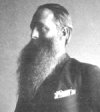 |
|
Owego, New York. Among his New England ancestors were Thomas Welles who arrived in Massachusetts in 1635 and was the only man in Connecticut's history to hold all four top offices, governor, deputy governor, treasurer, and secretary, John Deming, an early Puritan settler and original patentee of the Connecticut Colony, William Pynchon, a colonial assistant treasurer and original patentee of the Massachusetts Bay Colony, and Captain Elizur Holyoke, the namesake of the mountain, Mount Holyoke, and indirectly of the city of Holyoke, Massachusetts. Pumpelly |
attended common schools and graduated from Owego Academy in Owego, Tioga County, New York. He decided to study and travel in Europe rather than enrolling at Yale University. He graduated in 1859 from the Technische Universität Bergakademie Freiberg (Freiberg University of Mining and Technology). He also attended the polytechnic school in Hanover, and after graduating he traveled extensively through the mining districts of Europe for the purpose of studying geology and metallurgy by direct observation. After graduating, Pumpelly moved to Tioga Point, now Athens, in Bradford County, Pennsylvania, where he was soon appointed a justice of the peace, and became land agent for the Hon. Charles Carroll of Carrollton, Maryland. Wikipedia relates further that: “In 1860 Pumpelly was engaged in mining operations in Arizona. Invited by the respective governments, from 1861 to 1863 he surveyed Yesso Island of Japan and the coalfields of northern China. After this, he made the first extensive survey of the Gobi Desert, and explored Mongolia and Siberia. From 1866 to 1875, he was professor of mining science at Harvard University. Among his scientific accomplishments was a theory of secular rock disintegration. He was influenced by Louis Agassiz. In June 1870, he was living in a rooming house in Cambridge, Mass., where former slave and abolitionist author Harriet Jacobs also resided. From 1870 to 1871, he conducted the geological survey of the copper region of Michigan, for which he prepared Copper-Bearing Rocks, being part 2 of volume 1 of the Geological Survey of Michigan (New York, 1873). He was called upon in 1871 to conduct the geological survey of Missouri, and for three years devoted his energies to that task, preparing A Preliminary Report on the Iron Ores and Coal Fields, with an atlas, for the report of the Geological Survey of Missouri (New York, 1873). When the US Geological Survey was established in 1879, Pumpelly organized the division of economic geology, and as a special agent of the Tenth Census he planned and directed the investigations on the mining industries, exclusive of the precious metals, and prepared volume 15 of the Census Reports on "The Mining Industries of the United States" (Washington, 1886). From 1879-80, he conducted at Newport, Rhode Island, an elaborate investigation for the National Board of Health as to the ability of various soils to filter spores from liquids and from air. He became a resident of Newport in 1879, and lived there for 44 years. In 1879 Pumpelly introduced the idea that the numerous lakes of the Canadian Shield are the result of the creation of basins due to the stripping of an irregular mantle of weathered rock by glacier erosion. This idea was subsequently adopted by Alfred Gabriel Nathorst who used it to explain the great number of lakes existing in southern Sweden. In 1881, he organized the Northern Transcontinental Survey for the Northern Pacific Railroad and published parts of his report in the Tenth Census. This survey collected information concerning the topographical and economic features of Dakota, Montana, and Washington territories. He had charge of this work until its cessation in 1884, and also edited the reports of the survey. He was appointed the director of the US Geological Survey, New England branch, in 1884. Pumpelly spent his summers in Dublin, New Hampshire, near Mount Monadnock, and in 1884 he blazed a trail from his summer house to the summit along a ridge that carries his name. The Pumpelly Trail is considered one of the most scenic on the mountain. In 1903, he mounted a Carnegie-funded archeological dig with his son at the Anau mounds in Turkmenistan. He was a member of the New Hampshire Society of the Sons of the Revolution. He was president of the Geological Society of America in 1905.” He was the author of Across America and Asia. Notes of a five years' journey around the world, and of residence in Arizona, Japan, and China, Geology of the Green Mountains in Massachusetts, Explorations in Turkestan, with an account of the basin of eastern Persia and Sistan, Geological researches in China, Mongolia, and Japan during the years 1862-1865, and other works. He died in Newport, Rhode Island.
- puncta'ta/puncta'tum:
spotted, referring (at least in the case of P. punctatum) to
the gland-dotted calyx.
- punc'tum: possibly from the Latin punctus, "a stinging,
a puncture" and related to the previous entry.
- pung'ens: spiny, sharp-pointed, from pungere, "to prick, pierce, sting."
- Pu'nica: Stearn's Dictionary of Plant Names says: "The
Latin name contracted from punicum malum, Carthaginian apple,
in turn derived from Poenus, 'a Carthaginian,' or Phoinikes,
'Phoenicians,' " this is the generic name of the pomegranate, Punicum granatum. The genus Punica was published by Carl Linnaeus in 1753.
- punic'ea/punic'eus: reddish-purple from the Latin punicus, "scarlet."
- purd'yi: named for Carlton ('Carl') Elmer Purdy (1861-1945). He was a plant collector and nurseryman, and a leading expert on Western North American lilies, specifically Calochortus, Erythronium, and Lilium. He was born in Dansville, Michigan. He started collecting native seeds, bulbs and plants in about 1875 when he was only in his teens, for a nurseryman in the eastern United States. He moved to California with his parents, arriving in Mendocino County in 1870, and at the age of 17 found a species of Calochortus that had not been identified by botanists. He studied briefly to be a teacher, but because of his great interest in native lilies, he gave up that profession, purchased land high in the hills east of Ukiah in Mendocino County, and devoted more than fifty years to the collecting, propagating, and sale of lily bulbs and other plants. He established his own nursery in Ukiah in 1879, and in the decades that followed, built it into a well-known company. He made deliveries to every continent. He collected primarily in California’s Coast Ranges, from the prairies bordering the Pacific to the interior valleys. His first catalog was published in 1891. He sent specimens and questions to such California botanists as Edward Lee Greene, John Gill Lemmon and Kate Brandegee, and developed lifelong friendships with Willis Linn Jepson, Alice Eastwood and Luther Burbank. He also did landscaping in the San Francisco Bay area, and article writing and lecturing to make ends meet. He was garden manager for the 1915 Panama-Pacific International Exposition, and was a charter member of the California Botanical Club. He researched geophytes into old age and made important scientific contributions, including entries on California bulbs in L.H. Bailey's Cyclopedia of American Horticulture. He died east of Ukiah, California. His children, Mary Purdy Robinson, Mabel Purdy Mahurin, and Elmer C. Purdy, carried on the business with his son as manager starting in 1925. The business was called Carl Purdy Gardens after his death.
- purdyifor'mis: having the form of Iris purdyi. Robert Crighton
Foster who first described it as Iris tenuissima var. purdyiformis in "A cyto-taxonomic survey of the North American species of
Iris" in Contributions from the Gray Herbarium of Harvard
University (No. CXIX) wrote that "In the coloring and shape
of the cauline leaves, the short stems, pink tipped and margined spathes,
and one-sidedly glaucous leaves, this plant does have a deceptive
resemblance to I. purdyi," and he reported that specimens
had previously been misidentified as I. purdyi.
- puris'imae: named for La Purisima, in Baja California Sur, an old
mission site and village, the type locality.
- puris'sima: possibly for La Purisima Mission in the Lompoc area.
- purpuras'cens: becoming purple or purplish, from Latin purpura, "purple color, purple dye."
- purpura'ta: made purple.
- purpur'ea/purpur'eum/purpur'eus:
purple, from Latin purpura, "purple color, purple dye."
- Purpus'ia/purpus'ii: named for Carl Albert Purpus (or Carlos Alberto as he was called later) (1851-1941), a German
 |
|
plant collector, one of the most significant and least known of the early collectors in California. He was born in Hahnweilerhof in the Rhineland-Palatinate of Germany, the descendent of a Dutch family and the son of a forester who was in charge of the royal forests of Bavaria. After leaving school he roamed widely in the Swiss Alps and northern Italy where he sought out rare alpine plants. He trained as a pharmacist and obtained a degree in pharmacy in Giessen in 1876-77, probably as a potential career that would allow some use of his knowledge of the flora. The |
sedentary life of a pharmacist did not appeal to him, and in 1887 he embarked with his younger brother Joseph Anton Purpus, who was working at the botanical garden in St. Petersburg, Russia, on a North American trip where they were to collect winter-hardy plants in the United States and Canada for the arboretum at Zoeschen. They collected mostly in Canada the first year, then Joseph worked for a year at a commercial garden in Ohio before going back to Europe while Carl decided to remain in the West, making collecting trips over the next few years in the Rocky Mountains and the Northwest and then moving down to the desert regions of Nevada, Arizona, Utah and California by the 1890s, and becoming increasingly focused on Mexico. Joseph returned to St. Petersburg in 1888 and conducted extensive botanical surveys but political conditions caused him to leave Russia. He accepted a position at the botanical garden at Darmstadt, eventually becoming a leading staff member, and remained there for the rest of his life, while Carl was one of the first botanist/collectors to explore areas of California such as the North Coast Ranges and southern Sierra Nevada. During this time he shipped literally tons of cacti that he stripped from the landscape back to Germany, something that would not make him popular today. A boojum he collected in Baja in 1901 bloomed for the first time in 1960. Carl established a close working relationship with Townsend Stith Brandegee and Mary Katharine Brandegee. 1904 was his only other visit to Europe (Germany, Belgium and Italy) after leaving and he returned to San Diego later that year. In 1906 he accepted an unpaid post with Berkeley to be a botanical collector. His main source of support was the sale of seeds and plants to German horticulturists. He introduced more than 200 species of plants into Europe. He also published articles about the places he visited in the journal Ausland. In 1908 his brother and the director of the Darmstadt Botanical Garden, Heinrich Schenck, visited him and joined him in the difficult Mexican terrain so different from what they were used to. Joseph contracted malaria and he and Schenck departed later that year. Carl contracted malaria two years later but returned to collecting as soon as he had recovered. He called the hacienda named Zacuapam owned by Florentin Sartorius, son of the botanist Carl Sartorius, his home from 1905 for the remainder of his life, and he died at the age of nearly 90. Carl Purpus was a man of almost unimaginable hardiness, a man for whom concerns of safety and personal comfort were insignificant, and regrettably a man who in addition to discovering new species and encouraging botanical investigation supported his lifestyle by debuding the landscape of its native flora. The genus Purpusia was published by Townshend Stith Brandegee in 1899.
- purpusia'na: see previous entry.
- Pur'shia/purshia'na/purshia'nus/pursh'ii: named for Frederick Traugott Pursh (1774-1820), a Saxon explorer, plant collector, horticulturist and author who studied botany at Dresden where he was on the staff of the Royal Botanical Garden and was educated. He emigrated to the United States in 1799 and lived there until 1811. He worked in Philadelphia from 1802 to 1805 as the botanical manager of an extensive private garden owned by William Hamilton. By 1805 he was working for Benjamin Smith Barton on a flora of North America. He received the plant collections from the Lewis and Clark expedition and was the first to publish on them. In 1805 he traveled south from Maryland to the Carolinas, and the following year north from Pennsylvania to New Hampshire, covering over 3,000 miles during each trip, mostly on foot. During this period he also worked for the early botanists William Bartram and Bernard McMahon. The work on his North American flora proceeded slowly in fits and starts and in the end was never published. Pursh made two trips to the West Indies and then left the United States for England, taking with him his specimens and some of the specimens that Clark had given him. In 1813 he made a major contribution to North American botany when he published his Flora americae septentrionalis; or A Systematic Arrangement and Description of The Plants of North America, based on the Lewis and Clark collections. He returned to North America in 1816, botanizing around Quebec and making extensive botanical surveys there. Regrettably all of the material he collected was destroyed in a fire before it could be organized for publication. He became an alcoholic and died in poverty in Montreal at the age of 46. The genus Purshia was published by Augustin Pyramus de Candolle in 1816.
- pur'us: pure, from Latin purus, "clean, clear; unmixed; unadorned; chaste, undefiled," and probably from the Proto-Indo-European pewh, pow or peue, "to purify, cleanse."
- pusater'ii: named for Samuel Joseph Pusateri (1911-1996). The following
is from the Kaweah Commonwealth Online, Sept 26, 2003: "On Saturday,
Sept. 20, the late Samuel Pusateri was inducted into the Harvard Cup
Hall of Fame in Buffalo, N.Y. 'Sam is still remembered in these parts
as one of the area’s greatest football players ever,' wrote Richard
Kozak, a Hall of Fame representative. Sam lived in Three Rivers for
more than 50 years. He was a biologist, author, and a teacher at College
of the Sequoias. Sam played football at Bennett High School in Buffalo.
He was captain of the team, earned All-High honors, and was the best
halfback to have ever played for the school. He went on to become
one of the University of Buffalo’s most outstanding halfbacks.
'Sam is very fondly remembered in Buffalo even after all of these
years,' concluded Kozak." He was the author of Flora of our
Sierran parks, Yosemite, Sequoia and Kings Canyon, including many
valley and foothill plants and co-author with John R. White of Sequoia and Kings Canyon National Parks.
- pusil'la/pusil'lum/pusil'lus:
small, weak or insignificant, from Latin pusillus, "very small. petty, insignificant."
- pycnan'tha: same as entry below.
- Pycnanth'emum: from the Greek pychnos,
"dense," and anthemon, "flower," so "densely
flowered." The genus Pycnanthemum was published by André Michaux in 1803.
- pycnocar'pa: densely-fruited.
- pycnoceph'alus: thick-headed, with heads
in thick clusters.
- pycnosta'chyus: densely-spiked.
- pygmae'a/pygmae'um/pygmae'us:
pygmy, dwarf.
- pylaiea'num/pylais'ii: named for Auguste Jean Marie Bachelot de la Pylaie (1786-1856), a French explorer, antiquary, archeologist, botanist and politician. He was born in Fougères, Ille-et-Vilaine. Wikipedia relates: “He studied at Laval, and then in Paris at the Muséum National d'Histoire Naturelle, where he was a pupil of Georges Cuvier (1769–1832) and Henri Marie Ducrotay de Blainville (1777–1850). He was a prolific explorer, mainly in France, but also in Africa and America, in particular the islands of Saint Pierre and Miquelon [a French self-governing archipelago near Newfoundland and Labrador]. In 1816, sailing on the frigate Cybele, he surveyed St. George's Bay during a three months tour of Newfoundland and Saint Pierre and Miquelon. He was the first known collector of local species in Saint Pierre. In December 1825, he began surveying the French islands of Hoëdic and Houat, to pursue his passion of collecting algae. In January 1826, instead of returning to the continent as he had originally planned, he stayed on the islands, having become fond of their inhabitants, and began to describe their lives, their activities, and the natural history of their environment. He was the author of various archaeological studies on Brittany.” He began to publish Flore de Terre-Neuve et les îles Saint-Pierre et Miclon (1829), but only the first volume containing the algae was completed. He was the author of several other works including Études archéologiques et géographiques and Études cryptogamiques ou monographies de divers genres de mousses. He died in Marseilles.
- Pyracan'tha: from the Greek pyr for
"fire" and akantha for "a thorn" from the
fruit colors and thorns. The genus Pyracantha was published by Max Joseph Roemer in 1847.
- pyramida'ta: pyramid-shaped.
- Pyro'la: pear-like, from the Latin diminutive
of Pyrus, meaning "pear," for the pear-like leaf
shape, and a genus commonly called shinleaf or wintergreen. The genus Pyrola was published by Carl Linnaeus in 1753.
- pyrolifo'lium: with leaves like genus Pyrola.
- Pyrroco'ma: from the Latin for "reddish
hair" and the Freek pyrrhos. "reddish, tawny," probably referring to the pappus. The genus Pyrrocoma was published by William Jackson Hooker in 1833.
- Py'rus: classical name of the pear, from Latin pyrum, "pear." The genus Pyrus was published by Carl Linnaeus in 1753 and is called pear.
|


