| WILDFLOWERS OF SOUTHERN CALIFORNIA |
CALIFORNIA PLANT NAMES |
VIRGINIA PLANT NAMES |
FIELD TRIP PHOTO GALLERIES |
EPONYM DICTIONARY OF SOUTHERN AFRICAN PLANTS |
| FLOWERING PLANTS OF THE SANTA ROSA PLATEAU ECOLOGICAL RESERVE PAGE ONE |
| Photographs by Michael Charters |
|
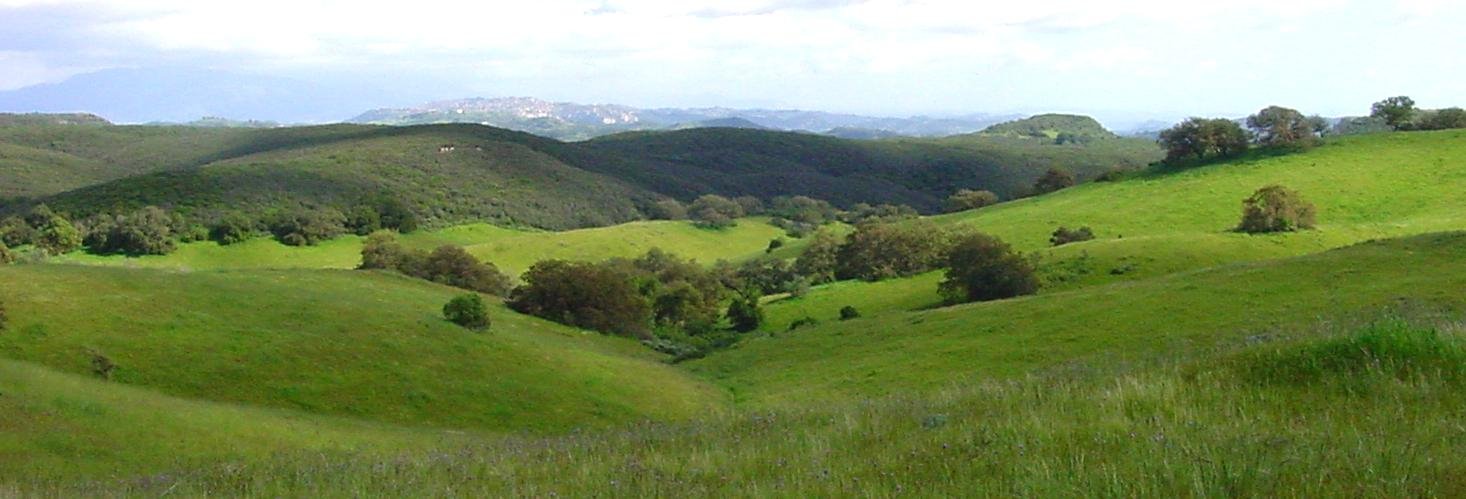
The Santa Rosa Plateau Ecological Reserve is an upland plateau region in the southeastern part of the Santa Ana Mountains, an island of calm and serenity amidst the increasingly urbanized and busy nearby Riverside County population centers of Temecula and Murrieta. It is unclear to me exactly how much land is included in the Reserve. Some sources say 7,500 acres, some say 8.400, some 9,000, and some 10,000. Tom Chester in his "Flora of the Greater Santa Rosa Plateau Region" says: "As defined by Lathrop and Thorne (1985), the Greater Santa Rosa Plateau Region encompasses 18,218 hectares (45,017 acres), about 5.4 times larger than the ~3,360 ha (~8,300 acres) preserved by the Santa Rosa Plateau Ecological Reserve." This photo gallery deals only with the flora of the Reserve itself. A Riverside County website says “the Reserve protects unique ecosystems such as Engelmann oak woodlands, riparian wetlands, coastal sage scrub, chaparral, bunchgrass prairie, and vernal pools as well as more than 200 species of native birds and 49 endangered, threatened or rare animal and plant species, including mule deer, mountain lions, badgers, bobcats, western pond turtles, white-tailed kites and fairy shrimp. Of the two species of fairy shrimp that live on the Reserve, one is found only here and nowhere else on Earth!” In one part of the Reserve stand the historical Moreno and Machado Adobes, the two oldest standing structures in Riverside County, which date back to 1846 and once served as bunkhouses for cowboys. Of particular interest is the Engelmann oak which was once widespread throughout the western US, but which is now increasingly limited in its extent but flourishes and reproduces in the Reserve. Creeks draining the plateau contain deep holes, which hold water throughout the summer months and provide an important water source for wildlife. The rare vernal pools are exceedingly significant. Shallow depressions in the soil which fill up with water during spring rains, the pools provide life for the fairy shrimp and other minute crustaceans which hatch during this time and lay eggs which remain dormant during the dry months until the next rainy season allows them to hatch. Wikipedia provides this: ”The Santa Rosa Plateau Ecological Reserve was assembled in several stages; two parcels comprising 3,100 acres were purchased by The Nature Conservancy in 1984. The intervening parcels were purchased in the 1990s by the State of California, the Riverside County Regional Park and Open-Space District, and the Metropolitan Water District of Southern California.” While remaining under the ownership of separate agencies, the parcels are managed cooperatively. Although this area was inhabited for up to 8,000 years by ancestors of the Payómkawichum (“People of the West”), it traces its recent history to Rancho Santa Rosa, which was named probably in honor of the first person born in the Americas to be canonized as a saint, Saint Rose of Lima (born Isabel Flores de Oliva, 1576-1617), and which was then granted to Juan Moreno in 1846 by the Mexican governor of California. The area passed through several more hands until finally becoming what it is today, a place where one can walk along its pristine trails, forget about the busy world outside, and experience a tranquility that is increasingly difficult to find elsewhere. This gallery contains photographs taken on 56 visits and photographs taken elsewhere but of species that are listed on Tom Chester's Flora of the Santa Rosa Plateau Ecological Reserve Area. As with my other galleries, an asterisk next to the common name indicates a non-native taxon. |
 |
 |
 |
||
| Chocolate lily Fritillaria biflora var. biflora Liliaceae |
||||
 |
 |
|
Blue dicks Dipterostemon capitatus ssp. capitatus Themidaceae |
||
|
|
|||||||||
|
||||
 |
 |
|
|
||||||||||
Parish's nightshade Solanum parishii Solanaceae [Named for Samuel Bonsall Parish, 1838-1928] |
||||||||||||
 |
 |
|
Western buttercup Ranunculus occidentalis Ranunculaceae |
||
|
|
|
 |
|
||
| California poppy Eschscholzia californica Papaveraceae [Named for Johann Friedrich Gustav von Eschscholtz, 1793-1831] |
|
|
|
 |
|
||
| Common fiddleneck Amsinckia intermedia Boraginaceae [Named for Wilhelm Amsinck, 1752-1831] |
 |
 |
 |
||
Chickweed * Stellaria media Caryophyllaceae |
Prickly sow-thistle * Sonchus asper ssp. asper Asteraceae |
Cutleaf geranium * Geranium dissectum Geraniaceae |
 |
 |
|
Slender cottonweed Micropus californicus var. californicus Asteraceae |
||
 |
 |
 |
||
| Purple sanicle Sanicula bipinnatifida Apiaceae |
Woolly lomatium Lomatium dasycarpum ssp. dasycarpum Apiaceae |
Poison sanicle Sanicula bipinnata Apiaceae |
||
 |
 |
|
Branched hareleaf Lagophylla ramosissima Asteraceae |
||
| PHOTO GALLERIES INDEX |
PAGE TWO OF SIXTEEN |
|
| CALIFORNIA PLANT NAMES: LATIN AND GREEK MEANINGS AND DERIVATIONS | ||
| VIRGINIA PLANT NAMES: LATIN AND GREEK MEANINGS AND DERIVATIONS | ||


