| |
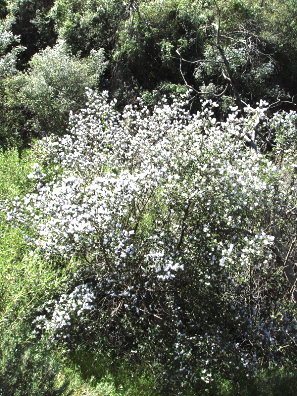
Hairy ceanothus is a 3' to 9' tall shrub sometimes
with a tree-like trunk and with flexible, hairy branchlets and twigs.
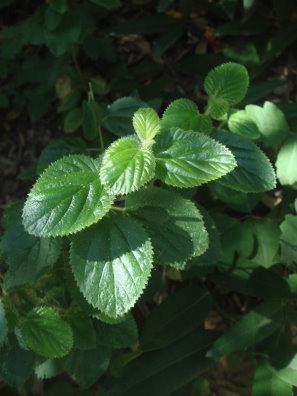
The alternate leaves are ovate, elliptic or elliptic-
oblong, and pubescent both above and below. This along with the reddish
color of the twigs is something that differentiates this variant from
sorediatus, which is pubescent only on the undersurface and has
grayish-green twigs. The leaves also have minutely gland-toothed
margins, three veins from the base, and are dark green above and paler
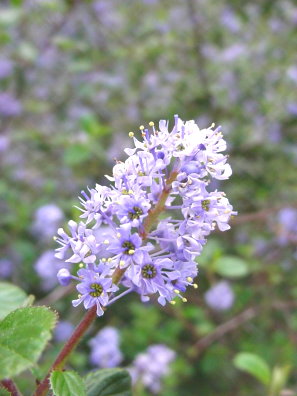
below. The inflorescence is a generally interrupted raceme or
panicle, and the small pale to deep blue flowers have a hypanthium surrounding
a fleshy disk below the base of the ovary to which are attached the
five incurved sepals. There are also five petals and five stamens
opposite the petals. The fruit is a ± spheric, crested,
usually viscid, 3-valved capsule. Hairy ceanothus blooms from
February to April and may be found on dry, shrubby slopes in chaparral
to about 4500' from Los Angeles and Riverside Counties north. These
pictures were taken along the Winter Creek trail in the front range
of the San Gabriel Mts.
Click here for Latin name derivations: 1) Ceanothus 2)
oliganthus.
Pronunciation: see-a-NO-thus ol-i-GAN-thus.
Click here for Botanical
Term Meanings.
|
|