Fridtjof Nansen was one of the great 19th century Arctic explorers. In 1888, at the age of 27, he became the first
person to cross the Greenland icecap, climbing over 9000' and enduring
temperatures as low as -45°. In July, 1893, he sailed
from Norway in the Fram, a specially-designed ice-strengthened
ship on one of the many attempts to be the first to reach
the North Pole. He had read that wreckage from an American ship that
was lost near the New Siberian Islands had been recovered
near the tip of Greenland, seemingly demonstrating the existence
of a westerly ocean current. He decided to sail as far east as possible
and allow his ship to freeze into the ice, and then drift
across the Arctic Ocean in the hopes that it would come close to the
North Pole. By July, 1845, the Fram had only reached 84°
N and he decided to set off across the ice on foot. It was a journey
of incredible hardship and privation, across broken sea
ice that unknown to him was moving southward. At their Farthest
North, Nansen and Johansen reached 86° 14' N, the closest to the
Pole that anyone had ever come, but they were forced to
turn back, and 132 days after leaving the Fram came within site of Cape
Norway on Jackson Island in the Franz Josef Archipelago. They managed to survive
the winter and the following summer kayaked southward to Cape Flora
where they met the British explorer Frederick Jackson, who took them
back to Norway. Three years after they left home, Nansen
and the Fram arrived back in Scandinavia almost at the same time, and
the intrepid adventurers enjoyed a heartfelt reunion. Only
someone as strong as Nansen could ever have survived such an amazingly
difficult feat, and the tale of his exploits made him famous the world
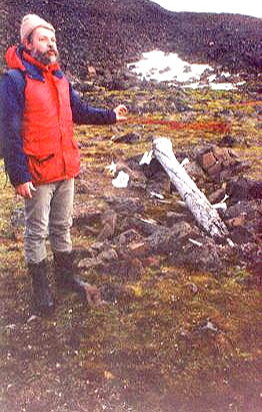
over. They had survived attacks by walruses and a polar bear, converted a sledge into a kayak to sail on icy water, proved the polar drift theory, established that the pole was not on any land, demonstrated the advantages of using Sami and Inuit expertise, set a new record for Farthest North, and actually put on weight over the course of the adventure. The remains of Nansen's shelter was lost until 1990
when it was discovered by a joint Soviet-Norwegian expedition. |