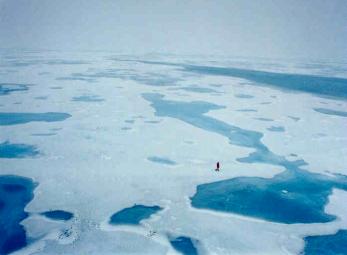
It was clear near the
ship but foggy in the distance, with a stiff breeze blowing. As the day
wore on, snowflakes began falling. Most of the days
on the trip were somewhat overcast; we rarely saw bright sunshine. The
Russian crew worked hard to set up the tables and barbecue
grills, and with over three hundred people it was the biggest group
that had ever assembled at the North Pole. There were ceremonies, speeches
by both ships' captains, and even an appearance by Santa Claus.
A volleyball net was strung up and a vigorous game commenced. Several
people had golf clubs and teed off. A soccer game was started,
although it was difficult to play in heavy Arctic jackets
and snow boots. A flag line was assembled with flags of all the nationalities
of passengers and crew represented. The night before, it was
learned that a Pakistani passenger would be the first from his country
to reach the North Pole, but there was no Pakistani flag.
So one was made. People were taking pictures of their friends
and having other people take pictures of them. A section of ice was broken
open next to the Yamal, and a number of people, mostly Russian (including the Captain)
went for a swim in 28° water. Actually, ropes were tied
around them, and they dove in and were immediately pulled out. I chose
not to take part in this traditional exercise. There were snowball fights
and fried chicken and champagne and music and dancing, and altogether
it was a block party that few of us, Russian or American, would ever forget. |