PAGE FIVE

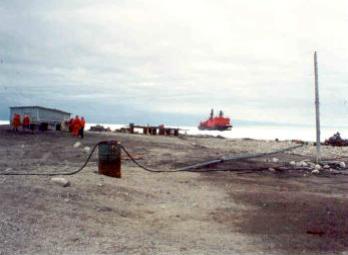
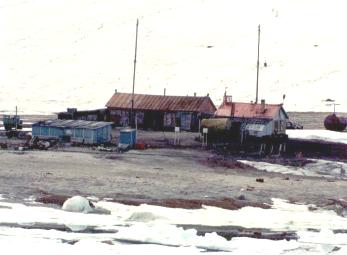
  (L) Bob Headland, Curator of the Scott Polar Research Institute at
  Cambridge. (R) The stony beach where Fridtjof Nansen and Frederik
  Johansen survived the winter of 1895-96 in a crude excavation with a
  driftwood rafter once covered by a frozen walrus hide.

 
  Fridtjof Nansen was one of the great 19th Arctic century explorers. In 1888, at the age of 27, he became the
  first person to cross the Greenland icecap, climbing over 9000' and enduring temperatures as low as -45°. In   July,1893, he sailed from Norway in the Fram, a specially-designed ice-strengthened ship on one of the many   attempts to be the first to reach the North Pole. He had read that wreckage from an American ship that was lost   near the New Siberian Islands had been recovered near the tip of Greenland, seemingly demonstrating the   existence of a westerly ocean current. He decided to sail as far east as possible and allow his ship to freeze into   the ice, and then drift across the Arctic Ocean in the hopes that it would come close to the North Pole. By July,   1845, the Fram had only reached 84° N and he decided to set off across the ice on foot. It was a journey of   incredible hardship and privation, across broken sea ice that unknown to him was moving southward. At their   Farthest North, Nansen and Johansen reached 86° 14' N, the closest to the Pole that anyone had ever come, but   they were forced to turn back, and 132 days after leaving the Fram came within site of Cape Norway in the Franz   Josef archipelago. They managed to survive the winter and the following summer kayaked southward to Cape   Flora where they met the British explorer Frederick Jackson, who took them back to Norway. Three years after   they left home, Nansen and the Fram arrived back in Scandinavia almost at the same time, and the intrepid   adventurers enjoyed a heartfelt reunion. Only someone as strong as Nansen could ever have survived such an   amazingly difficult feat, and the tale of his exploits made him famous the world over. The remains of Nansen's   shelter was lost until 1990 when it was discovered by a joint Soviet-Norwegian expedition.

   Polar bears are frequently sighted around the islands of Franz Josef    Land and would come across the ice very near to the ship. This big    female had blood spots on it, probably from a recent seal kill.
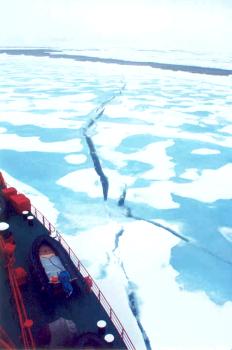
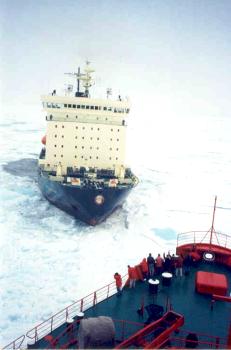
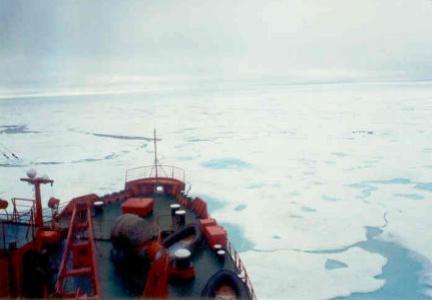
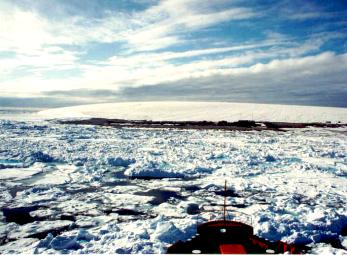
   (Above) My photograph of a polar bear that appeared in the Los Angeles Times. (Below) Differing ice
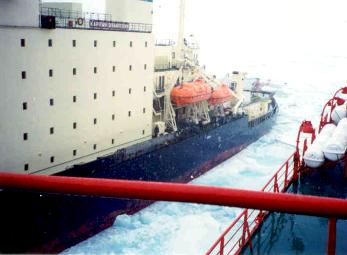
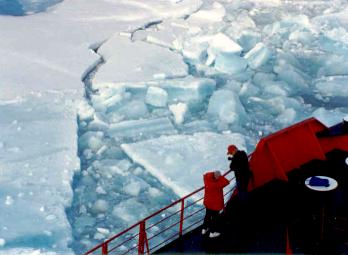
    conditions as we maneuver through the Franz Josef Archipelago en route to Ziegler Island.
 
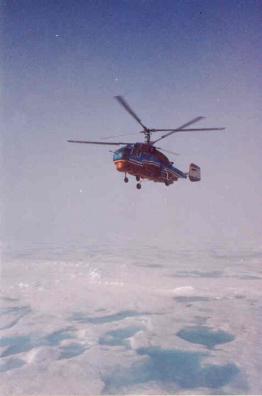
   (Above left) First view of Ziegler Island, shrouded in the Arctic mists. (Above right) Yamal's big helicopter en    route to a landing on Ziegler Island. (Below left) A movie set reconstruction of the Austrian exploration ship    Admiral Tegettoff. An Austrian version of Hollywood comes to the Arctic. (Below right) After landing on the    island, we are able to go aboard this perfectly reconstructed wooden sailing ship.
   The Admiral Tegettoff was the ship in which in 1873 the Austrian    explorer, polar and alpine scientist and surveyor Julius von Payer    discovered Franz Josef Land.
     PAGE FOUR
Visit my main website at:
www.calflora.net
            PAGE SIX