PAGE SIX

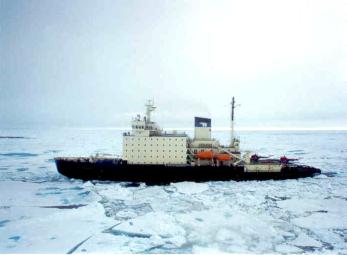
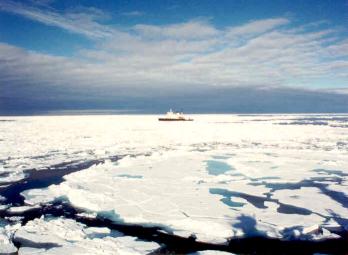
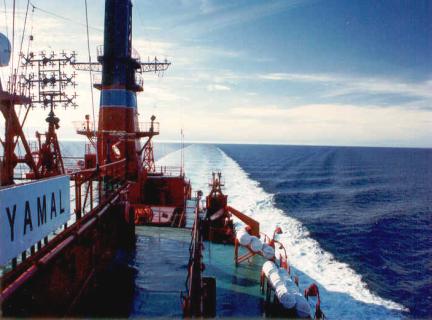
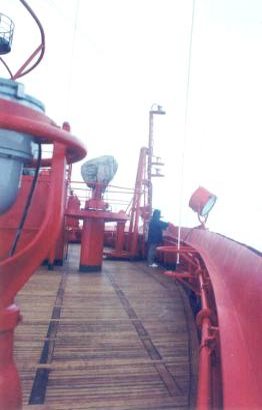
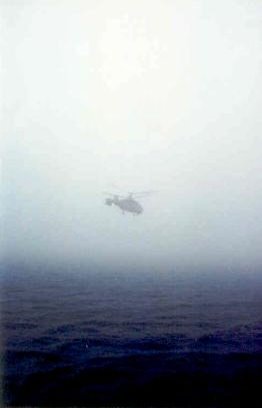
   (Above left) Yamal's small helicopter flying ahead doing ice reconaissance. (Above right) Yamal anchored off    Calm Bay Research Station, Hooker Island. (Below left) Passengers visiting the bridge, which was open to us at    all times. (Below right) We overtake the smaller diesel icebreaker Kapitan Dranitsyn, also bound for the North    Pole, but having been unable to break through the heavier ice north of Franz Josef Land.

  We were followed to the North Pole by another Russian icebreaker, the Kapitan Dranitsyn, a diesel ship not   capable of getting there by itself if it encountered thick ice, which it did. Like an overeager younger sibling, it   struggled to keep up with us, its maximum speed in open water being just about what we could do through six
  feet of ice, and sometimes even got stuck in the channel we had broken. In comparison to our ship's 75,000   horsepower, the Dranitsyn's diesel engines generated only 22,000, and the Dranitsyn was approximately 54'   shorter in length. And whereas the Dranitsyn was built by the Wartsila Company of Finland, the Yamal was   constructed in Russia. She was launched in 1992. Yamal would be the 7th surface ship to reach the top of the   world, all but two of the others being Russian nuclear ships, but this was the first time ever that two such ships   would be at the Pole at the same time.

   The Dranitsyn was often described as a Russian-style apartment    block dropped on the deck of a ship, and the plume of smoke that    often issued from its stack revealed it as a diesel-powered ship.
 
   (Above left) Small helicopter taking off on sightseeing flight to view Yamal and Kapitan Dranitsyn from the air.    (Above right and below) Aerial views of the two ships moving through the ice.
 
  Every place is convenient, if the ice is thick enough, so we stop to   stretch our legs, and there is ten feet of ice and ten thousand feet of   water below our feet.
     PAGE FIVE
Visit my main website at:
www.calflora.net