Brassica nigra (L.) Koch

Black Mustard
Brassicaceae (Mustard Family)


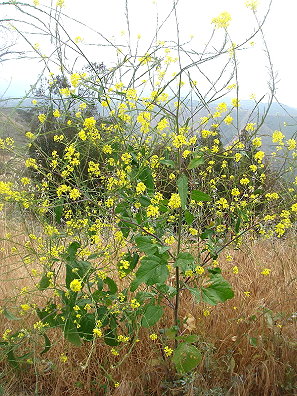
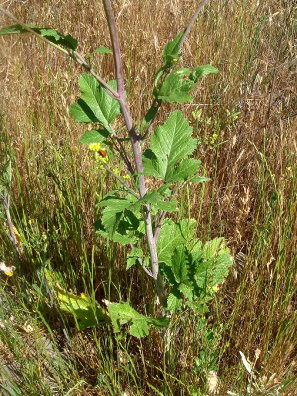
Black mustard is one of the most ubiquitous and widespread introduced plants in Southern California.  It is an erect and sparsely pubescent branching annual that can reach 8' tall.  The leaves are alternate, lower 4"-8" long, deeply pinnatifid with a large terminal lobe and few lateral ones, and upper reduced, ± sessile and tapering at the base.  The flowers are somewhat showy but not large and are positioned on short stems at the ends of the branches.  There are four sepals and four clawed, lemon yellow petals, with six stamens, 4 long and 2 short as is characteristic of the mustards, and curling anthers.  The seed pods are siliques 1/4"-3/4" long with terete or conic beaks and are closely appressed to the stems.  The seeds are dark reddish-brown and coarsely reticulate.  Black mustard grows in meadows and disturbed areas, along roadsides and trails, and on dry grassy hillsides and is abundant below 4500' in most of the California Floristic Province, blooming from April to July.  It is naturalized from Europe, but was supposedly introduced here by the Franciscan Padres who scattered the seed along the Camino Real to mark its route.  These pictures were taken in a variety of different locations.

Click here for Latin name derivations: 1) Brassica 2) nigra.
Pronunciation: BRAS-i-ka NYE-gra.
Click here for Botanical Term Meanings.


Return to Home Page