| |
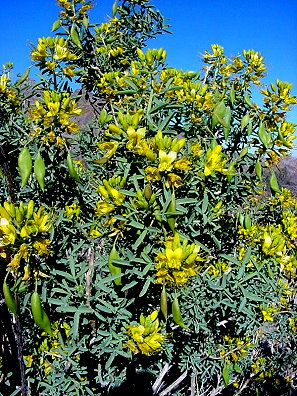
Bladderpod is an erect, rounded and profusely-branched,
disagreeably-smelling shrub growing from 3' to 6' tall with branches
that are minutely downy. It is the single species in genus Peritoma (formerly Isomeris)
in California, and has recently been moved from the Capparaceae to a family named Cleomaceae originally published in 1834 by Paul Fedrorowitsch Horaninow, a Russian botanist. It has also been divided into three varieties based on the shape of the fruit, with var. angustata having fusiform fruits, var. arborea having obovoid fruits, and var. globosa having spherical fruits. Bladderpod is quite common and ranges widely from
the coast to the deserts to an elevation of about 4000'. The leaves
are alternate, entire, petiolate and trifoliate with leaflets that are
oblong-elliptic, to 1-3/4" long, and have smallish, pointed tips.
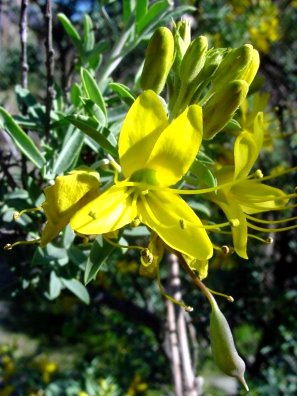
The showy yellow flowers are in dense terminal racemes to 12"
long. The calyx is four-cleft, the green sepals fused in the basal half.
There are four petals 1/2" long, six yellow stamens that are long
exserted, and a pistil with a short style that is sometimes aborted
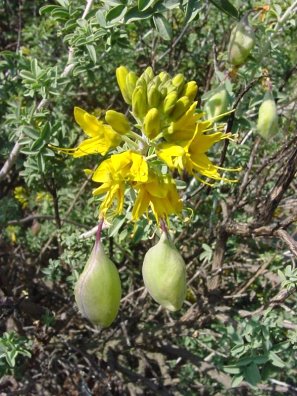
in bud. The fruit is a large, swollen capsule to 2" long
with a pointed tip that contains smooth seeds and hangs down. Bladderpod
blooms throughout much of the year. A measure of its hardiness is that
on a trip to Joshua Tree National Park in February, 2003, after five
years of below normal rainfall in the desert, bladderpod was observed
blooming everywhere.
Click here for Latin name derivations: 1) Peritoma
2) arborea.
Pronunciation: pare-i-TOE-ma ar-BORE-ee-a.
Click here for Botanical
Term Meanings.
Formerly Isomeris arborea.
|
|