| |
Emory indigo bush,
also known as dye bush or dyeweed, is a plant of dry open places below
2000', desert flats, washes, dunes, and creosote bush scrub from the
southern edge of the Mojave Desert throughout the Colorado Desert. It
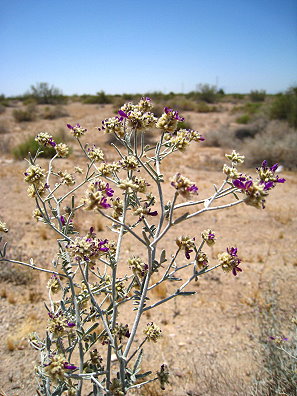
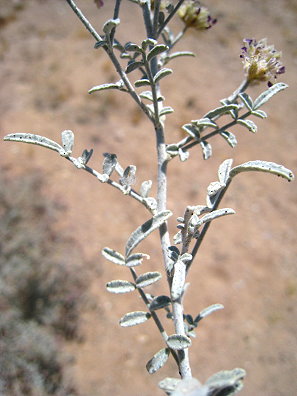
is a densely branched 1'-5' tall subshrub with stems covered by a thick,
felt-like tomentum and scattered orange glands. The pinnately-compound
leaves usually contain 5-11 ovate to linear-lanceolate leaflets to 5/8"
long and the terminal leaflet is generally longer than the others. The
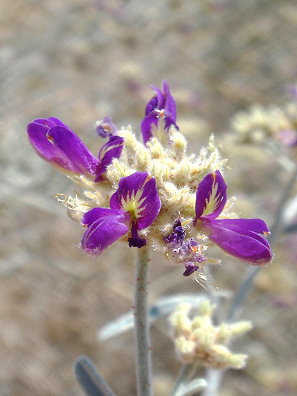
flowers are in dense ovoid or spheric bractless clusters from 1/4"
to 3/4" long. The papilionaceous corolla is puberulent and
a dark purple-blue with some white markings, and the calyx is gray-villous
and dotted with orange glands. The fruit is an ovoid long-hairy
pod with brownish glands. Dyeweed derives its name from the yellow
dye which can be extracted when the flowers are crushed. Anyone
who handles the plant will find that their hands become stained with
the dye. Another fascinating thing about this plant is that it
is the main host for Pilostyles thurberi, a parasitic plant in
the Rafflesia family that lives inside the dyeweed stems (see Thurber's
stemsucker). Emory indigobush blooms from March to May. These
pictures were taken at the Living Desert in Palm Springs.
Click here for Latin name derivations: 1) Psorothamnus
2) emoryi.
Pronunciation: soar-oh-THAM-nus EM-or-ee-eye.
Click here for Botanical
Term Meanings.
|
|