Echinocereus mohavensis (Engelm. & J.M. Bigelow) Rümpler

Mojave Mound Cactus
Cactaceae (Cactus Family)


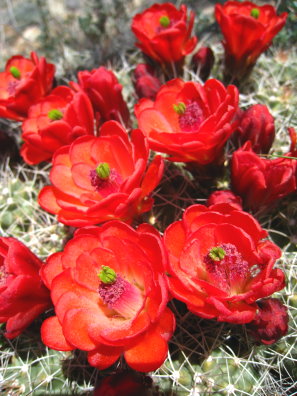
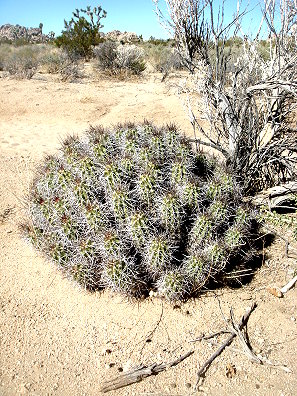
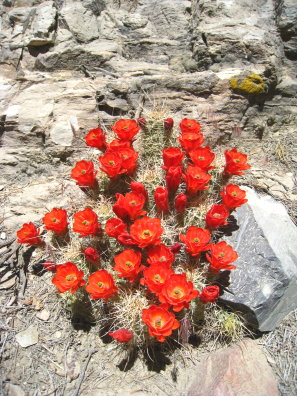
Mojave mound cactus, also known as claret cup cactus or three-spine hedgehog cactus, is a low, dense, clumped or mounded plant composed of 1-500 globose to oblong, pale green stems to 16" long and 6" in diameter.  The stems are 5-12-ribbed and strongly tubercled at the areoles.  The highly variable spines are white to gray or pink, curving, flexible, and are located in clusters on the ribs.  There are 1-6 central spines up to 1-1/2" long and 5-8 slightly shorter radial spines.  The flowers are funnel-
shaped with a perianth that is orange to dull scarlet.  There is a single style with green stigma-lobes and numerous stamens with the filaments inserted on the perianth throat. The thin-skinned fruit is oblong and deciduous-spiny, about 1" long and 1/2" wide, pink to red in color and contains many generally black, tuberculate seeds.  Mojave mound cactus occupies rocky places from 3500' to 9000' in creosote bush scrub, joshua tree and pinyon-juniper woodland in the east Mojave Desert and Joshua Tree National Park, but also in desert chaparral localities around Anza-Borrego State Park, blooming from April to June.  There is a second species of Echinocereus in our deserts, which is engelmannii, easily differentiated by its lavender to purple (as opposed to scarlet) flowers and its flattened (as opposed to rounded) central spines. These pictures were taken in Joshua Tree NP.

Click here for Latin name derivations: 1) Echinocereus 2) mohavensis.
Pronunciation: ek-eye-no-SEER-ee-us mo-ha-VEN-sis.
Click here for Botanical Term Meanings.
Formerly Echinocereus triglochidiatus.


Return to Home Page