| |
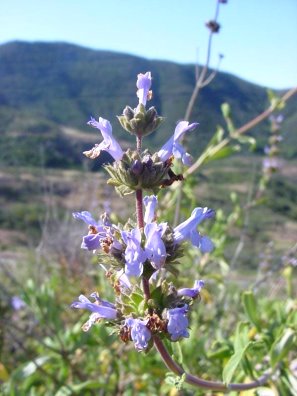
Black sage is a 3'-6' high, erect, openly-branched
perennial shrub with short-hairy stems, slightly narrowish, green, wrinkled
leaves that are crenulate, opposite, subsessile or on short petioles,
and give off a minty odor when crushed. The flowers are in compact
whorls spaced two to three inches apart on the main stems subtended
by bunches of ovate greenish bracts. The calyx is villous and
± glandular, the corolla is two-lipped, the upper lip being two-lobed,
pale blue to whitish and sometimes lavender, with exserted stamens.
The fruit is a nutlet generally brown. Black sage is a very
common shrub of dry slopes and benches to 2000' in coastal sage scrub
and open chaparral, forming dense thickets and blooming from April to
July. It hybridizes with S. apiana, S. columbariae
and S. leucophylla, and ranges from L. California to Central
California. Nectar-gathering bees utilize this plant in the production
of honey. Black sage is so named because of the dark whorls of dried
flowers that remain on the stems at the end of the season.
Click here for Latin name derivations: 1) Salvia
2) mellifera.
Pronunciation: SAL-vee-a mel-IF-er-a.
Click here for Botanical
Term Meanings.
|
|