| |
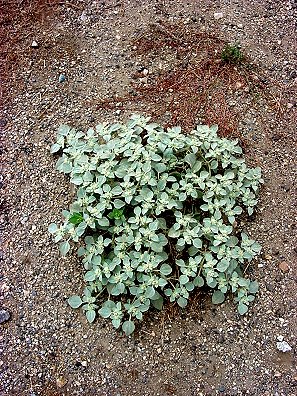
Doveweed, also known as turkey mullein, is a
grayish to light green, low-spreading, heavily scented annual that is
monoecious, generally mound-like in appearance, 1" to 8" tall
and up to 3' across, with hispid stems and soft stellate-hairy herbage.
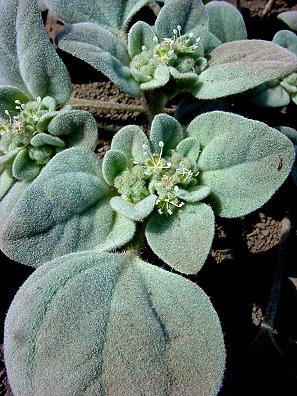
The thick leaves are alternate, ovate to suborbicular in shape, palmately
three-veined, the blades and petioles as long as 2". There are
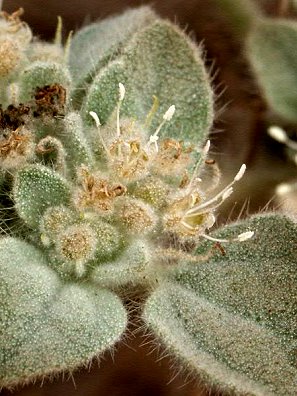
staminate flowers in terminal cymes, each of which has a calyx of 5-6
sepals, no petals and six to ten exserted, free stamens. The pistillate
flowers are sessile in the axils of branches below the staminate inflorescences
and they have no calyx or corolla, a slender style and a 1-chambered
ovary. The fruit is a capsule about 1/8" long with a single slightly
smaller dark, smooth or ± ridged seed. Doveweed is common in
dry, open, often disturbed sites mostly below 2500' in coastal sage
scrub, valley grassland and oak woodland, blooming from May to October.
Click here for Latin name derivations: 1) Croton
2) setiger.
Pronunciation: KRO-ton SEH-ti-jer.
Formerly Eremocarpus setigerus, Croton setigerus.
Click here for Botanical
Term Meanings.
|
|