| |
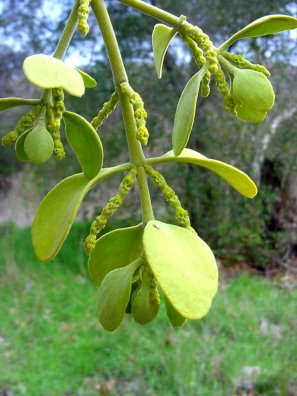
Big-leaf mistletoe is a stout, green, parasitic
perennial with brittle, woody stems, minutely canescent to canescent-tomentose
becoming glabrate in age. It is dioecious, having pistillate and
staminate flowers on separate plants. The leaves are opposite,
thick-fleshy, elliptic-obovate to oblanceolate, yellow-green and from
3/8" to 2" long. The flowers are on jointed spikes arising
from the leaf axils and up to 1-1/4" long. There are about 12 flowers
per pistillate joint and about 20 per staminate joint. The fruit
is a glabrous white berry sometimes tinged with pink and about 3/16"
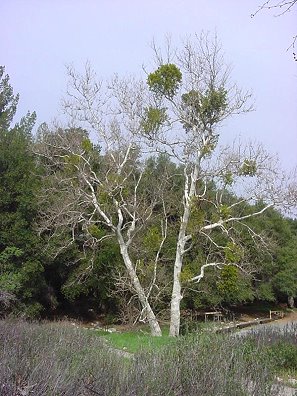
in diameter. Big leaf mistletoe is most frequently seen on Platanus
racemosa, but has also been observed on Populus, Salix,
Fraxinus and Juglans. It may be commonly found in
the Transverse and Peninsular Ranges, extending to the deserts, and
to Baja, west Texas and Colorado. The flowering period is mostly from
December to March.
Click here for Latin name derivations: 1) Phoradendron 2) serotinum 3) macrophyllumPronunciation: fore-a-DEN-dron ser-oh-TIE-num mak-ro-FIL-um.
Click here for Botanical
Term Meanings.
|
|