What's Blooming at the Los Angeles County
Arboretum
November 2006
Page One
|
|

|
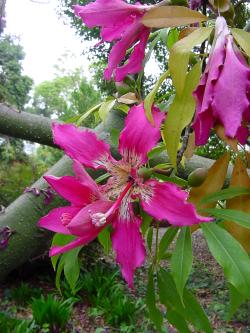
Ceiba (Chorisia) speciosa
Pink silk-floss tree Bombaceae (Bombax family) Brazil, Argentina |
Strelitzia reginae
Bird of paradise Strelitziaceae (Crane flower family) South Africa |
|
|


|
Encephalartos ferox
Zululand cycad Zamiaceae (Zamia family) South Africa |
Eucalyptus torquata
Coral gum Myrtaceae (Myrtle family) Australia |
|
|


|
Alstroemeria hybrid
Alstroemeria Alstroemeriaceae (Alstroemeria family) Hort. |
Ceiba (Chorisia) insignis
White silk-floss tree Bombaceae (Bombax family) Peru, Argentina |
|
|


|
Hemerocallis 'Russian Rhapsody'
Hemerocallis Hemerocallidaceae (Hemerocallis family) Hort. (Orig. East Asia) |
Eremophila glabra
Smooth emu bush Myoporaceae (Myoporum family) Australia |
|
|


|
Callistemon polandii
Gold-tipped bottlebrush Myrtaceae (Myrtle family) Australia |
Senna splendida
Golden wonder Fabaceae (Pea family) Brazil, Argentina |
|
|


|
Passiflora 'Lavender Lady'
Passion flower Passifloraceae (Passion flower family) Hort. |
Heliotropium arborescens 'Album'
Garden heliotrope Boraginaceae (Forget-me-not family) Peru |
|
|


|
Tagetes nelsonii
Citrus-scented marigold Asteraceae (Sunflower family) Mexico |
Indigofera suffruticosa
Indigo Fabaceae (Pea family) West Indies |
|
|


|
Stenocarpus sinuatus
Firewheel tree Proteaceae (Protea family) Eastern Australia |
Loropetalum chinense 'Monraz'
Chinese fringe-flower Hamamelidaceae (Witch-hazel family) Japan, Southern China |
|
|
| Canna sp. cf. 'Yellow King Humbert' Canna lily Cannaceae (Canna family) Hort. (Orig. Tropical America) |

|
|
|


|
Zantedeschia aethiopica
White arum lily Araceae (Arum family) South Africa |
Ajania pacifica (= Chrysanthemum
pacificum) Pacific chrysanthemum Asteraceae (Sunflower family) Eastern Russian, Japan |
|
|


|
Pentas lanceolata
Star clusters Rubiaceae (Madder family) Tropical Africa, Arabia, Madagascar |
Begonia cf. maculata
Begonia Begoniaceae (Begonia family) Hort. |
|
|


|
Justicia carnea
Brazilian plume flower Acanthaceae (Acanthus family) Northern South America |
Lycianthes rantonnetii
Blue potato bush Solanaceae (Nightshade family) Argentina and Paraguay |
|
|


|
Globularia X indubia
Globe daisy Globulariaceae (Globe-daisy family) Natural hybrid from the Canary Islands |
Salvia leucantha
Mexican bush sage Lamiaceae (Mint family) Mexico |
|
|


|
Bougainvillea sp.
Bougainvillea Nyctaginaceae (Four o'clock family) Brazil to Peru and Argentina |
|
|


|
Barleria obtusa
Bush violet Acanthaceae (Acanthus family) South Africa |
Coreopsis verticillata 'Zagreb'
Whorled tick-seed Asteraceae (Sunflower family) Southeastern U.S. |
| October 2006 |
Plant
List
Unidentifieds
Family Descriptions
References
Links
Los Angeles County
Arboretum Home Page
© M.L. Charters, Sierra Madre, CA. 2006-2007